Skip to content
In an emergencyAustriaEmergency numbers →
SurviveBetter
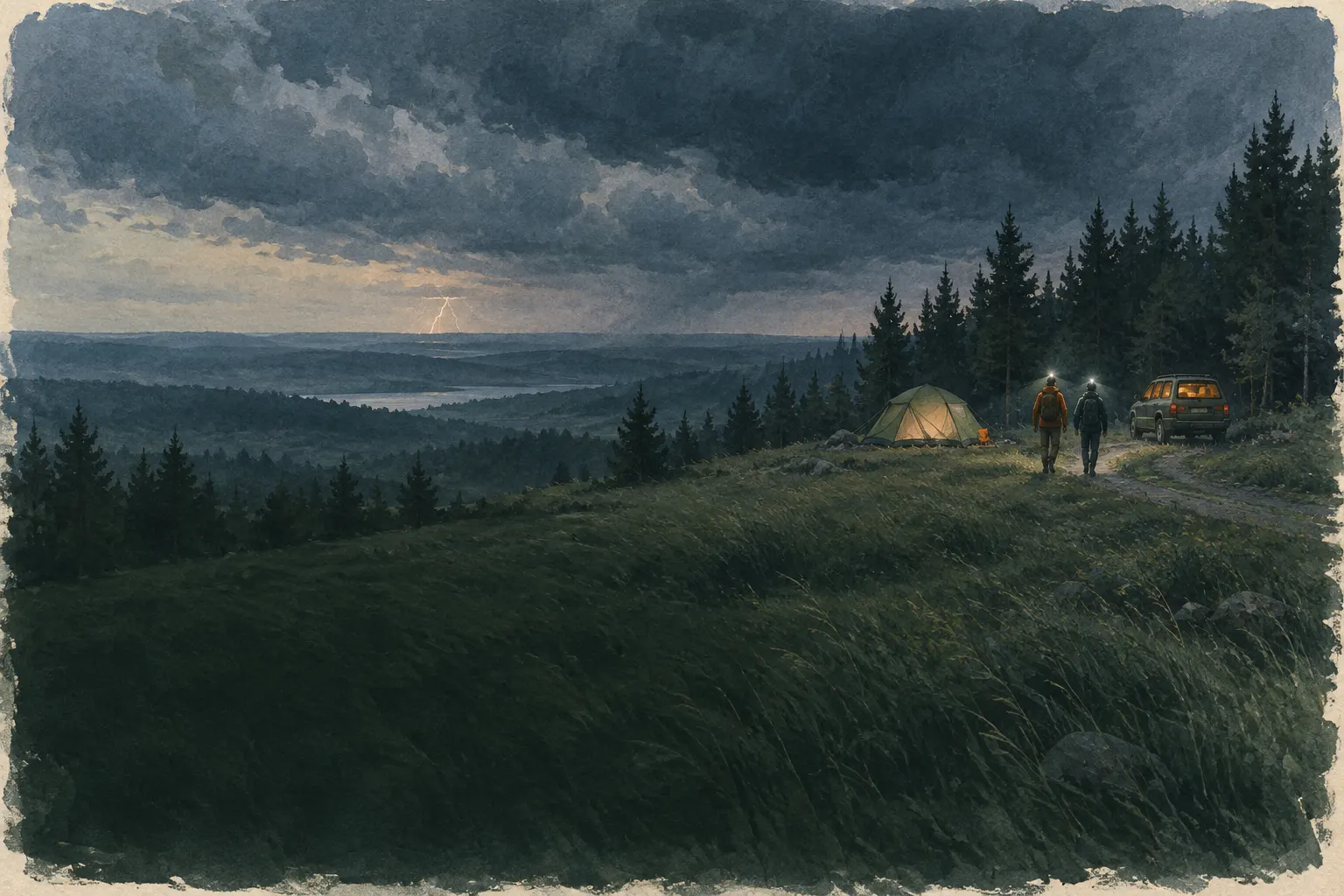
Campsite at a forest edge at night under storm clouds, two people with headlamps walking calmly to the car

A storm hits my tent or camp at night

In the middle of the night the wind tears at the tent, lightning lights up the sky, the stream grows louder. Now a quick, clear decision counts.

First

  1. Wake everyone, headlamps on, put on shoes and rain jacket, keep valuables and phone at hand.
  2. In a thunderstorm: a tent gives no protection from lightning. If a hard-topped car or a solid building can be reached safely in a short time, go there now.
  3. Leave spots under dead trees, broken branches and lone tall trees at once.
  4. If you are camped by a stream or on a valley floor and it is raining hard: move to higher ground immediately. Rising water can arrive within minutes.

Call emergency services if

  • Someone has been struck by lightning – victims can be touched straight away; check breathing and start CPR if needed
  • Someone was hit by a tree or branch
  • Water is rising and cutting off the way out
  • Someone is missing
  • Signs of hypothermia

What is happening

Summer thunderstorms and storm fronts often arrive in the evening or at night. Inside a tent everything sounds more threatening than it is – and sometimes it is more dangerous than you think. The three big dangers are lightning, falling trees and branches, and suddenly rising water.

A tent does not protect against lightning. Safe places are solid buildings and cars with a closed metal body. Anyone who cannot reach such a place can only reduce the risk: away from summits, ridges, lone tall trees, water and metal, and spread a group a few metres apart.

In a storm in the forest, most injuries come from falling branches and trees, especially deadwood. In valleys and by streams, heavy rain – including further up the catchment – can lead to a flash flood within minutes.

The best decision is usually made early: with a thunderstorm warning do not camp on a ridge or under deadwood, keep the car within reach and check the campsite critically before nightfall. If the storm comes anyway, a clear plan helps: everyone awake, shoes on, lights on, decide, act.

Step by step

A storm hits my tent or camp at night – Phase 1 of 4Before the night. Check the forecast and severe weather warnings. Check the campsite: look up (dead trees, hanging branches), not on a ridge, not in a stream channel or on the valley floor, not on crests. Pitch the tent storm-proof: all guy lines, pegs deep and angled, narrow end into the wind. Know the escape route to the car or hut; put headlamp, shoes and rain jacket within reach.
Phase 1 of 4

Phase 1 of 4

Before the night

Check the forecast and severe weather warnings. Check the campsite: look up (dead trees, hanging branches), not on a ridge, not in a stream channel or on the valley floor, not on crests. Pitch the tent storm-proof: all guy lines, pegs deep and angled, narrow end into the wind. Know the escape route to the car or hut; put headlamp, shoes and rain jacket within reach.

The animation shows the key actions of each phase schematically; the text below is what counts.

  1. Phase 1

    Before the night

    • Check the forecast and severe weather warnings.
    • Check the campsite: look up (dead trees, hanging branches), not on a ridge, not in a stream channel or on the valley floor, not on crests.
    • Pitch the tent storm-proof: all guy lines, pegs deep and angled, narrow end into the wind.
    • Know the escape route to the car or hut; put headlamp, shoes and rain jacket within reach.
  2. Phase 2

    When the storm arrives

    • Wake everyone, lights on, put on shoes and rain jacket, pocket your phone and important items.
    • Estimate the distance of the storm: if there are less than about 30 seconds between lightning and thunder, the storm is close.
    • Car or solid building within reach: go there together now, while it is still safe.
    • No refuge: leave spots under deadwood and lone trees; spread a group a few metres apart; crouch on your sleeping mat, feet together – this is a last resort, not protection.
    • Rising water or loud roaring: move higher at once and leave equipment behind.
  3. Phase 3

    During the storm

    • In the car: windows closed, hands away from metal parts, do not park under trees, do not drive through flooded roads.
    • In the tent in a wind-only storm without lightning: support the poles from inside, put weight in the windward corner.
    • If the tent tears or a pole breaks: take the tent down and weigh it down with stones or packs rather than chasing it.
    • Stay together, count heads, speak calmly.
    • Wait 30 minutes after the last thunder before going back into the tent or outside.
  4. Phase 4

    The morning after

    • Look up: cracked branches and leaning trees can still fall hours later.
    • Do not cross streams while they are in flood.
    • Dry wet clothing and sleeping bags, eat and drink something warm.
    • Make temporary repairs to damaged equipment or abandon the trip.

★ Pro tips

What experienced people do differently: proven practice from mountain rescue, fire services, lifeguards and civil protection that beginners rarely know.

  1. If you can hear thunder, you're in range

    Lightning often strikes many kilometres ahead of or behind the storm itself, even from what looks like clear sky. Weather services' rule of thumb: once you can hear thunder, you're close enough to be struck. Stop waiting and act.

  2. Flash flood: climb sideways, not downstream

    Don't flee along the stream or down the valley – the water is faster than you. Climb up the slope at right angles to the flow, even if it's steep. A few metres of height can be enough.

  3. Re-tension guy lines before bed

    Many tent fabrics stretch when they get wet and cold, so the tent starts flapping and is more likely to tear. Tighten guy lines and check pegs again in the evening and once the wind picks up.

  4. One grab bag at the tent door

    Before sleeping, pack a small waterproof bag with headlamp, phone, car keys, medication and a warm layer, and put it by the tent door. If you need to get out fast at night, you grab one thing.

  5. Keep watch when a storm is forecast

    When a storm is forecast, have one person in the group stay awake, or set alarms, to check the sky and the stream. Asleep, you often can't tell the sound of rain from rising water.

What to watch out for

  • A tent is no lightning protection

    Tent poles offer no protection – carbon or aluminium alike. The only safe places are solid buildings and cars with a metal body.

  • Deadwood (“widowmakers”)

    Dead trees and loosely hanging branches break first in a storm. Look up when pitching – that is the most important precaution in the forest.

  • Flash floods

    Heavy rain further up the valley can make a stream swell even if it is hardly raining at the campsite. Sudden muddy water, driftwood and roaring are warning signs.

  • Hypothermia after the storm

    Anyone standing wet and exhausted in the wind cools down quickly. Dry clothing, wind protection and something warm take priority after the storm.

  • First aid after a lightning strike

    People struck by lightning carry no electrical charge and can be touched straight away. Check breathing, call for help, start CPR if there is no normal breathing.

Common mistakes

  • Camping on a ridge, on a crest or under a lone tree when a thunderstorm is forecast.
  • Pitching the tent under dead trees or hanging branches.
  • Camping right beside a stream or on the valley floor.
  • Staying in the tent although a car could be reached safely in a short time.
  • Chasing a tent blowing away in a storm.
  • Going outside again too soon after the last thunder.

Prepare in advance

  • Install warning apps with severe weather alerts and check them before every night.
  • Use every guy-out point of the tent and carry spare pegs and a pole repair sleeve.
  • Always keep headlamp, shoes and rain jacket within reach at night.
  • Choose campsites with an escape route and distance from water.
  • Agree in the group beforehand where to go in a thunderstorm.
  • Take a first aid course that includes CPR.

Special consideration

Children
Children are often very frightened in a thunderstorm. Explain calmly what is happening, dress them and lead them by the hand. A small task (holding the lamp) helps.
Large groups
One person takes charge, counts heads regularly and gives clear instructions. In a thunderstorm in the open the group spreads out so a strike does not hit everyone.

Sources

  • Lightning Safety · NOAA National Weather Service (USA)
  • Thunderstorms & Lightning · Ready.gov – U.S. Federal Emergency Management Agency (FEMA)
  • Turn Around Don't Drown · NOAA National Weather Service (USA)
  • European Resuscitation Council Guidelines 2021: Basic Life Support · European Resuscitation Council – Resuscitation (journal), 2021
  • Are You Ready? An In-Depth Guide to Citizen Preparedness · U.S. Federal Emergency Management Agency (FEMA)

Your situation

What is the threat?
Refuge
Campsite

Matching entries

0 rules apply

No AI decides here. Every recommendation is based on a visible rule.

Add details about your situation above to get more specific guidance.

Basics for this situation

Why: Always applies to this situation – regardless of your answers.

All rules of this situation (8)
  1. [not active] If What is the threat? = Thunderstorm / lightning

    There is no safe place outdoors in a thunderstorm. Without a car or building: get away from summits, ridges, lone trees, water and metal; spread a group a few metres apart. Wait 30 minutes after the last thunder before going out again.

  2. [not active] If What is the threat? = Strong wind

    Re-tension the tent, secure the guy lines, pitch the tarp lower. If the tent tears, take it down and weigh it down rather than chase it – people matter more than gear.

  3. [not active] If What is the threat? = Heavy rain

    In heavy rain watch the terrain: roaring, muddy water and debris are warning signs. Small streams can turn into torrents.

  4. [not active] If Refuge = Car or building reachable

    In a metal-bodied car close the windows and keep hands away from metal parts. Do not park under trees and do not drive through flooded roads.

  5. [not active] If Refuge = Nothing nearby

    Without a refuge: crouch on your sleeping mat at the safest reachable spot (away from deadwood, water and crests), stay warm and dry and wait out the storm.

  6. [not active] If Campsite = In a forest

    In a forest, branches and whole trees fall in a storm. Clearings without overhanging crowns are safer than dense old stands with deadwood.

  7. [not active] If Campsite = Open ground, ridge or mountains

    On ridges and open ground, descend in good time as a thunderstorm builds – ideally before nightfall.

  8. [not active] If Campsite = By a stream / valley floor

    By a stream and on a valley floor, flooding is the greatest danger. Move higher at once and do not cross streams at night.