Lifts, electric doors and garage doors in a power outage
Without power lifts stop, and garage doors, shutters, barriers and electric door openers can no longer be used as usual. If you are stuck in a lift, trigger the alarm and wait for help – never climb out yourself. Doors and gates often have a manual release that you should know beforehand from the manufacturer's instructions.
- Preparation: 30 minutes
Explained simply
Many doors and gates in everyday life move with electricity: the lift, the garage door, electric shutters or the door opener at the building entrance. If the power fails, they simply stop. That feels strange at first but is usually not dangerous – if you know what to do.
If you are stuck in a lift, the most important rule is: stay inside and wait. The lift is built to stop safely. You press the alarm button, which usually has its own battery, and wait for helpers. Never force the doors open or climb out yourself – that is the dangerous part.
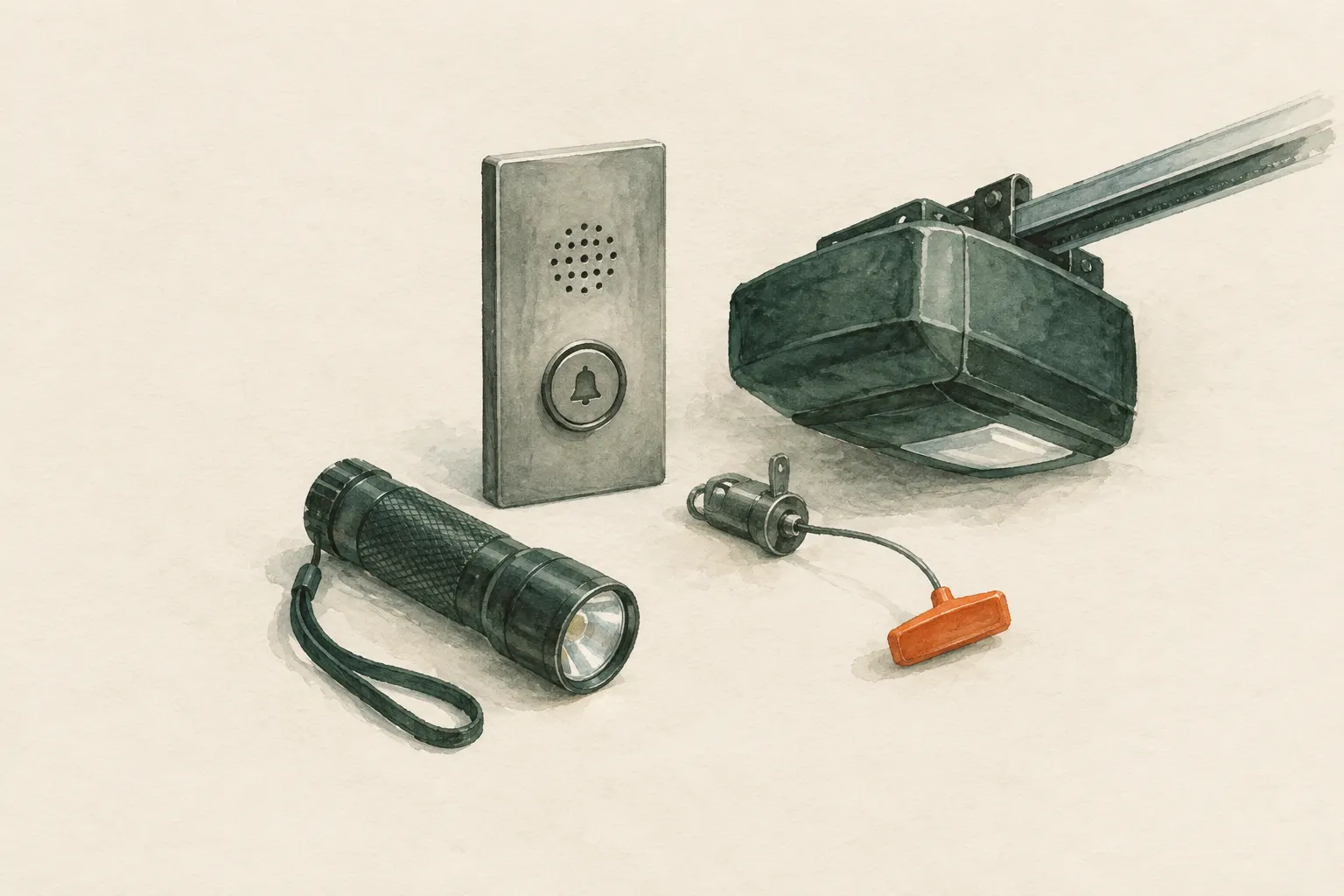
Garage doors and shutters often have a manual release or a crank. Try it out in daylight beforehand rather than searching for it in the dark.
How it works
Lifts are designed to stop safely in a power outage. Brakes and safety devices hold the car in place; it does not fall. The alarm and emergency light usually have their own battery so you can call for help and do not sit in the dark. The danger only begins when someone tries to free themselves: the car can move unexpectedly, and between the car and the shaft wall there is a risk of falling into the shaft.
Electric gates and doors almost always have a mechanical release, because they must stay operable during faults. How it works varies greatly from model to model, though: a pull cord on the door drive, a lever, a key switch or a crank. That is why there are no general instructions – your manufacturer's manual is what counts.
If the lift stops
Take a calm breath. Press the alarm button and speak as soon as someone answers: say where you are, how many people are in the car and whether anyone needs help. If your phone has signal, also inform the building management or emergency services. Then sit down, save your phone torch and wait for trained helpers – the lift company or the fire service.
If you have breathing difficulty, a panic attack or another medical emergency, call the local emergency number (112 in the EU). Even if it takes a long time: waiting is safer than any self-rescue.
Better still is not to get stuck at all. When outages are announced or the lights flicker, take the stairs. People who cannot use stairs plan with neighbours beforehand how they will be supplied, instead of risking the lift.
Safety: what to watch out for
Heavy garage doors and gates are under strong spring tension. The springs carry part of the weight. If a spring is broken and you release the door, it can suddenly fall. So use the manual release only exactly as the manufacturer describes and usually only when the door is closed or the manual expressly allows it. Never loosen springs or cables yourself.
When releasing: door closed, drive without power, manual at hand. Move the door slowly and with both hands. If it is very heavy or hangs crooked, stop and call a specialist. Never walk under a half-open door.
Lifts are always off-limits in a fire, even when the power is back. After an outage, only ride again once the system is working normally.
How to prepare
Read the manuals for the garage door, gate and shutters, find the manual release or crank and practise once in daylight. Also check whether the front door opens with the key without the electric opener. Keep mechanical keys for the front door, garage and letterbox at hand.
If your car usually stands in the garage and a storm is forecast, you could consider parking it outside beforehand – then you can get to your vehicle even without a working door. Electric shutters sometimes have an emergency crank and sometimes not. Half-closed shutters keep warmth in during winter and heat out in summer; but make sure escape routes stay clear.
Good to know
Ready.gov and the BBK point out that garage doors and lifts do not work during a power outage and recommend knowing the manual releases beforehand.
Freeing people from a lift is the job of the lift company or the fire service. They have the right tools and know how to secure the installation. A common misconception from films is that you can simply climb out through the roof hatch – in reality that is exactly what is life-threatening.
Step by step
Explore beforehand
Read the manuals for garage door, gate and shutters, find the release or crank and practise once in daylight. Check whether the front door opens with the key without the electric opener.
- 1
Explore beforehand
Read the manuals for garage door, gate and shutters, find the release or crank and practise once in daylight. Check whether the front door opens with the key without the electric opener.
- 2
Keep keys ready
Keep a mechanical key for front door, garage and letterbox at hand. If the car usually stands in the garage, consider parking outside when a storm is forecast.
- 3
If the lift stops
Stay calm, press the alarm button and speak when someone answers. If the phone has signal, inform the building management or emergency services. Sit down, save light, wait for helpers.
- 4
Avoid the lift
When outages are announced or the power flickers take the stairs. People who cannot use stairs plan with neighbours how they will be supplied instead of risking the lift.
- 5
Release the door
Door closed, drive without power, manual at hand: operate the release, move the door slowly with both hands. If it is heavy or hangs crooked, stop and call a specialist.
Common mistakes
- Climbing out of the lift
- Looking for the release for the first time in the dark
- Walking under a half-open door
- Not owning a mechanical key
Quick view
Materials
Headlamp / flashlight
Suitable for
- Apartment buildings with lifts
- Houses with an electric garage door, gate or shutters
- People who depend on the lift
Not suitable for
- Repairs to door drives, springs or lift installations – that is a job for professionals
Prerequisites
- Manual for the garage door or shutters
- Knowing where the manual release and crank are
Safety
- Even when power returns: never use lifts in a fire. After an outage only ride once the system works normally again.
How it works
Lifts are built to stop safely in a power outage; brakes and safety devices hold the car. The alarm and emergency light usually have their own battery. Electric gates and doors almost always have a mechanical release because they must remain operable during faults – but it works differently from model to model.
Advantages
- Prevents dangerous self-rescue
- Car and home remain accessible
Disadvantages
- Very different between models – no general instructions possible
Deep knowledge
Background
Official guides such as Ready.gov and the BBK point out that garage doors and lifts do not work in a power outage and recommend knowing manual releases beforehand.
Freeing people from lifts is a task for the lift company or fire service. The advice here only concerns your own behaviour.
Variants
- Electric shutters
- Some have an emergency crank, others do not. In winter half-closed shutters keep heat in, in summer heat out – escape routes stay clear.
Common mistakes
- Climbing out of the lift
- Looking for the release for the first time in the dark
- Walking under a half-open door
- Not owning a mechanical key
Limits and risks
- No instructions for specific door or lift models
- No technical maintenance
Material alternatives
Derived from material properties: a substitute must have all relevant properties. Observe the notes on the substitute.
- Headlamp / flashlight
- Mobile phone (The battery drains quickly in cold and with continuous screen and GPS use.), Battery lantern / LED light
Results come exclusively from structured entries. No improvised instructions are generated.
Sources
Ready.gov – U.S. Federal Emergency Management Agency (FEMA): Power Outages
Garage doors and manual release during outages
Bundesamt für Bevölkerungsschutz und Katastrophenhilfe (BBK), Deutschland: Ratgeber für Notfallvorsorge und richtiges Handeln in Notsituationen
Effects of a power outage on building systems