Water in high-rise buildings: when pumps stop
In taller buildings electric booster pumps lift water to the upper floors. If they stop, upper floors soon have no water while it still runs further down. A water stock in the flat, agreed ways of fetching water and sparing toilet use make the difference.
- Building a stock: once, then rotate
Explained simply
Water does not flow upwards by itself. There is pressure in the water main under the street, but it only reaches a certain height. In tall buildings, pumps in the basement therefore help out and push the water up to the upper floors. These pumps need electricity.
If the power fails, upper floors soon have no water from the tap, while lower floors often still have some. Picture a garden hose you hold up high: without enough pressure, the water cannot make it all the way to the top.
That is why a water stock in the flat is worthwhile. And if the power fails while water is still coming: fill containers quickly. Only drink water from clean containers meant for food.
How it works
The public water network has a certain pressure. It is enough to bring water up to a certain height in a building. Above that, so-called booster pumps in the basement make sure the upper floors are supplied too. Without power this stage drops out: water runs dry at the top first, while lower floors often keep it as long as the public network still has pressure.
From which floor the water fails and whether the system has backup power differs from building to building. Sometimes water keeps coming for a while after the outage because there is residual pressure in the pipes – but you should not rely on that.
Waste water has a special feature too: where toilets or drains are lower than the sewer, for example in a basement, a sewage pump often lifts the waste water up. Without power it can back up there.
What really matters
The most important step is a question to the building management or caretaker: is there a booster pump or a sewage pump? Does it have backup power? From which floor is there no water without the pump? With these answers you know how badly you would be affected.
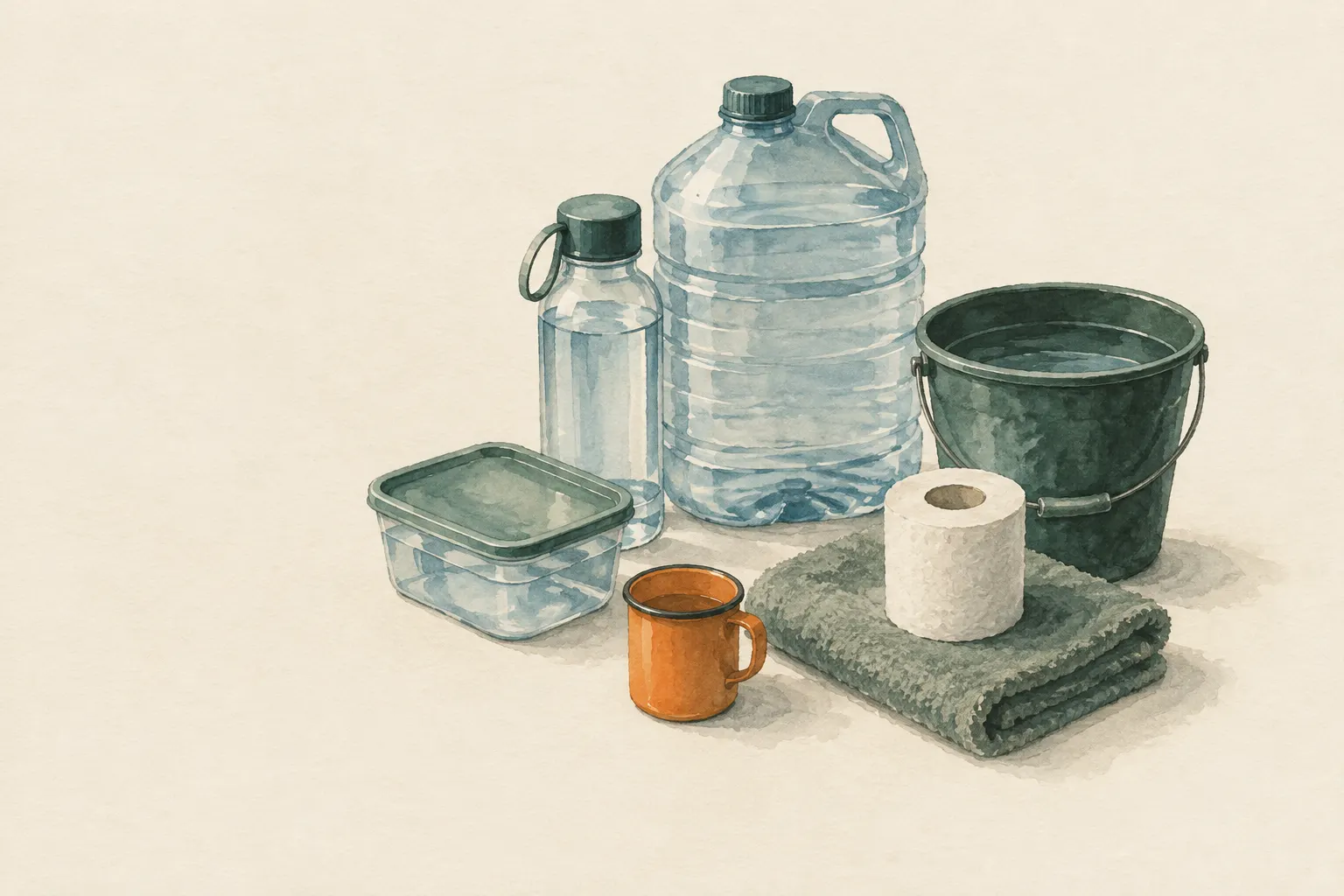
Keep a drinking water stock for several days in clean, food-grade containers and rotate it regularly. How much you need follows your authority's recommendations. Also plan utility water for the toilet and hygiene.
If the power fails and water is still coming, fill containers and pots immediately. A bathtub cleaned thoroughly beforehand can also be filled – but only as utility water for the toilet and washing, not for drinking. The residual pressure often does not last long, so it pays to act at once rather than wait.
Safety: what to watch out for
Only drink water from clean, food-grade containers. Bathtub water is not drinking water. Water from a hot water tank in the flat is also a reserve you draw only as the manual describes or after consultation, and treat before drinking. If the water supplier issues a boil-water notice or another warning, follow it.
Full water containers are heavy, and stairwells are dark during an outage. Use a headlamp so both hands are free, share the load between several people, prefer several smaller containers and do not rush. Carrying a large full can alone up many floors is a real risk of falls and overstrain.
If there is no water for flushing, do not just keep using the toilet until it blocks. Flush with a bucket of utility water only when needed, or use a bag toilet if there are sewer problems.
Typical situations
Saving helps your stock last longer: collect dishes rather than washing them one by one, use wet wipes and hand sanitiser in between, use used washing water for the toilet.
Fetching water is teamwork. Agree with neighbours on which lower floors or outdoor taps still have water and who supplies older, sick or mobility-impaired people. You will learn about official water distribution points, if any, via the radio and notices. Especially in high-rise buildings where the lift has also stopped, this help is crucial for many people.
Good to know
The BBK and Ready.gov recommend a drinking water stock for several days. The BBK expressly points out that water supply can also be disrupted during a power outage.
How long water keeps running in a particular building depends on the building and the supplier. That is why asking the building management is so valuable – it costs nothing and turns a surprise into a plan. How to treat water is described in the water world.
Step by step
Know your building
Ask the management or caretaker: is there a booster pump or sewage pump? Does it have backup power? From which floor is there no water without the pump?
- 1
Know your building
Ask the management or caretaker: is there a booster pump or sewage pump? Does it have backup power? From which floor is there no water without the pump?
- 2
Stock in the flat
Keep a drinking water stock for several days in food-grade containers and rotate it regularly. Also plan utility water for toilet and hygiene.
- 3
Fill immediately when the power fails
If water still runs, fill containers, pots and a cleaned bathtub (as utility water). The remaining pressure often does not last long.
- 4
Save water
Flush the toilet with a bucket only when needed; collect dishes, use wipes and hand sanitiser.
- 5
Organise fetching water
Agree with neighbours where water still runs on lower floors or outdoor taps and who supplies older or sick people. Learn about official distribution points through radio and notices.
Common mistakes
- Collecting water only when the tap is already dry
- Drinking bathtub water without treatment
- Carrying full 20-litre cans alone up many floors
- Continuing to use a toilet without water until it blocks
Quick view
Materials
Food-grade water container
Food-grade, clean
Only use containers that never held chemicals or fuel.
Collapsible water container or bag
Protect from sharp objects.
Use only food-grade and only for water.
Galvanised bucket
Utility water only
Do not heat: the zinc coating can release harmful fumes when heated.
Suitable for
- Flats on upper floors
- High-rise buildings and large housing estates
- People with limited mobility
Not suitable for
- Interfering with the building's water system
Prerequisites
- Knowing whether the building has a booster pump (ask the management)
- Space for a few water containers
Safety
- Only drink water from clean, food-grade containers. If the supplier issues a boil-water notice or warning, follow it.
- Full water containers are heavy. Use a headlamp on dark stairs, share the load, prefer smaller containers and do not rush.
- Where toilets or drains are below the sewer level (e.g. in a basement), a pump often lifts the waste water – without power it can back up there. Ask the building management.
How it works
The pressure in the public network only reaches a certain height. Above that, pumps in the basement increase the pressure. Without power this stage drops out: water runs dry at the top first, while lower floors often keep it as long as the public network has pressure.
Advantages
- Independent of pumps for a few days
- Low cost
Disadvantages
- Takes space
- Carrying is physically demanding
Deep knowledge
Background
The BBK and Ready.gov recommend a drinking water stock for several days; the BBK notes that water supply can be disrupted during power outages.
How long water keeps running in a particular building depends on the building and supplier. That is why asking the building management is the most important step.
Variants
- Hot water tank
- A hot water tank in the flat holds a water reserve. Draw from it only as the manual describes or after consultation; treat the water before drinking.
Common mistakes
- Collecting water only when the tap is already dry
- Drinking bathtub water without treatment
- Carrying full 20-litre cans alone up many floors
- Continuing to use a toilet without water until it blocks
Limits and risks
- No quantities for individual households
- No treatment instructions – see the water world
Material alternatives
Derived from material properties: a substitute must have all relevant properties. Observe the notes on the substitute.
- Food-grade water container
- Single-wall stainless steel bottle (Heat only single-wall bottles without paint/plastic; remove the lid before heating.), Double-wall insulated bottle (Never heat directly.), PET bottle (clear, max. 2 litres) (Do not heat or place in a fire.), Airtight food-grade storage container (Fill only when clean and completely dry; never use containers that previously held chemicals.), Collapsible water container or bag (Protect from sharp objects.), Food-grade water bag (Use only for drinking water, never for chemicals or fuel.), Fermentation jar or crock (Use only food-grade containers of glass, food-safe glazed stoneware or food-grade plastic – no metal containers for acidic food.), Resealable food bags (Use only bags intended for food; do not use with boiling water unless the manufacturer explicitly allows it.)
- Collapsible water container or bag
- Single-wall stainless steel bottle (Heat only single-wall bottles without paint/plastic; remove the lid before heating.), Double-wall insulated bottle (Never heat directly.), PET bottle (clear, max. 2 litres) (Do not heat or place in a fire.), Food-grade water container (Only use containers that never held chemicals or fuel.), Airtight food-grade storage container (Fill only when clean and completely dry; never use containers that previously held chemicals.), Food-grade water bag (Use only for drinking water, never for chemicals or fuel.), Fermentation jar or crock (Use only food-grade containers of glass, food-safe glazed stoneware or food-grade plastic – no metal containers for acidic food.), Resealable food bags (Use only bags intended for food; do not use with boiling water unless the manufacturer explicitly allows it.)
- Galvanised bucket
- Single-wall stainless steel bottle (Heat only single-wall bottles without paint/plastic; remove the lid before heating.), Double-wall insulated bottle (Never heat directly.), PET bottle (clear, max. 2 litres) (Do not heat or place in a fire.), Food-grade water container (Only use containers that never held chemicals or fuel.), Used chemical or fuel container (Never for drinking water or food – residues cannot be reliably removed.), Waterproof case or bag, Airtight food-grade storage container (Fill only when clean and completely dry; never use containers that previously held chemicals.), Wildlife-resistant food container (Where specific containers are required, use only approved models – check local rules.), Small metal tin with lid (Burn off coated or painted tins outdoors first.), Collapsible water container or bag (Protect from sharp objects.), Food-grade water bag (Use only for drinking water, never for chemicals or fuel.), Fermentation jar or crock (Use only food-grade containers of glass, food-safe glazed stoneware or food-grade plastic – no metal containers for acidic food.), Resealable food bags (Use only bags intended for food; do not use with boiling water unless the manufacturer explicitly allows it.)
Results come exclusively from structured entries. No improvised instructions are generated.
Sources
Bundesamt für Bevölkerungsschutz und Katastrophenhilfe (BBK), Deutschland: Ratgeber für Notfallvorsorge und richtiges Handeln in Notsituationen
Water stock and disrupted water supply during outages
Ready.gov – U.S. Federal Emergency Management Agency (FEMA): Water (emergency water supply guidance)
Emergency drinking water stock