Carrying water improvised – only in clean, food-grade containers
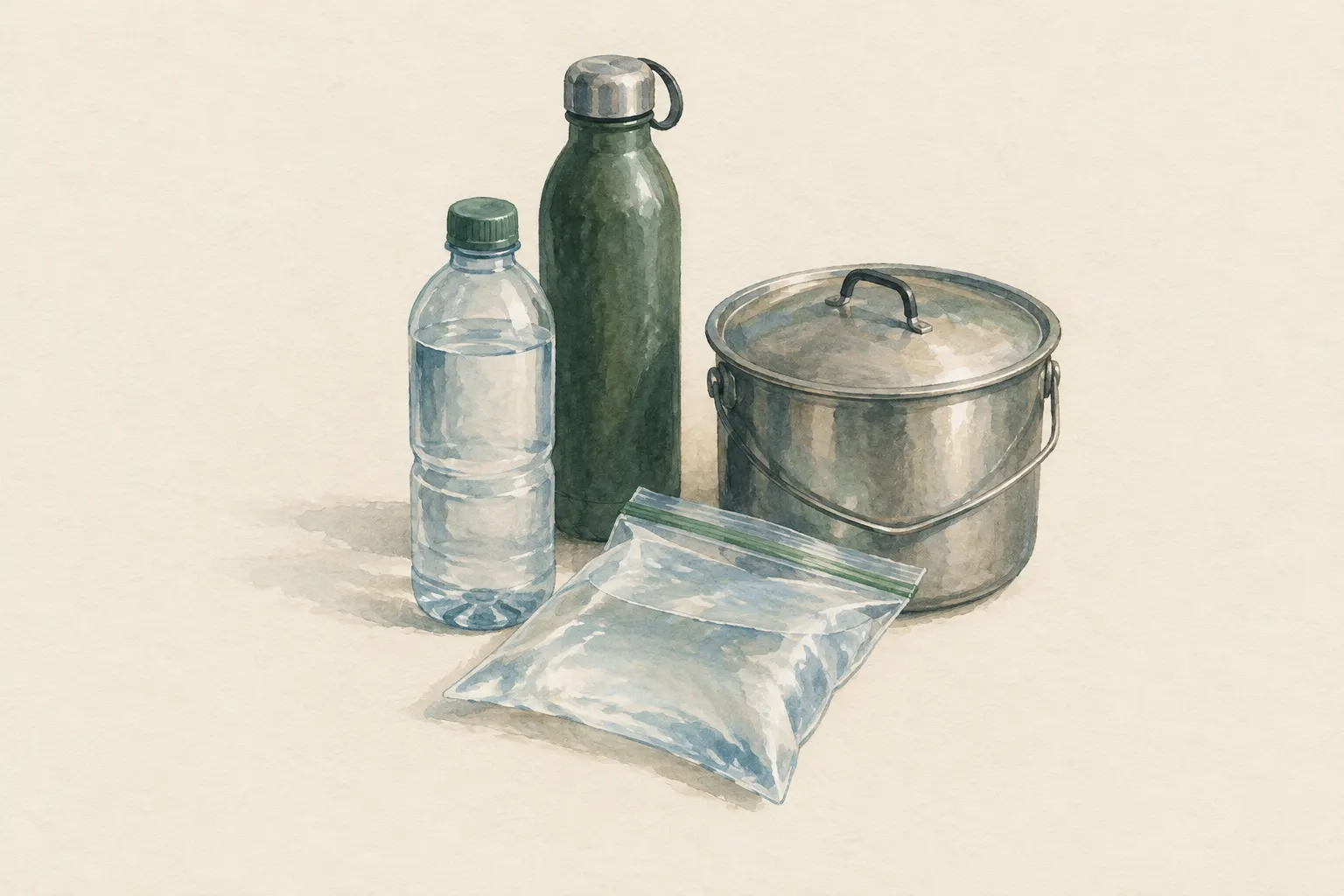
If there is no jerrycan, drinks bottles, freezer bags, cooking pots or a food-grade bag in a backpack can carry water. What matters is that the container is meant for food, clean and has never held chemicals or fuel. Bin bags are not food-grade.
- A few minutes
Explained simply
Water is only as clean as the container it is in. If you carry water in a bottle that used to hold cleaning fluid, you drink a little cleaning fluid with it – even if you rinsed the bottle well. So the most important rule when carrying water is: only use containers meant for food that have never held anything else.
Good containers are drinks bottles, zip-top freezer bags, cooking pots with lids or collapsible food-grade water containers. A bin bag, a paint bucket or an old cleaner bottle are not suitable. Water is heavy: one litre weighs about one kilogram. Several small containers are easier to carry than one big one.
And one more thing: a clean container does not make dirty water clean. Water from a stream or an unsafe source must be treated before drinking, for example by boiling.
How it works
Plastics and metals are not all the same. Containers intended for food are made from materials that do not release harmful substances into drinks or food under normal conditions. Other containers – such as bin bags, builders' and paint buckets or technical canisters – are not tested for this and can contain additives that do not belong in drinking water.
Then there are residues. Chemicals, cleaners, pesticides, oil and fuel partly soak into plastic or stay stuck in crevices and threads. They therefore cannot be reliably washed out, not even with lots of washing-up liquid. A container that has once held something like that stays off-limits for drinking water.
When carrying, physics plays the main role. Water is heavy and sloshes. Sloshing water pulls you back and forth with every step and tires you faster. Full or nearly full containers, carried close to the body and centrally, are much more comfortable than a half-full bucket at arm's length.
What really matters
The history of the container must be known for certain. Empty drinks bottles, freezer bags, pots and canisters that have only held food are suitable. In the EU a symbol showing a glass and a fork marks materials intended for contact with food. When in doubt: if you do not know it for sure, do not use it.
Clean every container with clean water and a little washing-up liquid and rinse thoroughly. Do not forget lids, caps and threads – dirt likes to settle there in particular. When filling, do not put your fingers into the opening.
Freezer bags are best used doubled; do not fill them completely, squeeze out the air and seal them. Then stand them upright in a pot, a bowl or a backpack so they do not tip over or burst. Label containers “drinking water” with the date, store them cool and dark and use the water soon.
Safety: what to watch out for
The container only decides whether water stays clean on the way – not whether it was safe to begin with. Water from streams, lakes, rain barrels or a tap under a boil-water notice must be treated before drinking, for example by bringing it to a rolling boil. Always follow the advice of local authorities. An improvised filter alone does not make water safe.
Keep untreated and treated water apart and label the containers. Otherwise someone may drink from the wrong one by mistake. A container that once held untreated water should be cleaned thoroughly before it is used for drinking water.
Water is heavy, and carrying it can overload your back and joints. Split the loads, carry them close to the body and take breaks. Two people can carry a bucket or pot on a pole between them – then the weight is shared.
Typical situations
When the water supply fails, authorities often set up distribution points, for example water tankers or drinking-water stations. Bringing your own clean containers helps a lot there. Several bottles in a backpack or a bag of freezer bags inside a pot are easier to carry home than a single large canister.
In a camp outdoors you might fetch water from a stream. Then carry it in a pot with a lid or a collapsible container back to camp – and boil it there before anyone drinks it or brushes their teeth with it.
Improvised containers, especially single-use bags, are not meant for long-term storage. Anyone who wants to build up an emergency water supply uses suitable food-grade containers and follows the authorities' recommendations.
Good to know
Civil protection authorities recommend clean, food-grade containers for drinking water and explicitly advise against vessels that held chemicals. The rule is simple, but it applies even when things have to happen quickly.
A common mistake is grabbing “any” canister from the garage in a hurry. Those canisters in particular have often held oil, fuel or cleaners. Several small, safe bottles are better than one large, questionable container.
Step by step
Choose containers
Drinks bottles, zip-top freezer bags, cooking pots with lids or food-grade collapsible containers. Their history must be known for certain.
- 1
Choose containers
Drinks bottles, zip-top freezer bags, cooking pots with lids or food-grade collapsible containers. Their history must be known for certain.
- 2
Clean
Wash with clean water and a little washing-up liquid and rinse well. Do not forget lids and caps.
- 3
Double bags
Use freezer bags doubled, do not fill them completely, squeeze out air, seal and stand upright in a pot or backpack.
- 4
Carry
Heavy items close to the back and central. Several small containers are easier to carry than one that sloshes.
- 5
Label and store
Label containers "drinking water" with the date, store cool and dark and use soon.
Common mistakes
- Using a bin bag or paint bucket
- Reusing cleaner bottles
- Filling bags to the brim
- Assuming untreated water is safe
Quick view
Materials
PET bottle (clear, max. 2 litres)
Do not heat or place in a fire.
Food-grade water bag
Use only for drinking water, never for chemicals or fuel.
Metal pot (stainless steel, aluminium, titanium)
Hot – scalding risk.
Backpack
To carry bags and bottles
Suitable for
- Bringing water home from a distribution point
- Fetching water for camp
- Short-term extra need
Not suitable for
- Containers that held chemicals, cleaners, oil or fuel
- Bin bags, paint buckets, builders' buckets
- Long-term storage in single-use bags
Prerequisites
- Clean containers that have only held food
- Knowing that carried water may need treatment depending on the source
Safety
- A clean container does not make untreated water safe. Treat water from unsafe sources.
- A litre of water weighs about one kilogram. Spread loads and carry them close to the body.
How it works
Drinking water is only transported as cleanly as the container allows. Food-grade plastics do not release harmful substances under normal conditions; containers for other purposes can hold residues or unsuitable materials. When carrying, load distribution decides how far you can go.
Advantages
- Uses existing household containers
- Quick to put into practice
Disadvantages
- Bags can burst
- Small amounts per container
- No long-term storage
Deep knowledge
Background
Authorities such as Ready.gov and the CDC recommend clean, food-grade containers for drinking water and advise against containers that held chemicals. This rule also applies when improvising.
In crises water distribution points are often set up; bringing your own clean containers helps there.
Variants
- Two people with a pole
- Two people carry a bucket or pot on a pole between them – the load is shared.
Common mistakes
- Using a bin bag or paint bucket
- Reusing cleaner bottles
- Filling bags to the brim
- Assuming untreated water is safe
Limits and risks
- No water treatment
- No storage duration figures
Material alternatives
Derived from material properties: a substitute must have all relevant properties. Observe the notes on the substitute.
- Food-grade water bag
- Single-wall stainless steel bottle (Heat only single-wall bottles without paint/plastic; remove the lid before heating.), Double-wall insulated bottle (Never heat directly.), PET bottle (clear, max. 2 litres) (Do not heat or place in a fire.), Food-grade water container (Only use containers that never held chemicals or fuel.), Airtight food-grade storage container (Fill only when clean and completely dry; never use containers that previously held chemicals.), Collapsible water container or bag (Protect from sharp objects.), Fermentation jar or crock (Use only food-grade containers of glass, food-safe glazed stoneware or food-grade plastic – no metal containers for acidic food.), Resealable food bags (Use only bags intended for food; do not use with boiling water unless the manufacturer explicitly allows it.)
- Metal pot (stainless steel, aluminium, titanium)
- Single-wall stainless steel bottle (Heat only single-wall bottles without paint/plastic; remove the lid before heating.)
- Backpack
- Sleeping pad, Dry leaves, grass or conifer boughs (Collect only where allowed; no protected plants. Check for ticks and insects.), Dry spare clothing (Carry it in waterproof packaging – wet clothing barely insulates.), Wool blanket / duvet (Keep away from candles, stoves and heaters.), Insulated cool box (Keeps cold only for a limited time; without ice packs or ice it is not a fridge.), Sleeping bag (Do not store compressed long-term; do not pack away damp.), Newspaper and cardboard (Flammable – keep away from candles, stoves, heaters and embers.), Insulated cooking box (hay box, thermal cooker) (Never put open flame or embers inside – only the hot, closed pot.)
Results come exclusively from structured entries. No improvised instructions are generated.
Sources
Ready.gov – U.S. Federal Emergency Management Agency (FEMA): Water (emergency water supply guidance)
Clean, food-grade containers for drinking water; no containers that held chemicals
Centers for Disease Control and Prevention: Making Water Safe in an Emergency
Safe storage and containers for water in an emergency