Carrying tools and wood safely
Many injuries happen not while working but on the way: a hatchet without a guard, an open saw, a stumble with an armful of wood. Always carry blades covered and away from the body, move wood in manageable bundles and lift with the legs.
- A matter of habit
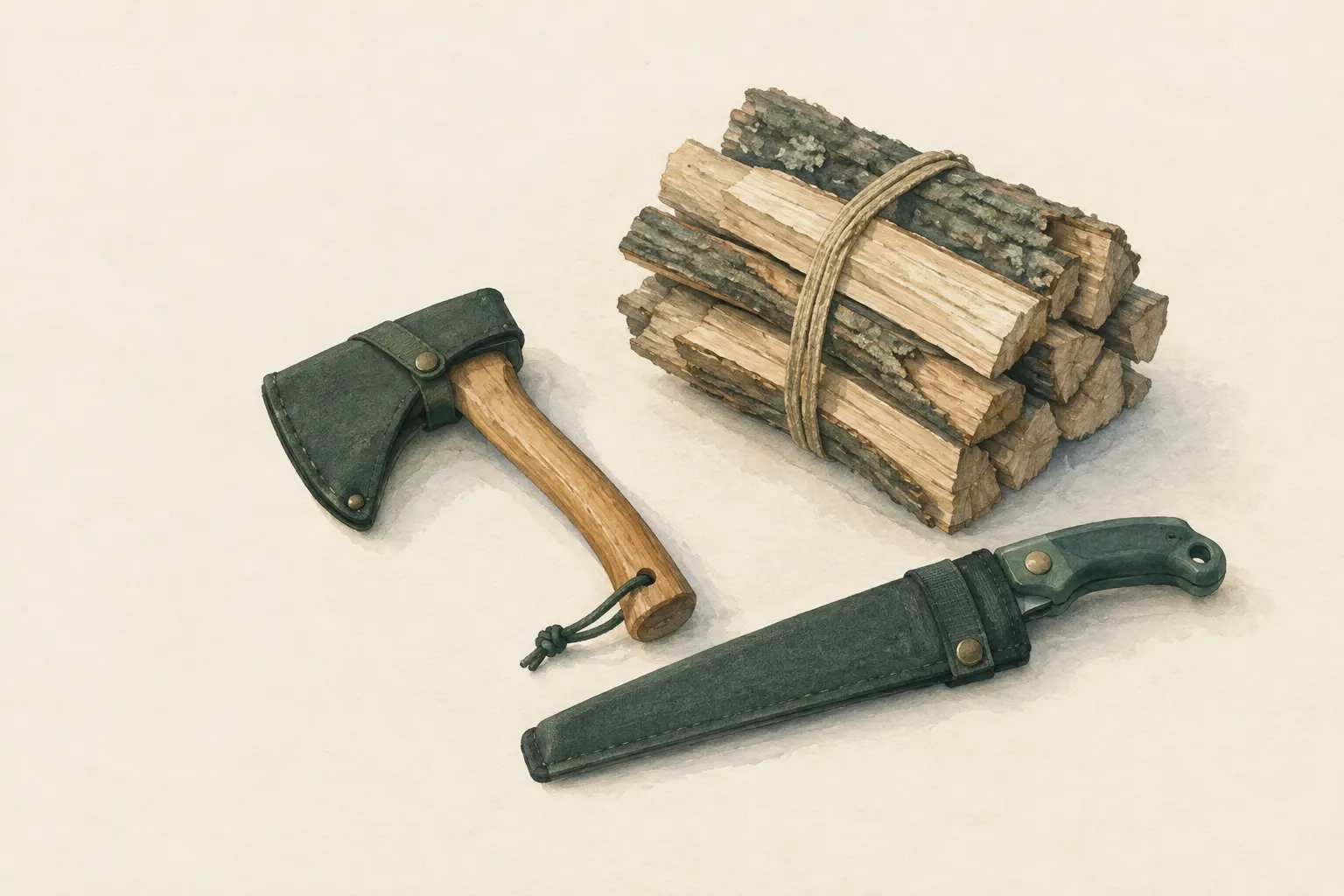
Explained simply
Many injuries with a knife, hatchet or saw do not happen while working but while walking about. You trip over a root, and suddenly the blade in your hand is dangerously close to your leg. That is why there is a simple rule: before you take a step, every blade is covered.
Knives go into their sheath, saws are folded and the hatchet gets its blade guard. You carry the hatchet at your side, blade pointing down and away from your leg – never over your shoulder. When you give someone a tool, you hand it over handle first and let go only when the other person says “got it!”.
When carrying wood, it helps to think: better three short trips than one too many. A huge armful of wood blocks your view, and you have no hand free to catch yourself. Heavy logs are carried by two people and lifted with the legs, not the back.
How it works
When you fall, you reflexively throw your arms forwards or down to catch yourself. If you are holding an open blade at that moment, it moves exactly to where your own body lands. A covered blade, on the other hand, cannot cut, and a blade pointing down and outwards points away from the body. Together these two measures make a stumble harmless.
Small loads leave one hand free. With that hand you keep your balance, push twigs out of your face or catch yourself. Someone with both arms fully loaded cannot see the ground in front of their feet and in a fall can only land on their face. That is why several short trips are safer than one overloaded one.
The back is under most strain when lifting if you bend forwards with straight legs and the load is far from the body. The closer the load is to the body and the more the strong leg muscles do the work, the lower the strain on the spine. Twisting under load is particularly bad.
What really matters
Grip the hatchet by the handle near the head, arm relaxed at your side, edge pointing down and slightly away from your leg. That way it cannot swing into your legs if you trip. Carried over the shoulder, the edge points at your neck and head – in a fall or when you turn round, that is dangerous for you and others. Knife and saw go closed or sheathed onto your belt or into your pack.
Bundle wood with a rope or a wide strap. A bundle can go over your shoulder or be dragged behind you. A wide strap spreads the pressure better than thin cord that cuts into your hand. Lift long poles at the front end and let the back end drag along the ground – that way you carry only part of the weight.
At the destination every tool has a fixed place, for example on a particular stump or on a tarp. A tool lying somewhere in the grass gets overlooked, stepped on or lost. These simple rules are often forgotten when fetching wood at dusk – so plan to collect wood while it is still light.
Safety: what to watch out for
The most important rule is short: never walk with an uncovered blade in your hand. This applies especially on slopes, over wet rocks, across streams and in the dark. Steep slopes and stream crossings with open blades are off limits. If you have lost a blade guard, improvise one first – for example from a piece of cloth tied on firmly – or carry the tool in your pack.
When handing over: handle first, blade away from the receiver, and let go only when they have clearly said “got it!”. That sounds fussy, but it prevents a tool from falling or both people grabbing at it at once. Practise this deliberately with children until it becomes second nature.
Heavy logs are not lifted alone. Bend your knees, grip the load close to your body, stand up with a straight back using your legs and turn with your feet, not your upper body. Work gloves protect against splinters. If someone still cuts themselves badly: press firmly on the wound and call the local emergency number (112 in the EU).
Typical situations
Fetching wood with a group: agree beforehand who carries which tool and talk through the route between collecting point and camp. Wood is collected only where that is allowed, and only deadwood. Children carry small bundles without tools; adults take the saw and hatchet. At camp the wood goes to a fixed stacking place at a distance from the fire.
Uneven ground and evening: this is where most stumbles happen. Switch on your head torch early, walk more slowly and carry less. If you have to climb over a fallen trunk, for example, put the bundle over first and then follow with your hands free. This entry does not replace occupational safety rules for commercial forestry work.
Step by step
Cover blades
Knife in its sheath, saw folded or blade guard fitted, hatchet with its guard on – before every step.
- 1
Cover blades
Knife in its sheath, saw folded or blade guard fitted, hatchet with its guard on – before every step.
- 2
Carry the hatchet
Grip the handle near the head, blade down and away from the leg, arm relaxed at your side. Do not carry it on your shoulder.
- 3
Hand tools over
Hand over handle first and only let go when the other person says "got it".
- 4
Bundle wood
Bundle poles and branches with a rope and drag or shoulder them. Lift long poles at the front end and let the back drag.
- 5
Lift properly
Bend the knees, grip the load close to the body and stand up using the legs. Carry heavy pieces with two people.
- 6
Keep the path clear
Know the path between collecting point and camp, avoid obstacles and put tools down in a fixed place at the destination.
Common mistakes
- Hatchet over the shoulder
- Open knife in the hand while walking
- An armful of wood blocking the view
- Putting tools down in grass where nobody sees them
Quick view
Materials
Hatchet or small axe
With a blade guard
Only use with a firmly seated head and sound handle; fit the edge guard when not in use.
Rules on carrying and on cutting wood differ by region – check local rules.
Folding saw
Fold or cover the blade after use; saw teeth are very sharp.
Rope
For wood bundles
Never use unknown or damaged rope for life-safety purposes.
Sturdy work gloves
When handling flood mud or chemicals, also wear waterproof gloves.
Suitable for
- Collecting wood in camp
- Groups with children
- Uneven terrain
Not suitable for
- Loads beyond what you can carry safely
- Carrying open blades on steep slopes or across streams
Prerequisites
- A guard for every blade
- Safe handling of saw and hatchet
Safety
- Do not lift heavy logs alone. Lift from the legs with a straight back, keep the load close and do not twist under load.
How it works
A covered blade pointing down and away cannot enter the body in a fall. Small bundles leave one hand free for balance and support. Several short trips are safer than one overloaded one.
Advantages
- Prevents typical cuts and back injuries
- Easy to teach
Disadvantages
- More trips and a little more time
Deep knowledge
Background
The US Forest Service axe manual ("An Ax to Grind") and bushcraft textbooks treat carrying and handing over axes safely as part of the basic rules.
The rules are simple but are often forgotten, especially when fetching wood at dusk.
Variants
- Carrying strap
- A wide strap or sling around the bundle spreads pressure better than thin cord on the hand.
Common mistakes
- Hatchet over the shoulder
- Open knife in the hand while walking
- An armful of wood blocking the view
- Putting tools down in grass where nobody sees them
Limits and risks
- No occupational safety rules for commercial forestry
- No figures for permissible loads
Material alternatives
Derived from material properties: a substitute must have all relevant properties. Observe the notes on the substitute.
- Rope
- Paracord (Not a climbing or safety rope.)
Results come exclusively from structured entries. No improvised instructions are generated.
Sources
USDA Forest Service, Missoula Technology and Development Center (Bernie Weisgerber, Bob Beckley) (1999): An Ax to Grind: A Practical Ax Manual
Carrying and handing over axes safely, blade guards
Ray Mears – Hodder & Stoughton (2002): Bushcraft
Tool safety in camp