Splitting wood with an axe: block, stance, swing
Safe splitting with an axe rests on three things: a stable chopping block at a suitable height, a wide stance with a clear swing area and a blow that ends in the block, not the leg, when it misses. Reading the wood – cracks, knots, grain – takes less force.
- Instruction and practice 1–2 hours
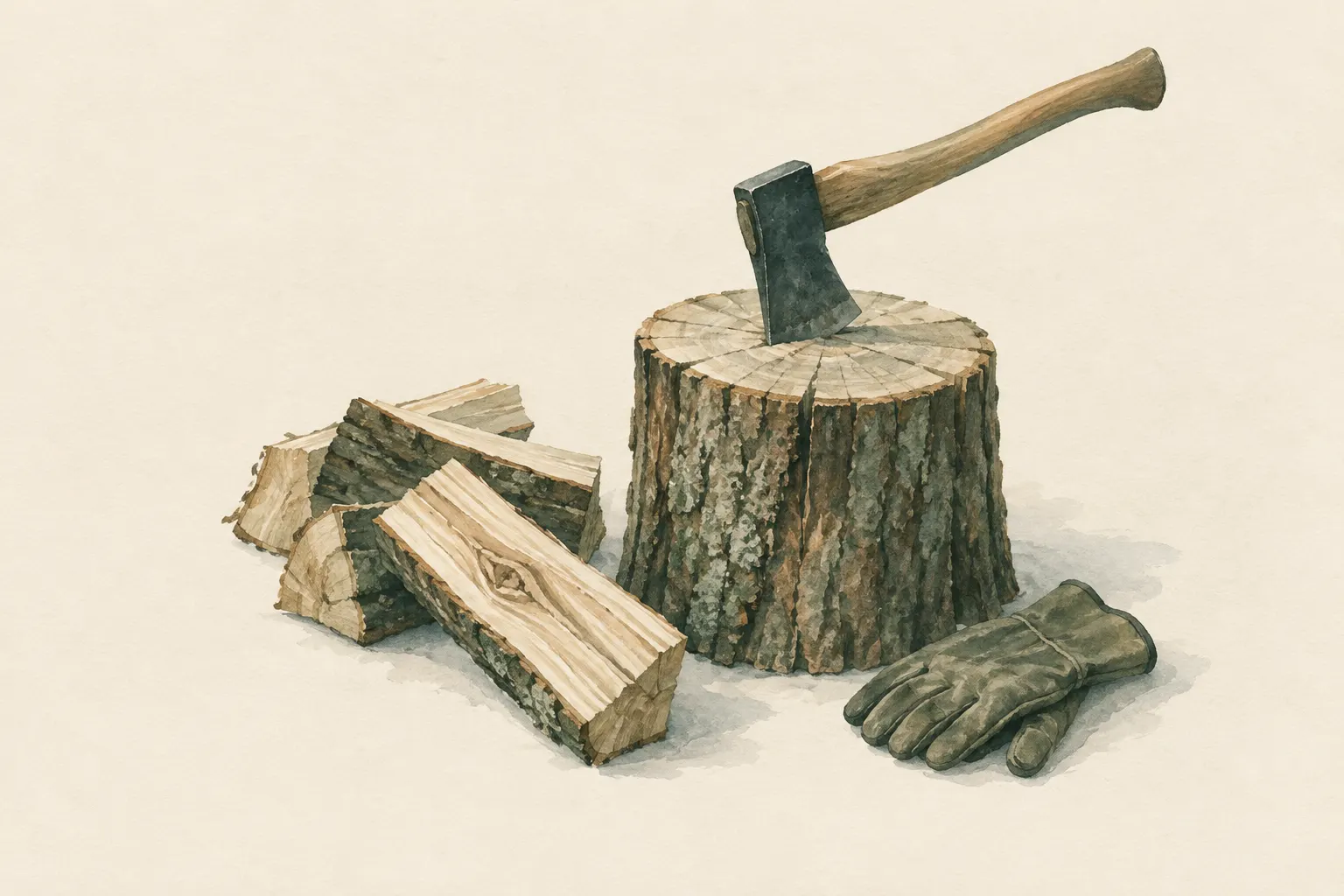
Explained simply
An axe is basically a heavy wedge on a long handle. When you swing it, force builds up in the head, and on impact the wedge pushes the wood apart – like a door wedge, only much more powerful. Wood splits most easily along its fibres, that is, in the direction the tree grew.
To avoid injury, you stand the wood on a chopping block, a thick block of wood about knee high. If the axe misses the wood or breaks through, it then lands in the block or the ground in front of you and not in your leg. Nobody holds the wood for you.
Very important: there must be plenty of clear space all around you, behind you too. Wear sturdy shoes, have a first-aid kit ready and stop when you get tired. Splitting with an axe is best learned with someone who knows how.
How it works
The axe works as a heavy wedge. The energy you put into the head as you swing drives the edge into the grain. Behind it, the wider sides of the head, the cheeks, push the wood apart. That is why a splitting axe has a thicker, more wedge-shaped head than an axe for cross-cutting, which is slimmer.
Wood helps you if you read it. As it dries, cracks often form in the end grain – the sawn surface – running from the centre outwards. These drying cracks are natural weak points; a blow along such a crack needs much less force. Knots, on the other hand, run across the grain and hold the wood together. That is why you split parallel to a knot, not straight through it.
Because the swing holds a lot of energy, geometry decides where a missed blow goes: the height of the block, your distance and the angle of the blow. A block at knee height means the handle is roughly horizontal on impact and a miss travels forward into the block or the ground.
What really matters
The block must be wide, sawn flat and stand firmly on solid ground. A wobbly block tips the wood away and deflects the blow. Stand the round upright in the middle, with the cracks in view.
Your stance is shoulder-width, and you stand far enough back that the edge meets the middle of the round with your arms extended. If you stand too close, the handle strikes the wood instead of the edge – that can damage the handle. The axe goes up vertically over the centre, and the upper hand slides down to the end of the handle during the blow. Power comes from letting the arms drop and bending the knees, not from yanking or muscle.
With thick rounds, begin at the edge and split off smaller pieces first instead of hitting the middle. That takes less force. If you miss, do not chase the swing; reset your stance. Clear split wood away regularly so that nothing lies in the way to trip over.
Safety: what to watch out for
A missed blow or one that goes right through the wood travels towards the shin and foot. Block height and distance are therefore your most important protection. Sturdy footwear, gloves and safety glasses further reduce injuries from splinters and missed blows. With a serious injury, press firmly on the wound and call the local emergency number (112 in the EU).
The swing zone must be clear all round – at least two axe lengths plus arm in every direction, including behind you and above, where branches can deflect the swing. Nobody holds the wood, not even "just for a moment". Children only split with instruction and supervision.
If the axe gets stuck in the wood, do not swing axe and log together over your head. Free it with a wooden wedge or a second piece of wood instead. Before each use, check that the head sits firmly and the handle has no cracks. Do not work in the dark, on ice or when exhausted – most accidents come from fatigue, distraction and too little distance.
When it makes sense – and when not
The axe is the right tool when you want to turn sawn rounds into firewood, for example as a supply for a stove or a permitted campfire. Split wood dries better than round pieces because more wood surface is exposed instead of being covered all round by bark.
For small wood a hatchet is handier; then you work kneeling, so that a missed blow ends in the block or the ground in front of your knees. Saw heavily twisted or knotty pieces instead. Felling trees and chainsaws do not belong here – they require training and protective equipment. And as always with wood: only dead wood where allowed, or with the landowner's permission; check local rules.
How to practise it
It is best to have the technique shown to you by someone with experience. Start with short, straight, knot-free rounds that already have drying cracks. Focus on accuracy, not force: if the edge lands every time where you are looking, the power comes almost by itself.
Plan breaks in advance and stop before you are exhausted. Especially at the end of a long work session, blows become imprecise. Short breaks and stopping in good time are not a weakness but part of the technique.
Step by step
Set up the block
Stand a wide, flat-sawn block on firm ground. Its top is about knee height so that a blow ends on the wood with the handle roughly horizontal.
- 1
Set up the block
Stand a wide, flat-sawn block on firm ground. Its top is about knee height so that a blow ends on the wood with the handle roughly horizontal.
- 2
Read the wood
Stand the round upright. Look for cracks in the end grain and avoid knots – split parallel to a knot, not across it.
- 3
Take the stance
Feet shoulder-width apart, distance such that the edge meets the middle of the round with arms extended. Check the space all around.
- 4
Swing with control
Bring the axe vertically over the centre, the upper hand sliding down to the end of the handle. Power comes from dropping the arms and bending the knees, not from yanking.
After a miss do not chase the swing – reset.
- 5
Start at the edge
With thick rounds split pieces off the edge first instead of hitting the middle. This takes less force.
- 6
Clear up
Regularly clear split wood from the work area so nothing is in the way. Cover the axe and do not leave it stuck in the block.
Common mistakes
- Splitting on the ground instead of a block
- Standing too close so that the handle hits the wood
- Forcing through knots
- Continuing with a loose head
- Swinging a stuck axe and log together overhead
Quick view
Materials
Hatchet or small axe
For logs a long-handled splitting axe; a hatchet only for small wood
Only use with a firmly seated head and sound handle; fit the edge guard when not in use.
Rules on carrying and on cutting wood differ by region – check local rules.
Chopping block
Must be level and stable; do not use a wobbling block.
Sturdy closed shoes
First-aid kit (household)
Does not replace a first-aid course; check contents and expiry dates regularly.
Suitable for
- Splitting sawn rounds into firewood
- Stocking a stove or campfire
- Straight-grained wood
Not suitable for
- Working in the dark, on ice or when exhausted
- Children without instruction and supervision
- Heavily twisted or knotty pieces – saw them instead
Prerequisites
- Axe with a firmly seated head and crack-free handle
- Clear space with no branches above and behind you
- Basic rules from "Using a saw and hatchet safely"
Safety
- If the axe gets stuck, do not swing axe and log together overhead. Free it with a wooden wedge or a second piece instead.
- Sturdy footwear, gloves and safety glasses reduce injuries from splinters and missed blows.
How it works
The axe works as a heavy wedge: the energy stored in the swing drives the edge into the grain and the cheeks push the wood apart. Existing drying cracks are natural weak points. Because the energy is large, geometry – block height, distance, angle of swing – decides where a missed blow goes.
Advantages
- Fast for larger amounts of wood
- No electricity or fuel needed
- Even firewood that dries well
Disadvantages
- High injury risk when mistakes happen
- Physically demanding
- Needs space and a block
Deep knowledge
Background
The US Forest Service manual "An Ax to Grind" describes splitting axes, handle inspection and a safe working posture for forest workers. Bushcraft textbooks recommend a kneeling position and a chopping block as a catching surface for small hatchets.
Most accidents come from fatigue, distraction and too little distance. Short breaks and stopping before exhaustion are therefore part of the technique.
Variants
- Kneeling with a hatchet
- For small wood with a hatchet work kneeling: a missed blow then ends in the block or ground in front of the knees. Never hold the wood with your hand.
- Holding pieces together with a ring
- Some place an old tyre or a loop around small pieces on the block so that split pieces do not fall off. The ring must not cross the swing path.
Common mistakes
- Splitting on the ground instead of a block
- Standing too close so that the handle hits the wood
- Forcing through knots
- Continuing with a loose head
- Swinging a stuck axe and log together overhead
Limits and risks
- No felling, no chainsaw
- No legal advice on cutting wood
- Does not replace hands-on instruction
Sources
USDA Forest Service, Missoula Technology and Development Center (Bernie Weisgerber, Bob Beckley) (1999): An Ax to Grind: A Practical Ax Manual
Splitting axes, checking head and handle, safe working posture
Ray Mears – Hodder & Stoughton (2002): Bushcraft
Chopping block and kneeling position with a hatchet