Filling and placing sandbags: the basics
Sandbags do not keep water out completely, but they can divert it and reduce inflow at doors, basement windows and light wells. What matters is correctly filled bags, staggered joints as in brickwork, firmly pressing down each layer and a sealing sheet. Many municipalities hand out sand and bags – follow local advice.
- Several hours with several people
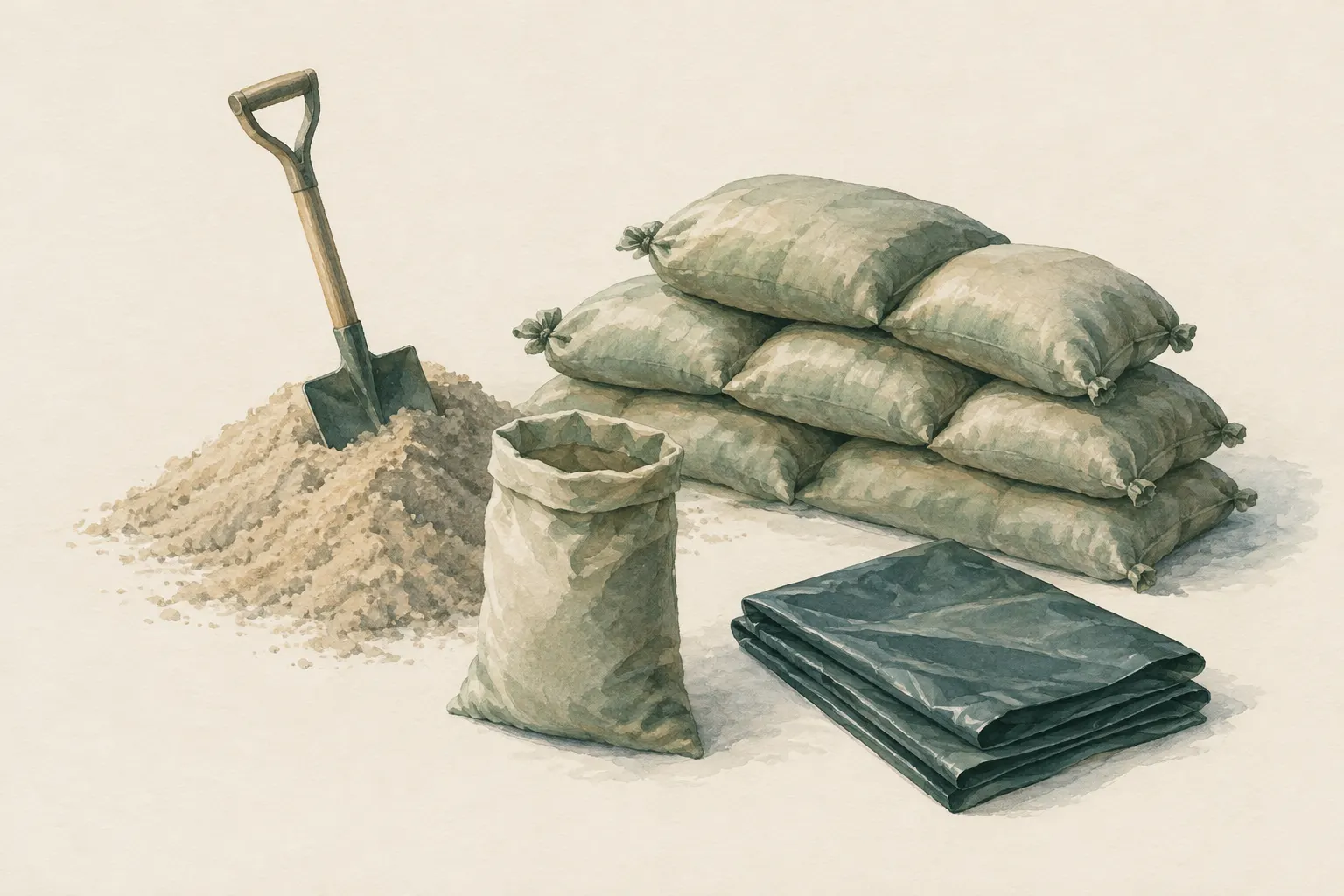
Explained simply
Sandbags are bags full of sand that are stacked like building blocks into a small wall to keep floodwater away from doors, basement windows and light wells. A sandbag is heavy and soft at the same time. That is why it moulds itself to the ground and to the bags next to it, a bit like a beanbag that takes on your shape. So hardly any gaps remain.
Such a wall is never completely watertight, because sand slowly lets water through. But it can divert a lot of water and greatly reduce the inflow. For it to hold, the bags are laid staggered like bricks in a house wall, each one is trodden down firmly, and a plastic sheet is laid over it on the water side.
The most important point: people matter more than houses. If the authorities say you must leave, or if the water is already rising and flowing, stop immediately and get to safety.
How a sandbag wall works
A sandbag wall works with two properties: weight and mouldability. The weight keeps the wall in place against the water pressure. The mouldability means that partly filled bags conform to each other and to the ground and close gaps. A bag filled to bursting, by contrast, stays round and hard like a ball – water easily finds a way between bags like that.
The staggered joints are just as important. If the joins of two layers lie directly on top of each other, a continuous gap forms through which water seeps. Laid staggered, like bricks in a wall, the water has to take a detour and is slowed down.
Because sand lets water through, a wall only reduces inflow. A sheet on the water side seals it further, and pumps on the dry side remove the water that still gets through. That is how the three parts complement each other.
What really matters when filling and laying
Filling works best in pairs: one person holds the bag open, the other shovels. The bags are filled only about half to two-thirds, so that they stay mouldable. The open end is folded over or loosely closed, as the local guidance says. Many municipalities hand out sand and bags when flooding threatens and explain how they want it done.
Before laying, clear the area of stones and branches so that the bags sit snugly. If possible, lay out a sheet first that you can later pull over the wall on the water side. The bags go lengthwise in the direction of flow, with the folded end underneath. Press and tread each bag down firmly before the next one comes, and stagger the joints of the next layer.
For multi-layer walls, build a pyramid-shaped base that is clearly wider than it is high – like a mountain, not a tower. A single row in front of a door is only enough for very low water depths. How high a wall can be and how many bags it needs depends on terrain and water level; for larger structures, emergency services decide.
When it makes sense – and when not
Sandbags are suitable for low flood depths and for diverting water away from doors, basement windows and light wells. But they take time: filling, carrying and laying take hours even with several people. So they only make sense when there is timely warning and enough help.
In high, rapidly rising floods or flash floods, sandbags are not the right answer – then all that counts is getting to higher ground in time. Defending dykes is a job for emergency services. And high water pressure from outside can damage basement walls if they are sealed off completely. For deeper water, therefore, get professional advice beforehand on whether sealing off makes sense at all.
Water does not only come through doors. It can push back from the sewer through drains and toilets – this is called backflow. A backflow valve is part of home preparedness and is installed by professionals. For doors there are also flood boards, mobile barriers and water-filled barriers that go up faster but must be acquired and tried out beforehand.
Safety: what to watch out for
Evacuation instructions always take priority. Do not keep working when the water is rising or starts to flow. Flowing water can sweep you off your feet, and a house can be replaced; a person cannot.
Filled bags are heavy, and after hours your back and arms ache. Lift with your legs, not your back, and pass the bags along in a chain from hand to hand rather than carrying each one. Plan breaks and drink enough. Gloves and sturdy shoes protect hands and feet.
Bags that were in floodwater are contaminated, because floodwater can contain sewage, oil and chemicals. Handle them only with gloves and dispose of them as the municipality instructs. Bags and sand from a flood do not belong in the sandpit or garden.
Checking and keeping watch
A finished wall is no reason to sit back. Watch where water seeps through and add bags there. Small trickles are normal; if more and more water is being pushed through at one spot, the wall is too low or too narrow there.
Keep pumps ready on the dry side if you have them and can use them safely, and make sure electrical equipment does not end up in water. And through it all, stay alert to warnings: as soon as there is danger, stop immediately and get to safety.
Step by step
Fill correctly
Work in pairs: one person holds the bag, the other shovels. Fill bags about half to two-thirds full so they stay mouldable. Fold over or loosely close the end as local guidance says.
- 1
Fill correctly
Work in pairs: one person holds the bag, the other shovels. Fill bags about half to two-thirds full so they stay mouldable. Fold over or loosely close the end as local guidance says.
- 2
Prepare the ground
Clear the area of stones and branches. Where possible, lay out a sheet so that it can later be pulled over the wall on the water side.
- 3
Lay like brickwork
Lay bags lengthwise in the direction of flow, with the folded end tucked under. Press and tread each bag firmly into place. Stagger the joints of the next layer.
- 4
Build wide enough
For multi-layer walls build a pyramid-shaped base that is clearly wider than it is high. Single rows in front of doors only for low water depths.
- 5
Check
Watch for leaks, add bags, keep pumps ready on the dry side. Stop immediately and get to safety if there is danger.
Common mistakes
- Filling bags to bursting
- Stacking joints on top of each other
- Not pressing bags down
- Starting too late
- Continuing to work in flowing water
Quick view
Materials
Sandbags (empty or filled)
Filled bags are heavy – lift with care for your back, work as a team.
Treat as contaminated after contact with floodwater; dispose of according to local rules.
Clean sand
Improvised sand layers do not reliably remove pathogens.
Small shovel / folding spade
Or a normal shovel
Plastic sheet / large bin bag
As a seal on the water side
Tears easily; never pull over the head (suffocation risk).
Do not use for drinking water unless food-grade.
Sturdy work gloves
When handling flood mud or chemicals, also wear waterproof gloves.
Sturdy closed shoes
Suitable for
- Doors, basement windows, light wells
- Diverting water away from buildings
- Low flood depths
Not suitable for
- High, rapidly rising floods
- Defending dykes – a job for emergency services
- Working in water that is already flowing
Prerequisites
- Timely warning – sandbags take time
- Helpers
- Access to sand and bags
Safety
- High water pressure from outside can damage basement walls. For deeper water, seek professional advice beforehand on whether sealing off makes sense.
- Filled bags are heavy. Lift with your legs, pass bags along instead of carrying them, take breaks.
- Bags that were in floodwater are contaminated. Handle with gloves and dispose of according to local instructions.
How it works
A sandbag wall works through weight and deformation: partly filled bags conform to each other and the ground and close gaps. Staggered joints prevent continuous water paths. Because sand lets water through, a wall only reduces inflow; a sheet on the water side and pumps on the dry side complement it.
Advantages
- Cheap and widely available
- Flexible to use
- Can reduce damage at doors and light wells
Disadvantages
- Labour-intensive and heavy
- Never completely watertight
- Disposal after a flood is laborious
Deep knowledge
Background
In its sandbagging guidance, the U.S. Army Corps of Engineers describes filling bags, laying them in staggered layers and building a wide base. Ready.gov and the BBK include protecting building openings in flood preparedness.
How high a wall can be built and how many bags it needs depends on terrain and water level – for larger structures emergency services decide.
Variants
- Alternative barriers
- For doors there are flood boards, mobile barriers and water-filled barriers. They can be set up faster but must be acquired and tested beforehand.
- Backflow
- Water can also enter through drains and toilets. A backflow valve is part of home preparedness – installation by professionals.
Common mistakes
- Filling bags to bursting
- Stacking joints on top of each other
- Not pressing bags down
- Starting too late
- Continuing to work in flowing water
Limits and risks
- No dyke defence
- No structural assessment of buildings
- No quantity calculations
Material alternatives
Derived from material properties: a substitute must have all relevant properties. Observe the notes on the substitute.
- Plastic sheet / large bin bag
- Tarp, Emergency blanket (Tears easily once punctured; short-term shelter only.), Document folder (waterproof) (Store securely – contains sensitive personal data.), Rain poncho (When used as a shelter, it no longer protects your body from rain.), Bivy bag (Never fully close off the face.), Tent (Do not cook or heat inside the tent (fire and carbon monoxide danger).), Heavy-duty bin bag (large) (Suffocation risk: never pull plastic bags over the head or face and keep them away from small children.), Group shelter bag (Airtight – ventilate regularly.)
Results come exclusively from structured entries. No improvised instructions are generated.
Sources
U.S. Army Corps of Engineers: Sandbagging Techniques
Filling, laying in staggered layers, wide base
Ready.gov – U.S. Federal Emergency Management Agency (FEMA): Floods
Building flood preparedness, priority of evacuation
Bundesamt für Bevölkerungsschutz und Katastrophenhilfe (BBK), Deutschland: Ratgeber für Notfallvorsorge und richtiges Handeln in Notsituationen
Household flood preparedness