After the disaster: returning home safely and cleaning up
After floods, storms, fires or earthquakes many accidents only happen when returning and cleaning up: damaged buildings, gas and electricity, carbon monoxide from generators, mud and mould. Return only when cleared, check the building from outside, photograph damage before cleaning up, work with protective equipment and dry out quickly.
- Days to weeks
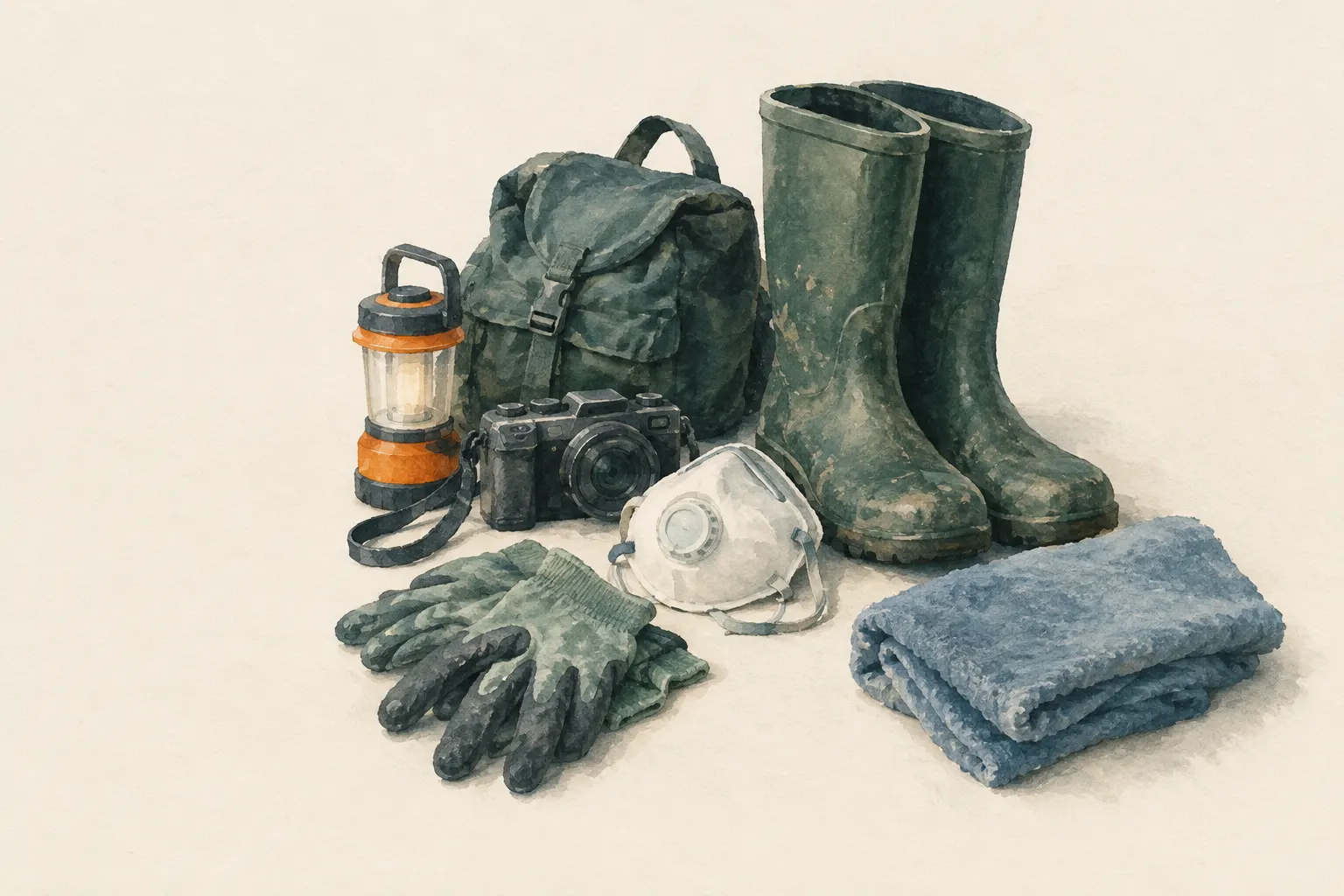
Explained simply
When a flood, storm, fire or earthquake is over, it feels as if the danger has passed. But many accidents only happen afterwards – when returning home and cleaning up. A house can look normal from outside and still be damaged inside, like an egg with a hairline crack. Gas can leak, electricity can be in the water and germs can be in the mud.
That is why you work in a fixed order: return only when the authorities allow it. Then look at the house from outside. Then photograph all the damage. Only after that do you clean up – with sturdy shoes, gloves, goggles and a mask. And because moisture makes mould grow, everything is dried as quickly as possible.
The most important point: if you smell gas, do not go in, do not press a light switch, and call the gas emergency service or the local emergency number (112 in the EU) from outside. And generators or machines with a petrol engine never run inside the house or basement – they produce invisible, poisonous carbon monoxide.
Why the time afterwards is dangerous
The dangers after a disaster are often invisible. Water can wash out foundations, an earthquake can loosen walls, and a fire can weaken beams from inside. Visible cracks in load-bearing walls, sagging ceilings or a house that leans are clear signs: do not go in; call in professionals or the authorities. This entry does not replace a professional structural assessment.
Gas and electricity are the second big danger. Pipes and cables may be torn or shifted. A single spark – from a light switch, for example – can ignite leaking gas. If water stands in rooms with sockets or wiring, it may be live. After water has got in, the power is switched back on only once a qualified electrician has checked the installation.
The third danger is sometimes one you bring along yourself: carbon monoxide. Generators, combustion-engine dryers, petrol pressure washers and grills produce this gas. It has no smell, is invisible and can quickly become life-threatening in closed rooms, basements and garages. Such equipment always belongs outdoors and well away from windows and doors.
The right order
First: safety. Return only when the authorities clear the area, preferably in daylight and not alone. Sturdy shoes, long clothing and gloves protect against glass, nails and mud. A headlamp is better than a candle or lighter, because a naked flame would be dangerous if gas is leaking. Start with a walk around the house and, when in doubt, stay outside.
Second: documentation. Before you move anything, photograph and film everything – every room, the waterline on the walls, damaged items and rating plates with serial numbers. Inform your insurer early and ask which things you must keep and which you may throw away. If you clear up too early, it can be harder to prove the damage later.
Third: restoring. Electricity, gas and heating are checked by professionals after damage. Use tap water again only when the water utility gives the all-clear – until then, your drinking-water reserve covers you. Only then does the actual cleaning and drying begin.
Drying and mould
After water damage, moisture is the biggest enemy. Mould grows quickly on wet materials. The US Environmental Protection Agency (EPA) therefore recommends drying wet materials within 24 to 48 hours where possible. Everything wet comes out of the house, windows and doors are opened for airing, and electric dryers are only used once the electrics have been cleared.
Soaked porous materials such as carpets, upholstered furniture, mattresses and insulation fill up like a sponge and often do not dry in time. They are usually discarded – after checking with the insurer. Hard surfaces such as tiles, metal or glass, on the other hand, can usually be cleaned and dried.
With mould, wear a particle mask, goggles and gloves, because scraping releases spores into the air. You can clean and dry small areas on hard surfaces yourself; leave large-scale growth to professionals. People with asthma or other respiratory conditions stay away from the work.
Safety: what to watch out for
Flood mud is not ordinary dirt. It can contain sewage, oil and chemicals. Wear waterproof gloves and boots, cover wounds and wash your hands thoroughly after work and before eating. Food that has come into contact with floodwater should usually be thrown away.
Anyone injured during clean-up should have their tetanus protection checked by a doctor. Clearing up is heavy physical work: plan breaks, drink enough and lift heavy, wet items in pairs. Many accidents happen when people keep working while exhausted.
If you smell gas, the rule is always: do not go in, do not operate switches, no flame, move away and call the gas emergency service or the local emergency number (112 in the EU) from outside. Work on gas, electricity or load-bearing parts is a job for professionals.
Looking after yourself
A disaster hits not only the house but also the people in it. Exhaustion, sleep problems, irritability or images that keep coming back are common reactions and not a sign of weakness. For many people they fade over time.
Accepting help is wise. Neighbours, family, aid organisations and advice centres can help with clearing up, with forms or simply by listening. Children need plenty of explanation and normality, such as regular meal and bed times. If the strain lasts a long time or gets worse, professional support makes sense.
Step by step
Return only when cleared
Wait for official clearance, return in daylight, not alone. Sturdy shoes, long clothing, gloves.
- 1
Return only when cleared
Wait for official clearance, return in daylight, not alone. Sturdy shoes, long clothing, gloves.
- 2
Check from outside
Walk around the house: cracks, tilting, damaged lines, gas smell, water in the building. When in doubt, stay outside.
- 3
Document damage
Photograph and film everything before cleaning up: rooms, water marks on walls, damaged items, serial numbers. Inform the insurer early and follow its rules on disposal.
- 4
Reconnect utilities safely
Have electricity, gas and heating checked by professionals after damage. Use tap water only when the utility gives the all-clear.
- 5
Dry out quickly
Clear out wet items, ventilate, dry. Soaked porous materials such as carpets, upholstery, mattresses and insulation that cannot be dried quickly are usually discarded.
- 6
Remove mould with protection
With mould, wear a mask, goggles and gloves. Clean small areas on hard surfaces and dry them; leave large-scale growth to professionals. People with respiratory conditions stay away.
- 7
Look after yourself
Breaks, drinking, have tetanus protection checked by a doctor if injured. Strain after a disaster is normal – accept help.
Common mistakes
- Returning before clearance
- Cleaning up before damage is photographed
- Running a generator or combustion dryer in the basement
- Switching the power back on yourself after flooding
- Leaving wet materials for weeks
- Scraping mould without a mask
Quick view
Materials
Sturdy closed shoes
Sturdy work gloves
When handling flood mud or chemicals, also wear waterproof gloves.
Particle-filtering respirator (FFP2/N95)
When removing mould and dust
Only protects with a tight fit; beards and the wrong size reduce effectiveness.
Filters particles, not gases – no protection against chemical vapours or carbon monoxide.
Close-fitting safety goggles
Headlamp / flashlight
No naked flame where gas may be leaking
Mobile phone
For damage photos
The battery drains quickly in cold and with continuous screen and GPS use.
Do not plan on it as your only means of navigation or emergency calls.
Suitable for
- Returning after an evacuation
- Flood, storm and fire damage
- Earthquake damage to homes
Not suitable for
- Entering buildings at risk of collapse
- Work on gas, electricity or structure without professionals
Prerequisites
- Clearance by the authorities
- Insurance documents or copies
How it works
The dangers after a disaster are often invisible: weakened structures, gas, electricity in water, germs in mud, carbon monoxide from clean-up equipment. A systematic approach – first safety, then documentation, then cleaning up – protects health and insurance claims. Moisture is the enemy afterwards: the faster things are dried, the less mould.
Advantages
- Prevents follow-on accidents
- Secures insurance claims
- Limits mould damage
Disadvantages
- Time-consuming and physically demanding
- Many tasks require specialist firms
Deep knowledge
Background
Ready.gov and FEMA's "Are You Ready?" guide recommend returning only when cleared, watching for gas, electricity and structural damage and documenting damage for insurance. The CDC warns of carbon monoxide from generators and engine-powered equipment during clean-up. The US Environmental Protection Agency (EPA) recommends drying wet materials within 24 to 48 hours where possible to prevent mould.
The time afterwards is also emotionally stressful. Exhaustion, sleep problems and worries are common; support from family, neighbours and professional services helps.
Variants
- Flood mud
- Mud can contain sewage, oil and chemicals. Wear waterproof gloves and boots, cover wounds, wash hands thoroughly.
Common mistakes
- Returning before clearance
- Cleaning up before damage is photographed
- Running a generator or combustion dryer in the basement
- Switching the power back on yourself after flooding
- Leaving wet materials for weeks
- Scraping mould without a mask
Limits and risks
- No structural assessment of buildings
- No insurance or legal advice
- No guidance on large-scale mould remediation
Material alternatives
Derived from material properties: a substitute must have all relevant properties. Observe the notes on the substitute.
- Headlamp / flashlight
- Mobile phone (The battery drains quickly in cold and with continuous screen and GPS use.), Battery lantern / LED light
- Mobile phone
- Headlamp / flashlight, Battery lantern / LED light
Results come exclusively from structured entries. No improvised instructions are generated.
Sources
Ready.gov – U.S. Federal Emergency Management Agency (FEMA): Recovering from Disaster
Returning when cleared, safety checks, documenting damage
U.S. Federal Emergency Management Agency (FEMA): Are You Ready? An In-Depth Guide to Citizen Preparedness
Recovering from disasters
Centers for Disease Control and Prevention: Carbon Monoxide Poisoning – Prevention guidance
Carbon monoxide from generators and engine-powered equipment
U.S. Environmental Protection Agency (EPA): A Brief Guide to Mold, Moisture, and Your Home
Drying wet materials quickly, removing mould with protection