Tornado: shelter in an interior room on the lowest floor
When a tornado warning is issued, minutes count. Protection is offered by a safe room, basement or windowless interior room on the lowest floor of a sturdy building – away from windows, doors and outside walls, with head and neck covered. Caravans, mobile homes and cars do not offer adequate protection.
- 30 minutes of planning; seconds to minutes in a real event
Explained simply
A tornado is a very fast spinning column of air that reaches from a thundercloud down to the ground. It often looks like a dark trunk or funnel. The wind inside is so strong that it can tear off roofs and hurl things like branches, tiles and glass through the air. It is exactly this flying debris that injures most people.
So the rule is: put as many walls as possible between you and the outside. Picture an onion – the further in you go, the more layers protect you. Best of all is a basement or a small room without windows on the lowest floor, such as a hallway, bathroom or storage room. There you kneel down and protect your head and neck with your arms.
The most important point: when a tornado warning is issued, go to your shelter spot immediately – not to the window first to look or film. Caravans, cars and bridges are not safe hiding places.
How a tornado forms and why it injures
Tornadoes usually form in very powerful thunderstorms. In such clouds, warm, moist air rises quickly while the wind at different heights blows at different strengths and in different directions. This can set the rising air spinning. Under certain conditions, a narrow, fast-rotating vortex forms that reaches the ground.
A tornado's wind can be much stronger than in an ordinary storm, but it is often confined to a narrow track. That is why one house can be badly damaged while the neighbouring house is almost untouched. Most injuries are caused not by the wind itself but by flying debris and collapsing parts of buildings.
The whole protection strategy follows from this: every additional wall stops debris, and low, small interior rooms have the most solid walls all around. Head and neck are the most vulnerable and are therefore covered as well – with your arms, a blanket, a mattress or under a sturdy table.
Watch, warning and signs
Many weather services distinguish two levels. A watch means: the weather situation makes tornadoes possible – now is the time to check your shelter spot, put shoes and a torch ready and follow the news. A warning means: a tornado has been sighted or detected on weather radar – go to shelter immediately. What the levels are called and which channels are used for warnings differs from country to country.
Sometimes there is hardly any warning time. That is why it pays to know the typical signs: a very dark, often greenish sky, large hail, a low-hanging rotating cloud or a loud, continuous roar reminiscent of a freight train. Anyone who notices something like this does not wait for an official message but takes cover.
Warnings only reach you if you can receive them. A warning app on your phone, a battery-powered radio and knowing the local siren signals are therefore part of preparation.
Finding the right shelter spot
It is best to choose your shelter spot before you need it – at home, at school and at work. Ideal is a designated safe room or a basement. If there is none, use the smallest windowless room on the lowest floor, preferably in the middle of the building: hallway, bathroom, storage room. Away from windows, doors and outside walls.
In tall buildings without a basement, go to an interior hallway or stairwell as low down as possible and do not use lifts. In large halls with wide roofs, such as gyms or shopping centres, move to smaller interior rooms such as toilets or corridors and follow staff instructions. Local shelter plans always take precedence.
Practise the route with everyone in the household, especially children. If everyone knows where to go, it saves valuable seconds in a real event.
Safety: myths and dangerous mistakes
Caravans, mobile homes and light structures do not offer adequate protection in a tornado. Anyone living or holidaying in one moves in good time to a sturdy building or designated shelter when warned. Sheltering under motorway bridges or overpasses is dangerous: the wind is funnelled and strengthened there, and debris flies through.
A persistent myth says you should open windows to equalise the pressure. That only wastes time and does not protect. Going to the window or filming is just as dangerous – that is exactly where glass splinters fly.
If you are caught in a car, drive to the nearest sturdy building if possible. If that is not possible, Ready.gov advises either staying in the car with your seat belt on, ducking your head below the window line and covering it, or, if reachable, lying in an area noticeably lower than the road and protecting your head. Both are last resorts, not safe places.
Afterwards and good to know
Stay in shelter until the warning has ended – sometimes a second tornado follows. Afterwards you need sturdy shoes and a light, because glass and nails can be lying everywhere. Watch for gas smells and hanging lines and do not enter damaged buildings.
Tornadoes also occur in Europe, usually weaker and less often than in parts of North America. The basic rules apply everywhere. It is also honest to say: in the very strongest tornadoes no interior room is completely safe. The right shelter spot still lowers the risk considerably, because it protects against the most common danger – debris.
Step by step
Choose a shelter spot beforehand
At home, school and work, find out where the nearest safe room, basement or windowless interior room on the lowest floor is. Practise with everyone in the household.
- 1
Choose a shelter spot beforehand
At home, school and work, find out where the nearest safe room, basement or windowless interior room on the lowest floor is. Practise with everyone in the household.
- 2
Know warnings and signs
Know the difference between a watch (tornado possible) and a warning (tornado sighted or on radar). Signs: a very dark, often greenish sky, large hail, a low rotating cloud, a loud roar like a freight train.
- 3
Go to shelter immediately
When warned, do not go to look or film. Put shoes on and go to the safe room or interior room on the lowest floor, away from windows, doors and outside walls.
- 4
Protect head and neck
Kneel or crouch, cover head and neck with your arms; additionally with blankets, a mattress or under a sturdy table.
- 5
In a car or outdoors
If possible, drive to the nearest sturdy building. If that is not possible, Ready.gov advises either staying in the car with the seat belt on, head down below the windows and covered – or, if reachable, lying in an area noticeably lower than the road and covering your head.
- 6
Afterwards
Stay in shelter until the warning has ended. Then watch for glass, nails, gas smell and hanging lines; do not enter damaged buildings.
Common mistakes
- Going to look or film first
- Sheltering under a bridge
- Staying in a caravan
- Opening windows
- No shelter spot chosen beforehand
Quick view
Materials
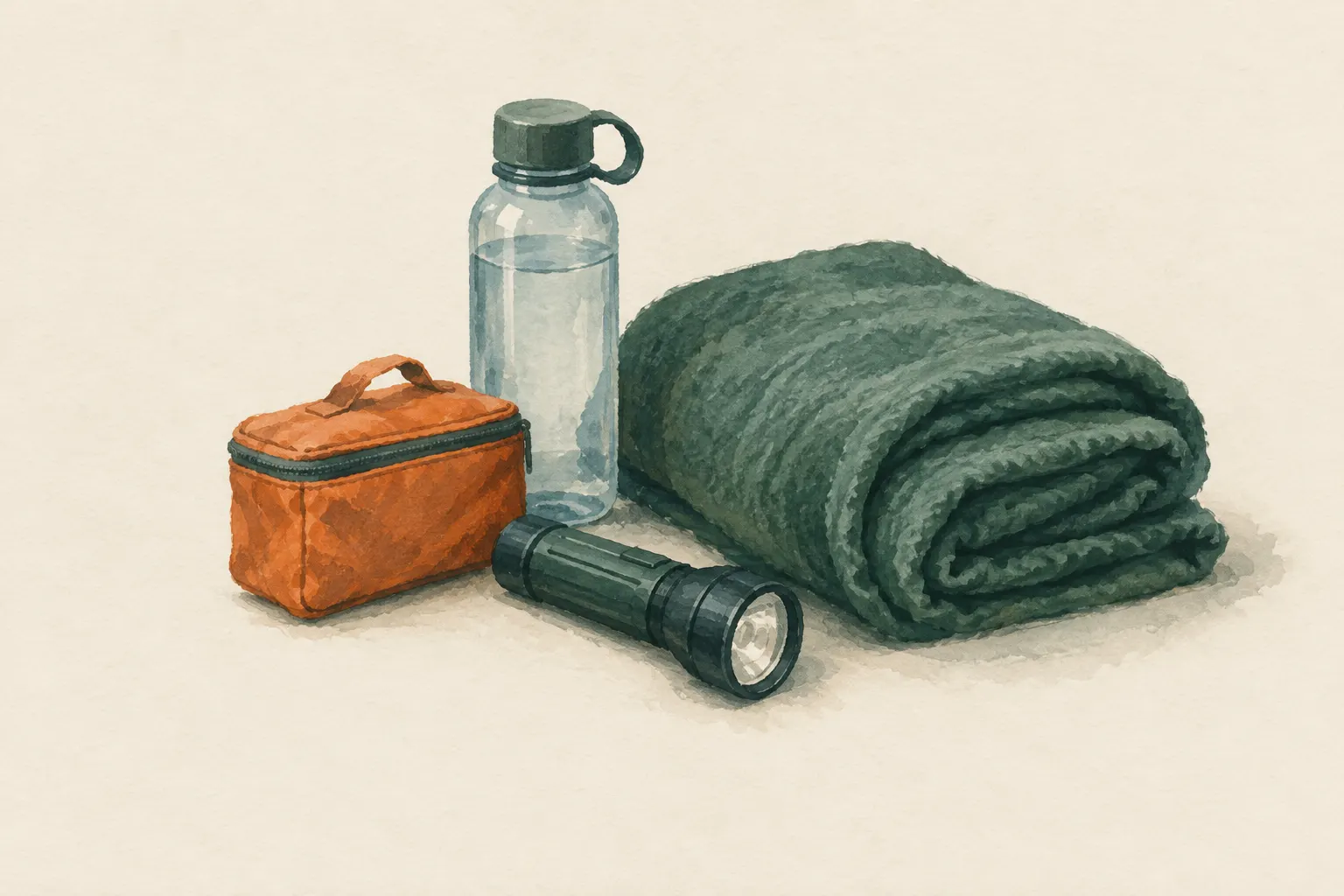
Battery or crank radio
Check batteries regularly and keep spares.
Sturdy closed shoes
For afterwards: glass and debris
Headlamp / flashlight
Wool blanket / duvet
As cover against flying debris
Keep away from candles, stoves and heaters.
Suitable for
- Regions with tornado risk
- Severe thunderstorm situations with a tornado warning
- Family and workplace planning
Not suitable for
- Replacing local shelter plans and official instructions
Prerequisites
- Able to receive warnings (radio, warning app, siren)
- A shelter location chosen beforehand at home, school and work
Safety
- Do not open windows to 'equalise pressure' – it wastes time and does not protect.
How it works
Most tornado injuries are caused by flying debris and collapsing building parts. Every additional wall between you and the outside stops debris; low, small interior rooms (basement, hallway, bathroom, storage room) are therefore safest. Head and neck are the most vulnerable and get extra protection.
Advantages
- Clear rule that can be applied quickly
- Protects against the most common cause of injury: debris
Disadvantages
- Very short warning time possible
- No interior room is completely safe in the strongest tornadoes
Deep knowledge
Background
Ready.gov recommends designated shelters, basements or small windowless interior rooms on the lowest floor as shelter locations, stresses protecting head and neck and advises against overpasses.
Tornadoes also occur in Europe, usually weaker and less often than in parts of North America. The basic rules apply everywhere; warning channels and terms differ by country.
Variants
- Tall buildings
- In multi-storey buildings without a basement go to an interior hallway or stairwell as low as possible; do not use lifts.
- Public buildings
- In halls with wide roof spans (gyms, shopping centres) move to smaller interior rooms such as toilets or corridors and follow staff instructions.
Common mistakes
- Going to look or film first
- Sheltering under a bridge
- Staying in a caravan
- Opening windows
- No shelter spot chosen beforehand
Limits and risks
- No guidance on building shelters
- Local shelter plans take precedence
Material alternatives
Derived from material properties: a substitute must have all relevant properties. Observe the notes on the substitute.
- Headlamp / flashlight
- Mobile phone (The battery drains quickly in cold and with continuous screen and GPS use.), Battery lantern / LED light
- Wool blanket / duvet
- Sleeping pad, Dry leaves, grass or conifer boughs (Collect only where allowed; no protected plants. Check for ticks and insects.), Backpack, Dry spare clothing (Carry it in waterproof packaging – wet clothing barely insulates.), Insulated cool box (Keeps cold only for a limited time; without ice packs or ice it is not a fridge.), Sleeping bag (Do not store compressed long-term; do not pack away damp.), Newspaper and cardboard (Flammable – keep away from candles, stoves, heaters and embers.), Insulated cooking box (hay box, thermal cooker) (Never put open flame or embers inside – only the hot, closed pot.)
Results come exclusively from structured entries. No improvised instructions are generated.
Sources
Ready.gov – U.S. Federal Emergency Management Agency (FEMA): Tornadoes
Shelter locations, head and neck protection, behaviour in vehicles, no overpasses
U.S. Federal Emergency Management Agency (FEMA): Are You Ready? An In-Depth Guide to Citizen Preparedness
Tornado preparedness in general