Understanding warning signals and sirens and responding correctly
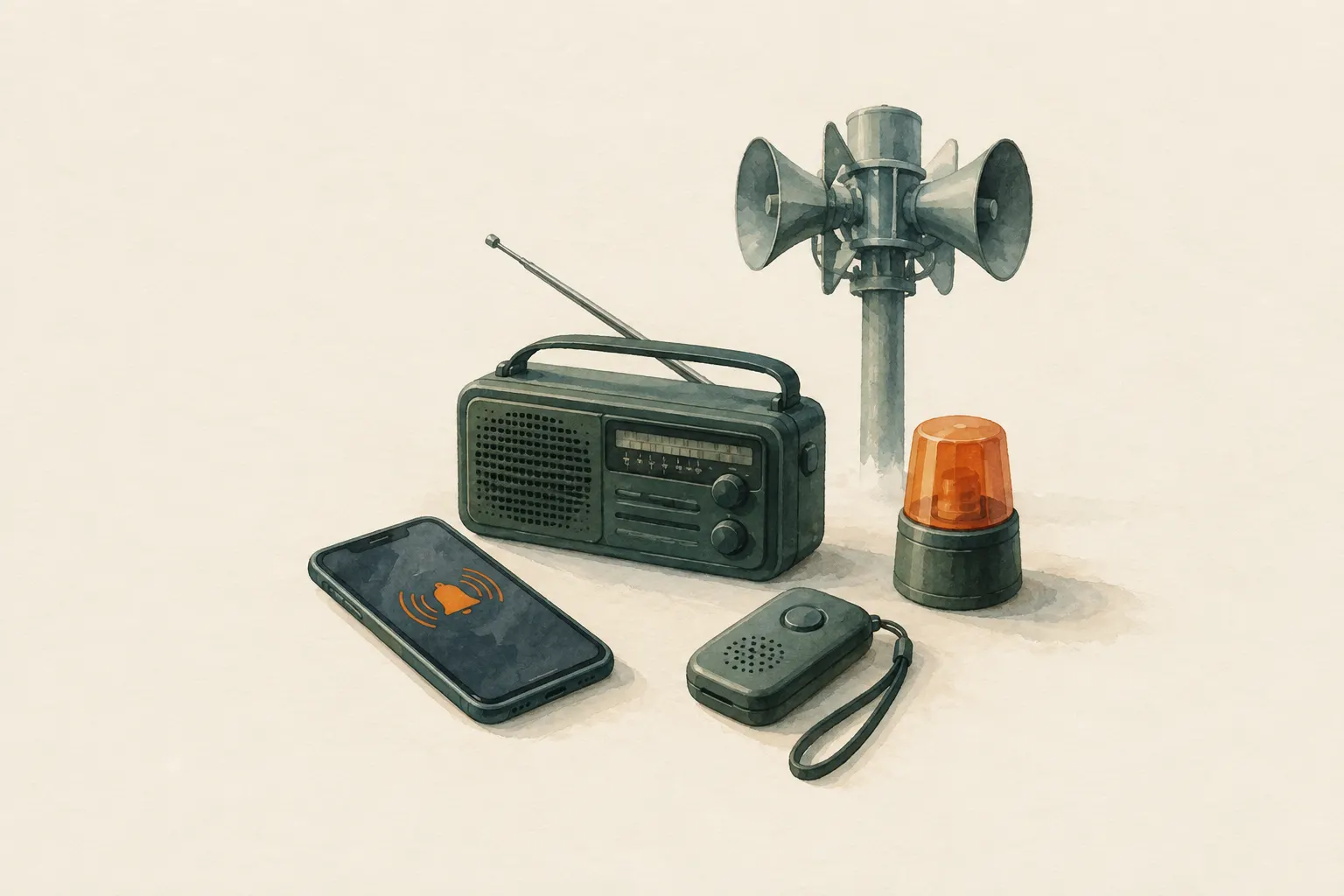
Sirens, warning apps, cell broadcast, radio and loudspeaker announcements complement each other. A siren usually only says: 'Attention – get informed.' Knowing the local signals means knowing what to do: go inside, close windows, switch on the radio or warning app and follow instructions. Signals and channels differ between countries – check locally.
- 30 minutes once; refresh on test days
Explained simply
A siren is like a loud alarm clock for a whole town. But it does not say what is happening – it only calls out: 'Attention, get informed!' What exactly is going on and what you should do, you then find out from the radio, a warning app on your phone, a message sent straight to your phone, or loudspeaker announcements.
There are so many different channels because none of them reaches everyone. A siren wakes even people who are asleep but says nothing specific. The phone shows you text but needs a network. A battery radio works even when the power is off. Together they are like a net with several strands – if one breaks, the others hold.
The most important point: when a siren sounds, go inside, close windows and doors and switch on the radio or warning app. Then do what the authorities say. Do not call the emergency number just to ask why the siren is sounding – the lines are needed for real emergencies.
How warning systems work
Modern warning systems use several channels at the same time. Sirens are loud and reach people who are asleep or not looking at their phones, but carry no content. Warning apps deliver detailed texts with location, hazard and instructions, but have to be installed. Cell broadcast sends a warning to all phones currently connected to the mobile network in a particular area, without needing an app. Radio and television interrupt their programmes for announcements, and sometimes vehicles with loudspeakers drive through the streets.
The basic idea is a two-step process: an alert gets your attention, and then you look for the information. Only the information tells you whether to stay inside, leave the area or do nothing at all. So a siren alone does not automatically mean danger for you, but it always means: check now.
Every channel has weaknesses. During a power cut, the mobile network can be overloaded or fail; sirens do not exist everywhere; and some people hear poorly or do not use a smartphone. That is why it is wise to have at least two channels – for example a phone plus a battery radio.
Knowing the local signals
Siren signals are not the same everywhere. In Germany, for example, the BBK describes a one-minute rising and falling tone as a warning and a one-minute continuous tone as the all-clear. Other countries use different tones, durations or meanings, and signals can change. So look up with your municipality or civil protection what applies where you live.
If you have just moved or are travelling, it is worth sorting this out right at the start. At your holiday destination, ask your accommodation how warnings are given – sirens, apps, loudspeakers or hotel staff – and where to go in case of a tsunami, storm-surge or wildfire warning.
This entry deliberately contains no complete list of national signals. Local information is always the most reliable.
Responding correctly
When you hear a warning, go into a building, bring children and pets inside and close windows and doors. Then switch on the radio or warning app and follow the instructions. For some hazards, such as a fire with smoke or a chemical accident, the authorities will also say to switch off ventilation. For others, such as a flood, the instruction may be to leave the area.
A common mistake is ignoring a siren because you 'can't see anything' outside. Many hazards are invisible or far away – toxic gases, smoke that arrives later or a flood wave upstream, for example. It is just as wrong to call the emergency number to ask about the reason. The emergency number is for people in acute need – you get information from the radio, warning apps and official websites.
When the danger has passed, an all-clear is given. Until then, stick to what the authorities have said.
Setting up channels and including others
Preparation takes only a few minutes: keep cell broadcast enabled on your phone, install your country's official warning app, keep a battery radio with spare batteries and note the frequency of the regional broadcaster. A crank or solar radio is a good addition but not a must.
People who cannot hear sirens or cannot use apps need a second channel – neighbours, relatives or special warning services, for example for deaf people. When you receive a warning, inform older neighbours and people without a smartphone. Pass on only official content, no rumours and no unverified messages from social media.
Businesses, schools and clubs also benefit from clear procedures: who follows the warnings, who informs whom, and where is the assembly point?
How to practise: using test days
Many countries run regular test alerts, in Germany for example a nationwide warning day. This is a good opportunity to check whether the warning really reaches you: can you hear the siren in your home? Does your phone ring? Does the app show an alert?
Also use the day to briefly discuss in the household what you will do in a real warning: who closes the windows, where is the radio, who calls grandma? Children understand sirens better if someone has explained beforehand that the sound means 'attention, check' and is no reason to panic.
Step by step
Learn the local signals
Look up with your municipality or civil protection which siren signals exist and what they mean. In Germany, for example, the BBK describes a one-minute rising and falling tone as a warning and a one-minute continuous tone as the all-clear – other countries use other signals.
- 1
Learn the local signals
Look up with your municipality or civil protection which siren signals exist and what they mean. In Germany, for example, the BBK describes a one-minute rising and falling tone as a warning and a one-minute continuous tone as the all-clear – other countries use other signals.
- 2
Set up channels
Keep cell broadcast enabled on the phone, install the official warning app, keep a battery radio with spare batteries, note the regional broadcaster's frequency.
- 3
React to a warning
Go into a building, close windows and doors, switch on the radio or warning app and follow instructions. Bring children and pets inside.
- 4
Pass it on
Inform neighbours, older people and those without a smartphone – no rumours, only official content.
- 5
Use test days
Use test alerts to check whether siren, app and phone actually reach you and to discuss what to do in the household.
Common mistakes
- Ignoring the siren because you 'can't see anything'
- Calling the emergency number to ask about the reason
- Relying only on the smartphone
- Forwarding unverified messages
Quick view
Materials
Battery or crank radio
Check batteries regularly and keep spares.
Mobile phone
The battery drains quickly in cold and with continuous screen and GPS use.
Do not plan on it as your only means of navigation or emergency calls.
Battery or crank radio
Store spare batteries and check them regularly.
Suitable for
- All households
- People who have just moved
- Travel and holidays
- Schools, businesses, clubs
Not suitable for
- Replacing official instructions during an event
Prerequisites
- Information from the municipality or civil protection on local signals
Safety
- Do not call the emergency number just to ask why a siren is sounding – it blocks lines for real emergencies. Get information via radio, warning app and official websites.
- People who cannot hear sirens or cannot use apps need a second channel – neighbours, relatives or special warning services.
How it works
Warning systems use several channels because no single channel reaches everyone: sirens wake even sleepers but carry no content; apps and cell broadcast deliver text but need a working network; radio works on batteries during a power cut. The alert should always lead to seeking information – only the information says whether to stay inside, leave or do nothing.
Advantages
- A few minutes of preparation
- More time to act in an emergency
- Helps others too
Disadvantages
- Signals are not uniform everywhere
- Sirens do not exist everywhere
Deep knowledge
Background
In its emergency preparedness guide, the BBK describes warning the population via sirens, radio and warning apps. For the USA, Ready.gov and FEMA explain the emergency alert system including Wireless Emergency Alerts.
Many countries run regular test alerts; they are a good opportunity to check whether warnings reach you.
Variants
- When travelling
- At your destination, ask how warnings are given (sirens, apps, loudspeakers, hotel staff) and where to go for tsunami, storm-surge or wildfire warnings.
- Businesses and clubs
- Set up internal alert chains: who follows warnings, who informs whom, where is the assembly point?
Common mistakes
- Ignoring the siren because you 'can't see anything'
- Calling the emergency number to ask about the reason
- Relying only on the smartphone
- Forwarding unverified messages
Limits and risks
- No complete list of national signals
- Signals can change – check locally
Material alternatives
Derived from material properties: a substitute must have all relevant properties. Observe the notes on the substitute.
- Mobile phone
- Headlamp / flashlight, Battery lantern / LED light
Results come exclusively from structured entries. No improvised instructions are generated.
Sources
Bundesamt für Bevölkerungsschutz und Katastrophenhilfe (BBK), Deutschland: Ratgeber für Notfallvorsorge und richtiges Handeln in Notsituationen
Public warning, siren signals, behaviour when warned
Ready.gov – U.S. Federal Emergency Management Agency (FEMA): Emergency Alerts
Emergency alert systems and channels
U.S. Federal Emergency Management Agency (FEMA): Wireless Emergency Alerts (Integrated Public Alert & Warning System, IPAWS)
Alerts to mobile phones