Radiological emergency: get inside, stay inside, stay tuned
In an accident involving radioactive material, a solid building offers the best protection: get inside immediately, close windows and doors, switch off ventilation, go to the middle of the building or the basement and follow official information. Take iodine tablets only when the authorities tell you to – they protect only the thyroid and only against radioactive iodine.
- Immediate steps 5–10 minutes; stay indoors as instructed
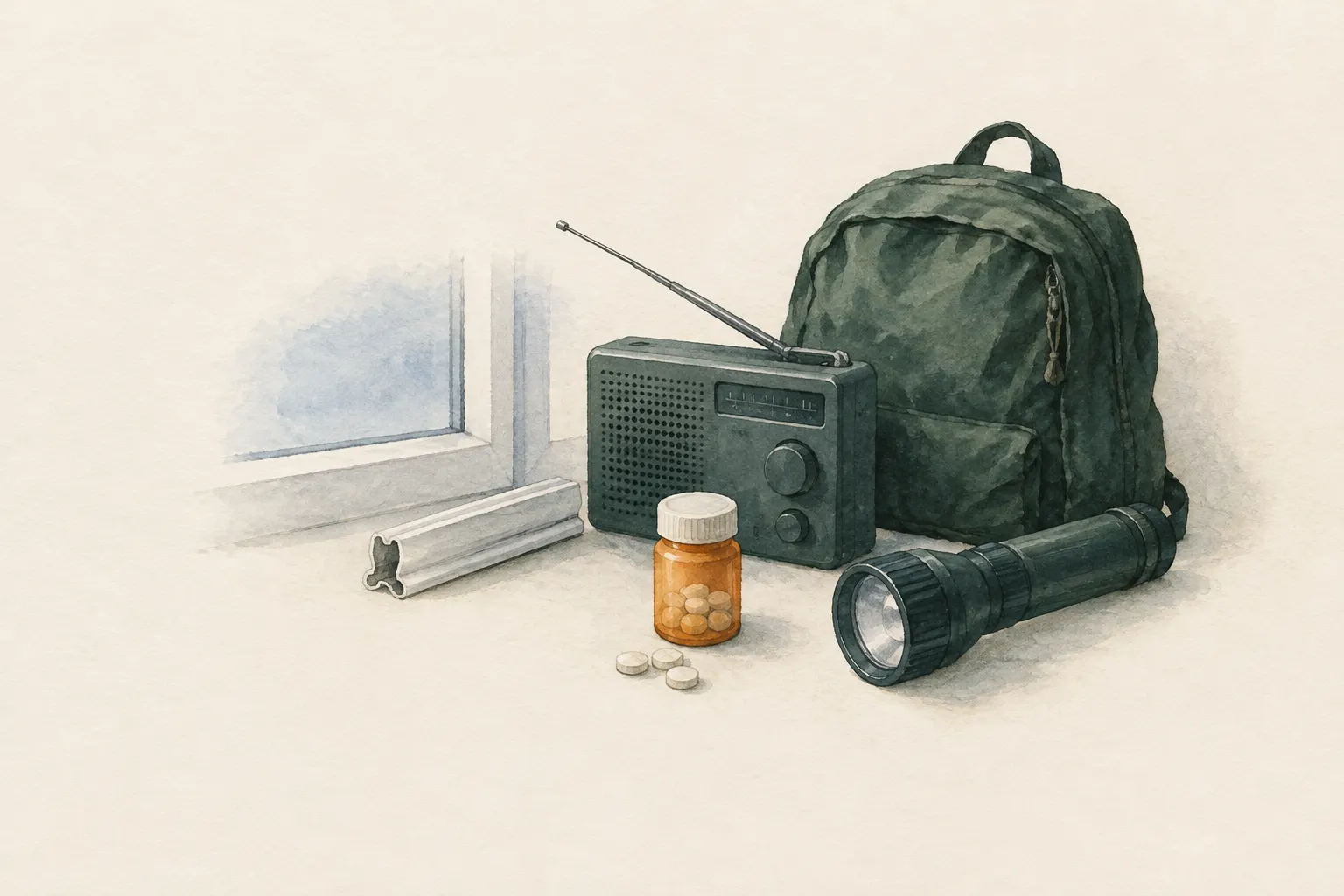
Explained simply
Radioactive substances give off invisible radiation that you cannot see, smell or taste. In an accident, for example at a power plant or during transport, tiny radioactive dust particles can be carried by the wind and settle on the ground, on cars and on clothing.
The best shield is a solid building. Walls, ceilings and the roof block part of the radiation, much as a thick wall muffles noise. Closed windows keep the dust out. That is why the rule is: get inside, stay inside, stay tuned. Ideally go to a room in the middle of the building or to the basement and listen to the radio or check the warning app.
The most important point: do what the authorities say. Take iodine tablets only when the authorities tell you to – not as a precaution and not on your own initiative. And if they say 'stay inside', do not set off, not even to pick someone up.
How protection from radiation works
Radiation protection has three simple basic ideas: time, distance and shielding. The shorter you are exposed to a radiation source, the further you are from it and the more material lies between you and the source, the lower the exposure. A solid building mainly uses shielding and distance: walls, ceilings and earth block part of the radiation, and in the middle of a house or in the basement you are further from the outer surfaces where radioactive dust can settle.
The second protection is keeping particles out. Radioactive substances can be carried through the air as fine dust. Closed windows and doors and switched-off ventilation and air-conditioning systems stop this dust from being drawn into the building.
Third, radiation from short-lived radioactive substances decreases over time by itself. That is why in many cases it is safest to stay inside at first, until the authorities have assessed the situation based on measurements, rather than going straight outside and onto the roads.
What matters in the first minutes
Go into the nearest solid building at once. If your home is far away, do not drive there first – in a car you are less protected than in a building. Bring pets in if that causes no delay.
If you were outdoors, take off your outer clothing and shoes at the entrance. That way a large part of any dust that may have settled on you stays outside. Put the items in a bag, seal it and place it away from the living areas. Then wash your hands, face and hair or take a shower.
Next, close windows and doors, switch off ventilation, air-conditioning and the cooker hood and go to a room in the middle of the building or the basement, away from outside walls and the roof. There, switch on the radio or warning app and stay until the authorities say otherwise.
Iodine tablets: what they can and cannot do
There are many misunderstandings about iodine tablets. They contain potassium iodide and protect only a single organ, the thyroid, and only against a single substance, radioactive iodine. They do not help against other radioactive substances or against radiation from outside. So they are not a general 'radiation protection pill'.
Take iodine tablets only when the authorities explicitly tell you to – not as a precaution and not on your own initiative. The authorities decide on the basis of measurements whether this makes sense and for which area, and then also say who should take them and how. The tablets can have side effects. This entry therefore deliberately gives no dosage information.
A common mistake is to swallow tablets at the first rumour. That gives no better protection but can cause harm.
Safety: mistakes that put people at risk
When the authorities tell people to stay inside, there is a strong urge to fetch children from school or nursery. But schools and nurseries have their own protection plans, and children in a solid building there are usually safer than on the way home. At the same time, lots of cars block the roads that must stay clear for responders or a later evacuation.
If, on the other hand, the authorities order an evacuation, follow the designated route and the instructions on assembly points immediately. Staying in and leaving are not opposites but two tools the authorities use depending on the situation.
Follow only official sources such as radio, warning apps and the authorities' websites. Rumours on social media can lead to dangerous behaviour, such as panicked drives. For health complaints, follow the authorities' guidance on where to go; in an emergency, call the local emergency number (112 in the EU).
Several days indoors: supplies and composure
You may need to stay indoors for some time. That is when a stock of food and drinking water in closed containers pays off. Eat and drink from closed packages. Wait for official guidance before eating fruit and vegetables from the garden.
Uncertainty and fear are high in such a situation, and that is normal. Fixed routines, conversations in the family and limited but regular news from official sources help you stay calm. Which protective measures apply to which area is decided by the responsible authorities based on measurements. This entry does not replace medical advice and does not describe radiation measurement techniques.
Step by step
Get inside
Go into the nearest solid building at once; do not drive home first if it is far. Bring pets in if that causes no delay.
- 1
Get inside
Go into the nearest solid building at once; do not drive home first if it is far. Bring pets in if that causes no delay.
- 2
Remove outer clothing
If you were outdoors: take off outer clothing and shoes at the entrance, put them in a bag and seal it, wash hands, face and hair or shower.
- 3
Seal the building
Close windows and doors, switch off ventilation and air-conditioning systems and cooker hoods.
- 4
Go to the middle or down
Go to a room in the middle of the building or the basement, away from outside walls and the roof.
- 5
Stay tuned
Follow radio, warning app and official channels. Use food and water from closed packages; wait for guidance on food from the garden.
- 6
Follow instructions
Stay inside until the authorities say otherwise. If evacuating, follow the designated route and instructions on assembly points.
Common mistakes
- Taking iodine tablets as a precaution
- Picking children up from school although the authorities say to stay put
- Opening windows to air the room
- Following rumours on social media
- Leaving worn clothing in the living area
Quick view
Materials
Battery or crank radio
Check batteries regularly and keep spares.
Battery or crank radio
Store spare batteries and check them regularly.
Non-perishable food
Prefer food that can be eaten without cooking; consider allergies and dietary needs; do not forget a can opener.
Food-grade water container
Drinking-water reserve in closed containers
Only use containers that never held chemicals or fuel.
Heavy-duty bin bag (large)
For worn outer clothing
Suffocation risk: never pull plastic bags over the head or face and keep them away from small children.
Not breathable – sweating and condensation.
Suitable for
- Accidents at nuclear facilities
- Transport and industrial accidents with radioactive material
- Official instruction to stay indoors
Not suitable for
- Medical treatment of radiation injury
- Taking medication on your own initiative without instruction
Prerequisites
- Able to receive warnings
- Supplies for a few days at home
Safety
- Follow only official sources (radio, warning app, authorities). Rumours on social media can lead to dangerous behaviour.
- For health complaints follow official guidance on where to go; in an emergency call the local emergency number (112 in the EU).
How it works
Radioactive particles can be carried by the air and settle. Walls, roof and distance from outside walls shield part of the radiation; closed windows and switched-off ventilation keep particles out. Radiation from short-lived substances decreases over time – which is why staying inside at first, until the authorities have assessed the situation, is often safest.
Advantages
- Simple and can be done immediately
- Clearly reduces exposure
- Possible without special equipment
Disadvantages
- Several days indoors possible – supplies needed
- Uncertainty and fear are high
Deep knowledge
Background
Ready.gov summarises behaviour in radiation emergencies as 'Get Inside, Stay Inside, Stay Tuned' and stresses taking potassium iodide only on official instruction. The BBK likewise recommends seeking buildings in such situations and following official information.
Which protective measures (staying indoors, iodine tablets, evacuation) apply to which area is decided by the responsible authorities based on measurements.
Variants
- Children at school or nursery
- Schools and nurseries have their own protection plans. If the authorities tell people to stay inside, children are usually safer there than on the way home.
Common mistakes
- Taking iodine tablets as a precaution
- Picking children up from school although the authorities say to stay put
- Opening windows to air the room
- Following rumours on social media
- Leaving worn clothing in the living area
Limits and risks
- No dosage information
- No radiation measurement techniques
- No medical advice
Material alternatives
Derived from material properties: a substitute must have all relevant properties. Observe the notes on the substitute.
- Food-grade water container
- Single-wall stainless steel bottle (Heat only single-wall bottles without paint/plastic; remove the lid before heating.), Double-wall insulated bottle (Never heat directly.), PET bottle (clear, max. 2 litres) (Do not heat or place in a fire.), Airtight food-grade storage container (Fill only when clean and completely dry; never use containers that previously held chemicals.), Collapsible water container or bag (Protect from sharp objects.), Food-grade water bag (Use only for drinking water, never for chemicals or fuel.), Fermentation jar or crock (Use only food-grade containers of glass, food-safe glazed stoneware or food-grade plastic – no metal containers for acidic food.), Resealable food bags (Use only bags intended for food; do not use with boiling water unless the manufacturer explicitly allows it.)
- Heavy-duty bin bag (large)
- Tarp, Plastic sheet / large bin bag (Tears easily; never pull over the head (suffocation risk).), Emergency blanket (Tears easily once punctured; short-term shelter only.), Document folder (waterproof) (Store securely – contains sensitive personal data.), Rain poncho (When used as a shelter, it no longer protects your body from rain.), Bivy bag (Never fully close off the face.), Tent (Do not cook or heat inside the tent (fire and carbon monoxide danger).), Group shelter bag (Airtight – ventilate regularly.)
Results come exclusively from structured entries. No improvised instructions are generated.
Sources
Ready.gov – U.S. Federal Emergency Management Agency (FEMA): Radiation Emergencies
Get inside, stay inside, stay tuned; potassium iodide only on instruction; removing clothing
Bundesamt für Bevölkerungsschutz und Katastrophenhilfe (BBK), Deutschland: Ratgeber für Notfallvorsorge und richtiges Handeln in Notsituationen
Seek buildings and follow official information