Fire bans, danger ratings and fire etiquette
Whether a fire is allowed depends on location, ownership, season and current wildfire danger – and rules differ greatly between countries and regions. This overview shows where to get information (authorities, forestry services, danger indices, signs), what kinds of restrictions typically exist, and which etiquette applies everywhere: use existing fire sites, stay small, only permitted wood, never unattended, extinguish completely, leave nothing behind.
- A few minutes of research before every trip
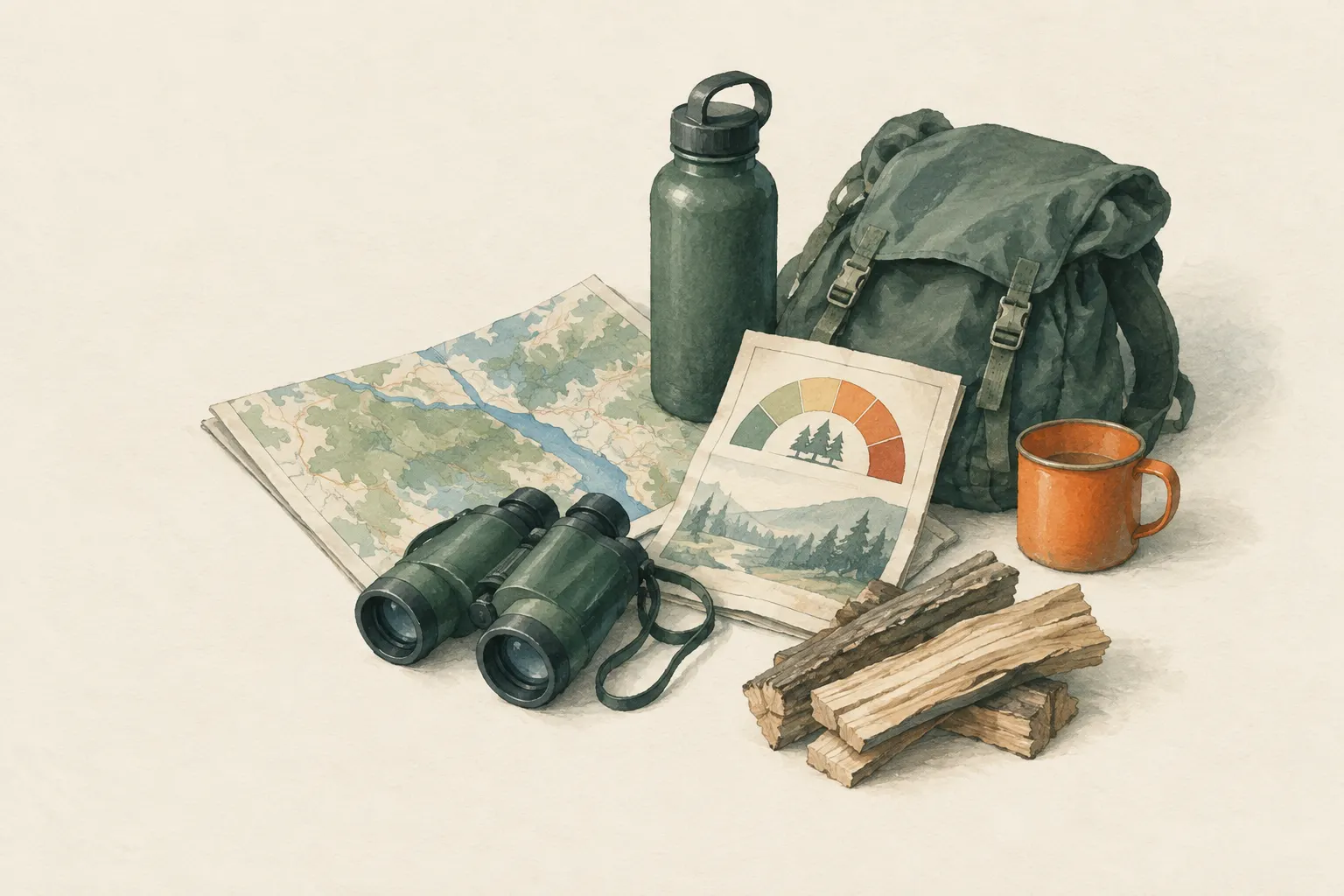
Explained simply
Whether you are allowed to make a fire somewhere is not the same everywhere. It depends on where you are, who owns the land, what season it is and how dry it currently is. When it has not rained for a long time, a single spark can start a wildfire. Then authorities often ban fires completely.
That is why you get informed before every trip: from signs, the municipality, the forestry service or the campsite. In many countries there is also a daily wildfire danger assessment, similar to a weather forecast. A fire ban always applies – even to a “really small” fire.
And where fire is allowed, there are good manners: use existing fire sites, keep the fire small, never leave it alone, put it out completely and leave nothing behind. That way nature stays beautiful, and everyone else can keep making fires there too.
How wildfire danger arises
Whether a spark becomes a fire depends mainly on how dry the grass, leaves, needles and thin twigs on the ground are. Drought, high temperatures, low humidity and wind dry this material out and let a fire grow faster. The danger can also be high in spring, when old, dry grass from the previous year is still lying around and fresh green growth is missing.
Weather services and forestry authorities summarise these factors in danger levels or indices, often updated daily. In Germany, for example, the German Weather Service (DWD) publishes a wildfire danger index. From such assessments, the responsible bodies derive restrictions, which can vary greatly from region to region.
Types of restrictions
Several forms are typical: fires only at designated fire sites; fires only with a permit or the landowner's consent; seasonal bans in dry months; and total bans, which may also include barbecues or certain stoves. Which rule applies you can only find out locally and currently.
A fire ban applies without exception – including small fires, practice fires, barbecues, cigarettes and open-flame stoves unless these are explicitly permitted. Anyone who makes a fire anyway and causes a wildfire must expect substantial penalties and liability for the damage.
The atlas deliberately does not state specific laws, distances or fines, because they differ by country, region, municipality and season and can change. This overview does not replace information from the responsible authority or legal advice.
How to get informed
Allow a few minutes before every trip. Ask the responsible authority, the forestry service, the management of a protected area or the campsite. Look up the current danger index. On site, signs and notices also apply – they can be stricter than what you read at home.
Make sure your information is current. A page from last summer or a tip from a forum does not help if a ban is in force today. If you are unsure, do not make a fire – a stove, where it is permitted, or cold food are then the simple solution.
Fire etiquette: what applies everywhere
Where fire is permitted, use existing fire sites instead of creating new ones. Every new fire site leaves a burn scar, and many small fire sites next to each other spoil a place. Keep the fire small – a small fire is enough for cooking and warmth and is easier to control.
Collect only dead and down wood where this is permitted, and do not break green branches off trees. In many places it is recommended to buy firewood locally rather than bringing it from far away, because pests can travel in the wood. Do not burn food scraps or packaging, and take all your rubbish back with you.
Never leave a fire unattended and extinguish it completely: water, stir, more water, feel. If a fire gets out of control, do not fight it alone: get yourself and others to safety and immediately call the local emergency number (112 in the EU).
Good to know
The Leave No Trace principles describe how to keep the impact of campfires as low as possible. Among other things, they recommend using a lightweight stove for cooking and making fires only where they are permitted and appropriate.
Good fire etiquette protects not only nature but also the relationship with landowners and residents. Handling fire responsibly helps keep fire sites open for others too.
Step by step
Get informed
Before the trip, check with the responsible authority, forestry service, protected-area management or campsite and look up the current danger index (e.g. the DWD wildfire danger index in Germany). Observe signs on site.
- 1
Get informed
Before the trip, check with the responsible authority, forestry service, protected-area management or campsite and look up the current danger index (e.g. the DWD wildfire danger index in Germany). Observe signs on site.
- 2
Know types of restrictions
Typical are: fires only at designated sites, fires only with permission or the landowner's consent, seasonal bans, total bans including barbecues or certain stoves. Ask about the exact local rules.
- 3
Use existing fire sites
Where fire is permitted, use existing fire sites instead of creating new ones.
- 4
Responsible wood
Collect only dead and down wood where this is permitted, do not damage living trees; in many places it is recommended to buy firewood locally rather than bringing it from far away.
- 5
Leave no trace
Keep fires small, never leave them unattended, extinguish completely, do not burn food scraps or packaging, and take all rubbish with you.
Common mistakes
- Assuming ‘small’ fires are not covered by the ban
- Outdated information
- Creating new fire sites next to existing ones
- Breaking green branches off trees
Quick view
Suitable for
- Trip planning
- Camping and barbecues
- Garden fires
Not suitable for
- Legal advice in individual cases
Prerequisites
- Access to current information (internet, notices, local enquiry)
How it works
Wildfire danger depends mainly on dryness, temperature, humidity and wind. Authorities summarise this in danger levels or indices and derive restrictions from them. Fire etiquette additionally reduces traces in nature and conflicts with other people.
Advantages
- Prevents fires and penalties
- Protects nature and relations with landowners
Disadvantages
- Rules are often confusing and vary by region
Deep knowledge
Background
Weather services and forestry authorities in many countries publish daily wildfire danger assessments, in Germany for example the wildfire danger index of the German Weather Service (DWD). Leave No Trace describes general principles for minimising campfire impacts.
The atlas deliberately does not state specific laws or distances because they differ by country, state, municipality and season.
Common mistakes
- Assuming ‘small’ fires are not covered by the ban
- Outdated information
- Creating new fire sites next to existing ones
- Breaking green branches off trees
Limits and risks
- Does not replace information from the responsible authority
Sources
Deutscher Wetterdienst (DWD): Waldbrandgefahrenindex (WBI)
Daily wildfire danger assessment in Germany
Leave No Trace Center for Outdoor Ethics: The Seven Principles of Leave No Trace (Principle 5: Minimize Campfire Impacts)
Minimising campfire impacts; existing fire rings; firewood
USDA Forest Service / Ad Council / National Association of State Foresters: Campfire Safety (Smokey Bear wildfire prevention campaign)
Checking fire restrictions and running campfires safely