Mound fire and fire pan: fire without burn scars
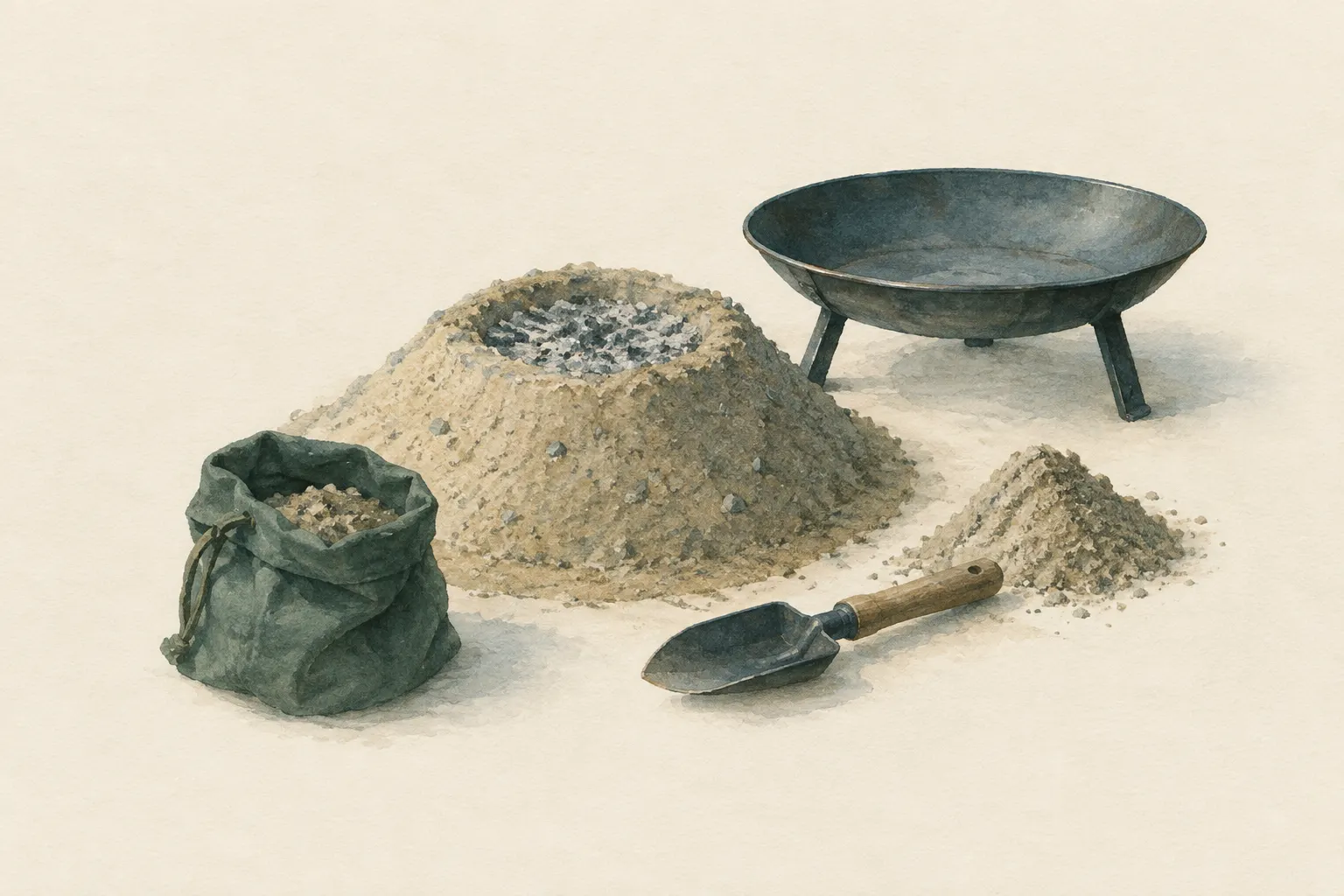
Where fire is allowed but no fire site exists, burn scars can be avoided: in a mound fire the fire burns on a thick layer of sand or mineral soil heaped onto a base; with a fire pan it burns on a raised metal pan. Afterwards the cold ash is scattered and the soil returned – the ground stays undamaged.
- About a quarter of an hour to build and dismantle
Explained simply
If you make a fire directly on a meadow or the forest floor, a black, dead patch is often left behind where nothing grows for a long time. You can avoid that: you build the fire a kind of tray on which it burns without touching the ground beneath.
In a mound fire, this tray is a flat heap of sand or mineral soil – that is soil without roots and without the dark humus layer, so soil that cannot burn itself. With a fire pan, it is a metal pan standing on stones. Afterwards you scatter the cold ash and take the sand back to where it came from. The ground stays intact.
Important: this is only allowed where fire is explicitly allowed. And on boggy, soft ground, embers can creep unnoticed into the soil and smoulder there for days.
How it works
The top layer of forest soil often consists of humus, roots, needles and leaves – all organic material that can burn or smoulder itself. A fire on it burns not only the wood but also the soil, kills plant roots and soil life and leaves a burn scar. Mineral soil and sand, by contrast, consist of rock and do not burn.
A layer of sand or mineral soil several fingers thick acts as insulation: the heat of the fire does not get through to the ground underneath. A base, such as a fireproof mat, under the mound makes dismantling easier because you can remove everything in one go. The fire pan works on the same principle, except that the metal on stones creates the distance from the ground. A layer of sand inside protects the pan as well.
What really matters
The mineral layer must be thick enough and larger than the fire. If it is too thin, the heat gets through anyway. Do not use soil with roots or dark humus – it can smoulder itself. Good mineral soil can be found, for example, in the root hole of a fallen tree or as sand and gravel in a dry stream bed.
Keep the fire small and use thin wood. Thin wood burns completely to fine ash, whereas thick logs leave charred chunks that cannot be scattered inconspicuously. Let the fire burn down in good time so that only ash is left at the end.
Dismantling is part of it: extinguish the ash with water, stir and feel whether everything is cold. Only then scatter the cold ash widely and take the sand or soil back to where it came from. Scattering warm ash risks starting a new fire.
When it makes sense – and when not
Mound fires and fire pans make sense where fire is allowed but no fire site exists – for example on a rock slab that should not be blackened, or in sensitive nature. They are suitable for small cooking and warming fires, not for big campfires.
An existing fire site always remains the first choice, because the ground there has already been affected. In many areas, fires outside designated sites are prohibited anyway – a stove is then the alternative. A mound fire never replaces permission, and during a fire ban there is no mound fire either.
Safety: what to watch out for
The biggest hidden danger is peat, moss and humus-rich soil. There, embers can creep into the ground unnoticed and smoulder underground for days until they break out again somewhere else. If you cannot build a very thick mineral layer, do without a fire.
Like every fire, this one must never be left unattended, not even briefly. Keep extinguishing water within reach and check the local rules and current wildfire danger beforehand. If a fire gets out of control, do not fight it alone: get yourself and others to safety and immediately call the local emergency number (112 in the EU).
Good to know
Mound fires and fire pans are named in the Leave No Trace principles as ways to make fires with as little impact as possible, where fire is permitted and appropriate.
The bottom of a small barbecue, for example, makes a suitable fire pan. Building and dismantling a mound fire takes about a quarter of an hour – little effort for leaving the spot looking as if you had never been there.
Step by step
Lay a base
On an open, safe spot, lay down a fireproof base or set a fire pan on stones.
- 1
Lay a base
On an open, safe spot, lay down a fireproof base or set a fire pan on stones.
- 2
Heap mineral soil
Heap sand or mineral soil into a flat platform several fingers thick and larger than the planned fire. Put a layer into a fire pan as well.
- 3
Small fire
Light a small fire with thin wood and keep it small.
- 4
Let it burn down
Let the wood burn down completely to ash in good time, then extinguish with water, stir and feel.
- 5
Restore
Scatter the cold ash widely and return the sand or soil to where it came from.
Common mistakes
- A mineral layer that is too thin
- Using soil with roots and humus
- Thick logs that do not burn completely
- Scattering ash while still warm
Quick view
Materials
Clean sand
Or mineral soil without roots and humus
Improvised sand layers do not reliably remove pathogens.
Small shovel / folding spade
Water for extinguishing (bucket, canister or pot)
Have several litres ready before lighting.
Suitable for
- Low-impact fires in sensitive nature, where permitted
- Rock slabs that should not be blackened
- Small cooking and warming fires
Not suitable for
- Peat, moss and humus soils without a thick enough mineral layer
- Large fires
- Fire bans
Prerequisites
- Fire is explicitly permitted at the location
- Access to sand, gravel or mineral soil (e.g. a root hole from a fallen tree, a stream bed)
- A fireproof base or fire pan
Safety
- Never leave a fire unattended, not even briefly. Keep extinguishing water within reach.
How it works
Mineral soil and sand do not burn and insulate: the heat does not reach the organic soil layer beneath, sparing plants and soil life. A base makes complete dismantling easier. Small, thin wood burns completely to ash, which can be scattered inconspicuously once cold.
Advantages
- No permanent burn scar
- Protects soil and plants
Disadvantages
- More effort than an existing fire site
- Only for small fires
Deep knowledge
Background
Leave No Trace names mound fires and fire pans as ways to make low-impact fires where fires are permitted and appropriate. Existing fire rings still remain the first choice.
In many areas, fires outside designated sites are prohibited anyway – a stove is then the alternative.
Variants
- Fire pan
- A metal pan (e.g. the bottom of a barbecue) on stones keeps the fire off the ground; a layer of sand in it protects the pan and extends its life.
Common mistakes
- A mineral layer that is too thin
- Using soil with roots and humus
- Thick logs that do not burn completely
- Scattering ash while still warm
Limits and risks
- Does not replace permission
- Not on peat without a very thick mineral layer
Sources
Leave No Trace Center for Outdoor Ethics: The Seven Principles of Leave No Trace (Principle 5: Minimize Campfire Impacts)
Mound fires and fire pans as low-impact fires; scattering ashes
USDA Forest Service / Ad Council / National Association of State Foresters: Campfire Safety (Smokey Bear wildfire prevention campaign)
Complete extinguishing and observing fire restrictions