Fire with a battery and steel wool
Very fine steel wool starts to glow and burn when it touches both terminals of a battery (typically a 9-volt block) at the same time. The glowing wool ignites a tinder bundle. The method is simple but carries a fire risk in transport: never carry the battery and steel wool loose together in your pack.
- Seconds
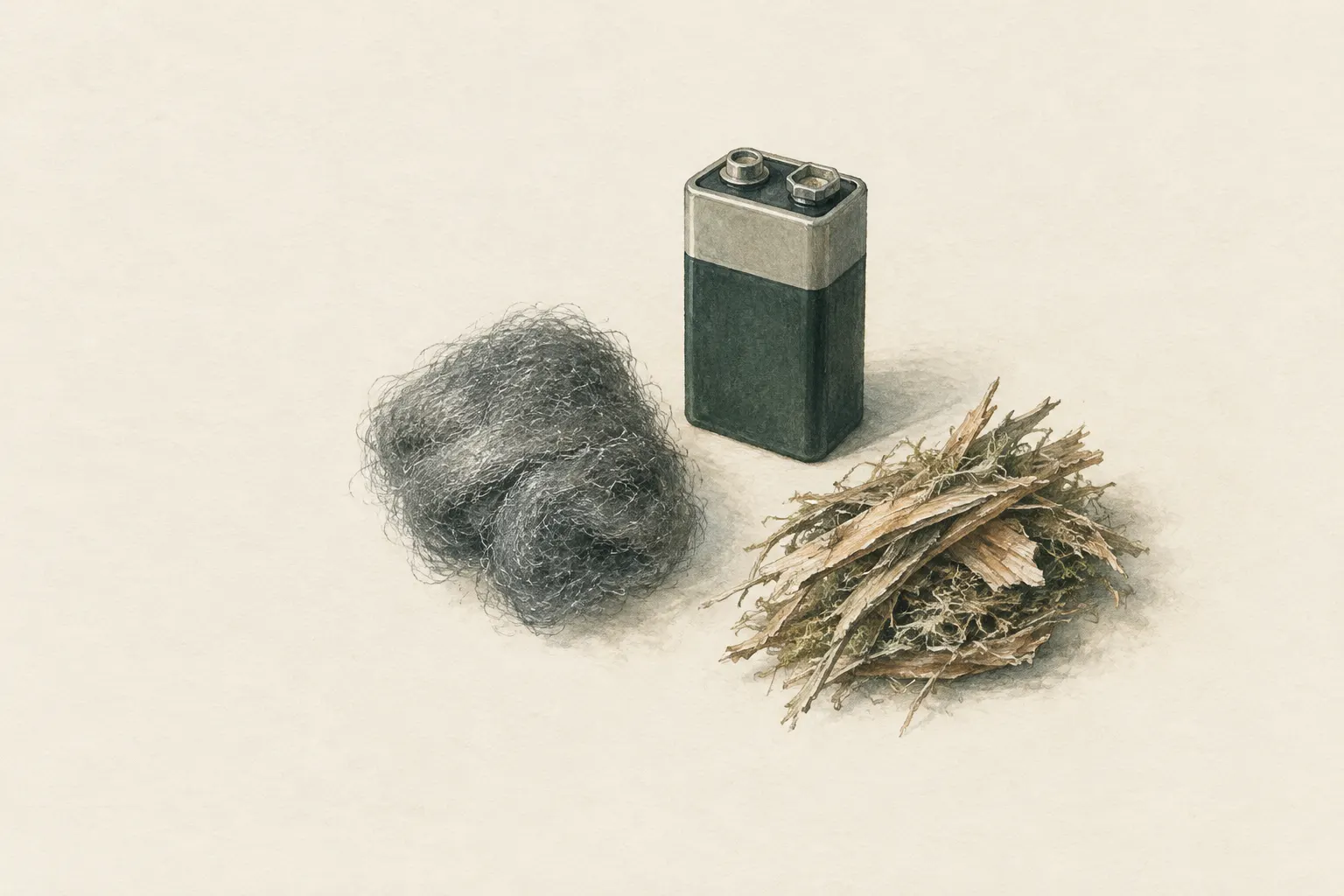
Explained simply
Steel wool looks like a tangle of very fine metal hairs. If you hold a battery against it so that both terminals touch the wool at once, current flows through the thin threads. They are so thin that they instantly get glowing hot – much like the wire in an old light bulb. You place the glowing wool in a tinder bundle and blow it into a flame.
It is very simple and usually works the first time. It is easiest with a 9-volt block, because its two terminals sit right next to each other.
The most important safety point: never carry the battery and steel wool loose together in your pack. If the wool happens to touch both terminals, it can catch fire in the middle of your gear. And phone batteries or power banks are completely off-limits for this.
How it works
Electric current heats every conductor it flows through. With thick cables you hardly notice, but a very thin wire gets hot quickly because the current has to squeeze through a tiny cross-section. Finest steel wool consists of countless such wafer-thin threads. When it touches both terminals, a short circuit forms, and the threads at the contact points glow immediately.
On top of that, iron this fine actually burns in air. A thick nail does not, because it carries heat away too quickly. The fine threads, however, have a great deal of surface for their mass. That is why the glow spreads through the pad even after the battery has been removed.
What really matters
Use the finest steel wool you can get. Coarse wool of the kind used for scouring glows poorly or not at all. Pull a piece apart loosely to make an airy pad – air is important for the glow to continue.
Prepare your tinder bundle completely before you put the battery to the wool. The glow in the wool lasts only briefly. Brush both terminals across the wool, put the glowing pad straight into the nest and blow gently. In a light breeze the wool often glows especially strongly because it gets more oxygen.
The battery must be charged. Batteries lose charge over time, even sitting in a cupboard. If you keep this method in your emergency kit, check the battery regularly and replace it in good time. Steel wool rusts when damp and then works less well; packed dry and airtight, it keeps for a long time.
Safety: what to watch out for
The biggest danger is not making the fire itself but carrying the materials. Pack steel wool and batteries separately in different closed bags. Cover the battery terminals with the protective cap or a piece of tape. That way nothing can cause an accidental short circuit.
Never use lithium-ion cells, phones or power banks. If they are short-circuited, they can overheat, swell, catch fire or even burst. That is far more dangerous than the small fire you actually wanted to make.
Burning steel wool throws sparks and drops glowing crumbs. Work on a non-flammable surface such as soil, stone or sand, and keep clothing, hair and fingers away. If you do get burned, cool the spot at once with cool, not ice-cold, running water; for large or deep burns, call the local emergency number (112 in the EU). Always check the local rules before making a fire.
When it makes sense – and when not
The method is a good addition to an emergency kit at home or in the car because it needs almost no practice. Even people who have never made a fire can get an ember this way. It is also a vivid experiment to show children, under supervision, that electricity produces heat.
It is less suitable as a main method: the battery may be flat, the wool may rust, and you only get an ember, not a finished fire. A lighter or matches remain the first choice. The battery method is a trick for when those are missing.
Step by step
Prepare the tinder bundle
Lay out the tinder bundle and kindling.
- 1
Prepare the tinder bundle
Lay out the tinder bundle and kindling.
- 2
Fluff the steel wool
Pull apart a piece of finest steel wool to make a loose pad.
- 3
Touch the terminals
Brush the battery with both terminals across the wool. The wool glows immediately at the contact points.
Keep fingers away from the glowing wool.
- 4
Into the nest
Place the glowing wool into the tinder bundle at once and blow. Afterwards, stow the battery again with its terminals covered.
Common mistakes
- Using coarse steel wool
- Battery and wool in the same bag
- Tinder bundle not prepared
- Short-circuiting lithium cells
Quick view
Materials
Finest-grade steel wool
Store separately from batteries – fire risk.
Rusts when damp.
Spare batteries
Easiest with a 9-volt block; no lithium-ion cells
Store cool and dry, observe the expiry date; keep button cells out of children's reach.
Tinder
Carry in waterproof packaging.
Do not use liquid accelerants as tinder.
Suitable for
- Emergency kit as an additional method
- Beginners
Not suitable for
- Smartphone batteries, power banks or other lithium cells
- Transport without separate packaging
Prerequisites
- Finest-grade steel wool
- A charged battery
- A prepared tinder bundle
Safety
- Burning steel wool throws sparks and drops glowing particles. Work on non-flammable ground and keep clothing away.
How it works
The thin steel fibres conduct current between the terminals; because their cross-section is tiny, they heat up so much that they glow and burn in air. The large surface area of the finest wool is crucial – coarse steel wool works poorly.
Advantages
- Very simple, even for beginners
- Works well as an ember source in wind
Disadvantages
- Fire risk if stored wrongly
- The battery loses charge
- Steel wool rusts when damp
Deep knowledge
Background
The method works on the same principle as a glowing filament. Military manuals mention batteries as an ignition source; in everyday life the 9-volt block with steel wool is the best-known form.
The battery and steel wool method is a trick for the emergency kit rather than a main method.
Variants
- Round cells
- Several round cells in series and a piece of thin wire can also make steel wool glow. This is more fiddly; the wire gets hot.
Common mistakes
- Using coarse steel wool
- Battery and wool in the same bag
- Tinder bundle not prepared
- Short-circuiting lithium cells
Limits and risks
- The battery must be charged
- Only an ember – a tinder bundle is still needed
Material alternatives
Derived from material properties: a substitute must have all relevant properties. Observe the notes on the substitute.
- Finest-grade steel wool
- Dry firewood (Collect only where permitted.), Tinder (Carry in waterproof packaging.), Char cloth (charred cotton) (Store dry in a tin.), Fatwood (resin-rich wood) (Collect only dead wood where permitted.), Stove fuel (canister, liquid fuel, alcohol) (Store fuels apart from food and in original containers or bottles intended for them.), Petroleum jelly cotton balls (Use only pure cotton.)
- Tinder
- Dry firewood (Collect only where permitted.), Char cloth (charred cotton) (Store dry in a tin.), Finest-grade steel wool (Store separately from batteries – fire risk.), Fatwood (resin-rich wood) (Collect only dead wood where permitted.), Stove fuel (canister, liquid fuel, alcohol) (Store fuels apart from food and in original containers or bottles intended for them.), Petroleum jelly cotton balls (Use only pure cotton.)
Results come exclusively from structured entries. No improvised instructions are generated.
Sources
Headquarters, Department of the Army (USA) (2002): FM 3-05.70 Survival
Battery as an ignition source