Burning lens, magnifier and reflector – fire from sunlight
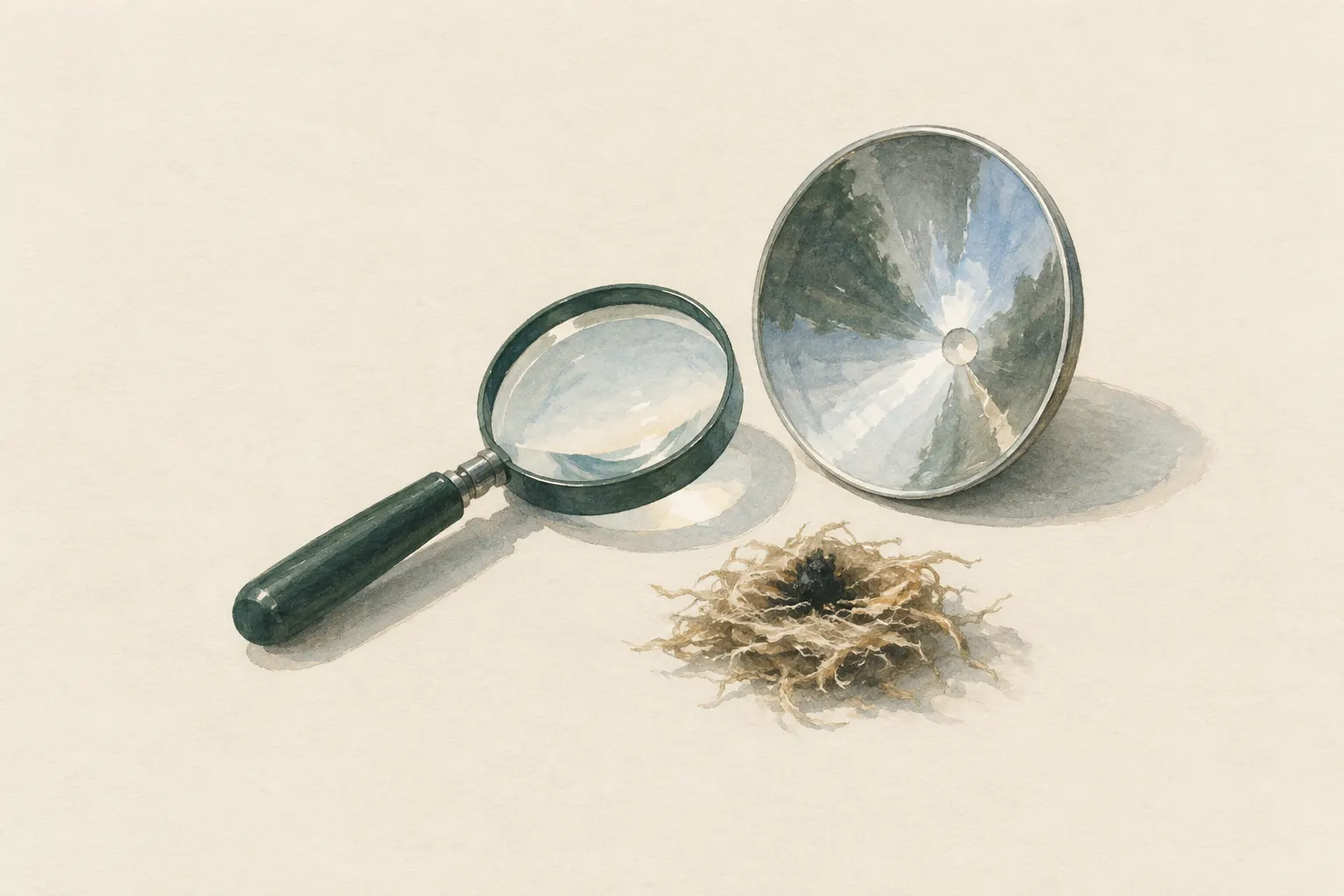
A converging lens (magnifying glass, burning glass, reading glasses for long-sightedness) or a polished concave reflector concentrates sunlight onto a tiny spot that makes dark, very fine tinder smoulder. It needs direct, strong sunshine and a steady hand. It does not work in overcast conditions, at dusk or at night.
- In strong sun usually seconds to a few minutes
Explained simply
You may have seen a magnifying glass make a tiny, very bright spot of light in the sun. The lens gathers sunlight from its whole surface and squeezes it onto one small spot. It gets so hot there that dark, dry material starts to smoke and smoulder.
This only works when the sun is shining strongly and directly. It does not work with clouds or fog, at dusk or at night. That is why a burning glass is a good addition, but never your only way to light a fire.
The most important safety point: never look at the sun through the lens and do not stare at the bright spot. It can permanently damage your eyes.
How it works
A converging lens is thicker in the middle than at the edge. It bends the sun's rays so that they meet at a single point behind the lens – the focal point. All the light energy falling on the lens then lands on a tiny area. The bigger the lens, the more light it collects, and the smaller the spot, the hotter it gets.
Dark material absorbs light and warms up, while light-coloured material reflects it. That is why char cloth, charred material or very fine, dark, dry plant material catches best. A polished concave reflector – such as the reflector of an old torch – works on the same principle, except that it bounces the light back instead of letting it through.
Glasses can work too, but only reading glasses for long-sightedness, whose lenses are thicker in the middle. Glasses for short-sightedness spread the light out and make no focal point.
What really matters
Hold the lens so that it faces the sun directly. Then slowly change the distance to the tinder until the light spot is as small and bright as possible. A large, blurred spot achieves almost nothing. Check the spot only briefly and from the corner of your eye.
Stillness is crucial. If the spot wanders back and forth, no single place can heat up properly. Brace your hands or elbows, for example on your knees or a rock. Shield the wind with your body, but do not cast a shadow on the lens.
The sun has to be strong. Around midday in summer it often works within seconds; with a low winter sun or thin cloud the method is much weaker or does not work at all. Keep your tinder bundle ready so you can pass the ember on straight away.
Safety: what to watch out for
Eyes first: never look at the sun through a lens or in a mirror. The bright focal point itself is also very glaring – a brief glance from the corner of your eye is enough. Sunglasses make looking more comfortable, but they do not make staring at the sun safe.
The focal point burns skin instantly. Never aim it at hands, clothing or other people – not even as a joke. Children should only practise together with an adult.
Lenses, glass bottles and reflective surfaces can also start fires unintentionally when they lie in the sun. So always pack magnifiers and burning glasses away covered. Check the local rules and wildfire danger before every fire, because in sunny, dry weather – exactly when this method works well – the fire risk is often highest.
Gear and materials
A flat Fresnel magnifier suits an emergency kit. It consists of a thin plastic sheet with fine rings that act like a thick lens, weighs almost nothing and fits in a wallet. A classic glass magnifier is sturdier but heavier. Both should be packed so they cannot get scratched, because scratches spoil the focal point.
A round container or bag filled with clear water can act like a weak lens. That is a makeshift solution and much less reliable than a real lens. As tinder, char cloth works best because it smoulders with very little heat.
Good to know
Burning glasses have been known since antiquity. Military survival manuals list the lens as an ignition method but stress that it only works in bright sunshine. Its big advantage: it uses nothing up. As long as the sun shines, you can make fire again and again.
A burning glass usually produces an ember rather than a flame. So you always need a good tinder bundle and thin kindling to turn it into a real fire. And because the weather has to cooperate, a lighter or ferro rod always belongs in your pack as well.
Step by step
Choose dark tinder
Use char cloth, charred material or very fine, dark, dry plant material. Light-coloured material reflects light and heats poorly. Have a tinder bundle ready.
- 1
Choose dark tinder
Use char cloth, charred material or very fine, dark, dry plant material. Light-coloured material reflects light and heats poorly. Have a tinder bundle ready.
- 2
Wind shelter
Block the wind with your body without casting a shadow on the lens.
- 3
Focus
Hold the lens perpendicular to the sun and adjust the distance until the light spot is as small and bright as possible.
- 4
Hold steady
Brace your hands and keep the spot still on one point until smoke rises and an ember forms.
- 5
Blow to flame
Place the ember in the tinder bundle and blow. Afterwards, stow the lens covered immediately.
Common mistakes
- Using light-coloured or damp material
- Focal spot too large and blurred
- Shaking hand, wandering spot
- Trying glasses for short-sightedness (diverging lens)
Quick view
Materials
Burning lens / magnifier
Never leave lying in the sun – fire risk.
Do not look at the sun through the lens.
Char cloth (charred cotton)
Catches the focal point most reliably
Store dry in a tin.
Make only outdoors.
Tinder
Carry in waterproof packaging.
Do not use liquid accelerants as tinder.
Suitable for
- Sunny, dry regions
- Fuel-free ignition by day
- Supplement in an emergency kit
Not suitable for
- Overcast, fog, night
- High latitudes in winter with low sun
- Sole ignition source
Prerequisites
- Direct, strong sunshine
- Dark, dry, fine tinder
- Shelter from wind
Safety
- The focal point burns skin instantly. Never aim it at hands, clothing or other people.
How it works
A convex lens or concave reflector directs the sunlight from a large area onto a small spot. The energy density there is so high that dark material, which absorbs light well, quickly heats up until it smoulders. The larger the lens and the smaller and sharper the focal point, the faster it works.
Advantages
- Consumes nothing – unlimited ignitions in sunshine
- Light and small
- Quiet and simple
Disadvantages
- Only in direct sun
- Needs dark, very fine tinder
- Risk of unintended fire
Deep knowledge
Background
Burning glasses have been known since antiquity. Military survival manuals list the lens as an ignition method but stress that it only works in bright sunshine.
In an emergency kit, a flat Fresnel magnifier is a light addition – as a supplement to a lighter or ferro rod, not a replacement.
Variants
- Concave reflector
- A curved, polished reflector (e.g. from a torch) also concentrates light. Hold the tinder at the focal point in front of the mirror. The focal point is often hard to find; the method tends to be slow.
- Water-filled containers
- A clear, curved, water-filled container can act like a weak lens. This is considerably less reliable than a real lens.
Common mistakes
- Using light-coloured or damp material
- Focal spot too large and blurred
- Shaking hand, wandering spot
- Trying glasses for short-sightedness (diverging lens)
Limits and risks
- Depends on weather and time of day
- Much weaker with low winter sun
Material alternatives
Derived from material properties: a substitute must have all relevant properties. Observe the notes on the substitute.
- Burning lens / magnifier
- Lighter, matches or ferro rod (Observe local fire bans.), Ferro rod (Practise before you need it.), Fire striker and hard stone (Carbon steel, not stainless.), Bow drill set (bow, spindle, hearth board, bearing block) (Use only dry wood.), Fire piston (Maintain the seal.)
- Char cloth (charred cotton)
- Dry firewood (Collect only where permitted.), Tinder (Carry in waterproof packaging.), Finest-grade steel wool (Store separately from batteries – fire risk.), Fatwood (resin-rich wood) (Collect only dead wood where permitted.), Stove fuel (canister, liquid fuel, alcohol) (Store fuels apart from food and in original containers or bottles intended for them.), Petroleum jelly cotton balls (Use only pure cotton.)
- Tinder
- Dry firewood (Collect only where permitted.), Char cloth (charred cotton) (Store dry in a tin.), Finest-grade steel wool (Store separately from batteries – fire risk.), Fatwood (resin-rich wood) (Collect only dead wood where permitted.), Stove fuel (canister, liquid fuel, alcohol) (Store fuels apart from food and in original containers or bottles intended for them.), Petroleum jelly cotton balls (Use only pure cotton.)
Results come exclusively from structured entries. No improvised instructions are generated.
Sources
Headquarters, Department of the Army (USA) (2002): FM 3-05.70 Survival
Convex lens as an ignition method in sunshine