Flint and steel with char cloth
In traditional flint and steel, a hard, sharp stone edge shaves tiny particles off a carbon-steel striker; they glow as sparks. These sparks are much weaker than those of a ferro rod and only catch in very receptive material such as char cloth (charred cotton). The resulting ember is blown to flame in a tinder bundle.
- A matter of practice; with prepared char cloth seconds to minutes
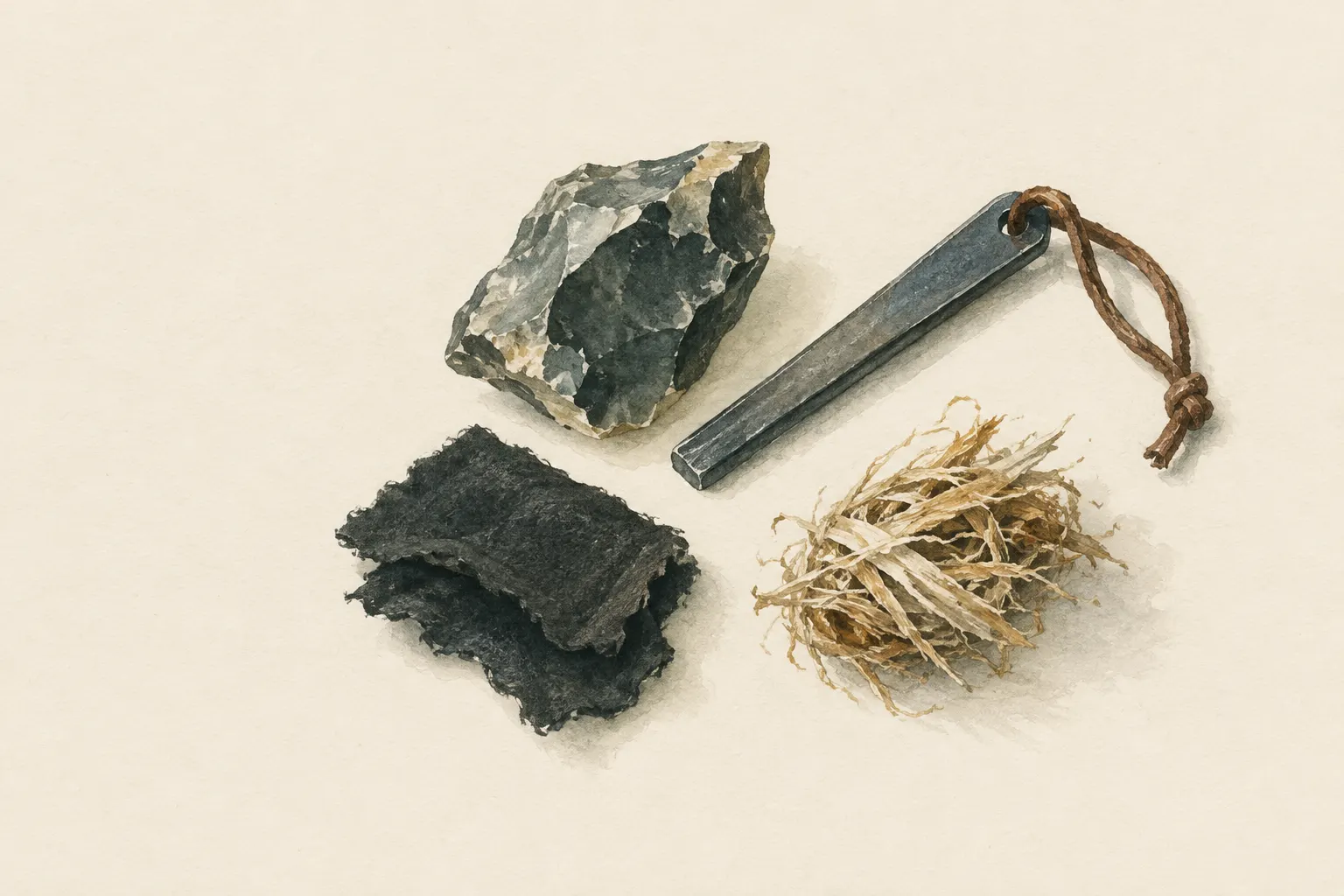
Explained simply
This is how people made fire for many centuries before there were matches: you strike a piece of steel along the sharp edge of a very hard stone. This scrapes off tiny crumbs of steel that get so hot they glow briefly as sparks.
But these sparks are weak – much weaker than those of a modern ferro rod. They do not light grass. They only catch in especially receptive material such as char cloth, which is charred cotton. There a small glowing spot forms. You put it into a nest of dry fibres and blow until a flame appears – just as you blow on the embers of a campfire to make them flare up again.
For safety: sharp stone flakes can fly off when you strike. Keep your fingers behind the edge and never strike towards your face.
How it works
In flint and steel, the stone is harder than the steel. When the sharp stone edge glances across the steel, it scrapes off the finest particles. Because of the heat of friction and because the iron reacts with the air (it oxidises, a bit like rusting but in a flash), these particles glow briefly. So what you see as sparks is glowing steel, not glowing stone.
For this to work, the striker must be made of high-carbon steel. Stainless or soft steel gives few or no usable sparks. The stone needs a fresh, sharp edge; besides flint, other very hard stones such as quartz or chert are suitable. Over time the edge gets blunt; then you turn the stone and use a new edge.
The sparks carry very little energy and die at once. They can only ignite material that starts to smoulder with very little heat. Char cloth is exactly such a material: it catches the spark, keeps glowing and becomes a small, stable ember. Only in the tinder bundle, with air, does this ember become a flame.
What really matters
Prepare everything before you strike: a loose, fist-sized nest of dry, fine fibres and kindling in several sizes. Once the char cloth is glowing, there is no time left to search.
Hold the stone with a sharp edge facing upwards and press a piece of char cloth onto the stone with your thumb, just behind the edge. Strike the steel downwards along the edge in a quick, glancing motion from the wrist. The sparks then fall straight onto the char cloth. It is about a glancing, scraping strike, not brute force.
A spark that catches forms a small, slowly spreading glowing spot. Blow on it gently until it grows. Then put the glowing char cloth into the nest, close it loosely and blow into it with steady breaths until flames appear. Only then does the nest go under the prepared kindling.
When it makes sense – and when not
Flint and steel is a rewarding, instructive skill for historical re-enactment, bushcraft and as extra practice. Steel and stone hardly wear and work again after drying even when they have got wet.
As the only ignition method in an emergency, however, it is unsuitable. Without char cloth or comparable material it hardly ever works, and a wet tinder bundle prevents the flame. Even those who master flint and steel should always carry modern ignition sources such as a lighter, matches or a ferro rod.
Keep the char cloth in a closed tin or a waterproof bag. Damp char cloth no longer catches sparks.
Safety: what to watch out for
Sharp stone flakes can fly off when you strike. Keep your fingers behind the stone edge, never strike towards your face and make sure nobody stands right next to you. Otherwise a slipping steel easily hits your knuckles.
Glowing char cloth and the burning nest are hot. Hold the nest a little away from you while blowing so flames do not leap into your face, and place it promptly in the prepared spot. Cool burns at once with cool, not ice-cold, running water; for large or deep burns, burns to the face or hands, and burns in children, call the local emergency number (112 in the EU).
As with any fire: check the local rules and the wildfire danger beforehand. Fire bans apply to practice fires too.
Good to know
Striking fire with stone and steel was a common way of making fire in Europe for centuries until matches replaced it. The kit was often kept in a tinderbox. Even earlier, people used iron pyrite, which also gives sparks when struck with flint.
“Flint and steel” and the modern ferro rod are often confused. The ferro rod is made of ferrocerium, gives much hotter sparks and can ignite fine natural tinder directly. In traditional flint and steel, by contrast, the ember material is the key. This atlas describes char cloth made from cotton for this because it is the simplest; traditionally used plant or fungus materials are deliberately not identified here.
Step by step
Prepare the tinder bundle
Form a loose, fist-sized nest of dry, fine fibres and lay out kindling. Only then start striking.
- 1
Prepare the tinder bundle
Form a loose, fist-sized nest of dry, fine fibres and lay out kindling. Only then start striking.
- 2
Hold stone and char cloth
Hold the stone with a sharp edge facing upwards. Press a piece of char cloth onto the stone with your thumb, just behind the edge.
- 3
Strike
Strike the steel downwards along the edge in a quick, glancing motion so that sparks fall onto the char cloth. The movement comes from the wrist; do not aim at your fingers.
No stainless steel: the striker must be high-carbon steel.
- 4
Spot the ember
A spark that catches forms a small, spreading glowing spot. Blow on it gently until it grows.
- 5
Place in the nest and blow
Put the glowing char cloth into the nest, close it loosely and blow with steady breaths until it flames. Then place it under the prepared kindling.
Common mistakes
- Using stainless or soft steel
- A blunt, rounded stone edge
- Uncharred or damp cotton instead of char cloth
- A tinder bundle packed too tightly
- Starting without prepared kindling
Quick view
Materials
Fire striker and hard stone
Carbon steel, not stainless.
Sharp stone flakes possible.
Char cloth (charred cotton)
Store dry in a tin.
Make only outdoors.
Tinder
Loose, dry tinder bundle of fine fibres
Carry in waterproof packaging.
Do not use liquid accelerants as tinder.
Waterproof case or bag
Suitable for
- Traditional fire-making and historical re-enactment
- Practice as an additional skill
- Supplement to modern ignition sources
Not suitable for
- Emergencies as the only ignition method
- Wet conditions without dry-packed char cloth
- Beginners
Prerequisites
- Char cloth or similarly receptive ember material
- A prepared tinder bundle
- Practice
Safety
- Striking can throw off sharp stone flakes. Keep your fingers behind the stone edge and do not strike towards your face.
- Cool burns immediately with cool, not ice-cold, running water. For large or deep burns, burns to the face or hands and burns in children, call the local emergency number (112 in the EU).
How it works
On impact, the hard stone scrapes fine particles off the steel. Friction heat and oxidation in air make them glow briefly. These sparks carry little energy and die quickly; they therefore do not light grass or wood directly but only material that starts to smoulder with very little heat. The ember becomes a flame only in the tinder bundle, with air.
Advantages
- Striker and stone hardly wear out
- Works again after drying even after getting wet
- Historically and practically instructive
Disadvantages
- Needs char cloth or similar material
- Sparks much weaker than from a ferro rod
- Requires practice
Deep knowledge
Background
Striking fire with stone and steel was a common way of making fire in Europe for centuries until matches replaced it. Before that, people used iron pyrite and flint.
The modern ferro rod (ferrocerium) is often confused with ‘flint and steel’ but works differently: it produces much hotter sparks and can ignite fine natural tinder directly.
Variants
- Other hard stones
- Not only flint but other very hard stones with a sharp edge, such as quartz or chert, can work. Hardness and a fresh, sharp edge are what matter.
- Other ember material
- Traditionally, other charred or specially prepared natural materials were also used to catch the spark. This atlas does not describe plant or fungus identification; char cloth made from cotton is the simplest choice.
Common mistakes
- Using stainless or soft steel
- A blunt, rounded stone edge
- Uncharred or damp cotton instead of char cloth
- A tinder bundle packed too tightly
- Starting without prepared kindling
Limits and risks
- Hardly successful without char cloth or comparable material
- A wet tinder bundle prevents the flame
Material alternatives
Derived from material properties: a substitute must have all relevant properties. Observe the notes on the substitute.
- Fire striker and hard stone
- Lighter, matches or ferro rod (Observe local fire bans.), Ferro rod (Practise before you need it.), Bow drill set (bow, spindle, hearth board, bearing block) (Use only dry wood.), Burning lens / magnifier (Never leave lying in the sun – fire risk.), Fire piston (Maintain the seal.)
- Char cloth (charred cotton)
- Dry firewood (Collect only where permitted.), Tinder (Carry in waterproof packaging.), Finest-grade steel wool (Store separately from batteries – fire risk.), Fatwood (resin-rich wood) (Collect only dead wood where permitted.), Stove fuel (canister, liquid fuel, alcohol) (Store fuels apart from food and in original containers or bottles intended for them.), Petroleum jelly cotton balls (Use only pure cotton.)
- Tinder
- Dry firewood (Collect only where permitted.), Char cloth (charred cotton) (Store dry in a tin.), Finest-grade steel wool (Store separately from batteries – fire risk.), Fatwood (resin-rich wood) (Collect only dead wood where permitted.), Stove fuel (canister, liquid fuel, alcohol) (Store fuels apart from food and in original containers or bottles intended for them.), Petroleum jelly cotton balls (Use only pure cotton.)
- Waterproof case or bag
- Single-wall stainless steel bottle (Heat only single-wall bottles without paint/plastic; remove the lid before heating.), Double-wall insulated bottle (Never heat directly.), PET bottle (clear, max. 2 litres) (Do not heat or place in a fire.), Food-grade water container (Only use containers that never held chemicals or fuel.), Used chemical or fuel container (Never for drinking water or food – residues cannot be reliably removed.), Galvanised bucket (Do not heat: the zinc coating can release harmful fumes when heated.), Airtight food-grade storage container (Fill only when clean and completely dry; never use containers that previously held chemicals.), Wildlife-resistant food container (Where specific containers are required, use only approved models – check local rules.), Small metal tin with lid (Burn off coated or painted tins outdoors first.), Collapsible water container or bag (Protect from sharp objects.), Food-grade water bag (Use only for drinking water, never for chemicals or fuel.), Fermentation jar or crock (Use only food-grade containers of glass, food-safe glazed stoneware or food-grade plastic – no metal containers for acidic food.), Resealable food bags (Use only bags intended for food; do not use with boiling water unless the manufacturer explicitly allows it.)
Results come exclusively from structured entries. No improvised instructions are generated.
Sources
Headquarters, Department of the Army (USA) (2002): FM 3-05.70 Survival
Flint and steel fire lighting
Ray Mears – Hodder & Stoughton (2002): Bushcraft
Traditional fire-making with sparks and ember material