Carving feather sticks
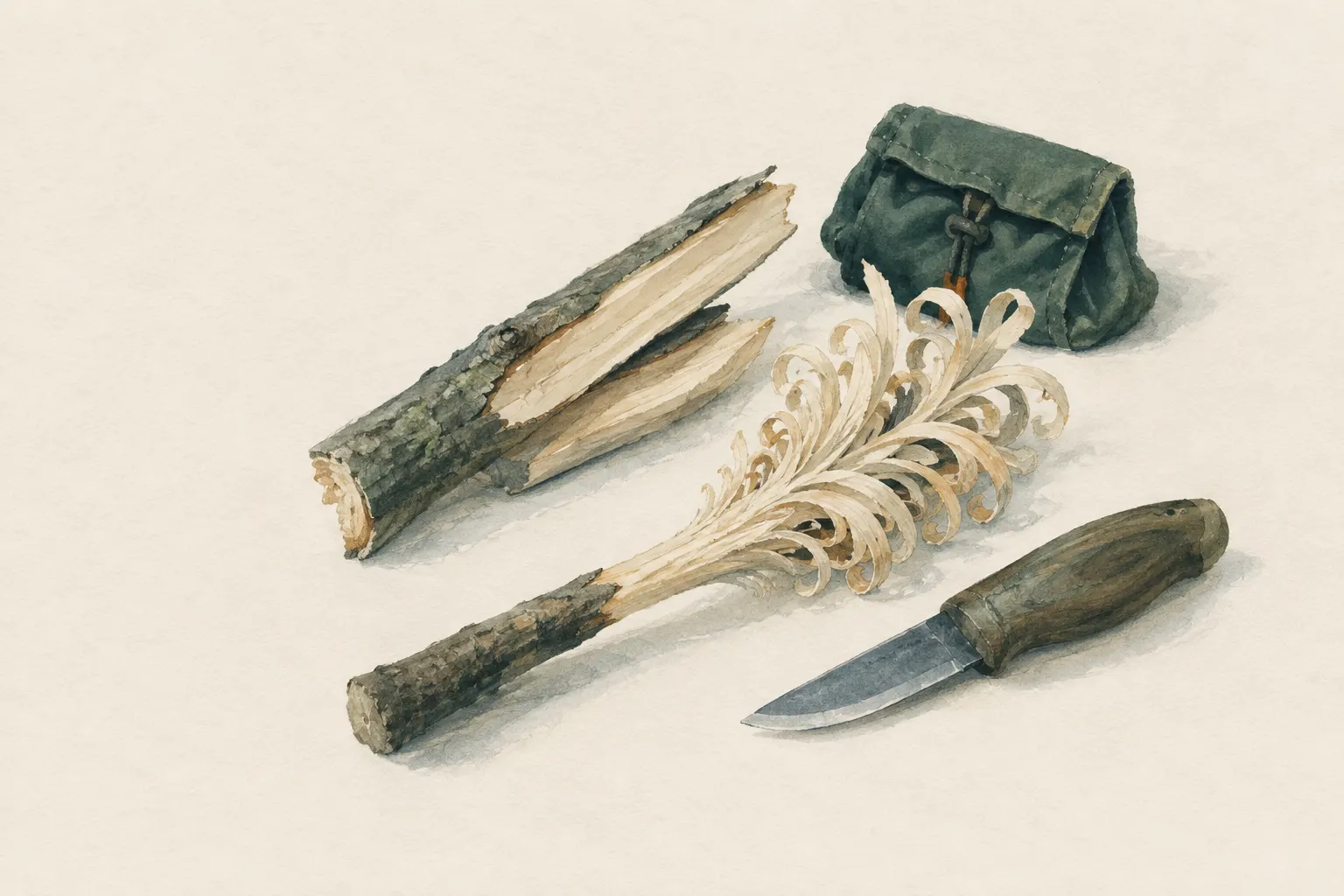
A feather stick is a dry stick with many thin shavings left attached as curls. The curls catch fire quickly and lead seamlessly into the thicker stick. Feather sticks are especially useful in wet weather because they can be carved from the dry inside of split branches.
- A few minutes per stick; prepare several
Explained simply
A feather stick is a stick of wood with lots of thin wooden curls hanging from it – a bit like a stick with feathers. Imagine sharpening a pencil with a knife, except that the shavings stay attached. The thin curls catch fire very quickly, and the fire then runs by itself into the thicker stick.
The great thing is that even after rain, the wood inside a dead branch is often still dry. You split the branch and carve your curls from the dry core.
Because you need a sharp knife for this, safety comes first: always carve away from your body and never work on your thigh.
How it works
A fire needs fuel, heat and oxygen – just as a stool needs three legs. A thick piece of wood is hard to light because it quickly conducts the heat of a small flame into its interior. A wafer-thin shaving, by contrast, has little mass and a lot of surface. It quickly becomes hot enough to burn.
In a feather stick, these thin shavings stay attached to the stick. This creates a continuous staircase from paper-thin to thumb-thick. The flame of the finest curls heats the slightly thicker ones, and these in turn heat the stick itself. Many fires fail at exactly this point: a step is missing between tinder and wood. The feather stick closes that gap.
What really matters
A sharp knife matters more than anything else. With a blunt knife you have to press harder, the shavings get thick and break off – and a slip becomes more likely. A straight, calm cut with the part of the blade near the handle gives you the most control.
Choose a straight piece without knots, because knots deflect the blade. Soft, evenly grown wood is easier to carve than hard wood. Resinous wood burns especially well, even when slightly damp.
Make the curls as thin as you can and stop just before the bottom end so they stay attached. Prepare several sticks, not just one. For lighting with a ferro rod, also scrape a small heap of the finest wood dust with the back of the blade and put it under the curls.
Safety: what to watch out for
Never carve on your thigh. If the blade slips, it can injure large blood vessels there – a genuine emergency. Instead, stand the stick upright on a firm base such as a block of wood, angled slightly away from your body, or work to the side of your body.
Always move the blade away from your body and make sure nobody is sitting in the direction you are cutting. Sit securely and take breaks when your hands get tired or cold – fatigue increases the risk. Fold or sheath the knife as soon as you are not using it.
If something does happen: for a heavily bleeding wound, press firmly on the wound and call the local emergency number (112 in the EU) straight away. Children should learn carving only under supervision and with a suitable knife.
When it makes sense – and when not
Feather sticks are the answer to the most common problem in fire-making: a lack of dry, fine material. After rain, in fog or in winter, the ground often offers only wet leaves and grass. Dead wood that is damp on the outside can still be dry inside – splitting exposes that dry core.
There are limits, though: wood that has lain in water for a long time or is completely soaked and rotten stays damp inside too. With very cold, stiff fingers, clean carving is hard and dangerous. Then it helps to warm your hands first or to fall back on tinder you have brought along.
How to practise it
Practise at home or in the garden with dry, straight wooden battens or split firewood. At first the curls will often be too thick or break off – that is normal. Concentrate on long, even strokes with little pressure.
A good test: light your feather stick at a permitted practice fire with a single match. If it catches at once and burns evenly, the curls are thin enough. Once you can do that reliably, try it after a rainy day with a split dead branch. Check the local rules and wildfire danger for every practice fire.
Step by step
Expose dry wood
Split a dead branch that is wet on the outside. The inside is often dry. Choose a straight, knot-free piece.
- 1
Expose dry wood
Split a dead branch that is wet on the outside. The inside is often dry. Choose a straight, knot-free piece.
- 2
Brace
Stand the stick upright on a firm base, angled slightly away from your body.
- 3
Carve curls
With a straight blade, cut long, thin shavings from top to bottom and stop just before the end so they stay attached. Turn the stick slightly and repeat.
Always move the blade away from your body.
- 4
Finest scrapings
For ignition with a ferro rod, also scrape the finest wood dust with the back of the blade and place it under the curls.
- 5
Use
Place several feather sticks with the curls downwards in the fire lay and light from below.
Common mistakes
- A blunt knife
- Shavings too thick
- Cutting the curls off instead of leaving them attached
- Preparing only a single stick
Quick view
Materials
Knife (fixed or locking blade)
Cut away from your body.
Rules on carrying knives differ by region – check local rules.
Dry firewood
Dry, straight, knot-free wood
Collect only where permitted.
Suitable for
- Fire in wet weather
- Tinder substitute when no natural tinder is dry
- Ignition with a ferro rod
Not suitable for
- Very cold, stiff hands
- Without a sharp knife
Prerequisites
- A sharp knife and the skill to use it safely
- Dry wood or branches that can be split
Safety
- When carving and notching, always work away from your body and sit securely. Fatigue increases the risk of injury.
- Do not carve on your thigh – a slip can injure large blood vessels. Brace the stick on a firm base or work to the side of your body.
How it works
Thin shavings have a lot of surface and little mass, so they reach ignition temperature quickly. Because they stay attached to the stick, they form a continuous fuel stage from wafer-thin to thumb-thick – with no gap in the chain.
Advantages
- Works with wood that is wet outside
- No carried tinder needed
Disadvantages
- Needs practice and a sharp knife
- Risk of injury
Deep knowledge
Background
Feather sticks are part of the basic repertoire of Nordic and North American woodcraft and are described in detail in bushcraft manuals.
They address the most common problem in fire-making: a lack of dry, fine fuel.
Variants
- From resinous wood
- Feather sticks from resinous wood burn especially well, even when damp.
Common mistakes
- A blunt knife
- Shavings too thick
- Cutting the curls off instead of leaving them attached
- Preparing only a single stick
Limits and risks
- Soaked wood stays damp inside too
- Difficult with cold hands
Material alternatives
Derived from material properties: a substitute must have all relevant properties. Observe the notes on the substitute.
- Dry firewood
- Tinder (Carry in waterproof packaging.), Char cloth (charred cotton) (Store dry in a tin.), Finest-grade steel wool (Store separately from batteries – fire risk.), Fatwood (resin-rich wood) (Collect only dead wood where permitted.), Stove fuel (canister, liquid fuel, alcohol) (Store fuels apart from food and in original containers or bottles intended for them.), Petroleum jelly cotton balls (Use only pure cotton.)
Results come exclusively from structured entries. No improvised instructions are generated.
Sources
Ray Mears – Hodder & Stoughton (2002): Bushcraft
Feather sticks as fire-lighting material
Mors L. Kochanski – Lone Pine Publishing: Bushcraft: Outdoor Skills and Wilderness Survival
Feather sticks and kindling