Using fatwood and resinous wood
Fatwood is wood heavily saturated with resin, found mainly in old, dead pine stumps and their root bases. It smells strongly of resin, is heavy and burns with a hot, sooty flame even when slightly damp. Use only dead wood and collect only where permitted.
- Finding and splitting: minutes or longer depending on terrain
Explained simply
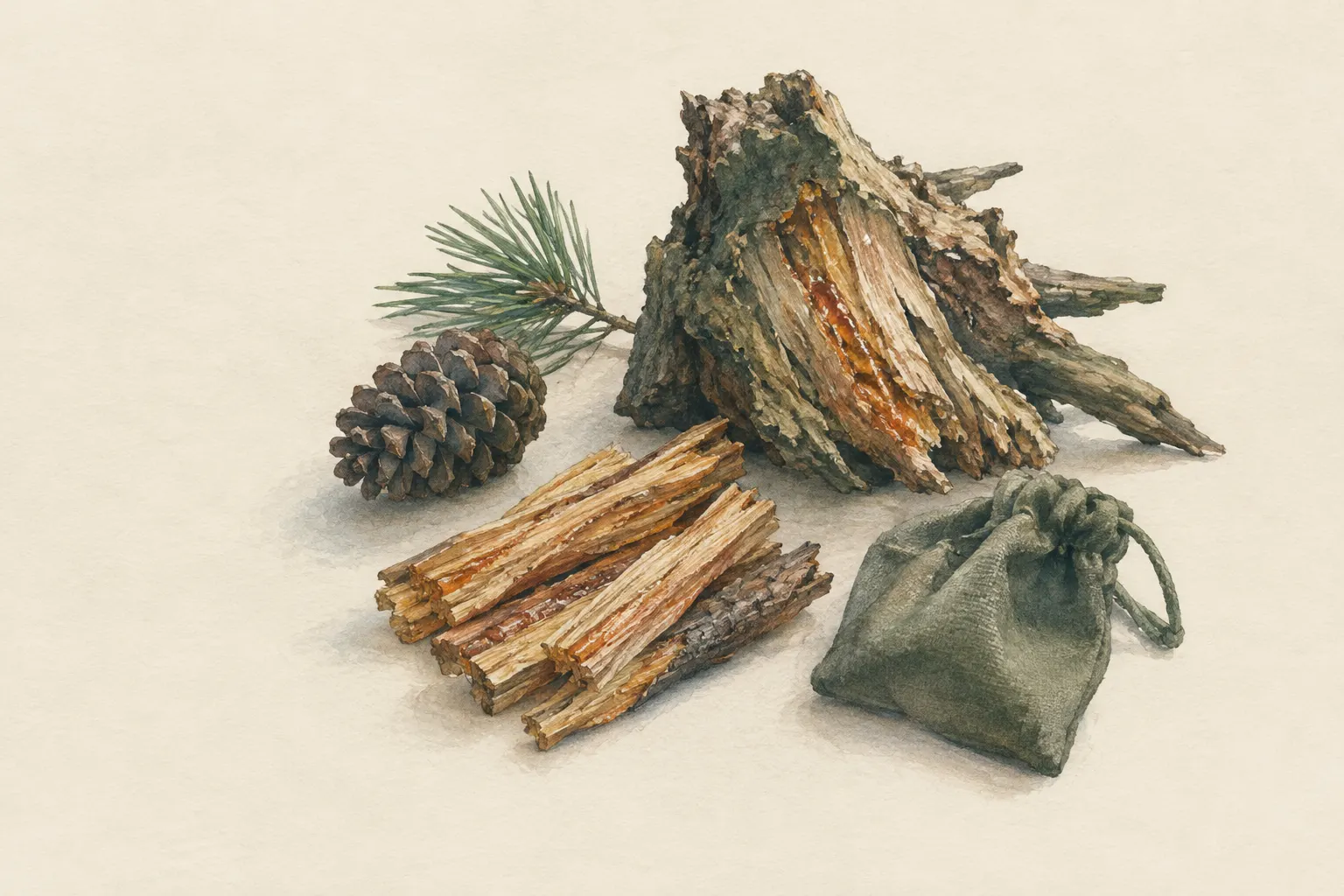
Fatwood is wood that is completely soaked with resin – like a sponge that has taken up sticky tree resin instead of water. It is found mainly in old, dead conifer stumps and at their root bases. It is heavy, smells strongly of resin and often looks amber-coloured and shiny.
Resin burns very well and does not let water in. That is why fatwood burns even when everything outside is damp. Just a few fine shavings of it are enough to start a fire.
Important: take only dead wood and collect it only where it is allowed. Living trees are never cut into or damaged.
How it works
Resin is a natural, combustible substance with a lot of energy. Trees produce it, among other things, to seal wounds. In some old stumps and root bases the wood is so heavily soaked with it that it feels almost like wax. This resin-rich wood often survives long after the rest of the wood around it has rotted.
Because resin repels water, moisture can hardly get in. When fatwood is heated, the combustible parts of the resin vaporise and burn with a hot, bright, very sooty flame. This flame is strong enough to dry and ignite even somewhat damp kindling.
What really matters
You do not recognise fatwood by a particular tree species – this atlas does not describe tree identification – but by three features: it smells clearly of resin, it is noticeably heavy for its size, and when freshly split it looks shiny, sticky and often reddish to amber and translucent. Rotten, light, crumbly wood is not fatwood, even if it comes from a stump.
For lighting you need very fine material. Scrape fine shavings and dust with the back or edge of your knife and form a small heap. These catch sparks from a ferro rod or the flame of a match. Thin split sticks then serve as kindling.
Do not add pieces that are too large too early. Fatwood also needs the staircase from fine to coarse. A fist-sized piece of fatwood can last for many fires if you split it sparingly into shavings and sticks.
Safety and respect
Collect fatwood only from dead wood and only where collecting is permitted. In protected areas, national parks and many forests, breaking wood out of stumps is not allowed. Living trees are never cut into to obtain resin. Take only as much as you really need.
When splitting and scraping, the usual knife rules apply: always work away from your body, sit securely and brace the piece on a firm base. Resin-rich wood is hard and sometimes tough – the blade can suddenly slip through. Use a hatchet only if you can handle it safely.
Fatwood burns with a lot of soot and can throw sparks. Keep your distance from tents, tarps and gear. Do not cook directly over the sooty flame, because soot blackens pots and tastes unpleasant. Use fatwood for lighting and cook later on the embers of ordinary wood. Check the local rules before every fire.
When it makes sense – and when not
Fatwood is especially valuable in wet weather, in winter and when lighting with a ferro rod, which gives only sparks and no flame. A small supply in your emergency kit or pack is light, keeps for a very long time and makes you less dependent on the weather.
It does not, however, replace a supply of dry fuel wood. Fatwood only helps with the start. Whether you find any at all depends heavily on the region – in some forests it is common, in others almost never found. So do not plan on discovering it along the way; if in doubt, take some with you.
Good to know
In the past, fatwood splinters were also used for light: in houses without candles or lamps, burning splinters were set in holders so people could see in the evening. Resin-rich kindling is still sold commercially today.
A small test at home: briefly hold a piece of fatwood and a piece of ordinary dry wood of the same size to a match flame, one after the other. The difference is usually obvious – the fatwood catches faster and burns more strongly. That gives you a feel for what you are looking for.
Step by step
Find
Check old, dead conifer stumps, root bases and branch junctions on dead wood. Fatwood is heavy, often amber to reddish and translucent, and smells clearly of resin.
- 1
Find
Check old, dead conifer stumps, root bases and branch junctions on dead wood. Fatwood is heavy, often amber to reddish and translucent, and smells clearly of resin.
- 2
Remove
Split off small pieces with a knife or hatchet. Take only what you need.
- 3
Scrape shavings
Scrape fine shavings or dust; they catch sparks from a ferro rod.
- 4
Use
Use shavings as tinder and thin sticks as kindling. Take remaining pieces with you as a dry reserve.
Common mistakes
- Damaging living trees
- Mistaking rotten, resin-poor wood for fatwood
- Adding pieces too large too early
Quick view
Materials
Fatwood (resin-rich wood)
Collect only dead wood where permitted.
Very sooty.
Knife (fixed or locking blade)
Cut away from your body.
Rules on carrying knives differ by region – check local rules.
Hatchet or small axe
Only use with a firmly seated head and sound handle; fit the edge guard when not in use.
Rules on carrying and on cutting wood differ by region – check local rules.
Suitable for
- Fire in wet weather
- Ignition with a ferro rod via shavings
- A supply in the emergency kit
Not suitable for
- Protected areas and living trees
- Cooking directly over the sooty flame
Prerequisites
- Permission to collect
- A tool for splitting
Safety
- Do not cut or damage living trees. Collect only dead material where permitted.
- When carving and notching, always work away from your body and sit securely. Fatigue increases the risk of injury.
- Resinous wood produces a lot of soot and can throw sparks. Keep a distance from tents and gear.
How it works
Resin is a combustible substance with high energy content that repels water. When wood is saturated with it, it ignites easily and burns even if the surface is damp.
Advantages
- Burns even when slightly damp
- Keeps for a long time
- A little goes a long way
Disadvantages
- Not found everywhere
- Very sooty
- Collecting often restricted
Deep knowledge
Background
Fatwood splinters were once also used for light. Resin-rich kindling is still sold commercially today.
This atlas does not describe tree species identification. Whether wood is resinous is recognised by its smell, weight and sticky, shiny appearance.
Common mistakes
- Damaging living trees
- Mistaking rotten, resin-poor wood for fatwood
- Adding pieces too large too early
Limits and risks
- Occurrence varies widely by region
- Does not replace a supply of dry fuel wood
Material alternatives
Derived from material properties: a substitute must have all relevant properties. Observe the notes on the substitute.
- Fatwood (resin-rich wood)
- Dry firewood (Collect only where permitted.), Tinder (Carry in waterproof packaging.), Char cloth (charred cotton) (Store dry in a tin.), Finest-grade steel wool (Store separately from batteries – fire risk.), Stove fuel (canister, liquid fuel, alcohol) (Store fuels apart from food and in original containers or bottles intended for them.), Petroleum jelly cotton balls (Use only pure cotton.)
Results come exclusively from structured entries. No improvised instructions are generated.
Sources
Ray Mears – Hodder & Stoughton (2002): Bushcraft
Resinous wood as fire-lighting material
Leave No Trace Center for Outdoor Ethics: The Seven Principles of Leave No Trace (Principle 5: Minimize Campfire Impacts)
Do not damage living trees