Packing a fire kit: redundant and dry ignition
A good fire kit contains at least two independent ignition sources, prepared tinder and waterproof packaging – and it is checked regularly. The ignition sources are carried in different places so that one loss or soaking does not make everything useless at once.
- Assemble once, then check every six months
Explained simply
A fire kit is a small, waterproof tin or pouch with everything you need to light a fire. The most important idea is “two is better than one”: you take at least two different things that make a flame or sparks, for example a lighter and a ferro rod.
Why two? Because every ignition source has a weakness. A lighter can be empty or stop working in the cold, matches get wet, and a ferro rod needs very fine tinder. If one fails, the other takes over – like a spare tyre on a car.
Add ready-made tinder that burns reliably and packaging that keeps water out. Always store the kit where small children cannot reach it.
How it works
The principle is called redundancy: several different solutions for the same task that will not all fail at the same time for the same reason. Two identical lighters in the same pocket are therefore worth less than a lighter and a ferro rod in different places. If the pocket gets wet or is lost, the other source remains.
Lighters are the simplest but lose power in the cold, because the gas inside vaporises less well. Matches, especially storm matches, burn even in wind but are sensitive to moisture – the striker too. A ferro rod works almost always, even after getting wet and being wiped off, but it only gives sparks and therefore needs very fine, dry tinder.
That is exactly why tinder belongs firmly in the kit. In wet weather, what is usually missing is not the spark but something dry to catch it. Petroleum jelly cotton, fire-lighter cubes or a piece of fatwood bridge this gap.
Gear and materials
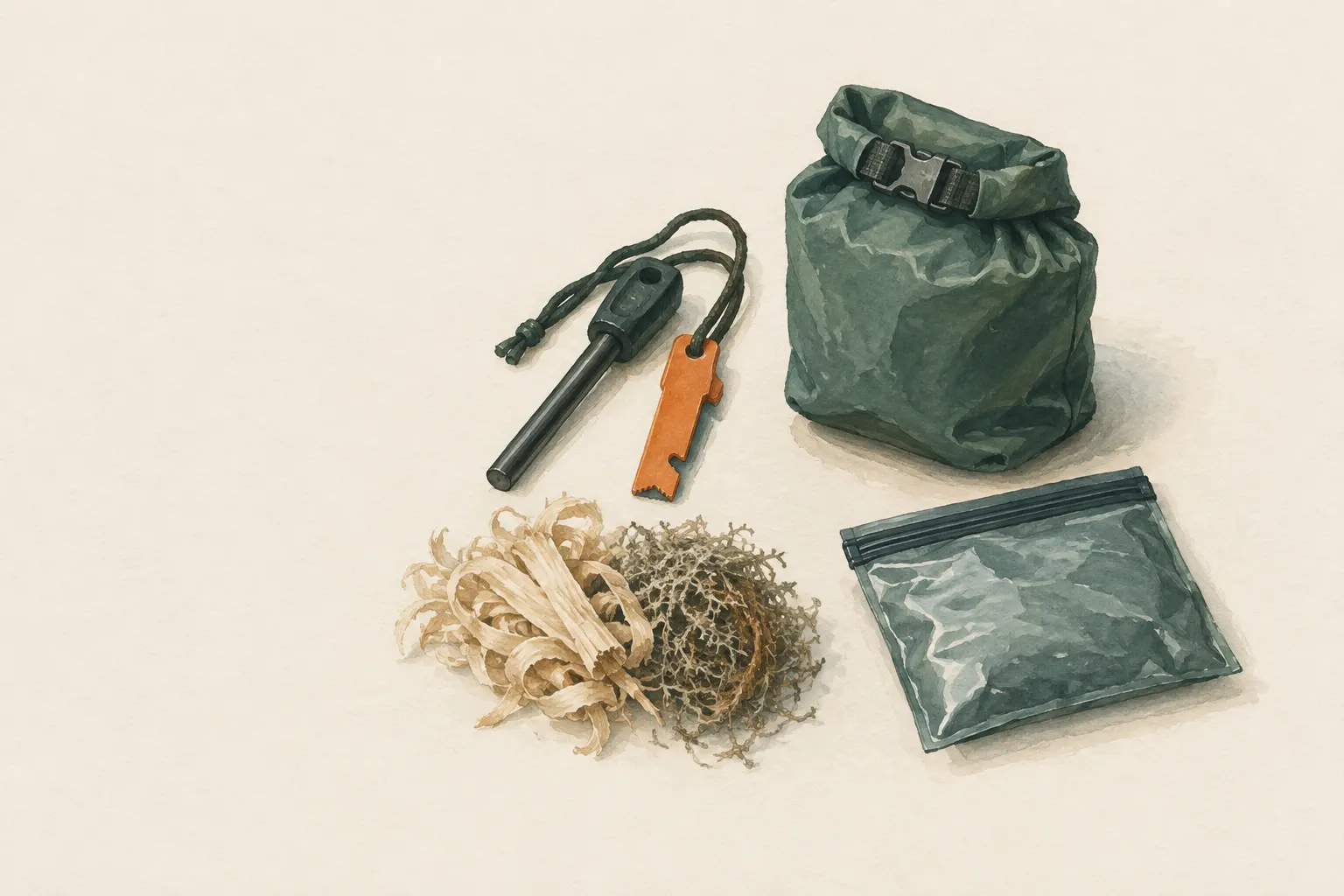
A proven basic kit consists of a lighter, a ferro rod, some storm matches with their own striker and prepared tinder. Everything that can get wet goes into a tight-closing tin or a waterproof bag. The match striker belongs inside the packaging too, because without a dry striker, matches are useless.
Spread the items out: carry one ignition source on your body, for example in a trouser pocket – there the lighter also stays warm in the cold. A second one goes in your backpack. For the home or the car, a separate small kit is worthwhile, for instance for candles or the stove during a power cut.
Batteries and steel wool must never go into one tin together: if the steel wool touches both terminals of a battery, it can catch fire. If you carry steel wool, pack it separately.
What really matters
A kit that is never checked only gives you a good feeling. Check before every trip and at least twice a year: is there still gas in the lighter, and does it light? Are the matches and the striker dry? Is the tinder clean, and does the tin still close tightly? Replace whatever is no longer in order.
Just as important: you need to know how to use every item in the kit. Using a ferro rod for the first time with cold, wet hands is hard. So try out each ignition source beforehand at a safe, permitted fire site. And remember: the best kit is useless without fuel – you still have to find or bring dry, thin kindling.
Typical situations
On hikes and trips the kit sits ready to hand at the top of your backpack, with one ignition source in your trouser pocket. In the home go-bag it is part of the basic equipment; official preparedness lists include matches in a waterproof container as part of an emergency supply.
When flying, special rules apply to lighters and matches, and they differ by airline and country. Find out from the airline beforehand instead of simply packing everything. And remember: a fire kit gives you the ability to make fire – whether you are allowed to is decided by local rules and the current wildfire danger.
Step by step
Choose ignition sources
Choose at least two different sources, e.g. a lighter and a ferro rod, plus storm matches with a striker.
- 1
Choose ignition sources
Choose at least two different sources, e.g. a lighter and a ferro rod, plus storm matches with a striker.
- 2
Add tinder
Add prepared tinder such as petroleum jelly cotton or fire-lighter cubes; optionally a piece of fatwood.
- 3
Pack waterproof
Put matches and tinder in a tight tin or sealable bag. Keep the match striker dry as well.
- 4
Distribute
Carry one ignition source on your body (e.g. in a trouser pocket, which also keeps a lighter warm) and one in the pack.
- 5
Check regularly
Check lighter fuel, dry matches and the condition of the tinder before every trip and at least every six months.
Common mistakes
- Only a single ignition source
- Everything in one pocket
- A kit that was never tested
- An empty lighter
- Forgetting tinder
Quick view
Materials
Lighter, matches or ferro rod
Lighter and/or storm matches
Observe local fire bans.
Ferro rod
Practise before you need it.
Sparks fly far – do not use near fuel containers.
Petroleum jelly cotton balls
Use only pure cotton.
Never substitute with fuel liquids.
Waterproof case or bag
Suitable for
- Hikes and trips
- Go-bag
- Vehicle and household supplies
Not suitable for
- Air travel without checking carriage rules for lighters and matches
Prerequisites
- Lighter and/or matches
- Ferro rod
- Prepared tinder
- Waterproof tin or bag
Safety
- Store ignition sources out of reach of children.
- Never pack batteries and steel wool together – risk of short circuit and fire.
How it works
Redundancy: every ignition source has a typical weakness – lighters fail in the cold or when empty, matches when wet, a ferro rod needs fine tinder. Several different sources, carried separately and packed dry, cover for each other. Tinder belongs in the kit because natural tinder is most often missing in wet weather.
Advantages
- Light and cheap
- Significantly increases reliability
Disadvantages
- Needs maintaining
- Carriage rules (e.g. on aircraft) must be observed
Deep knowledge
Background
Official preparedness lists include matches in a waterproof container as part of an emergency supply. Outdoor training usually adds a second ignition source of a different kind.
The fire kit is also part of the home go-bag, for example for candles or stoves during a power outage.
Common mistakes
- Only a single ignition source
- Everything in one pocket
- A kit that was never tested
- An empty lighter
- Forgetting tinder
Limits and risks
- Does not replace practice in making fire
- Useless without fuel
Material alternatives
Derived from material properties: a substitute must have all relevant properties. Observe the notes on the substitute.
- Lighter, matches or ferro rod
- Ferro rod (Practise before you need it.), Fire striker and hard stone (Carbon steel, not stainless.), Bow drill set (bow, spindle, hearth board, bearing block) (Use only dry wood.), Burning lens / magnifier (Never leave lying in the sun – fire risk.), Fire piston (Maintain the seal.)
- Ferro rod
- Lighter, matches or ferro rod (Observe local fire bans.), Fire striker and hard stone (Carbon steel, not stainless.), Bow drill set (bow, spindle, hearth board, bearing block) (Use only dry wood.), Burning lens / magnifier (Never leave lying in the sun – fire risk.), Fire piston (Maintain the seal.)
- Petroleum jelly cotton balls
- Dry firewood (Collect only where permitted.), Tinder (Carry in waterproof packaging.), Char cloth (charred cotton) (Store dry in a tin.), Finest-grade steel wool (Store separately from batteries – fire risk.), Fatwood (resin-rich wood) (Collect only dead wood where permitted.), Stove fuel (canister, liquid fuel, alcohol) (Store fuels apart from food and in original containers or bottles intended for them.)
- Waterproof case or bag
- Single-wall stainless steel bottle (Heat only single-wall bottles without paint/plastic; remove the lid before heating.), Double-wall insulated bottle (Never heat directly.), PET bottle (clear, max. 2 litres) (Do not heat or place in a fire.), Food-grade water container (Only use containers that never held chemicals or fuel.), Used chemical or fuel container (Never for drinking water or food – residues cannot be reliably removed.), Galvanised bucket (Do not heat: the zinc coating can release harmful fumes when heated.), Airtight food-grade storage container (Fill only when clean and completely dry; never use containers that previously held chemicals.), Wildlife-resistant food container (Where specific containers are required, use only approved models – check local rules.), Small metal tin with lid (Burn off coated or painted tins outdoors first.), Collapsible water container or bag (Protect from sharp objects.), Food-grade water bag (Use only for drinking water, never for chemicals or fuel.), Fermentation jar or crock (Use only food-grade containers of glass, food-safe glazed stoneware or food-grade plastic – no metal containers for acidic food.), Resealable food bags (Use only bags intended for food; do not use with boiling water unless the manufacturer explicitly allows it.)
Results come exclusively from structured entries. No improvised instructions are generated.
Sources
Ready.gov – U.S. Federal Emergency Management Agency (FEMA): Build A Kit
Matches in a waterproof container as part of an emergency kit
Headquarters, Department of the Army (USA) (2002): FM 3-05.70 Survival
Fire-making and ignition sources in survival situations