Preparing cotton balls with petroleum jelly as tinder
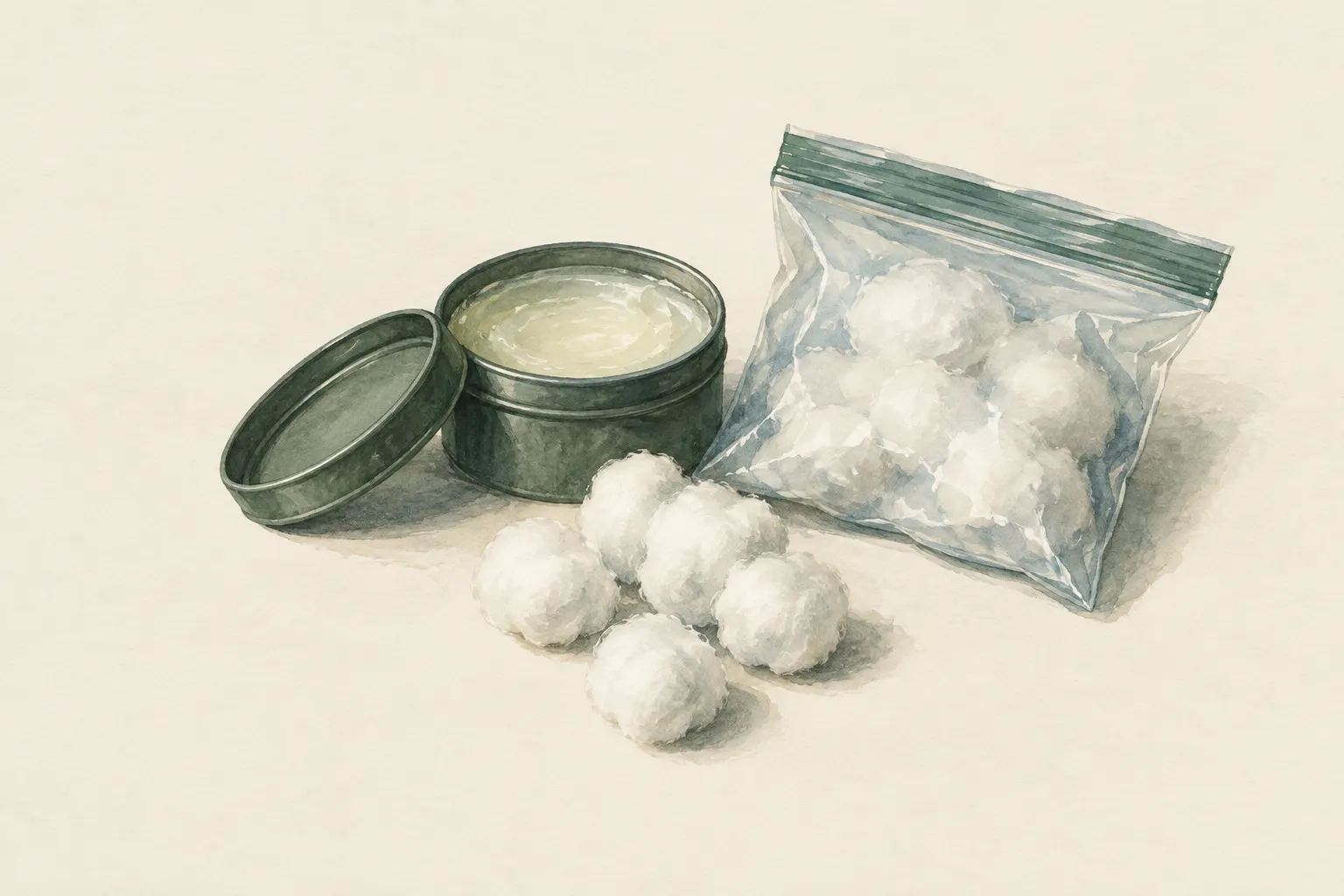
Cotton balls made of pure cotton and kneaded with petroleum jelly are a cheap, light and fairly weather-resistant tinder. When fluffed up, they catch sparks from a ferro rod and then burn noticeably longer than dry cotton – long enough to help dry out damper kindling. They are prepared at home and carried in waterproof packaging.
- A few minutes for a supply
Explained simply
Tinder is what burns first of all – the small, easily lit material from which the first flame grows. A very simple tinder can be made at home: cotton balls made of real cotton with petroleum jelly kneaded into them – the greasy cream that people also use for dry lips.
The cotton works like the wick of a candle and the jelly like the wax. That is why such a ball burns much longer than dry cotton – long enough for thin twigs above it to catch fire. And because grease repels water, the inside stays fairly dry even in damp weather.
Important: petroleum jelly is a solid tinder, not a liquid for lighting fires. Never pour petrol, spirit or anything similar into a fire. And do not hold a burning ball in your hand, because hot grease can drip off.
How it works
A candle does not burn because the solid wax itself burns, but because the wick draws melted wax upwards, where it vaporises and burns as a gas. Petroleum jelly cotton works the same way: the flame melts the jelly, the fine cotton fibres draw it upwards, and there it burns. So the flame lasts much longer and more evenly than with dry cotton, which flares up briefly and is gone.
A spark from a ferro rod is tiny and only hot for an instant. It needs dry, fine, loose fibres that it can light at once. A greasy, squashed ball therefore catches poorly. Only when you pull it apart do dry fibres from the inside appear that the spark can catch on – the grease around them then provides the long burning time.
Gear and materials
You need cotton balls made of 100% cotton, plain petroleum jelly and a small, tight-closing tin or a sealable bag. Pay close attention to the cotton: some cosmetic pads and cotton balls contain synthetic fibres. These melt into small lumps in the flame instead of burning. A quick test with a lighter at a safe spot outdoors soon shows whether the cotton burns or melts.
Knead a ball with a dab of petroleum jelly between your fingers until it is evenly coated but not dripping. Too much grease is a common mistake: then no dry fibres remain to catch a spark. Several balls fit nicely into a small tin. Some people fill them in portions into drinking straws and seal the ends – that keeps everything clean and portioned.
When it makes sense – and when not
Petroleum jelly cotton is ideal for an emergency or fire kit. It is cheap, light and bridges exactly the phase in which natural tinder most often fails in wet conditions. For beginners with a ferro rod in particular it makes the difference: instead of laboriously searching for fine, dry fibres, you have reliable tinder with you.
But it is no miracle cure. A ball burns for only a few minutes. If the kindling above it is wet or too thick, that time is not enough, and the real problem remains. So petroleum jelly cotton does not replace dry, thin kindling – it just gives you a better start. Bought fire-lighter cubes serve the same purpose, by the way.
Safety: what to watch out for
Petroleum jelly is a solid substance and not an accelerant. Because it is made from crude oil, some people think they could just as well use petrol or spirit. That is dangerous: the vapours of such liquids can ignite explosively. Never use liquid fuels on cotton or fires.
Burning cotton can drip melted, hot grease. So always put the ball into the fire site first and light it there instead of holding it in your hand. As with every fire: check local rules and wildfire danger, keep extinguishing water ready, and store ignition sources and tinder out of reach of children.
How to practise it
Make a small supply and try it once at a safe, permitted fire site before relying on it on a trip. Pull a ball apart until dry fibres are visible inside, and direct the ferro rod sparks exactly there. Note how long it burns and how much thin wood you can get burning in that time.
Have the kindling ready beforehand so you can build it over the flame at once. Check the supply in your kit regularly: the tin must be tight, and the cotton should stay clean and dry.
Step by step
Knead in
Knead a cotton ball with a dab of petroleum jelly between your fingers until it is evenly saturated but not dripping.
- 1
Knead in
Knead a cotton ball with a dab of petroleum jelly between your fingers until it is evenly saturated but not dripping.
- 2
Pack
Press several balls into a small, tight tin or bag. Alternatively, fill drinking straws in portions and seal the ends.
- 3
Fluff before use
Pull a ball apart in the fire site so that dry fibres from the inside become visible.
- 4
Light
Direct ferro rod sparks straight into the fluffed fibres or light with a match or lighter. Build thin kindling over it immediately.
Common mistakes
- Synthetic cotton wool or cosmetic pads with synthetic content
- Not fluffing up the cotton
- Too much jelly, so no dry fibres remain
- No kindling prepared
Quick view
Materials
Petroleum jelly cotton balls
Use only pure cotton.
Never substitute with fuel liquids.
Waterproof case or bag
Ferro rod
Practise before you need it.
Sparks fly far – do not use near fuel containers.
Suitable for
- Emergency and fire kits
- Fire in wet and cold conditions
- Beginners using a ferro rod
Not suitable for
- A substitute for dry kindling
- Synthetic cotton wool (melts instead of burning)
Prerequisites
- Cotton balls made of 100% cotton
- Plain petroleum jelly
- A small, tight tin or bag
Safety
- Burning cotton can drip melted grease. Do not hold it in your hand and use it only in a safe fire site.
How it works
The cotton fibres act like a wick: the flame melts the petroleum jelly, which is drawn up the fibres, vaporises and burns. As a result the cotton burns longer and more evenly than dry cotton. The grease also keeps moisture out. Only fluffing it up exposes dry fibres that catch a spark.
Advantages
- Cheap and quick to make
- Catches ferro rod sparks
- Relatively weather-resistant
Disadvantages
- Greasy and messy to handle
- Limited supply
- Does not replace dry kindling
Deep knowledge
Background
Prepared tinder made of cotton and petroleum jelly is a well-known part of many emergency and outdoor kits because it uses household materials and weighs little. It bridges exactly the phase in which natural tinder most often fails in wet conditions.
Bought fire-lighter cubes serve the same purpose; what matters is that tinder is kept dry and within reach next to the ignition sources.
Variants
- With wax
- Cotton or cardboard strips dipped in wax work similarly. Melt wax only in a water bath and never over an open flame.
Common mistakes
- Synthetic cotton wool or cosmetic pads with synthetic content
- Not fluffing up the cotton
- Too much jelly, so no dry fibres remain
- No kindling prepared
Limits and risks
- Burns for only a few minutes
- Wet kindling remains the main problem
Material alternatives
Derived from material properties: a substitute must have all relevant properties. Observe the notes on the substitute.
- Petroleum jelly cotton balls
- Dry firewood (Collect only where permitted.), Tinder (Carry in waterproof packaging.), Char cloth (charred cotton) (Store dry in a tin.), Finest-grade steel wool (Store separately from batteries – fire risk.), Fatwood (resin-rich wood) (Collect only dead wood where permitted.), Stove fuel (canister, liquid fuel, alcohol) (Store fuels apart from food and in original containers or bottles intended for them.)
- Waterproof case or bag
- Single-wall stainless steel bottle (Heat only single-wall bottles without paint/plastic; remove the lid before heating.), Double-wall insulated bottle (Never heat directly.), PET bottle (clear, max. 2 litres) (Do not heat or place in a fire.), Food-grade water container (Only use containers that never held chemicals or fuel.), Used chemical or fuel container (Never for drinking water or food – residues cannot be reliably removed.), Galvanised bucket (Do not heat: the zinc coating can release harmful fumes when heated.), Airtight food-grade storage container (Fill only when clean and completely dry; never use containers that previously held chemicals.), Wildlife-resistant food container (Where specific containers are required, use only approved models – check local rules.), Small metal tin with lid (Burn off coated or painted tins outdoors first.), Collapsible water container or bag (Protect from sharp objects.), Food-grade water bag (Use only for drinking water, never for chemicals or fuel.), Fermentation jar or crock (Use only food-grade containers of glass, food-safe glazed stoneware or food-grade plastic – no metal containers for acidic food.), Resealable food bags (Use only bags intended for food; do not use with boiling water unless the manufacturer explicitly allows it.)
- Ferro rod
- Lighter, matches or ferro rod (Observe local fire bans.), Fire striker and hard stone (Carbon steel, not stainless.), Bow drill set (bow, spindle, hearth board, bearing block) (Use only dry wood.), Burning lens / magnifier (Never leave lying in the sun – fire risk.), Fire piston (Maintain the seal.)
Results come exclusively from structured entries. No improvised instructions are generated.
Sources
Headquarters, Department of the Army (USA) (2002): FM 3-05.70 Survival
Tinder as fine, dry, easily ignited material
USDA Forest Service / Ad Council / National Association of State Foresters: Campfire Safety (Smokey Bear wildfire prevention campaign)
Not using flammable liquids to start fires