Bamboo fire saw
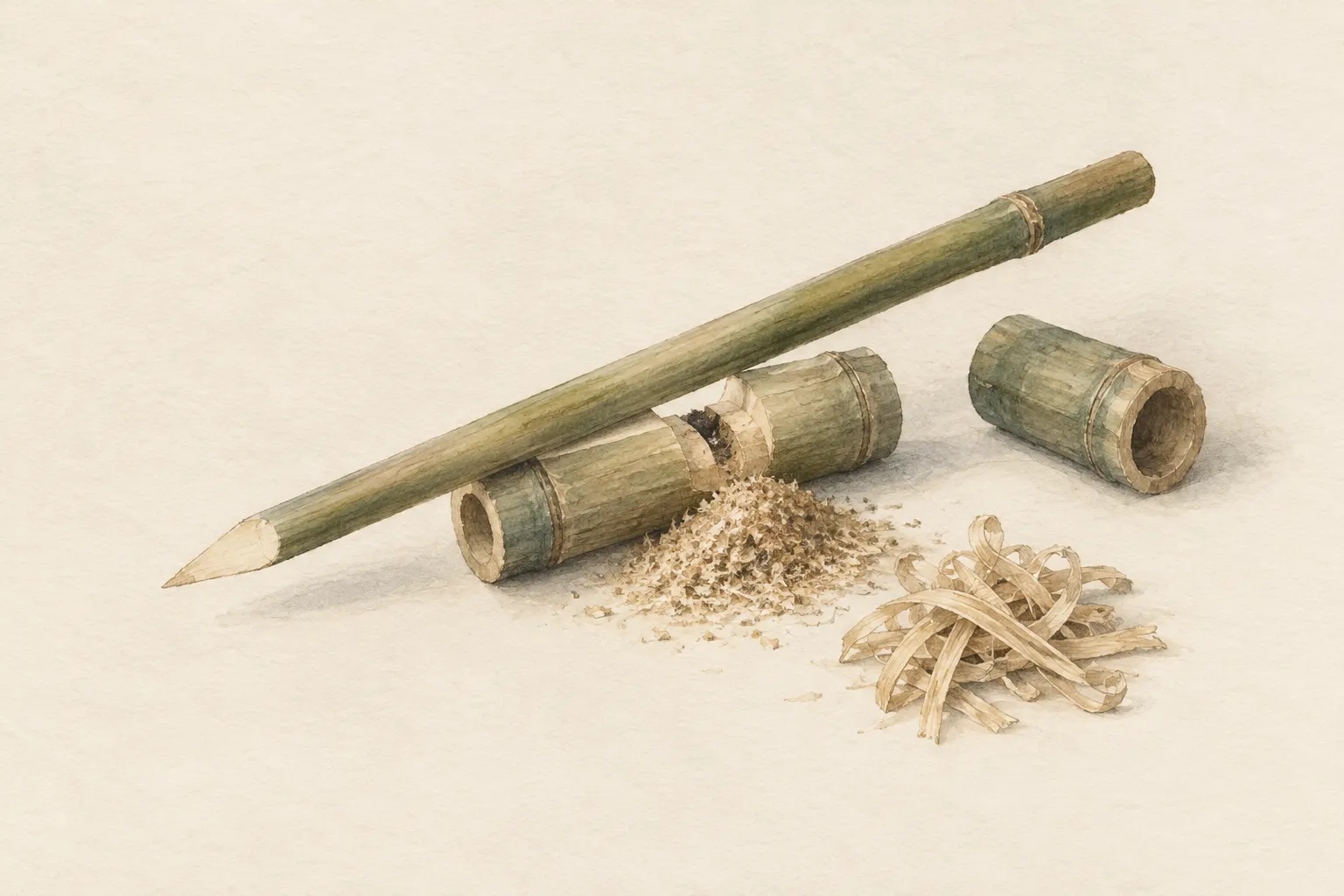
In the fire saw, the sharp edge of a piece of dry bamboo is sawn across another, notched piece of bamboo. Through the slot, hot bamboo dust falls onto fine bamboo shavings beneath and can form an ember. The method depends on dry bamboo, is strenuous and needs practice.
- Preparation 30 minutes or more; sawing very strenuous
Explained simply
Rub your hands together quickly – they get warm. That is exactly what happens with the fire saw, only much more strongly. You draw the sharp edge of one piece of bamboo hard and repeatedly across a second piece. This creates so much friction heat that tiny bamboo crumbs get hot and start to smoulder.
The second piece of bamboo has a narrow slot. Through this slot, the hot bamboo dust falls onto a small pad of fine bamboo shavings. If everything works, it becomes a small ember – a glowing little heap with no flame. You place this ember in a tinder bundle and gently blow it into a flame.
Important: this is a craft that needs a lot of practice and strength. In an emergency you are better off relying on a lighter or matches. And take care – split bamboo is as sharp as a knife.
How it works
Every friction fire relies on the same principle: movement is turned into heat by friction. In the fire saw, the edge of the saw piece rubs against the outer wall of the base piece. This wears off fine bamboo dust that is already very hot as it forms. The dust collects at the slot and falls inside.
Beneath the slot lies a pad of wafer-thin bamboo shavings. It catches the hot dust, keeps it together and protects it from wind and cooling like a small blanket. Only when enough hot dust gathers in one spot does it keep smouldering by itself. You can recognise that moment because smoke keeps rising even after you have stopped sawing.
The special thing is that bamboo provides everything itself – the tool, the friction surface and the tinder. You need no cord as with a bow drill. In return the method is very strenuous, and it only succeeds with truly dry, dead bamboo.
What really matters
The most important point is dry bamboo. Green or damp bamboo produces steam rather than an ember when you saw. Dead stems lying protected under a roof of leaves or in a dry spot are best. In the humid tropics, this is often the real difficulty.
The slot has to be right: if it is too wide, the dust simply falls through and cools. If it is too narrow, hardly any dust gets through. The shavings inside should be as fine as possible – almost like cotton wool. Coarse shavings catch the heat poorly.
When sawing, evenness matters more than brute force. The base piece must be held firmly, for example against the ground or secured with your knee. Strong, long, even strokes create more heat than frantic shaking. Do not stop at the first wisp of smoke, but only once thick smoke is rising.
When it makes sense – and when not
The fire saw is above all a practice and cultural technique. It comes from regions of South and Southeast Asia where bamboo is part of everyday life. Learning it gives you a very good understanding of how friction, heat and tinder work together.
It is no good as an emergency plan. It costs a lot of strength and time and often only succeeds after many attempts. If you are exhausted, soaked or injured, it is exactly the wrong method. So the rule is: always carry at least two modern ignition sources, stored in different places.
Safety: what to watch out for
Split bamboo has edges and splinters that can cut deeply. Handle it deliberately, wear gloves where possible and always work away from your body when splitting and notching. Fatigue makes you careless – take breaks before your hands start to shake.
Do not throw closed pieces of bamboo into the fire. The hollow chambers between the nodes trap air and sometimes moisture; when heated, they can burst with a loud bang and scatter embers. Before every practice fire, also check the local rules and current wildfire danger – fire bans apply to practice fires too.
How to practise it
Practise first at home or at a permitted fire site with bamboo that you have stored dry for a few days. That way you learn the technique under good conditions before trying it with material from the wild. Prepare the tinder bundle completely before you start sawing.
It is best to practise in pairs: one person holds the base piece firmly, the other saws, then you swap. Note what worked – the width of the slot, how fine the shavings were, the kind of movement. Expect your first attempts to produce only smoke. That is normal and part of learning.
Step by step
Split the bamboo
Split a dry bamboo section lengthwise. One half becomes the saw with a sharp edge, the other the base piece.
- 1
Split the bamboo
Split a dry bamboo section lengthwise. One half becomes the saw with a sharp edge, the other the base piece.
- 2
Cut the slot
Cut a notch across the outside of the base piece until a narrow slot opens through the wall.
- 3
Add shavings
Scrape fine shavings from the outer skin of bamboo and place them as a small pad inside, under the slot.
- 4
Saw
Fix the base piece and draw the saw piece across the notch with strong, even strokes until there is plenty of smoke.
- 5
Transfer the ember
Carefully remove the glowing pad, place it in a tinder bundle and blow it to flame.
Common mistakes
- Using green or damp bamboo
- A slot that is too wide or too narrow
- Shavings too coarse
Quick view
Materials
Sturdy sticks / poles
Dead, dry bamboo
Do not cut live wood where prohibited.
Knife (fixed or locking blade)
Cut away from your body.
Rules on carrying knives differ by region – check local rules.
Suitable for
- Tropical and subtropical regions with bamboo
- Skill training
Not suitable for
- Green or wet bamboo
- Areas without bamboo
- Emergencies without practice
Prerequisites
- Dry, dead bamboo
- A knife
- Practice
Safety
- Friction fire is not a reliable emergency plan. It succeeds only with suitable, dry wood and a lot of practice, and it costs a lot of energy. Always carry at least two modern ignition sources.
- Split bamboo has very sharp edges and splinters. Handle carefully; wear gloves where possible.
- When carving and notching, always work away from your body and sit securely. Fatigue increases the risk of injury.
How it works
Friction between the edge and the bamboo wall generates heat and fine dust. The slot in the lower piece channels the hot dust directly onto a small pad of bamboo shavings that catches and insulates it until it smoulders.
Advantages
- Bamboo provides both tool and tinder
- No cord needed
Disadvantages
- Only with dry bamboo
- Strenuous and unreliable
- Risk of cuts from sharp edges
Deep knowledge
Background
The fire saw is a traditional method from regions of South and Southeast Asia where bamboo is common.
In the humid tropics, dry bamboo is often found only in sheltered spots; success depends heavily on it.
Common mistakes
- Using green or damp bamboo
- A slot that is too wide or too narrow
- Shavings too coarse
Limits and risks
- Tied to bamboo
- Difficult in high humidity
Sources
Headquarters, Department of the Army (USA) (2002): FM 3-05.70 Survival
General principles of fire by friction and tinder