Mussels, snails and seaweed on the coast
On rocky coasts you find mussels, periwinkles, limpets and edible seaweeds such as sea lettuce and bladderwrack. But mussels can store toxins from algal blooms that cooking does not remove, and near harbours and sewage outlets they carry germs. Here you learn when and where you may collect, how to recognise live mussels, how to cook them through and how to keep an eye on the tide.
- 1–2 hours around low tide; preparation 20–30 minutes
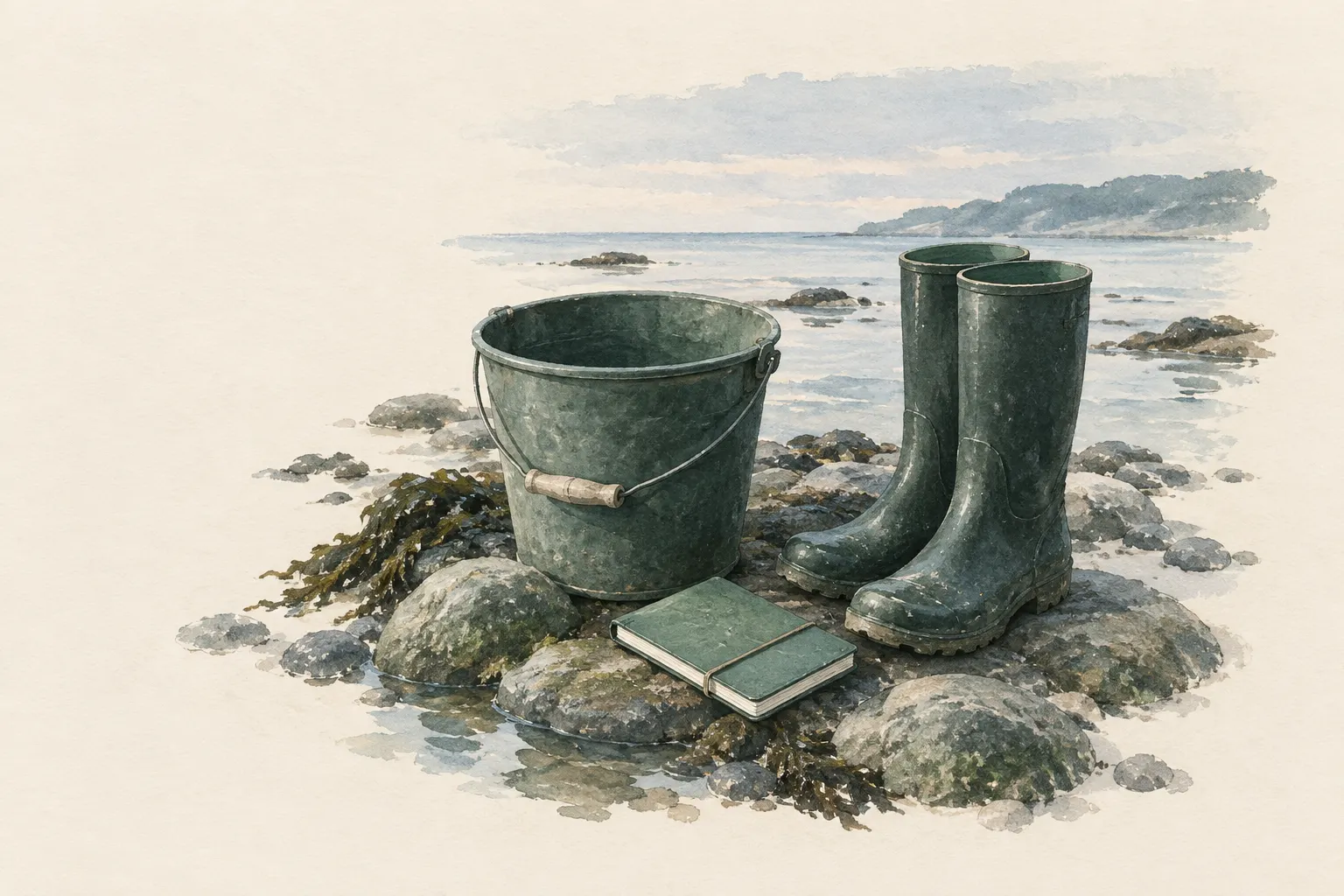
Explained simply
On rocky coasts many things appear at low tide: mussels on the stones, little snails, green and brown seaweed. Many of them can be eaten, and they are very nourishing. That is why the coast is often a good place to find food in an emergency.
But mussels are like little water filters: they suck in sea water and keep everything that floats in it – including poisons from certain algae and germs from sewage. You cannot see, smell or boil away these algal poisons. So you only collect where it is allowed and no warning applies.
And you always have to think of the sea: the tide comes back, sometimes faster than you think. Only collect at low tide, remember your way back, never turn your back on the waves. You only eat mussels that were collected alive and boiled well.
How it works
Mussels feed by pumping sea water through their gills and filtering out tiny algae. Sometimes certain algae multiply very strongly – an algal bloom. Some of them produce toxins that build up in the mussels. The mussels themselves stay healthy, but anyone who eats them can become seriously ill.
These toxins are heat-stable: boiling, frying and freezing do not destroy them. Paralytic shellfish poisoning often begins with tingling and numbness of the lips and fingers and can lead to paralysis of breathing. Other shellfish toxins mainly cause diarrhoea and vomiting. Sometimes an algal bloom turns the water reddish ("red tide"), but often you see nothing.
Against germs such as noroviruses and bacteria that get into mussels from sewage, thorough cooking helps. So both apply: the right place and time against the toxins, cooking against the germs. Seaweeds, on the other hand, are mostly harmless but often contain a lot of iodine, especially the brown kinds.
What really matters
Before collecting, find out: are there signs, closures or warnings of algal blooms? Many coastal countries monitor their shellfish areas and close them when there is danger. The old rule of only eating mussels in months with an "r" is not reliable. Always avoid harbours, moorings, sewage pipes and river mouths after heavy rain.
Only live mussels are good: they are tightly closed or close when tapped. Open, broken, unusually heavy or foul-smelling mussels are thrown away. Cook them with a lid until the shells open, and then for a few more minutes. Mussels that stay shut are not eaten.
With seaweed, only take living, attached plants that you recognise for certain, such as the very thin, bright green sea lettuce or the brown bladderwrack with its air-filled bladders. Cut them and leave the base on the rock, then they grow back. Washed-up, rotting seaweed is off-limits.
Safety: what to watch out for
The tide is the biggest immediate danger. Look at the tide table, set off while the water is going out and turn round by low water at the latest. On sandbanks and tidal flats the rising water can cut you off from behind. Non-slip shoes, never alone onto outlying rocks and always an eye on the waves – single large waves can also come without warning.
After eating mussels watch for warning signs: tingling or numbness of the lips, tongue or fingers, dizziness, weakness, nausea, vomiting or diarrhoea. With numbness, weakness or breathing problems call 112 at once and say that mussels were eaten. Stay together with others after a mussel meal.
Eat seaweed only in small amounts, because it can contain a great deal of iodine. People with thyroid disease, pregnant women and small children are better off without it. Do not collect freshwater mussels from streams and lakes at all: many are strictly protected and the water is often polluted.
When it makes sense – and when not
Collecting makes sense on clean, rocky coasts without warnings, in an emergency on the coast or where it is expressly allowed. Mussels and snails are then among the most productive protein sources of all, and seaweed complements them.
It does not make sense during closures, algal warnings, near harbours and sewage outlets, or on a rising tide. In tropical waters there are additional toxins in sea creatures that are not covered here – there you ask locals or leave it.
Good to know
The US Food and Drug Administration describes several kinds of shellfish poisoning in the "Bad Bug Book" and stresses that the toxins are not destroyed by cooking and the mussels look normal. For cooking live shellfish it recommends cooking until the shells open, then continuing to cook and throwing away those that do not open.
Leave cockles, which live in sand, in clean sea water for a few hours before cooking so they spit out sand. Washed, dried seaweed can be crumbled into soups as a salty seasoning – this way you only eat a little of it anyway, which is good because of the iodine.
Step by step
Check beforehand
Find out about local collecting bans and algal bloom warnings (signs, local council, authorities). The old rule of only collecting in months with an "r" is not reliable. Avoid harbours, moorings, sewage pipes and river mouths, especially after heavy rain. Reddish or brownish discoloured water is a warning sign – but clear water is no proof of safety.
- 1
Check beforehand
Find out about local collecting bans and algal bloom warnings (signs, local council, authorities). The old rule of only collecting in months with an "r" is not reliable. Avoid harbours, moorings, sewage pipes and river mouths, especially after heavy rain. Reddish or brownish discoloured water is a warning sign – but clear water is no proof of safety.
- 2
Plan with the tide
Look at the tide table: the best time is the hour before and around low water. Set off while the water is going out, note your way back and turn round by low water at the latest. Wear non-slip shoes, never go alone onto outlying rocks and keep an eye on the waves.
The tide can cut off your way back.
- 3
Collect mussels and snails
Mussels sit in clusters on rocks exposed at low water; take only a few large ones from clean, moving water, never from posts in harbours. Periwinkles are found on rocks and seaweed, limpets cling tightly to the rock. Take only as much as you will eat the same day and leave young animals.
- 4
Check they are alive
Put the mussels in a bucket of clean sea water. Closed mussels are good. Tap open ones: if they close, they are alive; if they stay open, throw them away. Also throw away broken, unusually heavy (full of sand) or foul-smelling mussels. Pull off the beard and scrub the shells.
- 5
Cook thoroughly
Put the mussels in a pot with a little water, put the lid on and boil hard until the shells open – then keep boiling for a few more minutes. Throw away mussels that do not open. Boil snails for a few minutes until the flesh pulls out easily. Never eat raw.
Cooking kills germs but not the algal toxins.
- 6
Gather seaweed
Sea lettuce is very thin, bright green and looks like a crumpled lettuce leaf; bladderwrack is brown, leathery and has paired, air-filled bladders. Cut only living, attached seaweed and leave the lower part on the rock – no washed-up, rotting seaweed. Wash it thoroughly in clean water and cook or dry it. Because of the high iodine content, eat only small amounts.
- 7
Watch after eating
The first time, eat only a small portion and stay together with others. Tingling or numbness of the lips, tongue or fingers, dizziness, nausea, vomiting or diarrhoea after eating mussels are warning signs. With numbness, weakness or breathing problems call 112 at once and say that mussels were eaten.
Common mistakes
- Ignoring collecting bans and algal warnings
- Collecting mussels near harbours or sewage pipes
- Believing cooking makes toxic mussels safe
- Using dead or open mussels
- Forgetting the tide
- Eating washed-up seaweed
Quick view
Materials
Rigid collecting container (box, basket or mug)
Or a bucket with sea water
One species per container – never mix in anything unknown
Metal pot (stainless steel, aluminium, titanium)
Hot – scalding risk.
Stove
Never operate inside a tent, shelter or enclosed room – carbon monoxide and fire risk.
Knife (fixed or locking blade)
For cutting seaweed
Cut away from your body.
Rules on carrying knives differ by region – check local rules.
Sturdy closed shoes
Non-slip soles on wet rocks
Suitable for
- Rocky coasts with clean water away from harbours
- Longer stays on the coast in an emergency
- A supplement to fish and supplies
Not suitable for
- Areas with a collecting ban or algal bloom warning
- Harbours, river mouths after heavy rain, sewage outlets
- Freshwater mussels – usually strictly protected
- People with thyroid disease (seaweed)
Prerequisites
- Tide table for the place
- Knowledge of local collecting bans and warnings
- A fire or stove for cooking through
Safety
- Only use live mussels: closed, or they close when tapped. Throw away broken mussels, ones that stay open or ones that smell bad. Always cook mussels through – raw they can transmit noroviruses and bacteria.
How it works
Mussels filter large amounts of sea water and collect everything floating in it: plankton as food, but also toxic algae, viruses and bacteria. Thorough cooking helps against germs, but not against algal toxins – only the right place, the right time and official warnings help against those. Seaweeds are mostly harmless but often contain a lot of iodine.
Advantages
- Productive, protein-rich food
- Can be collected without tools
- Seaweed is plentiful on many coasts
Disadvantages
- Invisible, heat-stable toxins possible
- Tide and wave danger
- Many areas with bans
Deep knowledge
Background
The "Bad Bug Book" of the US Food and Drug Administration describes several shellfish poisonings caused by algal toxins, including paralytic shellfish poisoning (PSP). These toxins are heat-stable, so normal cooking does not destroy them, and the mussels look completely normal. That is why many coastal countries monitor their shellfish areas and close them when necessary.
The German Federal Institute for Risk Assessment warns about very high iodine levels in dried seaweed, especially brown algae. Too much iodine can be dangerous, above all for people with thyroid disease.
Variants
- Drying seaweed
- Dry washed seaweed in the air or sun and crumble it into soups as seasoning – this way you only eat a little of it anyway.
- Cockles in sand
- Cockles live just below the surface of sandy flats. Leave them in clean sea water for a few hours before cooking so they spit out sand. On tidal flats the tide danger is especially high.
Common mistakes
- Ignoring collecting bans and algal warnings
- Collecting mussels near harbours or sewage pipes
- Believing cooking makes toxic mussels safe
- Using dead or open mussels
- Forgetting the tide
- Eating washed-up seaweed
Limits and risks
- Applies to temperate Atlantic and North Sea coasts; the tropics have further toxins
- No identification of all seaweeds and snails
- Official warnings always take precedence
Material alternatives
Derived from material properties: a substitute must have all relevant properties. Observe the notes on the substitute.
- Rigid collecting container (box, basket or mug)
- Metal pot (stainless steel, aluminium, titanium) (Hot – scalding risk.), Single-wall stainless steel bottle (Heat only single-wall bottles without paint/plastic; remove the lid before heating.), Double-wall insulated bottle (Never heat directly.), PET bottle (clear, max. 2 litres) (Do not heat or place in a fire.), Food-grade water container (Only use containers that never held chemicals or fuel.), Airtight food-grade storage container (Fill only when clean and completely dry; never use containers that previously held chemicals.), Collapsible water container or bag (Protect from sharp objects.), Measuring jug, Food-grade water bag (Use only for drinking water, never for chemicals or fuel.), Fermentation jar or crock (Use only food-grade containers of glass, food-safe glazed stoneware or food-grade plastic – no metal containers for acidic food.), Resealable food bags (Use only bags intended for food; do not use with boiling water unless the manufacturer explicitly allows it.), Airy collecting bag or basket (Collect each species separately so nothing unknown gets mixed in)
- Metal pot (stainless steel, aluminium, titanium)
- Single-wall stainless steel bottle (Heat only single-wall bottles without paint/plastic; remove the lid before heating.)
Results come exclusively from structured entries. No improvised instructions are generated.
Sources
U.S. Food and Drug Administration (FDA) (2012): Bad Bug Book: Handbook of Foodborne Pathogenic Microorganisms and Natural Toxins, 2nd edition
Shellfish toxins (including PSP, DSP, ASP): symptoms, heat-stable, not destroyed by cooking
U.S. Food and Drug Administration (FDA): Selecting and Serving Fresh and Frozen Seafood Safely
Only use live shellfish; cook until the shells open and then keep cooking; discard those that do not open
Bundesinstitut für Risikobewertung (BfR) (2007): Gesundheitliche Risiken durch zu hohen Jodgehalt in getrockneten Algen (Aktualisierte Stellungnahme Nr. 026/2007)
Health risks from high iodine levels in seaweed
U.S. National Oceanic and Atmospheric Administration (NOAA) – National Ocean Service: Tides and Water Levels (NOAA Ocean Service Education tutorial)
Tides and water levels
Headquarters, Department of the Army (USA) (2002): FM 3-05.70 Survival
Mussels, snails and seaweed as coastal food; poisonous shellfish at certain times