Fish trap and stone weir (emergency knowledge)
A fish trap works with a funnel: fish swim in easily but find it hard to get out again. In an emergency it can be built from a plastic bottle or willow rods; in shallow streams and on the coast, stone walls guide fish into a small pen. This is purely emergency knowledge: in Austria and Germany traps and weirs are prohibited without authorisation. Traps are checked often, bycatch is released, and afterwards everything is dismantled completely.
- Bottle trap 20 minutes; stone weir 1–3 hours
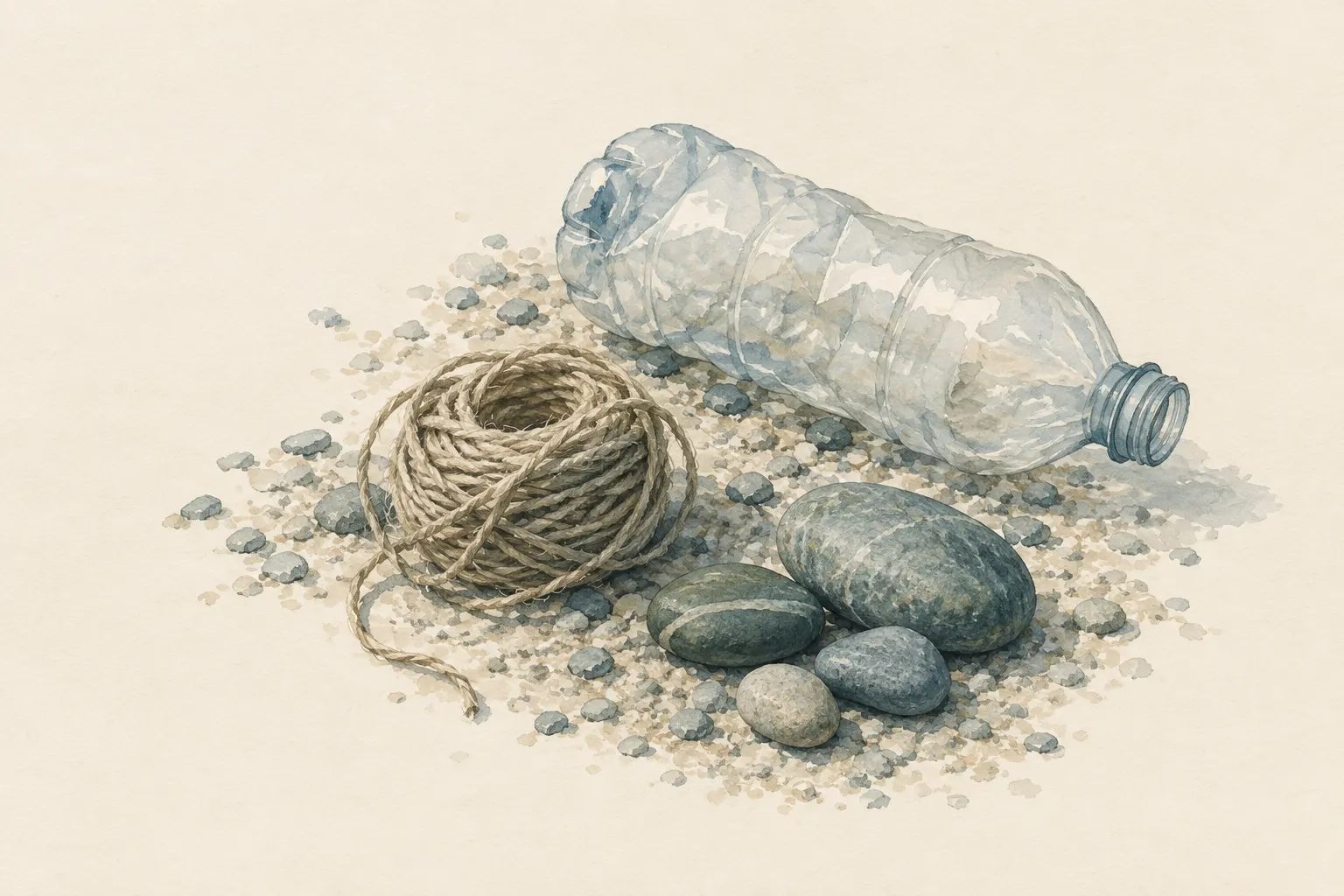
Explained simply
A fish trap is like a maze with an especially clever entrance. The entrance is a funnel: wide outside, narrow inside. A fish swims in easily, but from inside it can hardly find the small hole again. In an emergency you can build such a trap from a plastic bottle by cutting off the top part and pushing it in upside down.
In a shallow stream you can lay two angled walls of stones that lead like a V to a small stone pool. On the coast you build a low stone wall at low tide that fish swim over at high tide. When the water falls again, some stay behind in the pool.
All of this is only for genuine emergencies when someone is in danger to life. Otherwise it is prohibited, because traps can catch far too many animals. Anyone who builds a trap in an emergency checks it morning and evening, releases other animals at once and takes everything down again afterwards.
How it works
Fish do not swim around aimlessly. They follow banks, edges, the margins of weed beds and the current, looking for food and cover. A trap makes use of this: a funnel or two angled walls guide fish to a narrow opening. Behind it lies an enclosed space in which the opening is hard to find from inside because it looks like part of the wall.
In the bottle trap the funnel is the upturned top of the bottle. A little bait inside attracts small fish; they swim in through the neck and then search along the walls for a way out. Small holes in the bottle let water and the smell of the bait flow through.
The tidal stone trap works with the water level instead of a funnel. At high tide the low wall is under water, and fish swim over it near the shore. At low tide the water falls, and fish that turn back too late are left behind in the pool behind the wall.
What really matters
The location matters more than the construction. A trap belongs in calm, shallow water near the bank where small fish are moving anyway: along weed margins, in small bays, in places with slow water. It must lie on the bottom, be weighted and be secured to the bank with a cord so the current cannot carry it away.
With a stone weir in a stream, the wide side of the V faces downstream, and at the narrow point a hand-wide opening leads into the pen. The pen must be closed all round and the stones must lie close enough together. Crucially, the whole stream is never blocked: beside the weir there is always enough passage for water and fish.
A trap is only as good as its checking. Checking morning and evening is the minimum. At every check you decide immediately: young fish, crayfish, frogs, protected or unknown species are released at once; a fish you need is stunned and killed at once.
Safety: what to watch out for
The legal situation is clear: in Austria and Germany traps, weirs and fish pens are prohibited without special authorisation under fishing law, even for anglers with a licence. Only genuine danger to life with no help within reach can justify them. Anyone who can reach help does not build a trap.
The greatest danger to you is the water. Cold water quickly makes hands and feet numb, wet stones are slippery and current can knock you over. Only build in ankle-deep, calm water, never alone in current and never when the level is rising or a storm is coming. On the coast the incoming tide can cut off your way back – know the tide table and keep watching the water.
A forgotten trap keeps killing without anyone gaining from it. That is why every trap and every stone wall is dismantled completely after the emergency: stones back, bottles and cords taken away, rods scattered. Traps that could injure people, and poison, are off limits in every case.
When it makes sense – and when not
A trap only makes sense in a genuine emergency lasting some time, when you stay in one place, water, warmth and shelter are already secured and you can check the trap regularly. Then it works while you deal with other tasks.
In all other cases it is out of place: in a short emergency, when help can be reached, in nature reserves and spawning waters, in fast or cold water and when you have to move on. Realistically a bottle trap only yields very small fish anyway – it does not replace rescue.
Good to know
Stone weirs and traps are among the oldest fishing methods. Remains of old tidal stone traps are found on many coasts of the world, and woven willow traps were used by professional fishers in Europe for centuries. Precisely because these methods can be so effective, they are strictly regulated today.
Knowing about traps also helps you understand the rules: anyone who has seen how a trap keeps catching without supervision understands why anglers may only fish with rod and line, and why bycatch and checking matter so much.
Step by step
Honestly check the emergency
Only build a trap if you are genuinely in danger to life, stuck in one place for a longer time and the emergency call, water, warmth and shelter are dealt with. A person can last much longer without food than without water. If help is in sight or within reach, do not build a trap.
- 1
Honestly check the emergency
Only build a trap if you are genuinely in danger to life, stuck in one place for a longer time and the emergency call, water, warmth and shelter are dealt with. A person can last much longer without food than without water. If help is in sight or within reach, do not build a trap.
- 2
Cut the bottle trap
On a 1.5–2 litre bottle, cut off the top third where the shoulder meets the straight part. Remove the cap, turn the top round and push it into the bottle as a funnel. Fasten it with cord through small holes at the rim and pierce a few small holes in the bottle so water can flow through.
- 3
Set the trap
Put some bait inside, for example worms or insects. Weigh the bottle down with a stone so it lies on the bottom, and place it in calm, shallow water close to the bank with the opening across or facing downstream. Tie it with cord to a branch or stone on the bank. A bottle trap only catches very small fish.
- 4
Trap from willow rods
A funnel trap made from flexible rods is larger: a ring of rods forms the opening, and long rods are tied to it to form a basket that narrows at the back. A second, smaller funnel of short rods points inwards. The gaps must be narrower than the fish. Only cut willow rods where the landowner allows it.
- 5
Stone weir in a shallow stream
Find an ankle-deep, calm spot. Lay two walls of stones that come together like a V, with the wide side facing downstream. At the point leave a hand-wide opening leading into a small stone pen closed all round. Never block the whole stream – fish and water must still be able to pass beside it.
- 6
Tidal stone trap on the coast
On flat, rocky coasts with tides, a low semicircular stone wall is laid in the shallows at low tide, open towards the land. At high tide fish swim over it; at low water some stay behind in the pool. Know the tide table and never let the incoming water take you by surprise.
- 7
Check often
Check every trap at least morning and evening. Release bycatch such as young fish, crayfish, frogs or species you do not know carefully and at once. A fish you keep is stunned at once with a blow to the back of the head and killed with a heart stab or gill cut.
- 8
Dismantle everything completely
As soon as the emergency is over or you move on, dismantle every trap and every wall completely: stones back in place, take bottles, cords and rods with you. A forgotten trap keeps killing, and a weir changes the stream.
Common mistakes
- Building a trap although help can be reached
- Blocking the whole stream
- Not checking the trap for days
- Wading in current or cold water
- Keeping or letting bycatch die
- Leaving bottles and cords by the water
Quick view
Materials
PET bottle (clear, max. 2 litres)
1.5–2 litres
Do not heat or place in a fire.
Knife (fixed or locking blade)
Cut away from your body.
Rules on carrying knives differ by region – check local rules.
Thin twine
Low breaking strength – light loads only.
Suitable for
- A longer emergency at a fixed place with a stream, lake or coast
- When fishing with a hand line is not possible
- Understanding why traps are prohibited
Not suitable for
- Any situation without genuine danger to life
- Fast, deep or cold water you would have to wade into
- Nature reserves and spawning waters
- When you cannot check the trap regularly
Prerequisites
- Genuine danger to life with no help within reach
- Water, warmth and shelter are already secured
- Safe handling of cold, shallow water
Safety
- A trap catches everything that swims in: young fish, protected species, crayfish, amphibians. Check it at least morning and evening, release bycatch at once, stun and kill caught fish at once. After the emergency, dismantle everything completely.
How it works
Fish follow banks, edges and currents. A funnel or two angled stone walls guide them to a narrow opening behind which they end up in an enclosed space. From inside, the narrow opening looks like a wall, so most fish do not find their way back. On the coast the ebb does this job: fish that swim over a stone wall at high tide stay behind in the pool at low tide.
Advantages
- Works while you deal with other things
- A bottle trap is quick to build
- No hook needed
Disadvantages
- Prohibited without authorisation
- Catches bycatch and protected species
- Success is uncertain
- Building in water is cold and slippery
Deep knowledge
Background
Stone weirs and traps are among the oldest fishing methods; remains of tidal stone traps are found on many coasts of the world. The US Army survival manual (FM 3-05.70) describes funnel traps, stone pens in streams and tidal traps on the coast.
Precisely because these methods can be effective and keep catching without supervision, they are reserved for fishers with special authorisation. The states' fishing acts expressly forbid them for anglers.
Variants
- Natural pool
- When water levels fall, fish are sometimes left in cut-off pools. The same applies here: only in a genuine emergency, only from safe, shallow water and only as much as needed.
Common mistakes
- Building a trap although help can be reached
- Blocking the whole stream
- Not checking the trap for days
- Wading in current or cold water
- Keeping or letting bycatch die
- Leaving bottles and cords by the water
Limits and risks
- No instructions for nets or larger fishing installations
- No fish identification
- No tide calculation – use the local tide table
Material alternatives
Derived from material properties: a substitute must have all relevant properties. Observe the notes on the substitute.
- Thin twine
- Rope (Never use unknown or damaged rope for life-safety purposes.), Paracord (Not a climbing or safety rope.), Accessory cord (Use only certified cord after training for life-safety purposes.), Webbing (tubular webbing) (Inspect knotted webbing before every use.), Jute or sisal twine (bought) (Low strength, absorbs water and rots – light loads and practice only.), Tree straps (Load only within the manufacturer's limits.), Monofilament fishing line (Never leave scraps of line behind: birds and other animals get tangled in them and die slowly. Wind up scraps and take them with you.), Thin, soft wire (brass or galvanised steel) (Wire ends are sharp – protect eyes and fingers when bending), Tow rope or tow strap (Attach only to the towing eyes provided by the manufacturer; never stand next to it under load.)
Results come exclusively from structured entries. No improvised instructions are generated.
Sources
Headquarters, Department of the Army (USA) (2002): FM 3-05.70 Survival
Funnel traps, stone pens in streams and tidal traps on the coast
Land Niederösterreich – Rechtsinformationssystem des Bundes (RIS), Landesrecht (2001): NÖ Fischereigesetz 2001
Fishing only with authorisation; fishing gear is regulated by law
Freistaat Bayern – Bayerische Staatskanzlei (gesetze-bayern.de) (2008): Fischereigesetz für Bayern (BayFiG)
Fishing only with a licence and the rights holder's permission
Bundesrepublik Deutschland – Bundesministerium der Justiz (gesetze-im-internet.de) (2006): Tierschutzgesetz (TierSchG) in der Fassung der Bekanntmachung vom 18. Mai 2006
Protection of vertebrates from avoidable pain and suffering
U.S. National Oceanic and Atmospheric Administration (NOAA) – National Ocean Service: Tides and Water Levels (NOAA Ocean Service Education tutorial)
Tides and water levels