Killing, gutting and cooking fish over a fire
A caught fish is stunned and killed at once, then scaled, cut open from the vent to the gills and gutted. The dark kidney along the backbone is scraped out, the fish kept cool and eaten the same day. Over a fire you cook it on a stick, on a wooden plank or in clay – always right through, because freshwater fish can carry parasites. Scraps go far away from camp.
- Gutting 5–10 minutes; cooking 15–40 minutes depending on size
Explained simply
When a fish has been caught, things must happen quickly so it does not suffer. First it gets a firm blow to the back of the head, which makes it unconscious. Straight afterwards it is killed with the knife. That is not nice, but it is the kindest way for the fish.
Then the fish is cleaned: scrape off the scales, cut open the belly, take out the innards and the gills and scrape out the dark strip along the inside of the back. Then it is cooked over the fire – on a stick, on a board or wrapped in clay – until the flesh inside is completely white and comes away easily from the bones.
Fish spoils quickly, so you eat it the same day. Watch out for bones while eating. And carry the scraps far away from camp, otherwise animals come in the night wanting their share.
How it works
A firm blow to the back of the head, just behind the eyes, strikes the brain and makes the fish unconscious at once. The heart stab or the cut through the gill arches then kills it while it is stunned. Bleeding out makes the flesh lighter and keeps it fresh longer. In Germany the Animal Welfare Slaughter Regulation expressly requires this order – first stun, then kill.
Gut and gills contain most of the bacteria and spoil first. That is why they are removed as soon as possible after killing. The dark kidney along the backbone is full of blood, tastes bitter and also spoils quickly; it is scraped out.
During cooking, heat kills bacteria and parasites. What counts is the temperature inside the fish, not the colour outside. Embers give off even radiant heat, whereas open flames burn the skin before the inside is cooked.
What really matters
When slitting, insert the knife tip only shallowly into the vent and cut with the edge facing up to between the gills. That way you do not damage the gut, whose contents would otherwise soil the flesh. Pull the innards out with your fingers from the head end, then the gills. Finally scrape out the kidney with your thumbnail or a spoon and rinse the fish with treated water.
For cooking, let the fire burn down to embers. On a spit, push the fish lengthwise along the backbone onto a fresh green-wood stick, which does not burn so quickly, and stand it at an angle beside the embers. On a plank, open out the fish and fix it with wooden pegs. Wrapped in clay – about two centimetres thick – it lies directly in the embers, and when you break it open the skin and scales come off with it.
The fish is done when the flesh at the thickest part is opaque throughout and comes away easily from the backbone. With a thermometer it is at least 63 °C at the centre – as the US food safety agency USDA FSIS recommends. If the flesh is still glassy inside, keep cooking.
Safety: what to watch out for
Freshwater fish can carry parasites, for example fish tapeworm. That is why fish from streams and lakes is never eaten raw or half-raw. Thorough cooking makes it safe. Do not eat fish with cloudy, sunken eyes, grey or brown gills, soft flesh or an unpleasant smell – nor fish floating dead in the water, or fish from waters with warnings about pollutants or algal blooms.
Hygiene protects against diarrhoea: wash hands, knife and board after gutting, never leave raw fish next to cooked food and only use treated water for washing. These are exactly the WHO Five Keys to Safer Food: keep clean, separate, cook thoroughly, store safely, use safe water.
The slippery fish slides away easily, so work on a firm surface and cut away from the holding hand. Stones from a stream do not belong in the fire, because trapped water can make them burst when heated. And when eating, especially with children, watch out for bones.
When it makes sense – and when not
Cooking over the fire is worthwhile for any fish you have caught lawfully – or in a genuine emergency. It needs only a knife, a fire and some clean water. A pot is a good alternative: small fish in pieces are boiled, and the broth provides extra nutrients.
There is hardly any refrigeration outdoors, so only catch and kill as much as you can eat the same day. Preserving by smoking or drying takes experience and is not part of this entry. If in doubt about freshness or the water, the fish is not eaten.
Good to know
Fish scraps attract animals: foxes, martens, wild boar and, in some regions, bears. That is why you take innards, gills and bones far from camp, from the water and from paths and bury them there where that is allowed, or take them away packed. Then wash your hands and store leftover food out of animals' reach.
For wrapping: aluminium foil or clay are safer than leaves. Anyone who uses leaves only takes ones they know for certain to be non-toxic – if in doubt, never. And the sticks for the spit come from wood you know and are allowed to cut.
Step by step
Stun at once
Hold the fish firmly with a wet cloth on a hard surface and at once strike it once or twice hard on the back of the head, just behind the eyes, with the priest or a short hardwood club. The fish is stunned when it no longer moves and its eyes no longer roll when you tilt it.
- 1
Stun at once
Hold the fish firmly with a wet cloth on a hard surface and at once strike it once or twice hard on the back of the head, just behind the eyes, with the priest or a short hardwood club. The fish is stunned when it no longer moves and its eyes no longer roll when you tilt it.
- 2
Kill: heart stab or gill cut
Straight afterwards, stab with the knife tip behind the gill cover from below into the throat, where the heart lies between the gills, or cut through the gill arches on one side. The fish bleeds out; the flesh becomes lighter and keeps longer.
- 3
Remove slime and scales
Rinse off the slime with clean water. Scrape off the scales with the back of the knife from the tail towards the head. Fish with very small scales such as trout can also be cooked with the scales on and the skin pulled off afterwards.
- 4
Slit the belly and gut
Insert the knife tip shallowly into the vent and cut along the belly with the edge facing up to between the gills – only deep enough not to cut into the gut. Pull the innards out with your fingers from the head end and remove the gills.
- 5
Scrape out the kidney and check
Along the backbone lies a dark, bloody strip, the kidney. Scrape it out completely with your thumbnail or a spoon and rinse the fish inside and out with treated water. If the flesh looks blotchy or you see worms, discard the fish when in doubt.
- 6
Work hygienically and keep cool
Wash your hands, knife and board after gutting and keep raw fish separate from cooked food. Until cooking, the fish lies in the shade wrapped in a damp cloth or in a bag in cold water – and is eaten the same day.
- 7
Cook over the fire
Let the fire burn down to embers. Push the fish lengthwise along the backbone onto a fresh green-wood stick, or open it out and clamp it in a split stick, and stand it at an angle beside the embers, not in the flames. Alternatively, fix the opened fish with wooden pegs to a wooden plank leaning towards the embers, or coat the gutted fish in about 2 cm of clay and lay it in the embers. Turn it regularly.
- 8
Check that it is done
The fish is done when the flesh at the thickest part is opaque throughout and comes away easily from the backbone with a little stick; with a thermometer it is at least 63 °C at the centre. Break open a clay coating and lift the skin and scales off with it. If it is still glassy inside, keep cooking.
- 9
Dispose of scraps far away
Innards, gills and bones attract animals into camp. Take them far from camp, from the water and from paths and bury them there where that is allowed, or take them away packed. Then wash your hands and store leftover food out of animals' reach.
Common mistakes
- Leaving the fish alive or letting it suffocate
- Cutting into the gut when slitting the belly
- Not scraping out the kidney along the backbone
- Leaving fish in the sun for hours
- Cooking in open flames – black outside, raw inside
- Using unknown leaves for wrapping
- Throwing innards away next to the tent
Quick view
Materials
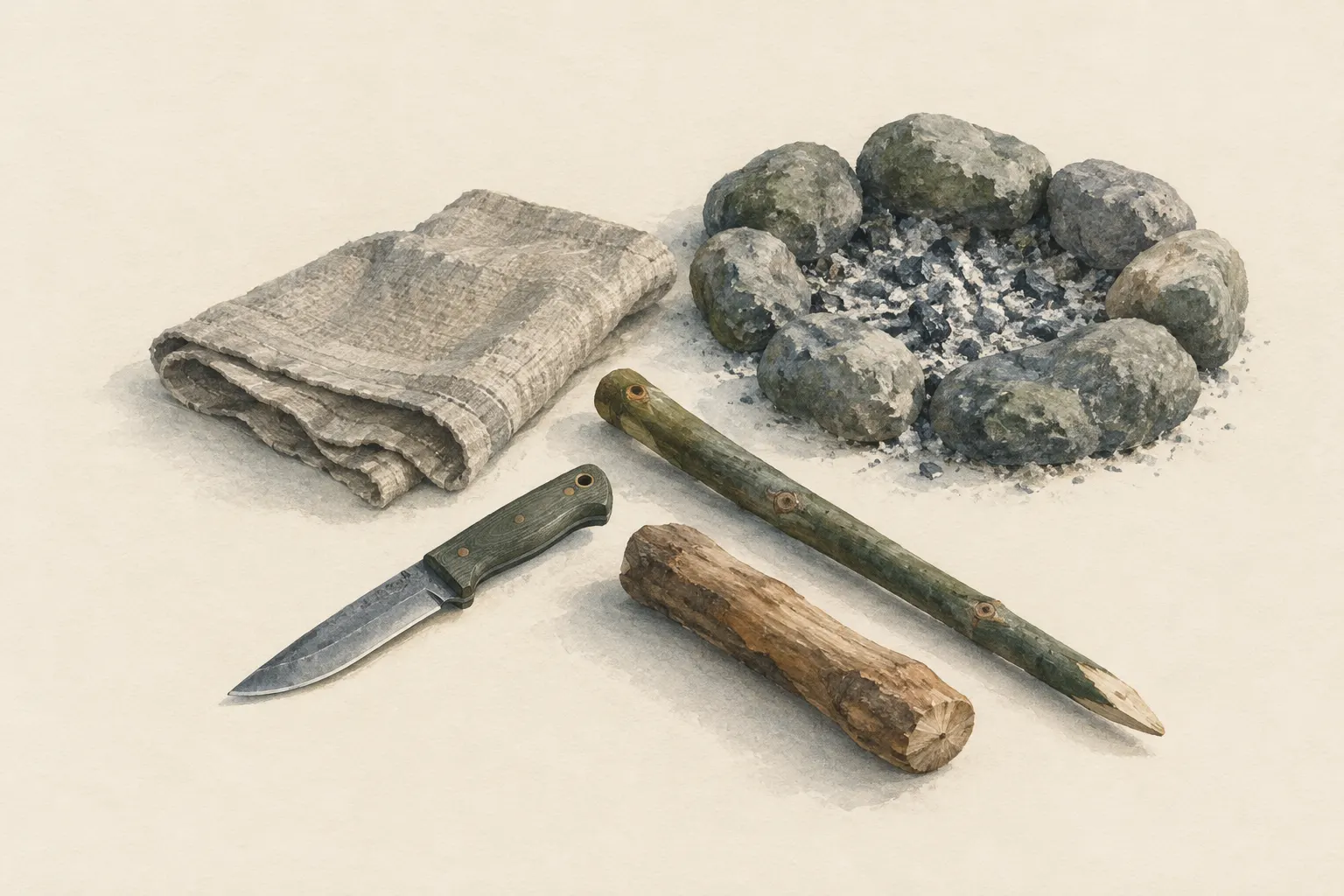
Fish priest (club for stunning fish)
Or a short hardwood club
Intended only for quickly stunning caught fish. A short, solid hardwood club does the same job.
Knife (fixed or locking blade)
Cut away from your body.
Rules on carrying knives differ by region – check local rules.
Dry firewood
Collect only where permitted.
Lighter, matches or ferro rod
Observe local fire bans.
Sturdy sticks / poles
Spit of fresh green wood or a plank
Do not cut live wood where prohibited.
Aluminium foil (heavy-duty)
Edges can be sharp; conducts heat and electricity.
Small trowel
For burying scraps
Suitable for
- Fish you have caught yourself when camping
- Cooking without a kitchen
- Emergencies with fish caught
Not suitable for
- Fish found floating dead or smelling spoiled
- Fish from waters with warnings about pollutants or algal blooms
- Eating raw
Prerequisites
- A lawfully caught fish – or a genuine emergency
- Safe handling of knife and fire
- Clean, treated water for washing
Safety
- Fish spoils quickly. Kill caught fish at once, gut it, keep it cool in the shade and eat it the same day. Do not eat fish with cloudy, sunken eyes, grey gills, soft flesh or an unpleasant smell.
- The slippery fish slides away easily. Work on a firm surface, cut with the edge away from your body and from the holding hand, and hold the fish with a cloth if necessary.
- Do not put stones from streams or wet ground into the fire: trapped water can make them burst when heated. Warn children about bones.
How it works
A quick blow to the back of the head makes the fish unconscious; the heart stab or gill cut kills it while it is stunned. Gut and gills contain most of the germs and spoil first, so they come out quickly. Cooking with enough heat right to the centre kills bacteria and parasites; embers cook more evenly than open flames.
Advantages
- Fish provides plenty of protein
- Preparation needs only a knife and fire
- Quick killing spares the animal suffering
Disadvantages
- Spoils quickly without refrigeration
- Scraps attract animals
- Bones and parasites require care
Deep knowledge
Background
The US Army survival manual (FM 3-05.70) describes gutting fish quickly, removing the gills and the blood line along the backbone and warns against spoiled fish. The WHO Five Keys to Safer Food sum up hygiene: keep clean, separate raw and cooked, cook thoroughly, keep food at safe temperatures, use safe water.
The US food safety agency USDA FSIS gives a core temperature of 145 °F, about 63 °C, for fish. In Germany the Animal Welfare Slaughter Regulation requires fish to be stunned before killing.
Variants
- In aluminium foil
- Wrap the gutted fish twice in heavy aluminium foil and lay it in the embers. This is safer than wrapping in leaves: only use leaves you know for certain to be non-toxic – if in doubt, use foil or clay.
- In a pot
- Small fish can be boiled in pieces in a pot. The broth contains nutrients and is eaten as well. This also works on a stove.
Common mistakes
- Leaving the fish alive or letting it suffocate
- Cutting into the gut when slitting the belly
- Not scraping out the kidney along the backbone
- Leaving fish in the sun for hours
- Cooking in open flames – black outside, raw inside
- Using unknown leaves for wrapping
- Throwing innards away next to the tent
Limits and risks
- No fish identification and no information on poisonous sea fish
- No preserving by smoking or drying
- No information on pollution of individual waters
Material alternatives
Derived from material properties: a substitute must have all relevant properties. Observe the notes on the substitute.
- Dry firewood
- Tinder (Carry in waterproof packaging.), Char cloth (charred cotton) (Store dry in a tin.), Finest-grade steel wool (Store separately from batteries – fire risk.), Fatwood (resin-rich wood) (Collect only dead wood where permitted.), Stove fuel (canister, liquid fuel, alcohol) (Store fuels apart from food and in original containers or bottles intended for them.), Petroleum jelly cotton balls (Use only pure cotton.), Cooking oil or cooking fat (tallow, lard) (Never put out burning fat with water – cover it with a lid to smother it.), Tree resin (spruce, pine) (Resin is flammable and sticks to the skin when hot – melt it only slowly over low heat.), Birch bark (from dead, fallen wood) (Never peel from living trees.)
- Lighter, matches or ferro rod
- Ferro rod (Practise before you need it.), Fire striker and hard stone (Carbon steel, not stainless.), Bow drill set (bow, spindle, hearth board, bearing block) (Use only dry wood.), Burning lens / magnifier (Never leave lying in the sun – fire risk.), Fire piston (Maintain the seal.), Pump drill (spindle, flywheel, crossbar, cord) (Fix the flywheel firmly and centrally – a loose disc can fly off.)
- Aluminium foil (heavy-duty)
- Emergency blanket (Tears easily once punctured; short-term shelter only.), Signal mirror (Do not flash into the eyes of people nearby or of drivers.), High-visibility vest (Keep within reach inside the cabin, not in the boot/trunk.), Warning triangle (Whether warning triangles are mandatory, or should be placed at all on certain roads (e.g. motorways), differs between countries – check local rules.)
Results come exclusively from structured entries. No improvised instructions are generated.
Sources
Headquarters, Department of the Army (USA) (2002): FM 3-05.70 Survival
Gutting fish, removing gills and blood line, recognising spoiled fish
World Health Organization (WHO) (2006): Five Keys to Safer Food Manual
Keep clean, separate raw and cooked, cook thoroughly, store safely
United States Department of Agriculture – Food Safety and Inspection Service (USDA FSIS): Safe Minimum Internal Temperature Chart
Core temperature for fish 145 °F (63 °C)
U.S. Food and Drug Administration (FDA) (2012): Bad Bug Book: Handbook of Foodborne Pathogenic Microorganisms and Natural Toxins, 2nd edition
Parasites in fish, e.g. fish tapeworm
Bundesrepublik Deutschland – Bundesministerium der Justiz (gesetze-im-internet.de) (2012): Verordnung zum Schutz von Tieren im Zusammenhang mit der Schlachtung oder Tötung und zur Durchführung der Verordnung (EG) Nr. 1099/2009 des Rates (Tierschutz-Schlachtverordnung – TierSchlV)
Stunning fish before killing
Republik Österreich – Rechtsinformationssystem des Bundes (RIS) (2004): Bundesgesetz über den Schutz der Tiere (Tierschutzgesetz – TSchG), BGBl. I Nr. 118/2004
Prohibition on causing animals unjustified pain, suffering or harm