Fishing: law, licences and animal welfare
Fish do not simply belong to whoever catches them. In Austria and Germany you need two things to fish: an official licence (Fischerkarte or Fischereischein) and the permission of whoever holds the fishing rights on that water. On top of that come closed seasons, minimum sizes and banned methods. Every fish you keep is stunned and killed at once. Fishing without permission can only be justified in genuine danger to life.
- Course and exam once; read the rules before every fishing day
Explained simply
Imagine apples growing in your neighbour's garden. Even if they hang over the fence, you may not simply pick them. Fish are similar: every body of water belongs to someone, or someone has the right to fish there. Anyone who wants to fish needs the permission of that person or that club.
You also have to show that you know how to fish properly. For this there is the Fischerkarte in Austria and the Fischereischein in Germany. In the course you learn which fish are protected, when they have their young and must therefore be left alone, and how big a fish must be before you may keep it.
But the most important thing is the fish itself. A fish can feel pain. If you keep a fish, you stun it at once with a firm blow to the head and kill it straight afterwards. Fishing without permission is only allowed if someone is really in danger to life and no help can come.
How it works
In Austria each of the nine federal states regulates fishing in its own fishing act, in Germany each of the sixteen Länder. That is why the rules in Tyrol differ from those in Lower Austria, and those in Bavaria from Brandenburg. All share the basic principle: anyone who fishes needs a personal licence and permission for the specific water.
The personal licence is called the official Fischerkarte in Austria and the Fischereischein in Germany. Usually you get it after a course or exam covering fish biology, waters, equipment, law and animal welfare. For visitors and holidaymakers many states offer time-limited licences with simpler requirements.
Permission for the water is issued by the holder of the fishing rights – often a club or tenant, sometimes the state or a landowner. It is called a licence, permit, fishing card or day ticket. With it you also get the water's rules, which state exactly what is allowed on that water.
What really matters
Closed seasons protect fish while they spawn, that is, lay their eggs. During this time they are especially vulnerable, and every fish caught is missing from the next generation. Minimum sizes make sure a fish has been able to spawn at least once before it is taken. Some species are protected all year because they have become rare.
Banned methods are usually those that catch too many fish at once or cause unnecessary suffering: nets, traps, snares, spears, snagging hooks, light to attract fish, poison and explosives. As a rule only the rod and line with a limited number of rods and hooks is allowed. The state law and the water's rules say exactly what applies.
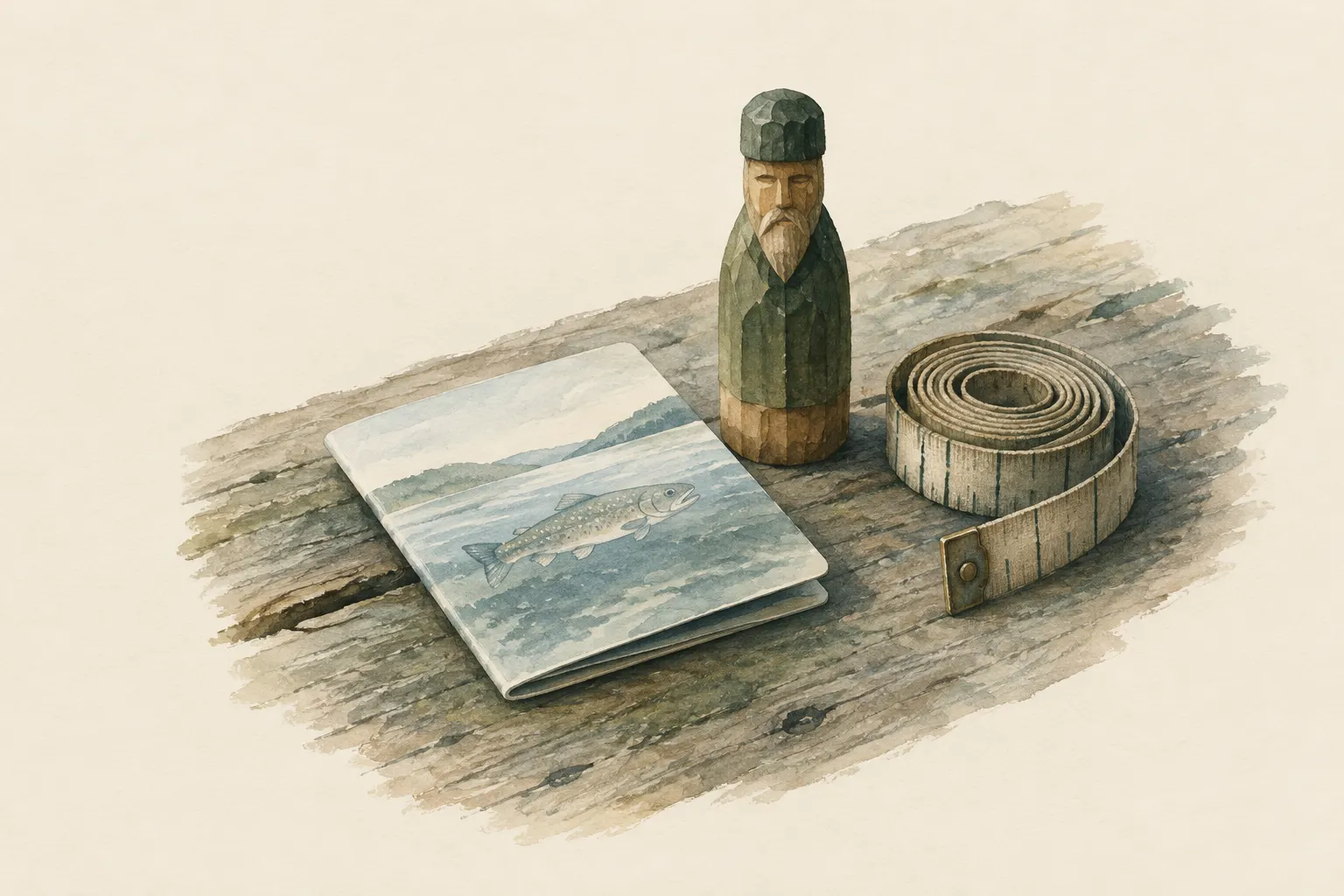
Fishing properly includes the right equipment: a priest, a sharp knife, a hook remover, a measuring tape and a landing net. With these you can measure every fish quickly, unhook it gently and – if you keep it – kill it at once. On many waters you also have to enter every fish you take in a catch log.
Safety: what to watch out for
Fishing without authorisation is not a minor matter. Depending on the state and the case it is an administrative offence or a crime, and fishing gear can be confiscated. Fishery wardens check licences, gear and catches. A genuine emergency – for example when someone is stuck for days and no help can be reached – can justify fishing for food, but only as far and as long as is really necessary.
Animal welfare always applies too. A fish must not flap about in the air for long, must not lie alive in a bag or a bucket without water and must not bleed out without being stunned. Anyone who releases fish does it quickly, with wet hands and preferably in the water. Catching fish just for fun and releasing them is legally delicate in Germany, because a reasonable cause is needed for dealing with vertebrates in this way.
By the water itself the usual dangers lurk: slippery stones, undercut banks, current and cold water. Do not fish alone at dangerous spots, do not wade into fast water and never leave children unsupervised. In an emergency dial 112, in Austria also 144.
When it makes sense – and when not
The course for the fishing licence is worthwhile for anyone who wants to fish regularly and for anyone who takes fishing seriously as part of their emergency knowledge. It teaches exactly the knowledge that also helps in an emergency: where fish hold, how to handle them gently and how to kill and prepare them properly.
In a genuine emergency there is a clear order: first the emergency call and safety, then protection from cold or heat, then drinking water, and only then food. A healthy person can last many days without food, but only a short time without water and warmth. Anyone near help waits for help and does not fish without permission.
Good to know
Fishing rights are often very old and tied to land. Many clubs stock their waters with young fish, look after banks and spawning grounds and pay wardens. The price of a day ticket contributes to this. Anyone who buys a ticket often also gets valuable tips on where and how to fish on that water.
Before travelling, check the rules of the destination country. Some countries allow fishing on certain coasts without a licence, while inland a permit is needed almost everywhere. Tourist offices, tackle shops and clubs usually know where to get tickets. This entry is not legal advice – the current laws and water rules always apply.
Step by step
Get the official licence
In Austria each federal state issues the official fishing licence (Fischerkarte), usually after a course or exam; many states offer visitors a time-limited guest licence. In Germany you need a fishing licence (Fischereischein) under state law, usually after passing the fishing exam. Some states have exceptions, for example for accompanied children or for holidaymakers – this is in the state's fishing act.
- 1
Get the official licence
In Austria each federal state issues the official fishing licence (Fischerkarte), usually after a course or exam; many states offer visitors a time-limited guest licence. In Germany you need a fishing licence (Fischereischein) under state law, usually after passing the fishing exam. Some states have exceptions, for example for accompanied children or for holidaymakers – this is in the state's fishing act.
- 2
Get permission for the water
Every body of water has a holder of the fishing rights: a club, a tenant, the state or a landowner. You buy the licence, day ticket or permit from them. Only the official licence and the permit together allow you to fish – carry both with you while fishing.
- 3
Read the water's rules
The permit or the water's rules list fishing times, permitted stretches, the number of rods and hooks, permitted baits, daily catch limits and whether a catch log must be kept. Read them before your first cast, not afterwards.
- 4
Check closed seasons and minimum sizes
Many species may not be caught during their spawning time (closed season), and a fish may only be kept if it reaches the minimum size – measured from the tip of the head to the end of the tail fin. Some species are protected all year round. Unhook undersized or protected fish gently with wet hands in the water and release them at once.
- 5
Know the banned methods
As a rule anglers are not allowed to use: nets and traps, snares, spears, snagging, artificial light to attract fish, poison and explosives, and in some states also live bait fish. Usually only the hand-held rod or line with a limited number of hooks is permitted. The state law and the water's rules set out exactly what applies.
- 6
Take the required equipment
Typically required or strongly advisable: a fish priest, a sharp knife, a hook remover, a measuring tape, a landing net and the catch log. That way you can measure every fish quickly, unhook it gently or kill it at once.
- 7
Kill humanely
A fish you keep is stunned at once with a firm blow to the back of the head and then killed by a heart stab or gill cut. Animal welfare law and fishing law require this. A fish must not bleed out or suffocate without being stunned.
- 8
In a genuine emergency
If you are genuinely in danger to life and without help, fishing for food can be justified as necessity. Even then, the emergency call, shelter, warmth and water come first – a person lasts much longer without food than without water. Catch only what you really need, kill quickly, take down every device afterwards and report to the holder of the fishing rights or the authorities later.
Common mistakes
- Having a permit but no licence – or the other way round
- Reading the water's rules only after the catch
- Letting fish suffocate on the bank
- Handling undersized fish with dry hands or throwing them on the ground
- Leaving scraps of line and hooks on the bank
- Using emergency as an excuse although help can be reached
Quick view
Materials
Fish priest (club for stunning fish)
Required by many water rules
Intended only for quickly stunning caught fish. A short, solid hardwood club does the same job.
Knife (fixed or locking blade)
For the heart stab or gill cut
Cut away from your body.
Rules on carrying knives differ by region – check local rules.
Tape measure or folding rule
Check the minimum size
Field notebook and pencil
Catch log
Suitable for
- Anyone who wants to learn to fish
- Preparing trips on which you plan to fish
- Parents going fishing with children
Not suitable for
- As legal advice for a specific case – the state law and the water's rules are what count
- As an excuse for fishing without permission
Prerequisites
- Official fishing licence (Austria: Fischerkarte; Germany: Fischereischein), unless an exception applies
- Permit, licence or day ticket for the specific water
- Knowledge of the water's rules
Safety
- Fish are vertebrates and protected by animal welfare law. Anyone who keeps a fish stuns it at once and then kills it. Never leave fish alive on the line, in a bag or lying out of the water.
- Near water there is a risk of slipping, cold and current. Do not wade alone into cold or fast water, never leave children unsupervised on the bank, and in an emergency call 112 (in Austria also 144).
How it works
In Austria fishing law is a matter for the federal states, in Germany for the Länder. It separates two questions: may this person fish at all (licence after a course or exam)? And may they fish in this particular water (permission of the holder of the fishing rights)? Closed seasons, minimum sizes and bans on methods protect fish stocks; animal welfare law protects the individual fish from unnecessary suffering.
Advantages
- Protects fish stocks and waters
- Course and exam teach species knowledge and animal welfare
- Legal certainty when fishing
Disadvantages
- Rules differ between states and waters
- Course, exam and permits cost time and money
Deep knowledge
Background
Fishing law has a long tradition in Central Europe: the right to fish is tied to the water or to land ownership and is often leased to clubs that take care of stocking, maintenance and control. That is why a day's fishing costs a ticket, and why there are fishery wardens who check licences and catches.
The animal welfare law of both countries protects all vertebrates. In Germany the Animal Welfare Slaughter Regulation requires fish to be stunned before killing; the Animal Welfare Act requires a reasonable cause for killing a vertebrate, usually use as food. Austria's Animal Welfare Act prohibits causing animals unjustified pain, suffering or harm.
Variants
- Abroad
- Other countries have other rules: some allow fishing on certain coasts without a licence, while inland a permit is needed almost everywhere. Ask the tourist office, authorities or a fishing club before you travel.
- With children
- Many states allow children to fish accompanied by an adult who holds a licence, sometimes with their own youth licence. Children learn best from the start how to measure, release gently and kill quickly.
Common mistakes
- Having a permit but no licence – or the other way round
- Reading the water's rules only after the catch
- Letting fish suffocate on the bank
- Handling undersized fish with dry hands or throwing them on the ground
- Leaving scraps of line and hooks on the bank
- Using emergency as an excuse although help can be reached
Limits and risks
- No legal advice – state laws, regulations and water rules change
- No list of closed seasons and minimum sizes – these are in the state regulations and on the permit
Sources
Land Niederösterreich – Rechtsinformationssystem des Bundes (RIS), Landesrecht (2001): NÖ Fischereigesetz 2001
Fishing law as state law, licence and permission of the rights holder (example Lower Austria)
Land Tirol – Rechtsinformationssystem des Bundes (RIS), Landesrecht (2002): Tiroler Fischereigesetz 2002
Fishing licence, fishing rights, closed seasons and minimum sizes (example Tyrol)
Freistaat Bayern – Bayerische Staatskanzlei (gesetze-bayern.de) (2008): Fischereigesetz für Bayern (BayFiG)
Fishing licence and permit under state law (example Bavaria)
Bundesrepublik Deutschland – Bundesministerium der Justiz (gesetze-im-internet.de) (2012): Verordnung zum Schutz von Tieren im Zusammenhang mit der Schlachtung oder Tötung und zur Durchführung der Verordnung (EG) Nr. 1099/2009 des Rates (Tierschutz-Schlachtverordnung – TierSchlV)
Stunning fish before killing
Bundesrepublik Deutschland – Bundesministerium der Justiz (gesetze-im-internet.de) (2006): Tierschutzgesetz (TierSchG) in der Fassung der Bekanntmachung vom 18. Mai 2006
Protection of vertebrates, reasonable cause for killing
Republik Österreich – Rechtsinformationssystem des Bundes (RIS) (2004): Bundesgesetz über den Schutz der Tiere (Tierschutzgesetz – TSchG), BGBl. I Nr. 118/2004
Prohibition on causing animals unjustified pain, suffering or harm
Headquarters, Department of the Army (USA) (2002): FM 3-05.70 Survival
In survival, getting food ranks below water and shelter