Ice fishing – only on safe ice
In ice fishing you fish through a small hole in the ice with a short line and bait just above the bottom. The greatest danger is not the cold but the ice itself: only on ice that the responsible authority has opened and where ice fishing is allowed, never alone, with ice picks around your neck and a rope. Holes stay small and are marked when you leave.
- Half a day with preparation; in cold only short sessions
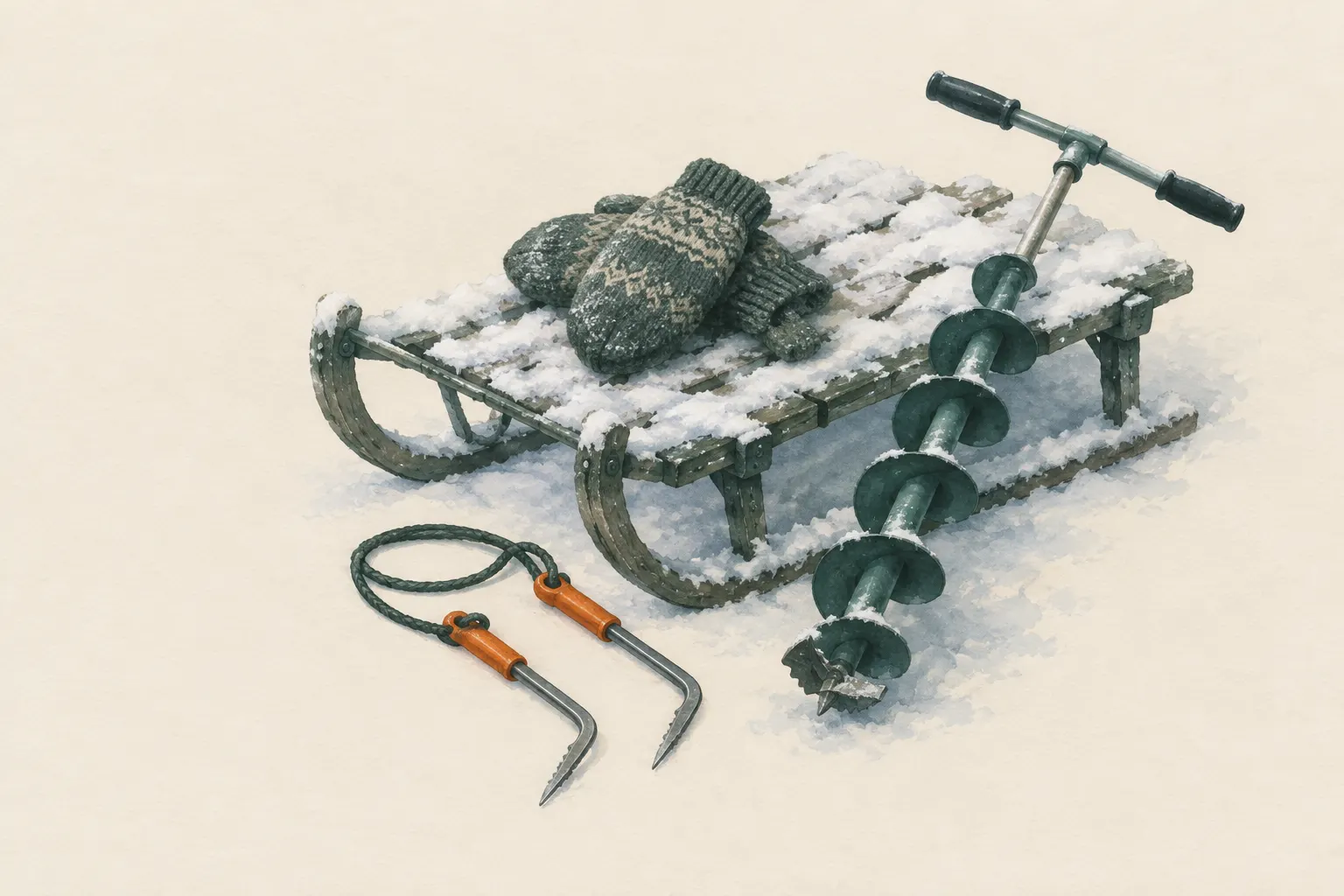
Explained simply
When a lake freezes in winter, the fish keep swimming under the ice. In ice fishing you drill a small hole in the ice and lower a short line with bait to just above the bottom. That is where fish wait in winter, because the water down there is a little warmer.
The greatest danger in ice fishing is not the fish and not even the cold, but the ice itself. You cannot see from above whether ice will hold. That is why you only go onto ice that the municipality or another responsible authority has opened – and never alone.
Around your neck you wear two ice picks. If you fall through, you drive them into the ice and pull yourself out flat. Then you roll away instead of standing up. When you leave, you stick a branch in your hole so nobody steps into it.
How it works
Water is heaviest at about 4 °C. In winter this water sinks to the bottom, while colder water stays at the top and freezes. That is why it is warmer at the bottom of a lake than directly under the ice. Many fish then stay in deeper water, move little and feed more slowly.
For ice fishing you do not need a long rod. A short line with a small hook and maggots or a small ice jig is enough. Let the bait sink to the bottom, raise it a hand's width and move it slowly up and down every few seconds. This movement attracts fish nearby.
A hole only weakens the ice a little as long as it is small. A diameter of about 15 centimetres is enough for most fish. Distance between the holes and between people spreads the weight and stops the ice from being overloaded in one spot.
What really matters
Everything begins on land. Find out whether the ice has been opened and whether ice fishing is allowed on that water – many waters ban it. You also need your fishing licence and the permit. Tell someone where you are and when you plan to be back.
You carry the safety gear on your body, not in the backpack: ice picks within reach around your neck, the phone packed waterproof in an inside pocket. Your partner carries a throw line. A complete change of clothes is ready in a dry bag, because anyone who gets wet needs dry things at once.
On the ice, walk one behind the other several metres apart and avoid all places where the ice may be weaker: inlets, outlets, reeds, jetties, dark patches and water on the ice. At the drill hole you see how thick the ice really is. If it is thinner than locally required, go back.
Safety: what to watch out for
Anyone who falls through first experiences cold shock: you gasp uncontrollably. This passes after a short time. Try to keep your head above water and do not fight wildly. Then turn to the side you came from – the ice held you there. With the ice picks, pull yourself flat onto the ice, kick with your legs and then roll away from the hole. Only stand up on safe ground.
If someone else falls through, you do not follow them. Call 112, in Austria also 144, and help from the shore or from safe ice: throw a rope, reach out a branch or pole, lie down flat to spread your weight. Anyone who has been in icy water always needs medical help, even if they feel fine.
Cold is the second big danger. Wet hands, wind and sitting still for a long time quickly lead to frostbite and hypothermia. And in an ice tent or windbreak a stove, barbecue or heater must never burn without good ventilation – carbon monoxide is invisible, odourless and deadly.
When it makes sense – and when not
Ice fishing is for experienced anglers on waters where it is expressly allowed and the ice has been opened. With good winter gear, a partner and clear rules it can be a quiet, beautiful experience.
It is not suitable on flowing water, during thaw, on ice with water on the surface, on snow-covered ice of unknown thickness, alone, in the dark or with small children. In a winter emergency, warmth, shelter and getting help are far more important than a fish – nobody should risk their life on unsafe ice for a meal.
Good to know
This entry deliberately gives no general minimum ice thickness. Clear ice, cloudy snow ice, ice over currents or springs and ice during thaw carry very different loads. A single number would give false security. What counts is the local opening of the ice and what you see at the drill hole.
A freshly drilled hole freezes over only thinly and is quickly covered by snow. For walkers, children and dogs it then becomes a trap. That is why you stick a branch in it when you leave, or mark it in the locally usual way, and take all rubbish and scraps of line with you.
Step by step
Check opening and permission
Check beforehand with the municipality, the holder of the fishing rights or the club whether the ice has been opened and whether ice fishing is allowed on this water. Many waters ban it entirely. Without both you do not go onto the ice.
- 1
Check opening and permission
Check beforehand with the municipality, the holder of the fishing rights or the club whether the ice has been opened and whether ice fishing is allowed on this water. Many waters ban it entirely. Without both you do not go onto the ice.
- 2
Put on the safety gear
Ice picks hang within reach around your neck, your partner carries the throw line, the phone is packed waterproof on your body. A change of clothes is in a dry bag on the shore or on the sledge. Tell someone on land where you are and when you plan to be back.
- 3
Walk onto the ice with spacing
Walk one behind the other several metres apart, not as a group. Avoid inlets, outlets, reeds, jetties, dark patches and places with water on the ice. If the ice cracks or crackles, turn back at once along the same track.
- 4
Drill a small hole
Drill a hole about 15 cm across with the ice auger – no bigger than necessary. Check the ice thickness at the hole: if it is less than locally required, go back at once. Keep several metres between this hole and the next and other people. Scoop out slush with a ladle.
- 5
Short line, bait just above the bottom
Lower a small bait, for example maggots on a small hook or a small ice jig, on a short line to the bottom and then raise it a hand's width. Every few seconds lift it slowly and let it sink again. A bite shows as a tug or suddenly slack line – then strike briefly.
- 6
Protect against the cold
Sit or kneel on an insulating mat, never directly on the ice. Wear thin gloves for handling with mittens over them, and change wet gloves at once. Stand up and move regularly, drink something warm and stop before anyone gets very cold.
- 7
Deal with the catch
Pull the fish up through the hole steadily. If you keep it, stun it at once with a blow to the back of the head and kill it with a heart stab or gill cut. Return undersized or protected fish quickly through the hole without holding them long in the cold air.
- 8
Mark the hole and go back
A freshly drilled hole freezes over only thinly and gets covered by snow – a trap for others. When you leave, stand a branch or marker in or next to the hole where that is the local custom, take all rubbish and scraps of line with you and walk back along the known track.
Common mistakes
- Judging ice by its colour, recent cold or other people's tracks
- Going onto the ice alone
- Ice picks in the backpack instead of around the neck
- Large holes or many holes close together
- Sitting directly on the ice
- Gas stove or heater in a closed ice tent
- Leaving holes unmarked
Quick view
Materials
Ice picks (ice rescue awls)
Within reach around the neck
They belong within reach around the neck or on the chest, not in the backpack. Keep the points covered when carrying them.
Rope
Throw line, at least 15 m
Never use unknown or damaged rope for life-safety purposes.
Ice auger (hand auger)
The auger blades are very sharp – only remove the guard to drill and never leave the auger lying on the ice where someone can trip over it.
Mini fishing kit (survival fishing kit)
Hooks are sharp and barbed – always keep them covered in the kit, e.g. in a piece of cork or a small tin.
Sleeping pad
For sitting and kneeling
Gloves and mittens
Mobile phone
Packed waterproof, carried on the body
The battery drains quickly in cold and with continuous screen and GPS use.
Do not plan on it as your only means of navigation or emergency calls.
Dry spare clothing
Complete change in a dry bag
Carry it in waterproof packaging – wet clothing barely insulates.
Suitable for
- Still waters with opened ice where ice fishing is allowed
- Experienced anglers with good winter gear
Not suitable for
- Flowing water, inlets, outlets, reed zones
- Ice whose load capacity you do not know for certain
- Thaw, ice with water on the surface, snow on thin ice
- Alone, in the dark or with small children
Prerequisites
- Official opening of the ice and permission for ice fishing on that water
- Fishing licence and permit
- At least one other person
- Know how to self-rescue from the ice
How it works
In winter many fish stay in deeper water near the bottom, where it is a little warmer and they move little. A small bait moved slowly up and down just above the bottom attracts them. A hole only weakens the ice a little if it stays small and has enough distance to the next hole and to other people.
Advantages
- In winter fish can be targeted in deep spots
- Little gear needed for the fishing itself
Disadvantages
- Danger to life from falling through and cold
- Only on opened ice and where allowed
- Long exposure to cold
Deep knowledge
Background
Ice fishing has a long tradition in northern countries and is often firmly regulated there. In Central Europe many waters only freeze safely in some winters; accordingly ice fishing is often banned or only allowed on individual lakes.
This entry deliberately gives no general minimum ice thickness: it depends on the type of ice, the water, snow and the weather, and a number would give false security. What counts is the local opening of the ice.
Variants
- With a winding stick instead of a rod
- A short hand line on a winding stick is enough for ice fishing. Lay the stick across the hole so the line cannot slip in while you warm your hands.
Common mistakes
- Judging ice by its colour, recent cold or other people's tracks
- Going onto the ice alone
- Ice picks in the backpack instead of around the neck
- Large holes or many holes close together
- Sitting directly on the ice
- Gas stove or heater in a closed ice tent
- Leaving holes unmarked
Limits and risks
- No ice thicknesses as a licence to go out
- No ice rescue training
- No treatment of hypothermia beyond lay measures
Material alternatives
Derived from material properties: a substitute must have all relevant properties. Observe the notes on the substitute.
- Rope
- Paracord (Not a climbing or safety rope.), Thin, soft wire (brass or galvanised steel) (Wire ends are sharp – protect eyes and fingers when bending), Tow rope or tow strap (Attach only to the towing eyes provided by the manufacturer; never stand next to it under load.)
- Sleeping pad
- Dry leaves, grass or conifer boughs (Collect only where allowed; no protected plants. Check for ticks and insects.), Backpack, Dry spare clothing (Carry it in waterproof packaging – wet clothing barely insulates.), Wool blanket / duvet (Keep away from candles, stoves and heaters.), Insulated cool box (Keeps cold only for a limited time; without ice packs or ice it is not a fridge.), Sleeping bag (Do not store compressed long-term; do not pack away damp.), Newspaper and cardboard (Flammable – keep away from candles, stoves, heaters and embers.), Insulated cooking box (hay box, thermal cooker) (Never put open flame or embers inside – only the hot, closed pot.), Long-stemmed thatch (reed, grass, rushes) (Extremely flammable – no open fire and no sparks nearby.)
- Mobile phone
- Headlamp / flashlight, Battery lantern / LED light
- Dry spare clothing
- Sleeping pad, Dry leaves, grass or conifer boughs (Collect only where allowed; no protected plants. Check for ticks and insects.), Backpack, Wool blanket / duvet (Keep away from candles, stoves and heaters.), Insulated cool box (Keeps cold only for a limited time; without ice packs or ice it is not a fridge.), Sleeping bag (Do not store compressed long-term; do not pack away damp.), Newspaper and cardboard (Flammable – keep away from candles, stoves, heaters and embers.), Insulated cooking box (hay box, thermal cooker) (Never put open flame or embers inside – only the hot, closed pot.), Long-stemmed thatch (reed, grass, rushes) (Extremely flammable – no open fire and no sparks nearby.)
Results come exclusively from structured entries. No improvised instructions are generated.
Sources
Royal National Lifeboat Institution (RNLI), UK: Respect the Water – Float to Live
Cold shock and staying calm in cold water
Wilderness & Environmental Medicine (Wilderness Medical Society) (2019): Wilderness Medical Society Clinical Practice Guidelines for the Out-of-Hospital Evaluation and Treatment of Accidental Hypothermia: 2019 Update
Hypothermia after cold exposure and cold-water contact
Centers for Disease Control and Prevention: Carbon Monoxide Poisoning – Prevention guidance
No fuel-burning devices in enclosed spaces or tents
Headquarters, Department of the Army (USA) (2002): FM 3-05.70 Survival
Fishing through ice, protection from cold
Land Tirol – Rechtsinformationssystem des Bundes (RIS), Landesrecht (2002): Tiroler Fischereigesetz 2002
Fishing only with a licence and the rights holder's permission