Fishing with a hand line and mini fishing kit
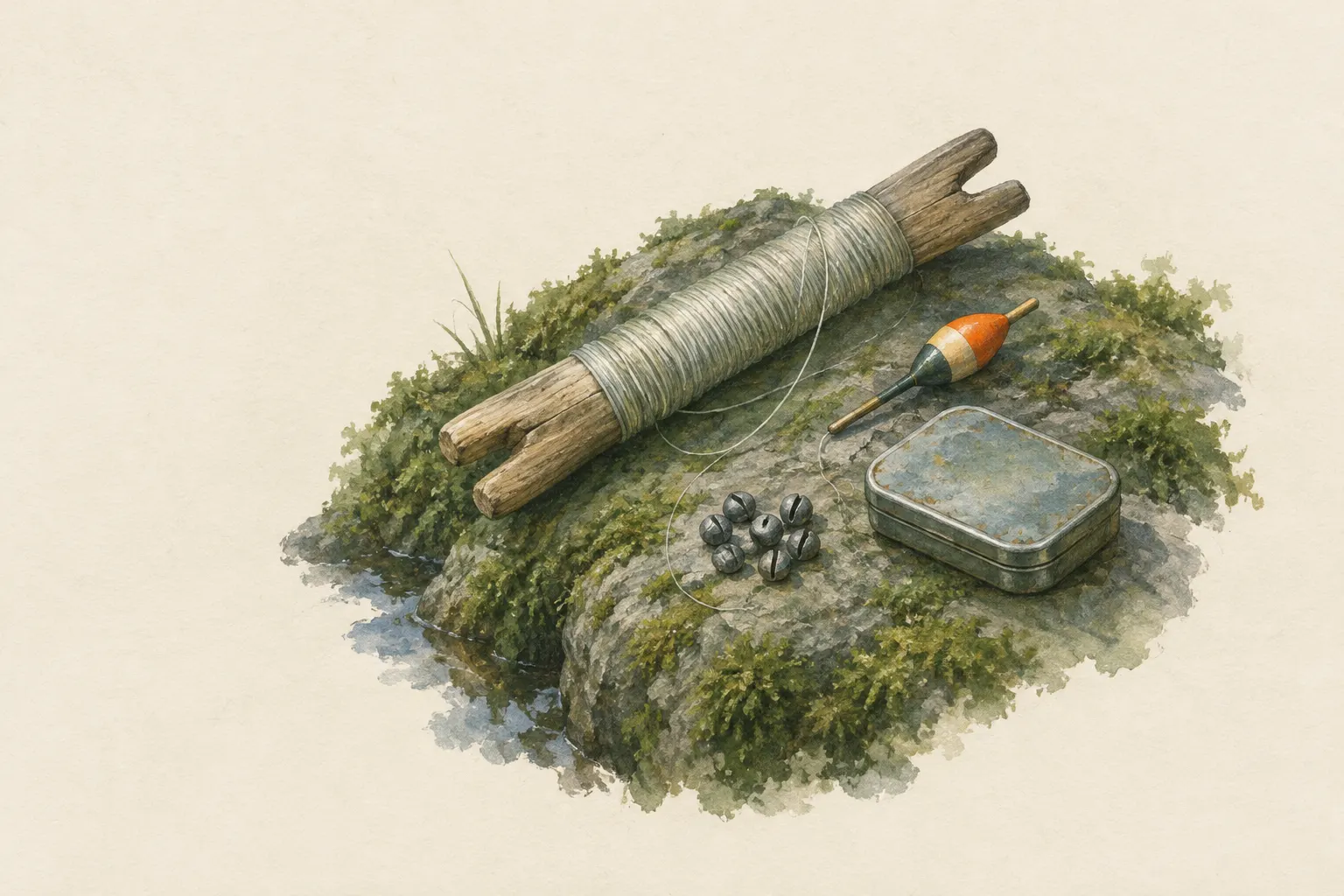
A hand line is the simplest fishing rod: line on a piece of wood, a hook, a small weight and a float. With a mini fishing kit from a tin and worms or insects as bait you can catch small fish in quiet spots – if you know where they hold, tie the hook on properly and recognise the bite. Fish only with a licence and permission, or in genuine danger to life.
- Setup 15 minutes; fishing often takes hours with uncertain success
Explained simply
A hand line is a fishing rod without the rod. You wind thin line onto a piece of wood, tie a small hook on the end, pinch a small weight above it and, at the very top, a floating piece called the float. The float bobs on the water like a little cork and shows you what is happening below.
Bait goes on the hook, for example an earthworm. Then you throw everything to a place where fish like to wait: behind big stones, under bushes on the bank or where fast and slow water meet. When a fish bites, the float is pulled under. Then you pull the line briefly and firmly.
Fishing needs a lot of patience, and often nothing bites for a long time. You may only fish if you have a licence and permission – or if you are really in danger to life. And a fish you keep is stunned and killed at once so that it does not suffer.
How it works
The hand line consists of four parts that work together. The hook holds the fish, the bait attracts it, the weight pulls the bait to the right depth, and the float carries everything and shows the bite. The spacing decides success: the weight sits about 20 to 30 centimetres above the hook so the bait still moves naturally.
Set the float so the bait hangs just above the bottom. That is where many fish look for food. To find the depth, first hang on a heavy weight and slide the float until it just stands upright – then the weight is lying on the bottom. Then shorten it a little.
Fish save energy. In fast water they therefore hold where the current breaks: in the slack water behind stones, in deep pools below rapids and on the edge between fast and slow water. From there they snap at food drifting past. In lakes they often stay along drop-offs, the edges of weed beds and at inflows.
What really matters
The knot at the hook is the weakest point of the whole line. The improved clinch knot holds well in thin line if you wet it before tightening – otherwise friction heats the line and makes it brittle. Pull slowly and evenly until the turns lie snugly together, and test it with a firm pull.
Fish are shy. They feel footsteps through the ground and see movement and shadows on the bank. So walk quietly, keep back from the edge, kneel down and do not cast your shadow on the water. In the morning and evening the light is weaker, and many fish feed especially actively then.
When a fish bites, patience is needed. If the float only trembles, the fish is nibbling at the bait. If it is pulled under or moves off sideways, that is the right moment: a short, firm flick of the wrist. After that keep the line tight all the time and lead the fish to a shallow spot instead of yanking it up by the line.
Safety: what to watch out for
Barbed hooks are made not to come out again – not out of your finger either. Keep them covered, never cast when someone is standing behind you, and never wrap the line around your hand. A hook sitting deep in the skin, near the eye or in a joint is not pulled out yourself: cover it, keep it still and get medical help.
The banks themselves are often more dangerous than the fish. Undercut edges collapse, wet and mossy stones are very slippery, and even knee-deep fast water can knock an adult over. Cold water chills the body quickly. Children by the water are always within an adult's reach.
Legally: without a licence and a permit, fishing is prohibited. And every fish you keep is stunned and killed at once. Always take scraps of line with you – birds get tangled in them.
When it makes sense – and when not
A mini fishing kit is light and fits into any emergency kit that might be used near water. During a longer stay in one place – with permission or in genuine danger to life – it can be a welcome supplement, above all for protein.
Realistically, though, the hand line is not a reliable food source. On some days nothing bites, and time by the water costs energy and warmth. As long as shelter, warmth or drinking water are missing, you deal with those first. And anyone who can reach help does not need to fish.
Good to know
You can find good bait almost anywhere: earthworms under damp leaves, stones and deadwood, beetle larvae in rotten wood, grasshoppers in meadows. Small baits often catch better than large ones because small fish can swallow them too. Keep the point of the hook free, otherwise it will not go in when you strike.
Practise at home before you need it: tying on hooks, setting the float, winding the line on and off without tangles. With a licence and a day ticket you can try the hand line quite legally on a club water. Then in an emergency you know exactly what to do.
Step by step
Check the kit and wind the line
A good mini kit contains 15–25 m of line, several small hooks (about size 8–14), a few split shot, a small float and swivels. Wind the line in figure-of-eight turns onto a smooth stick about as long as your hand so it does not twist. Notch the ends so nothing slips off.
- 1
Check the kit and wind the line
A good mini kit contains 15–25 m of line, several small hooks (about size 8–14), a few split shot, a small float and swivels. Wind the line in figure-of-eight turns onto a smooth stick about as long as your hand so it does not twist. Notch the ends so nothing slips off.
- 2
Tie on the hook (improved clinch knot)
Pass about 10 cm of line through the hook eye. Wrap the free end five to seven times around the main line. Then push it through the small loop right by the eye and then through the big loop that has formed. Wet the knot, pull it tight slowly and trim the end leaving 2–3 mm.
- 3
Fit the float and weight
Pinch a small weight onto the line about 20–30 cm above the hook – without a kit, a small stone tied on with cord will do. Above it goes the float, if necessary made from a piece of dry wood, bark or cork. Set the depth so the bait hangs just above the bottom.
- 4
Bait the hook
Good natural baits are earthworms, maggots, beetle larvae and grasshoppers; you find them under stones, deadwood and in damp leaves. Thread the bait so it covers the bend of the hook but leaves the point free. Small baits usually catch more than large ones.
- 5
Find the right spot
Fish hold at current seams between fast and slow water, in the slack water behind large boulders, in deep pools below rapids, under overhanging banks and bushes, and at inflows. They usually bite best early in the morning and in the evening. Move quietly, stay back from the edge and do not cast your shadow on the water.
- 6
Cast
Hold the winding stick so the line can run off the side, swing the hook, weight and float loosely two or three times and let them drop into the water in front of you. In current, cast a little upstream of the spot and let the bait drift in. A long dead-wood switch as a rod makes placing the bait easier.
- 7
Recognise the bite and strike
If the float only trembles, the fish is playing with the bait – wait. If it is pulled under or moves away sideways, strike: a short, firm flick of the wrist, not a big yank. Then keep the line tight so the hook does not fall out.
- 8
Land, stun, kill
Bring the fish with a tight line to a shallow spot and slide it ashore instead of lifting it by the line. Hold it with wet hands. If you keep it, stun it at once with a firm blow to the back of the head and kill it with a heart stab or gill cut. Unhook undersized or protected fish in the water and let them swim off.
Common mistakes
- Walking noisily on the bank and casting shadows on the water
- Hooks and baits that are too large
- Striking too early when the float only trembles
- Wrapping the line around your hand
- Lifting the fish out by the line – the line breaks
- Leaving scraps of line on the bank
Quick view
Materials
Mini fishing kit (survival fishing kit)
Hooks are sharp and barbed – always keep them covered in the kit, e.g. in a piece of cork or a small tin.
Monofilament fishing line
About 0.20–0.30 mm for small fish
Never leave scraps of line behind: birds and other animals get tangled in them and die slowly. Wind up scraps and take them with you.
Sturdy sticks / poles
Winding stick and rod
Do not cut live wood where prohibited.
Knife (fixed or locking blade)
Cut away from your body.
Rules on carrying knives differ by region – check local rules.
Fish priest (club for stunning fish)
Or a short hardwood club
Intended only for quickly stunning caught fish. A short, solid hardwood club does the same job.
Suitable for
- Streams, rivers and lakes with fish
- As a light addition to emergency gear
- Longer stays in one place
Not suitable for
- Waters without permission outside a genuine emergency
- When water, warmth or shelter are still missing
- Steep, slippery or undercut banks
Prerequisites
- Fishing licence and permit for the water – or genuine danger to life
- Able to stun and kill a fish
- Safe footing on the bank
Safety
- Barbed hooks easily go into fingers and clothing. Never wrap the line around your hand – a big fish or a snag will cut in. A hook in the eye or deep in tissue is not removed yourself: cover it, keep it still and get help.
- Undercut banks collapse and wet stones are slippery. Do not wade into fast or cold water, never deeper than your knees in current, and never let children by the water out of your sight.
How it works
Fish save energy: they hold where the current is weak but food drifts past, and where they have cover. The float keeps the bait at the right depth and shows you the bite; the weight pulls the bait down. A thin, well-tied hook inside the bait goes into the fish's mouth when you strike briefly.
Advantages
- Light, cheap and small to pack
- Works without rod and reel
- Can be supplemented with natural materials
Disadvantages
- Success is uncertain and takes patience
- Only small fish can be landed safely
- Only permitted with a licence or in a genuine emergency
Deep knowledge
Background
The US Army survival manual (FM 3-05.70) describes hand lines, improvised hooks and the typical holding places of fish and recommends fishing above all early in the morning and in the evening. That is why a small fishing kit is part of many emergency kits.
Realistically, a hand line usually only provides small meals. For food in an emergency it is a supplement, not a guarantee.
Variants
- Bottom line without a float
- A slightly heavier weight holds the bait on the bottom; you feel the bite as a tug on the line between your fingers. Good in deep, quiet spots.
- Short pole from deadwood
- Tie a rod length of line to a straight, light dead-wood switch. With it you can hold the bait right under the overhanging bank.
Common mistakes
- Walking noisily on the bank and casting shadows on the water
- Hooks and baits that are too large
- Striking too early when the float only trembles
- Wrapping the line around your hand
- Lifting the fish out by the line – the line breaks
- Leaving scraps of line on the bank
Limits and risks
- No fish identification and no closed seasons of individual species
- No instructions for fly fishing or spinning
Material alternatives
Derived from material properties: a substitute must have all relevant properties. Observe the notes on the substitute.
- Monofilament fishing line
- Rope (Never use unknown or damaged rope for life-safety purposes.), Paracord (Not a climbing or safety rope.), Thin twine (Low breaking strength – light loads only.), Accessory cord (Use only certified cord after training for life-safety purposes.), Webbing (tubular webbing) (Inspect knotted webbing before every use.), Jute or sisal twine (bought) (Low strength, absorbs water and rots – light loads and practice only.), Tree straps (Load only within the manufacturer's limits.), Thin, soft wire (brass or galvanised steel) (Wire ends are sharp – protect eyes and fingers when bending), Tow rope or tow strap (Attach only to the towing eyes provided by the manufacturer; never stand next to it under load.)
Results come exclusively from structured entries. No improvised instructions are generated.
Sources
Headquarters, Department of the Army (USA) (2002): FM 3-05.70 Survival
Hand lines, bait, fish holding places and best times of day
Land Niederösterreich – Rechtsinformationssystem des Bundes (RIS), Landesrecht (2001): NÖ Fischereigesetz 2001
Fishing only with a licence and the permission of the rights holder
Bundesrepublik Deutschland – Bundesministerium der Justiz (gesetze-im-internet.de) (2012): Verordnung zum Schutz von Tieren im Zusammenhang mit der Schlachtung oder Tötung und zur Durchführung der Verordnung (EG) Nr. 1099/2009 des Rates (Tierschutz-Schlachtverordnung – TierSchlV)
Stunning caught fish before killing