Improvising fish hooks: gorge, thorn hook, safety pin and wooden hook
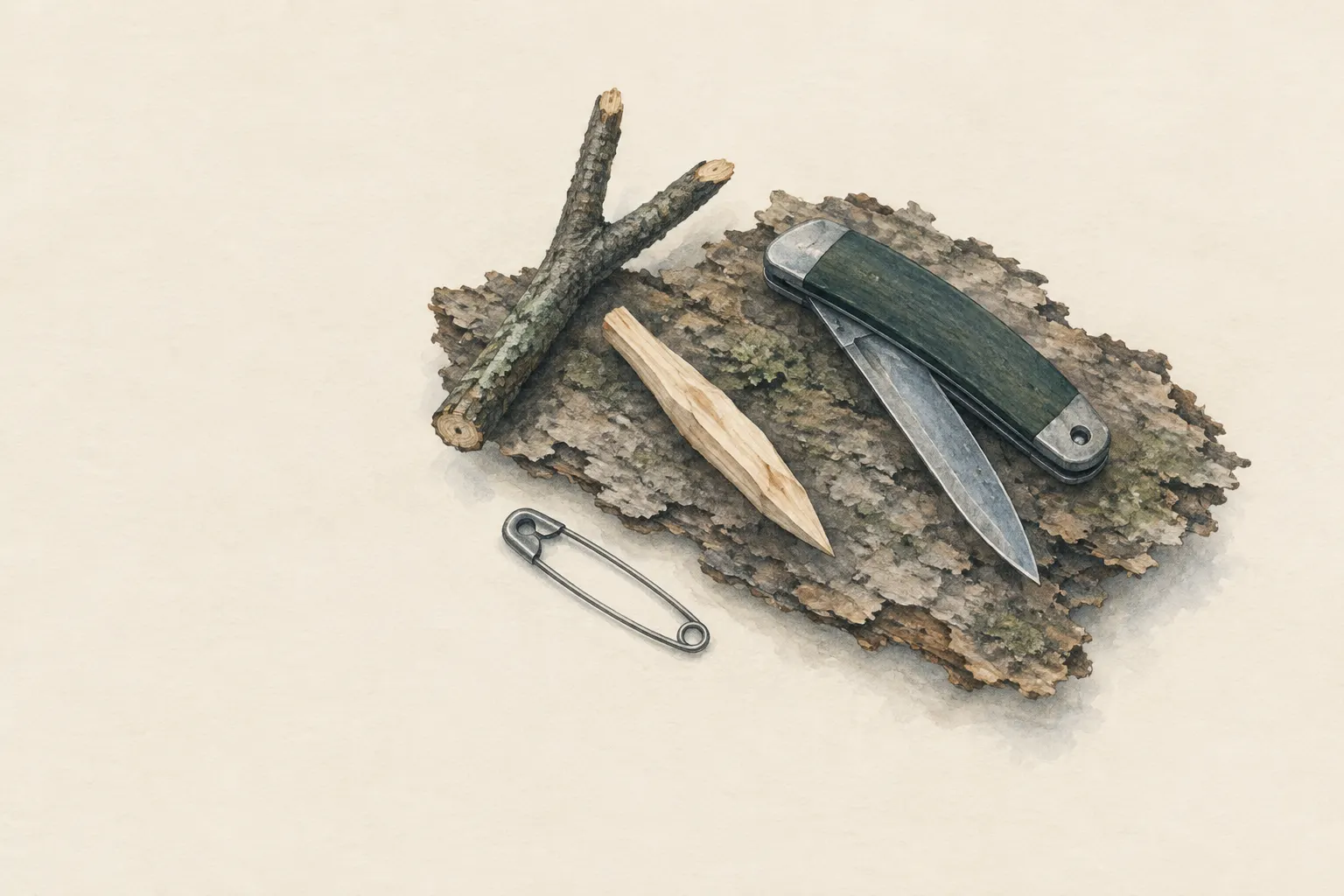
Without bought hooks you can make a hook yourself in an emergency: a gorge of wood or bone that turns crosswise inside the fish, a thorn hook from a hawthorn or blackthorn twig, a hook from a safety pin or a carved wooden hook. These hooks are emergency knowledge – they hold less well, and a swallowed gorge makes release impossible.
- 10–30 minutes per hook
Explained simply
If you have no bought fish hook, you can make one yourself in an emergency. The simplest is called a gorge: a small wooden sliver, pointed at both ends, with the line tied exactly in the middle. You hide it lengthwise in a worm. The fish swallows the worm, and when you pull the line, the sliver turns crosswise and gets stuck.
Other makeshifts are a sharp thorn on a twig, a bent safety pin or a small forked twig whose short branch is carved into a point. None of these hooks has a barb. So you must always keep the line tight after the bite, or the fish slips off again.
When carving such small things, a cut happens easily. Always carve away from your body and, as a child, get an adult to help you. And remember: such hooks are only meant for genuine emergencies when someone is in danger to life.
How it works
A bought hook has three important parts: a sharp point that penetrates, a bend that holds the fish and a barb that stops it slipping out. Improvised hooks usually copy only the point and bend. The gorge takes a completely different approach: it has no bend but turns crosswise in the fish's gullet, like a bolt across a door.
For this to work the line must sit exactly in the middle of the gorge, and the gorge must lie lengthwise in the bait. The fish swallows the bait with the gorge. When the line pulls, the gorge tips around its middle and wedges with both points. If the line sits too close to one end, the gorge slips out again.
Thorn, pin and wooden hooks work like a bought hook without a barb. The fish takes the bait into its mouth, the point goes in when you strike, and the bend holds it – but only as long as there is tension on the line. If the tension slackens, the fish can come free.
What really matters
The material decides how long a hook lasts. Dry, firm wood without cracks breaks less easily than green or rotten wood. Bone is even harder but laborious to work. A safety pin from the first-aid kit is the strongest improvised hook and bends most cleanly with pliers.
With a gorge three things matter: both ends sharp, the groove exactly in the middle, and the bait covering everything. With a thorn hook the thorn must be strong and stand at a sharp angle to the twig; tie the line in a groove at the other end with several turns. Test every hook on land with a firm pull.
Because there is no barb, how you play the fish after the bite matters. Keep the line evenly tight, bring the fish without pausing to a shallow spot and slide it ashore. A jerk or a pause gives it the chance to free itself.
Safety: what to watch out for
Carving tiny parts is more dangerous than carving large ones: the fingers are close to the blade and the piece slips easily. Sit down, put the piece on a firm surface, always carve away from your body and from the holding hand, and make small, controlled cuts. With heavy bleeding press firmly on the wound and get help.
Blackthorn and hawthorn thorns cause deep, narrow puncture wounds into which dirt easily gets. Such wounds often become infected. Cut thorny twigs wearing gloves or with a cloth, clean every puncture and watch it. Redness, swelling, throbbing pain or fever are a reason to see a doctor. Only use shrubs you recognise for certain.
A gorge sits deep in the gullet or stomach. A fish caught this way can no longer be released gently and must be stunned and killed at once. That is why gorges are only defensible in genuine danger to life and must never be left in the water unattended. Fishing without authorisation is prohibited in Austria and Germany.
When it makes sense – and when not
Improvised hooks make sense when you are stuck in a genuine emergency, there is water nearby and no fishing kit is available. They are also valuable as practice on land: anyone who has built a gorge and a pin hook once can do it faster and more safely when it matters.
They have no place in normal fishing with a licence. Water rules often specify which hooks are allowed, and fish that have to be released must not carry deeply swallowed hooks. A few bought hooks in the emergency kit are also lighter, more reliable and gentler.
Good to know
Gorges are among the oldest fishing devices of humankind. Archaeologists have found gorges made of bone, wood and stone in many parts of the world. That shows how well this simple principle works – but also that people replaced it with better hooks as soon as they could.
A good place for a few hooks, some line and a safety pin is a small tin in the emergency kit. A piece of cork protects the points. That way you do not have to improvise at all when it matters – and the carving know-how remains the reserve for when everything else is missing.
Step by step
Choose the material
For gorges and wooden hooks use dry, firm wood without cracks or a piece of bone from an animal already used for food. For thorn hooks you need a twig with a strong, straight thorn, for example from hawthorn or blackthorn – only from shrubs you recognise for certain, and wearing gloves. A safety pin from the first-aid kit makes the strongest hook.
- 1
Choose the material
For gorges and wooden hooks use dry, firm wood without cracks or a piece of bone from an animal already used for food. For thorn hooks you need a twig with a strong, straight thorn, for example from hawthorn or blackthorn – only from shrubs you recognise for certain, and wearing gloves. A safety pin from the first-aid kit makes the strongest hook.
- 2
Carve a gorge
Carve a sliver about 2–4 cm long and as thick as a matchstick. Sharpen both ends to a point. Cut a shallow groove all the way round the middle so the line cannot slip.
- 3
Tie and bait the gorge
Tie the line exactly in the middle groove with a firm knot. Then lay the gorge flat along the line and push it lengthwise into the bait, for example a worm, so nothing sticks out. The fish swallows the bait; when you pull, the gorge turns crosswise.
- 4
Make a thorn hook
Cut the twig so that a piece about 3 cm long remains with the thorn at its lower end; the thorn forms a sharp angle with the piece like a hook. Carve a groove at the upper end and tie the line on there with several tight turns.
- 5
Hook from a safety pin
Open the pin and bend the pointed arm outwards with pliers or between two stones until it stands out at a right angle. Then bend the front third back into a U so that the point faces the shank. The spring coil at the other end serves as the eye for the line. Always keep the point facing away from you.
- 6
Wooden hook from a fork
Find a small, firm fork in a twig. Shorten one branch to about 4 cm as the shank and the other to about 1.5 cm and sharpen it – that is the point. Notch the end of the shank for the line. Hard, dry wood breaks less easily.
- 7
Test and use correctly
Pull hard on the line of every hook before using it; anything that breaks or slips is made again. Keep the line tight after the bite because there are no barbs. Use gorges only while watching them, stun and kill every catch at once, and take all hooks and scraps of line with you afterwards.
Common mistakes
- Not tying the gorge exactly in the middle – it then does not turn crosswise
- The point of the gorge or hook sticks out of the bait
- Using rotten or green wood
- Carving towards the body
- Letting the line go slack after the strike
- Leaving lines with gorges unattended
Quick view
Materials
Knife (fixed or locking blade)
Cut away from your body.
Rules on carrying knives differ by region – check local rules.
Safety pins
Keep out of reach of small children.
Sturdy sticks / poles
Dry hardwood for gorges and wooden hooks
Do not cut live wood where prohibited.
Thin twine
Or fishing line
Low breaking strength – light loads only.
Multitool
Pliers for bending
Rules on carrying blades differ by place – check local rules.
Suitable for
- Emergencies without a fishing kit
- Practising carving skills at home
- Supplementing an improvised hand line
Not suitable for
- Normal fishing with a licence – the prescribed hooks apply there
- Fish that must be released
- Children carving without supervision
Prerequisites
- Able to carve safely (away from the body)
- A genuine emergency – or practising on land without catching fish
- Basics of the hand line
Safety
- Carving small parts is the classic moment for cuts to fingers and thumbs. Always carve away from your body, hold the workpiece on a firm surface and sit down. With heavy bleeding press firmly on the wound and get help.
- Blackthorn and hawthorn thorns cause puncture wounds that easily become infected. Cut them with gloves, clean any punctures and watch them; see a doctor if redness, swelling or fever develop.
- A gorge is swallowed and lodges deep inside the fish. A fish caught this way cannot be released gently – it is stunned and killed at once. Never leave lines with gorges unattended.
How it works
A hook has to do two things: stay hidden in the bait and lodge in the mouth when pulled. The gorge solves this without a point or bend – it lies lengthwise in the bait, is swallowed with it and turns crosswise when the line tied at its middle is pulled. Thorn and pin hooks work like a bought hook, just without a barb; so the line must always stay tight after the strike.
Advantages
- Needs almost no material
- Good carving practice even without fishing
- Gorges work without a point or bend
Disadvantages
- Hold less well than bought hooks
- Gorges make release impossible
- Only legally defensible in a genuine emergency
Deep knowledge
Background
Gorges are among the oldest fishing devices of humankind; bone and wooden gorges are known from many early cultures. The US Army survival manual (FM 3-05.70) describes gorges, thorn hooks and hooks from pins, wire, wood and bone as makeshifts.
In a packed emergency kit a few bought hooks are still the better choice: they weigh almost nothing and catch more reliably.
Variants
- Wire or needle
- A piece of stiff wire or a needle from a sewing kit can be bent in the same way. Sewing needles are brittle and break easily – bend them carefully and slowly, preferably after warming.
- Bone gorge
- A bone splinter from an animal already used for food is ground to a point at both ends on a rough stone and notched in the middle. Bone is harder than wood but more laborious to work.
Common mistakes
- Not tying the gorge exactly in the middle – it then does not turn crosswise
- The point of the gorge or hook sticks out of the bait
- Using rotten or green wood
- Carving towards the body
- Letting the line go slack after the strike
- Leaving lines with gorges unattended
Limits and risks
- No plant identification – only use thorny shrubs you recognise for certain
- No figures on catch success
Material alternatives
Derived from material properties: a substitute must have all relevant properties. Observe the notes on the substitute.
- Thin twine
- Rope (Never use unknown or damaged rope for life-safety purposes.), Paracord (Not a climbing or safety rope.), Accessory cord (Use only certified cord after training for life-safety purposes.), Webbing (tubular webbing) (Inspect knotted webbing before every use.), Jute or sisal twine (bought) (Low strength, absorbs water and rots – light loads and practice only.), Tree straps (Load only within the manufacturer's limits.), Monofilament fishing line (Never leave scraps of line behind: birds and other animals get tangled in them and die slowly. Wind up scraps and take them with you.), Thin, soft wire (brass or galvanised steel) (Wire ends are sharp – protect eyes and fingers when bending), Tow rope or tow strap (Attach only to the towing eyes provided by the manufacturer; never stand next to it under load.)
Results come exclusively from structured entries. No improvised instructions are generated.
Sources
Headquarters, Department of the Army (USA) (2002): FM 3-05.70 Survival
Gorges, thorn hooks and hooks from pins, wire, wood and bone
Land Tirol – Rechtsinformationssystem des Bundes (RIS), Landesrecht (2002): Tiroler Fischereigesetz 2002
Fishing only with a licence and fishing rights
Bundesrepublik Deutschland – Bundesministerium der Justiz (gesetze-im-internet.de) (2006): Tierschutzgesetz (TierSchG) in der Fassung der Bekanntmachung vom 18. Mai 2006
Protection of vertebrates from avoidable pain and suffering