Cordage from stinging nettle fibre
The stems of the common stinging nettle contain long, tough fibres. In late summer and autumn you cut tall stems wearing gloves, strip the leaves, flatten the stem, break out the woody core and dry the fibre strips. Then you twist them into two-ply cord – for lashings, net bags or as a spare, not for people or heavy loads.
- Harvest and processing about 1 hour, drying a few days, twisting depends on length
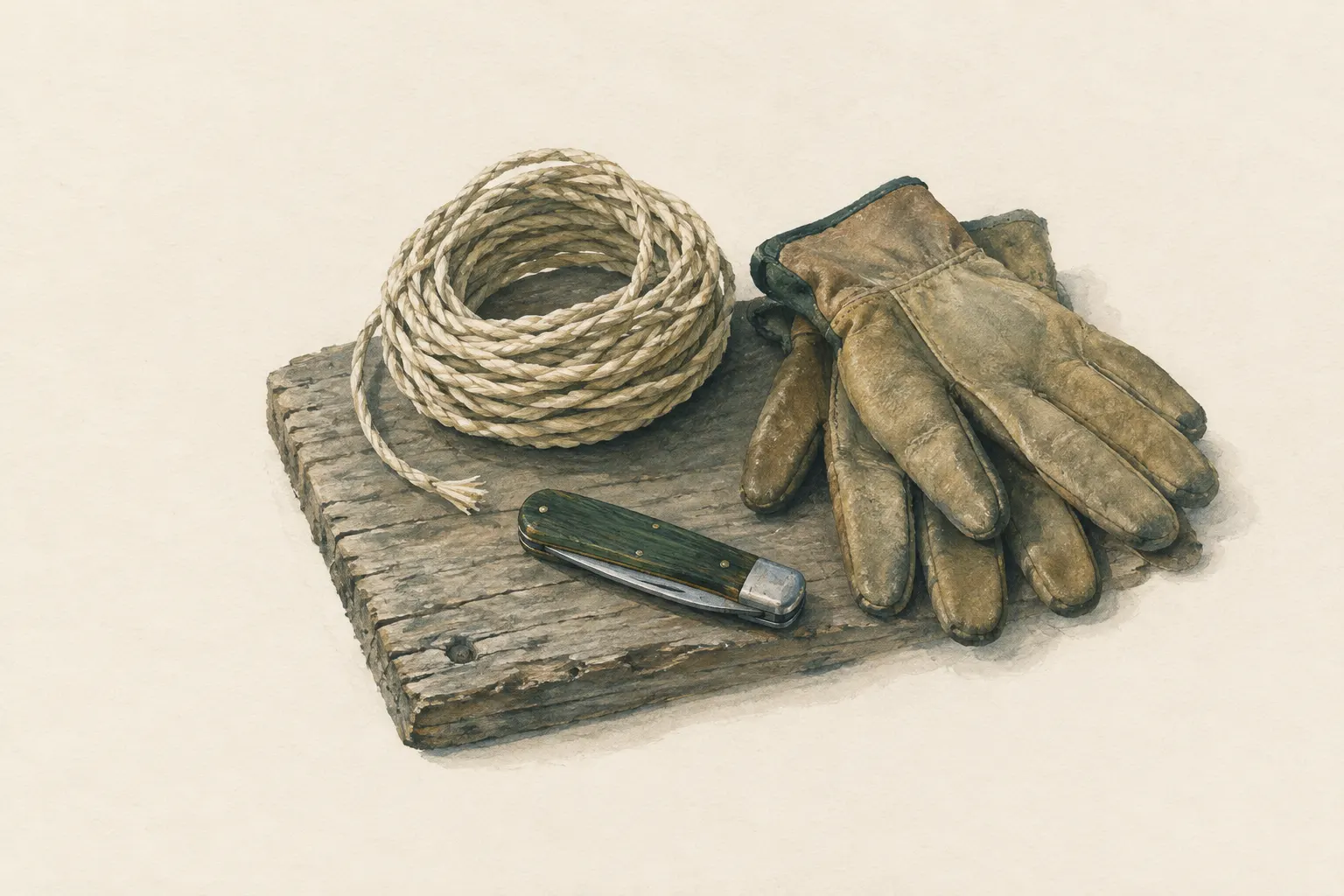
Explained simply
You know the stinging nettle because it pricks and burns. But its stem hides something useful: long, strong threads. In the past people made yarn and even cloth from them. You can twist a cord out of them – no shop needed.
To do this you put on gloves, cut long stems in late summer and strip off the leaves. Then you press the stem flat until it splits open. Inside there is a hard, woody core. You break it out, and what is left are green ribbons holding the fibres. You let them dry.
Finally you twist two bundles of fibre around each other, like a cord. This gives you a string for small things: a bag, a pendant, a binding. Important: such a cord is never meant for climbing or for people – nobody knows how much it can hold.
How it works
The nettle stem is square and hollow inside. From the outside in there is a thin green skin, a layer of long bast fibres and a woody, brittle core. The fibres run almost the full length of the stem. So the rule is: the longer the stem, the longer the fibres you get – and the fewer joins your cord will need later.
The woody core snaps when you bend it, whereas the fibres are flexible and tough. You use exactly this difference: you bend the core at short intervals and peel the fibre ribbons off it. As they dry the ribbons lose water, become paler and can later be split into fine bundles.
In two-ply twisting you twist each of two fibre bundles in one direction and lay them around each other in the opposite direction. The two twists work against each other and lock each other in place. So the cord does not unravel, even though the individual fibres are not endlessly long.
What really matters
The right time is decisive. In spring the shoots are soft and the fibres short and weak. In late summer and autumn the stems are long and the fibres mature. Choose the longest, straightest stems without many side shoots and take only a few from a large stand.
When breaking out the core, work patiently from the middle towards the ends. If you pull too fast, the fibre ribbons tear off. The green outer skin can stay on; it partly crumbles off by itself after drying. If you want finer cord, scrape it off lightly beforehand with the back of the knife.
Dry the ribbons hung up loosely in an airy, shady place. Crumpled up and damp they go mouldy. Before twisting, dampen them briefly so they become supple. When twisting, always add new fibres at staggered points, never in both strands at the same spot – that is where the cord would be weakest.
Safety: what to watch out for
The nettle's stinging hairs are tiny tubes that break off when touched and release irritating substances into the skin. This burns and itches but is usually harmless and goes away on its own. Gloves and long sleeves prevent it almost completely. Anyone who reacts allergically – with swelling of the face or difficulty breathing – needs help at once: call 112, in Austria also 144.
When cutting the stems the normal knife rules apply: cut away from the body, keep your free hand behind the blade and keep enough distance from other people. Afterwards the knife goes back into its sheath.
The finished cord has no known strength. Home-made plant cord can suddenly break at a thin spot. Never use it for climbing, for securing people or for loads with anyone underneath.
When it makes sense – and when not
Nettle cord is ideal for understanding how people made cord without factories. In camp it is good for light lashings, a small net bag, a necklace or tying up bundles of tinder. For a group it is a nice project over several days: harvest, dry, twist.
If you have proper cord with you, the bought kind is always stronger and more reliable. For tent, tarp, loads or emergencies involving people you therefore use paracord or accessory cord. Nettle cord is an addition and a skill, not a replacement for good equipment.
Good to know
Nettles are food plants for the caterpillars of many butterflies, for example the peacock and the small tortoiseshell. So you take only a small part of a stand and leave the rest. At field edges and on other people's land the rule is the same: ask first.
Twisting is easiest to learn with bought jute or sisal twine that you unravel. Once the movement is second nature, switching to nettle fibre is easy. Nettle fibre behaves similarly, just a little less evenly.
This entry covers only the fibre. Whether and how to eat nettles does not belong here – you only eat wild plants that you recognise with one hundred per cent certainty.
Step by step
Choose stems
In late summer or autumn pick the longest, straight stems from a large stand – the longer the stem, the longer the fibres. Take only a small share: many butterfly caterpillars live on nettles.
Caution: Only take plants you know for certain are nettles, and only with permission.
- 1
Choose stems
In late summer or autumn pick the longest, straight stems from a large stand – the longer the stem, the longer the fibres. Take only a small share: many butterfly caterpillars live on nettles.
Only take plants you know for certain are nettles, and only with permission.
- 2
Cut wearing gloves
Put on gloves and long sleeves. Cut the stem just above the ground with the knife, cutting away from the body.
- 3
Strip the leaves
Grip the stem firmly with your gloved hand and pull from top to bottom – the leaves and most stinging hairs come off. Break off the soft tip.
- 4
Flatten the stem
Lay the stem on a smooth surface and press it flat along its length with your fingers or a round piece of wood until it splits open at the edges.
- 5
Break out the woody core
Open the stem out. Bend the core outwards every few centimetres so that it snaps, and peel the fibre strips away from the core – working from the middle towards the ends.
- 6
Dry the fibres
You can lightly scrape off the green outer skin with your thumbnail or the back of the knife. Hang the strips loosely in an airy, shady place until they are completely dry after a few days. Dry, they keep for a long time.
- 7
Dampen before twisting
Briefly dampen the dry strips so they become supple, and split them into thin, even fibre bundles.
- 8
Twist two-ply
Fold a bundle unevenly and twist it as in the reverse-wrap technique: twist the upper strand, lay it over the other one, repeat. Lay in new fibres with an overlap, secure the end with an overhand knot and test the cord.
Never for people, climbing or heavy loads.
Common mistakes
- Taking young, soft stems in spring
- Working without gloves
- Storing fibres damp and crumpled – they go mouldy
- Joins in the same place – that is where the cord breaks
- Stripping whole stands
Quick view
Materials
Gloves and mittens
Sturdy gloves against the stinging hairs
Knife (fixed or locking blade)
For cutting the stems
Cut away from your body.
Rules on carrying knives differ by region – check local rules.
Sturdy sticks / poles
A round piece of wood for flattening
Do not cut live wood where prohibited.
Suitable for
- Light lashings, net bags, pendants, practice lines
- Learning how people made cord in the past
- Spare cord when nothing else is available
Not suitable for
- Securing people, climbing, abseiling
- Heavy or important loads
- Young, soft spring shoots – the fibres are still too short and weak
Prerequisites
- Able to recognise the common stinging nettle reliably
- Able to twist two-ply cord (practised with bought twine)
- Permission to cut plants on the land
Safety
- The stinging hairs cause burning, itchy weals. Wear gloves and long sleeves. Anyone who reacts strongly – swelling of the face, difficulty breathing – needs help at once: call 112 (in Austria also 144).
- When cutting always cut away from the body and keep your other hand behind the blade.
How it works
The fibres sit in the outer layer of the square, hollow stem, between the green skin and the woody core. When the brittle core is broken, the tough fibre strips peel away in long ribbons. In two-ply twisting the counter-twist of the two strands holds the fibres together so the cord does not unravel.
Advantages
- Nettles grow almost everywhere in large stands
- No tools except a knife and gloves
- Dried fibres can be stored
Disadvantages
- Time-consuming – a metre of cord needs many stems
- Strength unknown and uneven
- Only good in late summer and autumn
Deep knowledge
Background
Nettle fibres were long spun into yarn and cloth in Europe; the German word „Nessel“ for a plain cotton fabric still recalls this. Bushcraft textbooks present the nettle as one of the most accessible fibre plants.
The best way to learn two-ply twisting is to practise first with bought jute or sisal twine.
Variants
- Working green
- The fresh strips can also be twisted straight away. The cord gets a little thinner and looser as it dries – re-twist or tighten it carefully afterwards.
- Other plant fibres
- Other fibre-rich plants you know well can be processed in a similar way. Lime bast is taken from branches the owner gives you – never from standing trees.
Common mistakes
- Taking young, soft stems in spring
- Working without gloves
- Storing fibres damp and crumpled – they go mouldy
- Joins in the same place – that is where the cord breaks
- Stripping whole stands
Limits and risks
- No strength figures
- No identification of other wild plants
- Not about eating – this entry covers only the fibre
Sources
Ray Mears – Hodder & Stoughton (2002): Bushcraft
Nettle as a fibre plant, processing the stems and twisting cord
Headquarters, Department of the Army (USA) (2002): FM 3-05.70 Survival
Making cordage from plant fibres
Mors L. Kochanski – Lone Pine Publishing: Bushcraft: Outdoor Skills and Wilderness Survival
Natural cordage and two-ply twisting