Collecting and preparing stinging nettle
The common stinging nettle is one of the best-known wild plants: stinging hairs, opposite, coarsely toothed leaves and a square stem. You collect the young shoot tips wearing gloves. Brief blanching or cooking removes the sting completely – afterwards it tastes like spinach, in soup or as tea.
- Collecting 15–30 minutes, preparing 10 minutes
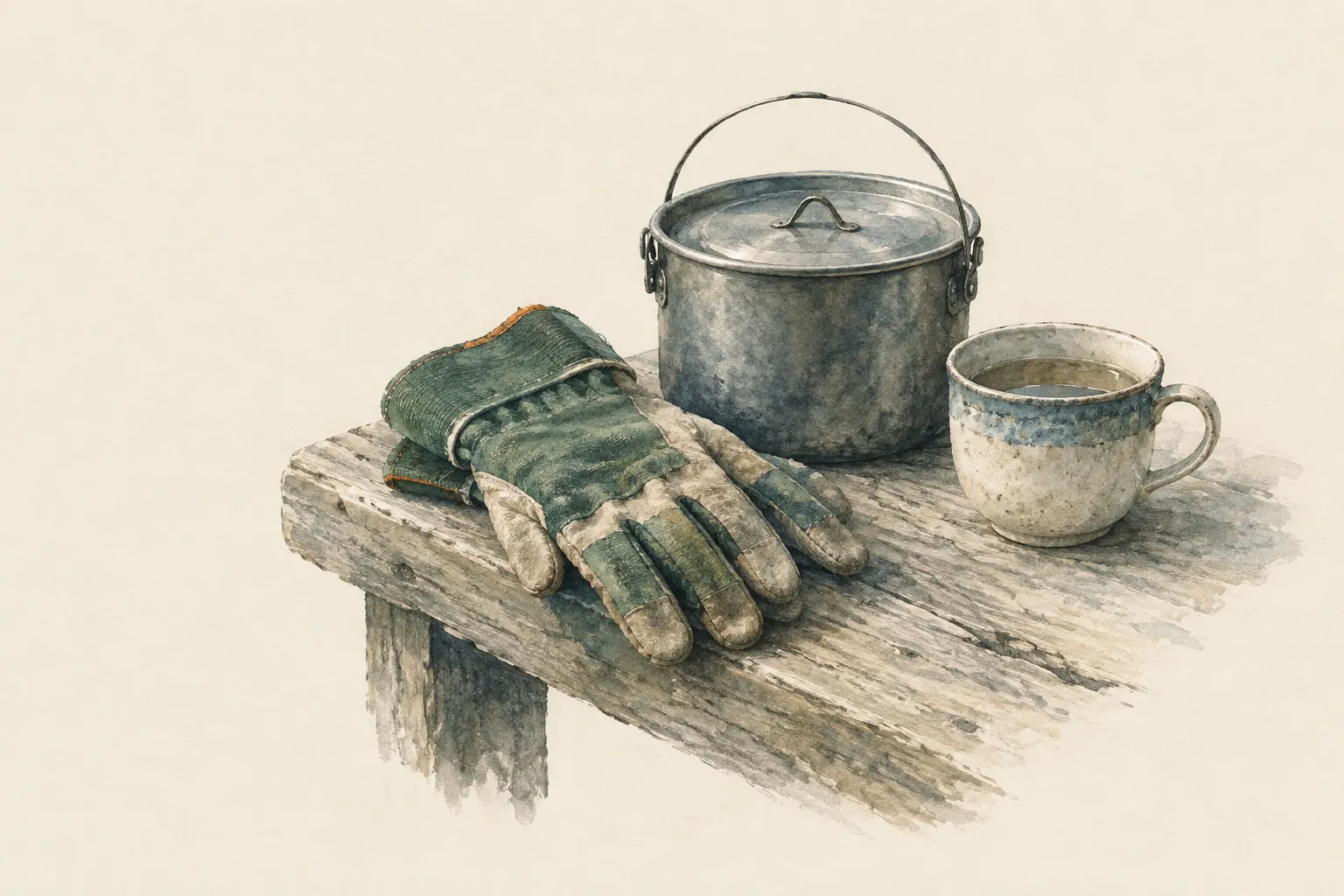
Explained simply
Almost every child knows stinging nettle – usually because it has stung them before. On its leaves and stems sit tiny hairs that are like very fine glass tubes. When you touch them, the tip breaks off and a little burning liquid gets into the skin. That is why you collect it with thick gloves.
The great thing is: if you put the nettle into boiling water briefly, the hairs break and it stops stinging completely. Then it tastes similar to spinach. You can make soup from it or make tea. Best are the very young tips at the top of the plant, they are tender.
You recognise the nettle by its stinging hairs, by the leaves that always sit in pairs facing each other and have a jagged edge, and by its square stem. It likes to grow where the soil has lots of fertiliser – so you do not pick it at the edge of a field or where dogs walk.
How it works
The nettle's stinging hairs are single, elongated cells with a silica-hardened, brittle tip. When touched, the tip breaks off at an angle and the hair acts like a tiny syringe: it pierces the skin and releases a mix of irritants. The result is burning, itching and small weals, which usually fade after a few hours.
Heat, drying or firm crushing destroy the hairs. That is why blanched, cooked or dried nettle no longer stings. Just one to two minutes in boiling water are enough for the leaves to collapse and turn dark green. You can use the cooking water as broth if the site was clean.
The young shoot tips are tender and mild. Older leaves become fibrous, tough and contain more mineral deposits. Many herbalists therefore advise not eating large amounts of old leaves after flowering. If a stand is cut back, fresh tips often regrow that can be used again.
What really matters
You recognise the common stinging nettle reliably by the combination: stinging hairs, opposite leaves (two facing each other at every node), elongated heart-shaped leaves with a coarsely toothed edge and a square stem. It usually grows in dense groups and often reaches over a metre. The flowers are inconspicuous greenish tassels that hang down.
Dead-nettle is the most common look-alike. It too has a square stem and opposite leaves, but does not sting and carries distinct lipped flowers in white, yellow or purple. The confusion is harmless, because dead-nettle is edible too. Still, the rule applies here as well: if you are not sure, leave it.
The site is especially important with nettles. They love nitrogen-rich soil and therefore grow at manure heaps, field edges, ditches and near settlements. There they can store a lot of nitrate or be contaminated with sprays and faeces. Good spots are woodland edges, clearings and unsprayed gardens away from paths.
Safety: what to watch out for
The sting is unpleasant but normally harmless. Cooling helps, scratching makes it worse. Rarely people react allergically. If the face, lips or tongue swell or breathing problems start, that is an emergency: call 112 at once (in Austria also 144).
Nettle is a diuretic. Anyone taking medication, pregnant or with kidney or heart problems should eat it only in small amounts and ask a doctor if in doubt. Children try new wild herbs only together with adults and in small portions.
Since nettle sprouts close to the ground and grows along path edges, the general hygiene rule applies: wash thoroughly and cook. That lowers the risk from germs and fox tapeworm eggs.
When it makes sense – and when not
Nettle is one of the best beginner plants: easy to recognise, widespread, available in large amounts. In spring and early summer it provides fresh, mineral-rich greens that complement supplies from tins and sacks well. Dried, it can be kept as tea for the winter.
It does not fill you up, though. Like all leafy vegetables it contains a lot of water and little energy. In an emergency it is a building block for vitamins and variety, but calories have to come from other sources – supplies, nuts, grain or fish.
Good to know
Nettle used to be a fibre plant too: yarn and even cloth were made from the long fibres in the stem. Dried, older stems can be made into simple cord. For butterflies such as the peacock and the small tortoiseshell it is an important food plant for the caterpillars – one reason never to clear whole stands.
An old trick for handling it: if you carefully stroke along the leaf from bottom to top, the hairs lie flat and break off less often. But that is no guarantee – gloves remain the safe choice.
Step by step
Recognise it reliably
Check all features: stinging hairs on leaves and stem, opposite leaves (always two facing each other), heart-shaped to elongated leaves with a coarsely toothed edge, square stem. The plant usually grows in dense stands, often knee-high to over a metre.
- 1
Recognise it reliably
Check all features: stinging hairs on leaves and stem, opposite leaves (always two facing each other), heart-shaped to elongated leaves with a coarsely toothed edge, square stem. The plant usually grows in dense stands, often knee-high to over a metre.
- 2
Know the look-alike
Dead-nettle looks similar and also has a square stem, but it does not sting and carries conspicuous white, yellow or purple lipped flowers. It is harmless. Unsure? Then leave it.
- 3
Gloves and sleeves
Put on dense gloves and long sleeves. Good garden gloves are enough; thin fabric gloves let stinging hairs through.
- 4
Harvest young tips
Pinch or cut off only the top four to six leaves (the shoot tip). Young tips are tender; older leaves become tough and fibrous. After flowering do not take large amounts any more – at most fresh regrown tips.
- 5
Sort and wash
Spread the harvest on a light surface, remove stray leaves, insects and wilted parts. Then wash in plenty of clean water using tongs or gloves.
- 6
Blanching removes the sting
Bring water to the boil, put the tips in for one to two minutes until they collapse and turn dark green. Drain. From now on nothing stings and you can handle them with bare hands.
- 7
Spinach, soup or tea
Chop blanched nettle and use it like spinach, add it to soups or stews. For tea pour hot water over a handful of fresh or dried leaves and steep for a few minutes.
Common mistakes
- Collecting without gloves
- Large amounts of old, tough leaves after flowering
- Picking at fertilised field edges or dog paths
- Eating raw without destroying the stinging hairs
- Overlooking stray leaves in the collecting bag
Quick view
Materials
Sturdy work gloves
Dense, so the stinging hairs cannot get through
When handling flood mud or chemicals, also wear waterproof gloves.
Knife (fixed or locking blade)
Or scissors
Cut away from your body.
Rules on carrying knives differ by region – check local rules.
Airy collecting bag or basket
Collect each species separately so nothing unknown gets mixed in
No plastic bags for long periods – greens sweat and spoil
Metal pot (stainless steel, aluminium, titanium)
Hot – scalding risk.
Stove
Or a fire
Never operate inside a tent, shelter or enclosed room – carbon monoxide and fire risk.
Suitable for
- Spring to early summer (young shoots)
- Vitamin-rich vegetable in emergencies
- Beginners – very easy to recognise
Not suitable for
- Eating raw, untreated leaves – they sting in the mouth
- Sites next to heavily fertilised fields (high nitrate)
- As a main food – very little energy
Prerequisites
- Recognising the nettle reliably by all features
- A clean site without fertiliser, chemicals or dog mess
- A pot and water for cooking
Safety
- The stinging hairs cause burning, itchy weals. Collect with dense gloves and wear long sleeves. With strong reactions, facial swelling or breathing problems call 112 at once (in Austria also 144).
- Nettles like nutrient-rich soil – including manure heaps, field edges and dog meadows. Do not collect there: nitrate, sprays and faeces. Always wash and cook.
- Anyone taking medication, pregnant or with kidney disease should eat wild herbs only in small amounts and ask a doctor if in doubt.
How it works
The stinging hairs are tiny, brittle tubes whose tip breaks off when touched and injects an irritating fluid into the skin. Heat and crushing destroy the hairs – that is why cooked or blanched nettle no longer stings.
Advantages
- Very easy and reliable to recognise
- Grows almost everywhere in large amounts
- Rich in minerals and vitamins
Disadvantages
- Stings while collecting
- Provides hardly any calories
- Often grows at contaminated sites
Deep knowledge
Background
Nettle has been a vegetable, tea plant and fibre plant for centuries; its stem fibres were once even woven into cloth. Survival manuals such as FM 3-05.70 list it as an easily recognised food plant that is cooked before eating.
Its preference for nitrogen-rich soils makes it an indicator of fertiliser and human presence – which is exactly where you are better off not collecting.
Variants
- Drying for tea
- Lay young leaves loosely on a cloth and dry them in an airy, shady place until they rustle. Store dry and dark in a jar.
- Seeds in late summer
- The seed clusters of the female plant can be stripped off in late summer, dried and sprinkled over food in small amounts.
Common mistakes
- Collecting without gloves
- Large amounts of old, tough leaves after flowering
- Picking at fertilised field edges or dog paths
- Eating raw without destroying the stinging hairs
- Overlooking stray leaves in the collecting bag
Limits and risks
- No medicinal claims
- Not a complete identification guide
Material alternatives
Derived from material properties: a substitute must have all relevant properties. Observe the notes on the substitute.
- Airy collecting bag or basket
- Metal pot (stainless steel, aluminium, titanium) (Hot – scalding risk.), Single-wall stainless steel bottle (Heat only single-wall bottles without paint/plastic; remove the lid before heating.), Double-wall insulated bottle (Never heat directly.), PET bottle (clear, max. 2 litres) (Do not heat or place in a fire.), Food-grade water container (Only use containers that never held chemicals or fuel.), Airtight food-grade storage container (Fill only when clean and completely dry; never use containers that previously held chemicals.), Collapsible water container or bag (Protect from sharp objects.), Measuring jug, Food-grade water bag (Use only for drinking water, never for chemicals or fuel.), Fermentation jar or crock (Use only food-grade containers of glass, food-safe glazed stoneware or food-grade plastic – no metal containers for acidic food.), Resealable food bags (Use only bags intended for food; do not use with boiling water unless the manufacturer explicitly allows it.), Rigid collecting container (box, basket or mug) (One species per container – never mix in anything unknown)
- Metal pot (stainless steel, aluminium, titanium)
- Single-wall stainless steel bottle (Heat only single-wall bottles without paint/plastic; remove the lid before heating.)
Results come exclusively from structured entries. No improvised instructions are generated.
Sources
Headquarters, Department of the Army (USA) (2002): FM 3-05.70 Survival
Nettle as a food plant, cooking before eating
Bundesinstitut für Risikobewertung (BfR) (2017): Risiko Pflanze – Einschätzung und Hinweise
Plant poisonings and advice on handling plants in the wild
Robert Koch-Institut: RKI-Ratgeber Echinokokkose
Preventing fox tapeworm: washing, heating
Bundesrepublik Deutschland (gesetze-im-internet.de) (2009): Gesetz über Naturschutz und Landschaftspflege (Bundesnaturschutzgesetz – BNatSchG), insbesondere § 39 und § 30
Collecting small amounts for personal use