Foraging wild plants: the ground rules
Wild plants can supplement emergency food – but only if you recognise every plant with 100 % certainty by several features, collect at clean sites, respect nature-protection rules and try anything new in small amounts first. The "universal edibility test" from military manuals does not replace identification: it does not protect against deadly poisons such as hemlock. And: leafy greens supply hardly any calories.
- Learning: one season with a field guide or a guided walk
Explained simply
Outdoors many plants grow that you can eat – but also some that are very poisonous and look almost the same. That is why one golden rule applies when foraging: you only eat what you know for certain. As certain as you recognise your best friend's face – not just by the nose, but by everything together.
With plants you therefore look at many things at once: what do the leaves look like? How do they sit on the stem? Is the stem round or square? How does the plant smell, what does the flower look like, where does it grow? If even one thing does not fit, you leave the plant. And you do not collect next to the road or where dogs do their business.
Some books describe a "test" in which you rub an unknown plant on your skin and then try tiny pieces. That is dangerous: the most poisonous plants here do not sting and do not taste bad, they only make you ill hours later. So a test never replaces knowing for sure. And because leaves hardly fill you up, water and warmth are almost always more important than food outdoors.
How it works
Safe identification is based on a combination of features. Every single feature – toothed leaves, white umbrella-shaped flowers, garlic smell, parallel leaf veins – occurs in several plants, including poisonous ones. Only when leaf shape, leaf arrangement, stem, smell, flower or fruit, habitat and season all fit together does the identification become clear. That is why plants are best learnt over a whole season, from first shoots to fruit.
Just as important is knowing the dangerous look-alike. Anyone wanting to collect wild garlic must know lily of the valley and autumn crocus; anyone collecting plantain must know autumn crocus too; anyone wanting to collect umbellifers such as wild carrot must be able to rule out the deadly hemlocks reliably. Umbellifers are therefore completely off limits for beginners. In this atlas we only describe plants that can be told apart well by a few clear features.
The "universal edibility test" from the US manual FM 3-05.70 works with smelling, skin contact, lip and tongue contact and then small tastes with waiting periods. It is based on the assumption that toxicity shows early through irritation or nausea. That is exactly what is not true for the most dangerous plants of Central Europe: hemlock, autumn crocus or yew can be deadly in small amounts, and some poisonings only show after hours. So here the test is not protection but a risk.
What really matters
The site also decides whether a correctly identified plant is harmless. Plants take up heavy metals, sprays, fertiliser and exhaust from soil, water and air. So you do not collect along roads, railway embankments, field edges, industrial sites, contaminated land and polluted water – washing does not remove what is inside the plant. Dog paths and game trails are not good collecting spots either, because of faeces and germs.
Order helps while collecting: each species goes into its own bag. That way no stray leaf that you overlooked while picking can get mixed in. At home or in camp you spread the harvest on a light surface and check leaf by leaf once more. You keep a sample of the plant until it is clear that everyone tolerated it well – in an emergency it helps with treatment.
Even a reliably identified, edible plant can occasionally cause problems: allergies, intolerances or interactions with medicines. That is why you eat anything new in a small portion first and wait a day. This is a tolerance check for a known plant – something completely different from trying to classify an unknown plant as non-poisonous by tasting it.
Safety: what to watch out for
If plant poisoning is suspected, time counts. Signs can be nausea, vomiting, diarrhoea, stomach cramps, dizziness, tingling in the mouth, racing heart, confusion or breathing problems – sometimes only hours after eating. Then call 112 (in Austria also 144) or a poison information centre; in Austria you reach the Poison Information Centre on +43 1 406 43 43, in Germany there are regional poison information centres. Do not induce vomiting and do not give milk. Bring plant remains.
Fox tapeworm is a small parasite whose eggs get into the environment with the faeces of foxes – and also dogs and cats. Whether it is actually transmitted via forest berries or herbs is, according to the Robert Koch Institute, not fully clarified, and the risk is considered low. The disease, however, is serious. So you wash low-growing harvest thoroughly and preferably cook it. Heat kills the eggs, normal freezing does not. Washing your hands after collecting is part of it.
This atlas deliberately does not cover fungi. Many deadly mushrooms look confusingly similar to edible ones, and identification needs real expertise. Children should learn not to put anything that grows outdoors into their mouth without an adult – not even berries.
When it makes sense – and when not
Wild plants are a good supplement when supplies run short or you are outdoors for a long time: they provide vitamins, minerals and variety. Leafy plants are no good as a main food because they contain very little energy. Anyone who collects greens for hours may burn more calories doing so than they take in. Energy comes rather from nuts, seeds and starchy rhizomes – and those are only available at certain times of year.
In a genuine emergency in the wild, protection from cold and wet comes first, then water, then getting help or being found. A healthy person can manage without food for some time, but only briefly without water and warmth. Looking for food only becomes important when the situation lasts longer. Legally: in Germany § 39 of the Federal Nature Conservation Act generally allows collecting small amounts for your own use outside protected areas; in Austria state laws regulate this. Protected species and protected areas are excluded.
Good to know
The best start is a wild herb walk with a nature park, an adult education centre or a nature conservation group. There you see, smell and feel the features on the real plant, and a knowledgeable person corrects you. A good regional field guide with drawings of the features is then your most important tool. Apps and photos are at most an aid, never the sole decision.
Start small: three to five plants that you really know are worth more than fifty that you roughly know. Nettle, dandelion, plantain and hazelnut are good first species because they grow almost everywhere and are easy to tell apart. Note sites and features in a notebook – that way your knowledge grows from year to year.
Step by step
Learn a few species properly
Start with three to five very well-known plants (e.g. stinging nettle, dandelion, hazelnut). Get to know each one with a book or a knowledgeable person over a whole season – from young leaf to flower or fruit – and learn their poisonous look-alikes at the same time.
- 1
Learn a few species properly
Start with three to five very well-known plants (e.g. stinging nettle, dandelion, hazelnut). Get to know each one with a book or a knowledgeable person over a whole season – from young leaf to flower or fruit – and learn their poisonous look-alikes at the same time.
- 2
Check several features
Check at least four features on every single plant: leaf shape and edge, leaf arrangement (opposite, alternate, rosette), stem (round, square, hollow, hairy), smell, flower or fruit. If one feature does not fit: leave it.
Never identify by just one feature or one photo.
- 3
Choose a clean site
Collect away from roads, railway lines and sprayed fields, not along dog-walking paths, sewage ditches, contaminated land or rubbish sites. Plants take up pollutants from soil and water; washing does not remove them.
- 4
Respect nature protection and permission
In Germany nature-protection law usually allows collecting small amounts for your own use outside protected areas (a "hand bunch"); in Austria the federal states regulate this. Protected species and protected areas are off limits. Never take more than a small part of a stand and do not pull up roots unless necessary.
- 5
Collect cleanly and separately
Cut only fresh, healthy parts. Each species goes into its own bag so no stray leaf gets mixed in. Wilted, nibbled, mouldy or dirty plants stay where they are.
- 6
Check again before preparing
Tip the harvest onto a light surface and check leaf by leaf. Anything that does not clearly belong is thrown away. Then wash thoroughly under running or boiled water.
- 7
Better cook low-growing plants
Plants that grow close to the ground are better cooked or blanched. Heat kills germs and possible fox tapeworm eggs; washing only reduces the risk. Freezing in a household freezer is not enough.
- 8
Small amounts of anything new
Eat a new, reliably identified plant in a small portion first and wait a day. That way you notice intolerances or allergies before eating larger amounts. Keep a sample of the plant until it is clear that all is well.
This is a tolerance check for known plants – not a test of whether an unknown plant is poisonous.
- 9
Plan realistically for energy
Leafy greens provide vitamins and minerals but hardly any energy – collecting them may burn more calories than you gain. Energy comes rather from fatty and starchy parts such as nuts, seeds and rhizomes. Water and warmth are almost always more important than food in the wild.
Common mistakes
- Identifying from a photo or an app alone
- Paying attention to only one feature, e.g. "smells of garlic"
- Mixing species in the same bag
- Collecting along roads or sprayed fields
- Relying on the "edibility test"
- Eating a lot of a new plant at once
Quick view
Materials
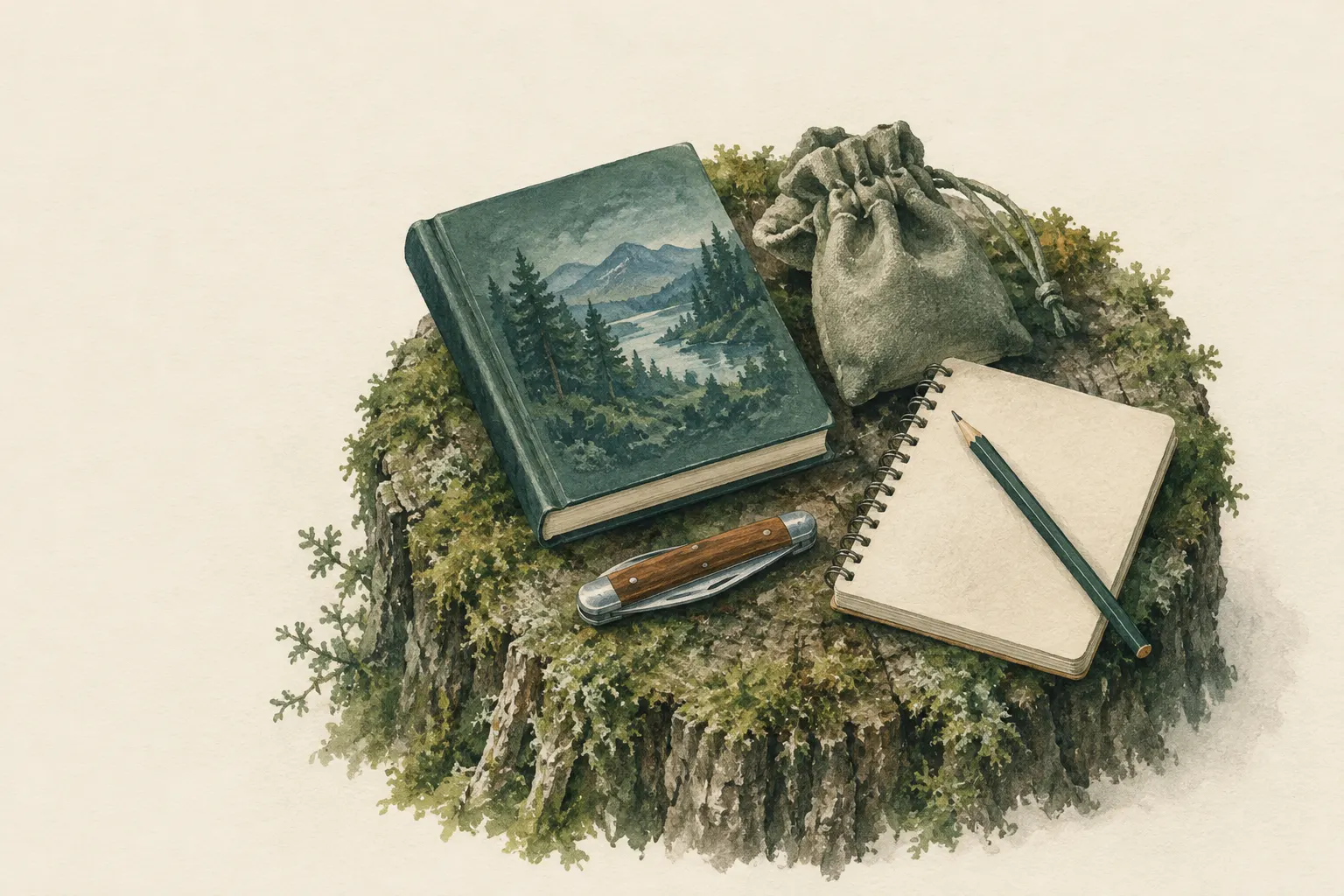
Airy collecting bag or basket
Collect each species separately so nothing unknown gets mixed in
No plastic bags for long periods – greens sweat and spoil
Knife (fixed or locking blade)
For cutting instead of uprooting
Cut away from your body.
Rules on carrying knives differ by region – check local rules.
Field notebook and pencil
Note site, features, date
Sturdy work gloves
When handling flood mud or chemicals, also wear waterproof gloves.
Suitable for
- Supplementing supplies with vitamins and variety
- Longer stays outdoors
- Practising in peaceful times so you can do it in an emergency
Not suitable for
- As the main food source – greens provide too little energy
- Plants you only "roughly" know
- Fungi – deliberately not covered here
- Nature reserves and national parks where collecting is forbidden
Prerequisites
- A good regional field guide or a walk with a knowledgeable person
- Knowing the poisonous look-alikes of the plant you want
- Knowledge of local collecting and nature-protection rules
Safety
- Do not collect along roadsides, railway embankments, sprayed field edges, industrial land or dog-walking paths. Wash low-growing plants well and cook them where possible (fox tapeworm, germs from faeces).
How it works
Safe foraging means you recognise the plant like a good friend's face – by many features at once (leaf shape, leaf arrangement, stem, smell, flower, habitat, season). A single feature almost always fits another plant too. Add a clean site, respect for nature and caution with new foods.
Advantages
- Vitamins and variety when supplies are short
- Good nature knowledge for any situation
- Free
Disadvantages
- Takes time and practice
- Few calories from greens
- Confusion can be deadly
- Not legal everywhere
Deep knowledge
Background
The US survival manual FM 3-05.70 describes a multi-stage "Universal Edibility Test" for unknown plants. For Central Europe this test is especially problematic: some of the most poisonous plants of all grow here, such as poison hemlock, water hemlock, monkshood, autumn crocus and yew. Even small amounts can be deadly, and some toxins act with a delay – a small taste followed by waiting does not protect against that. The German Federal Institute for Risk Assessment (BfR) stresses that above all, knowing the plants reliably protects you.
The risk of fox tapeworm from forest berries or herbs is considered low by current knowledge and not fully clarified; the disease, however, is serious. Hence the simple rule: wash low-growing harvest thoroughly and preferably cook it.
Variants
- Guided herb walk
- The safest start: many adult education centres, nature conservation groups and nature parks offer wild herb walks. There you learn the features on the real plant.
- Practise in your own garden
- Nettle, dandelion and plantain grow almost everywhere. In your own unsprayed garden you know the site and can watch them all year.
Common mistakes
- Identifying from a photo or an app alone
- Paying attention to only one feature, e.g. "smells of garlic"
- Mixing species in the same bag
- Collecting along roads or sprayed fields
- Relying on the "edibility test"
- Eating a lot of a new plant at once
Limits and risks
- Not a field guide – features here are pointers, not a complete description
- No fungi
- Legal situation only in outline; check local rules
Material alternatives
Derived from material properties: a substitute must have all relevant properties. Observe the notes on the substitute.
- Airy collecting bag or basket
- Metal pot (stainless steel, aluminium, titanium) (Hot – scalding risk.), Single-wall stainless steel bottle (Heat only single-wall bottles without paint/plastic; remove the lid before heating.), Double-wall insulated bottle (Never heat directly.), PET bottle (clear, max. 2 litres) (Do not heat or place in a fire.), Food-grade water container (Only use containers that never held chemicals or fuel.), Airtight food-grade storage container (Fill only when clean and completely dry; never use containers that previously held chemicals.), Collapsible water container or bag (Protect from sharp objects.), Measuring jug, Food-grade water bag (Use only for drinking water, never for chemicals or fuel.), Fermentation jar or crock (Use only food-grade containers of glass, food-safe glazed stoneware or food-grade plastic – no metal containers for acidic food.), Resealable food bags (Use only bags intended for food; do not use with boiling water unless the manufacturer explicitly allows it.), Rigid collecting container (box, basket or mug) (One species per container – never mix in anything unknown)
Results come exclusively from structured entries. No improvised instructions are generated.
Sources
Headquarters, Department of the Army (USA) (2002): FM 3-05.70 Survival
Plants as survival food, the "Universal Edibility Test" and its limits, caution with unknown plants
Bundesinstitut für Risikobewertung (BfR) (2017): Risiko Pflanze – Einschätzung und Hinweise
Poisonous plants in the wild, poisoning risks and advice if poisoning is suspected
Bundesinstitut für Risikobewertung (BfR): Giftpflanzen: Wie kann man sich schützen und was ist bei einer Vergiftung zu tun? (Fragen und Antworten)
Protection from plant poisoning, what to do if poisoning is suspected
Robert Koch-Institut: RKI-Ratgeber Echinokokkose
Fox tapeworm (echinococcosis): transmission, risk, prevention
Bundesrepublik Deutschland (gesetze-im-internet.de) (2009): Gesetz über Naturschutz und Landschaftspflege (Bundesnaturschutzgesetz – BNatSchG), insbesondere § 39 und § 30
Collecting wild plants in small amounts for personal use (§ 39(3)), protected areas and protected species
Gesundheitsportal Österreich (gesundheit.gv.at), Bundesministerium für Soziales, Gesundheit, Pflege und Konsumentenschutz: Vergiftungsinformationszentrale (VIZ)
Poison emergency line in Austria