Collecting and preparing rose hips
Rose hips are the red fruits of wild roses. They hang on the bush from autumn into winter, are easy to recognise and rich in vitamin C. You can only eat the flesh: the hard seeds inside carry fine hairs that irritate mouth, throat and gut. Here you learn how to recognise wild roses, which red poisonous fruits you must never confuse with them and how to turn rose hips into purée, tea or dried shells.
- Picking 20–40 minutes; cleaning is the real work (about an hour for a bowlful); purée or tea 30–45 minutes
Explained simply
In autumn small red fruits hang on wild roses: the rose hips. They often stay on the bush into winter, when almost nothing else grows. You can make tea and purée from them, and they are full of vitamin C.
But careful: inside there are hard seeds with tiny hairs. They itch on the skin and scratch in the throat and the tummy. So you cut the rose hip open and scrape everything out – or you cook it soft and press it through a fine sieve.
Not every red fruit is a rose hip. Yew, mezereon and spindle also have red fruits and are poisonous. A rose hip always grows on a rose bush with prickles and has a small, dry crown on top. If you are unsure, you leave it hanging.
How it works
The rose hip is not a berry in the strict sense but a compound fruit. The red, fleshy shell grew from the base of the rose flower, and inside it lie many small, hard nutlets – the actual fruits. Each nutlet is surrounded by fine, stiff hairs. These hairs are exactly what bothers you when eating.
Frost makes the shell softer because ice crystals loosen the cell walls. That is why rose hips are sweeter and easier to process after the first cold nights. Cooking has a similar effect: the shell softens and you can press it through a sieve, while seeds and hairs stay on top.
When drying, the shells lose their water and become light and long-lasting. You later boil tea from them. Vitamin C is sensitive to heat – brief cooking is better than hours of it.
What really matters
Recognition only works from the whole picture: a shrub with arching branches and curved prickles, pinnate leaves of usually 5 to 7 toothed leaflets, rose flowers with five petals in early summer and oval red fruits with a dried crown in autumn. Anyone who has seen the flowers in summer will find the bush again reliably in autumn.
Thorough cleaning is the real work. When scraping out, put on gloves and rinse the shells in a bowl of water afterwards. For purée a really fine sieve or a dense cloth helps; a coarse colander lets hairs through. For tea, strain through a coffee filter.
Leave enough on the bush. Rose hips are an important food for birds in winter. A few handfuls are enough for several pots of tea for you.
Safety: what to watch out for
The hairs are not poisonous, but they irritate skin, eyes, mouth and gut. Do not touch your face while cleaning and wash your hands afterwards. If the purée or tea scratches your throat, the sieve was too coarse – then strain it once more through a cloth.
The red poisonous fruits that glow in the same autumn are dangerous: yew, mezereon, spindle and guelder rose. Children in particular like to grab them. If someone has eaten an unknown red fruit, remove remains from the mouth, keep a piece of the plant and in Austria call the Poison Information Centre (+43 1 406 43 43). With breathing problems, seizures or drowsiness call 144 or 112 at once.
Ornamental roses in gardens and parks are often sprayed. Do not pick by roads or sprayed fields either. A few metres further on, at a quiet hedge, it is cleaner.
When it makes sense – and when not
Rose hips are ideal in the cold season, when there is hardly any fresh fruit. A warm rose hip tea feels good, brings vitamin C and some variety. Dried shells are light and easy to carry.
Rose hips do not fill you up. They contain few calories, and cleaning takes time. In a real emergency they are a supplement to energy-rich food, not a substitute.
Good to know
The itching powder children once used for pranks was exactly these hairs from rose hips. That shows well why they do not belong in your mouth.
On coasts the Japanese rose with especially large hips often grows. It is prepared in the same way. And when you see a rose bush flowering in summer, remember the spot – in autumn you will know where to pick.
Step by step
When and where to pick
Rose hips ripen from September and often stay on the bush into winter. After the first frost they become softer and sweeter – so you can safely wait. Pick at forest edges, hedges and banks, not by roads, on sprayed fields or from ornamental roses in parks. Take only small amounts for yourself and leave enough for the birds that live on them in winter.
- 1
When and where to pick
Rose hips ripen from September and often stay on the bush into winter. After the first frost they become softer and sweeter – so you can safely wait. Pick at forest edges, hedges and banks, not by roads, on sprayed fields or from ornamental roses in parks. Take only small amounts for yourself and leave enough for the birds that live on them in winter.
- 2
Recognise wild roses reliably
Wild roses are shrubs with long, arching branches and curved prickles. The leaves are pinnate: usually 5 to 7 toothed leaflets on one stalk. In early summer they flower pink or white with five petals. The fruit is oval to round, red to orange-red and has a crown of dried sepals at its tip. All features must fit at the same time.
- 3
Rule out red poisonous fruits
Memorise the red fruits you must never eat: yew (a conifer with flat needles, red cup open at the top, dark seed visible), mezereon (a small shrub, red berries sit directly on the twig), spindle (pink, four-lobed capsules with an orange seed) and guelder rose (glassy red berries in clusters). None of these plants has rose prickles and pinnate leaves.
Yew seeds and needles are highly poisonous – just a few can be life-threatening for children.
- 4
Pick ripe fruits
Put on gloves, because the prickles sting. Only pick deep red, undamaged fruits that are firm or, after frost, slightly soft. Leave mushy, mouldy or nibbled ones on the bush. At home or in camp cut off the stalk and the crown with your knife.
- 5
Remove seeds and hairs
Cut each rose hip open lengthwise and scrape out all seeds and the white hairs with the tip of your knife or a small spoon handle. Then rinse the shells in a bowl of clean water so loose hairs come away too. Wear gloves while doing this and do not rub your eyes.
Hairs in food irritate mouth and gut – better rinse once more.
- 6
Purée: cook and press through
Faster than scraping: barely cover the whole, trimmed fruits with water and simmer until they are completely soft – about half an hour, depending on ripeness. Then press everything through a fine sieve or a dense cloth. Seeds and hairs stay behind, an orange-red purée comes through. Test it with your tongue for scratchiness before eating more.
- 7
Rose hip tea
Use one to two tablespoons of cleaned, chopped shells per cup (fresh or dried). Bring to the boil with water and simmer gently for about ten minutes, then strain through a coffee filter or a fine cloth so that no hairs float in the tea. The tea tastes fruity and slightly sour and warms you.
- 8
Dry the shells for later
Lay halved, cleanly scraped shells thinly on a cloth or rack and let them dry in an airy, warm place – in the sun, on the stove or next to, but not above, the fire. They are done when they are hard and no longer give. Store them dry in a jar or bag and check for mould before use.
Common mistakes
- Eating rose hips raw with seeds and hairs
- Getting hairs into your face or eyes while cleaning
- Not straining the tea finely
- Picking red fruits without looking at leaves and prickles
- Using ornamental roses from parks and gardens
- Stripping all the fruit from one bush
Quick view
Materials
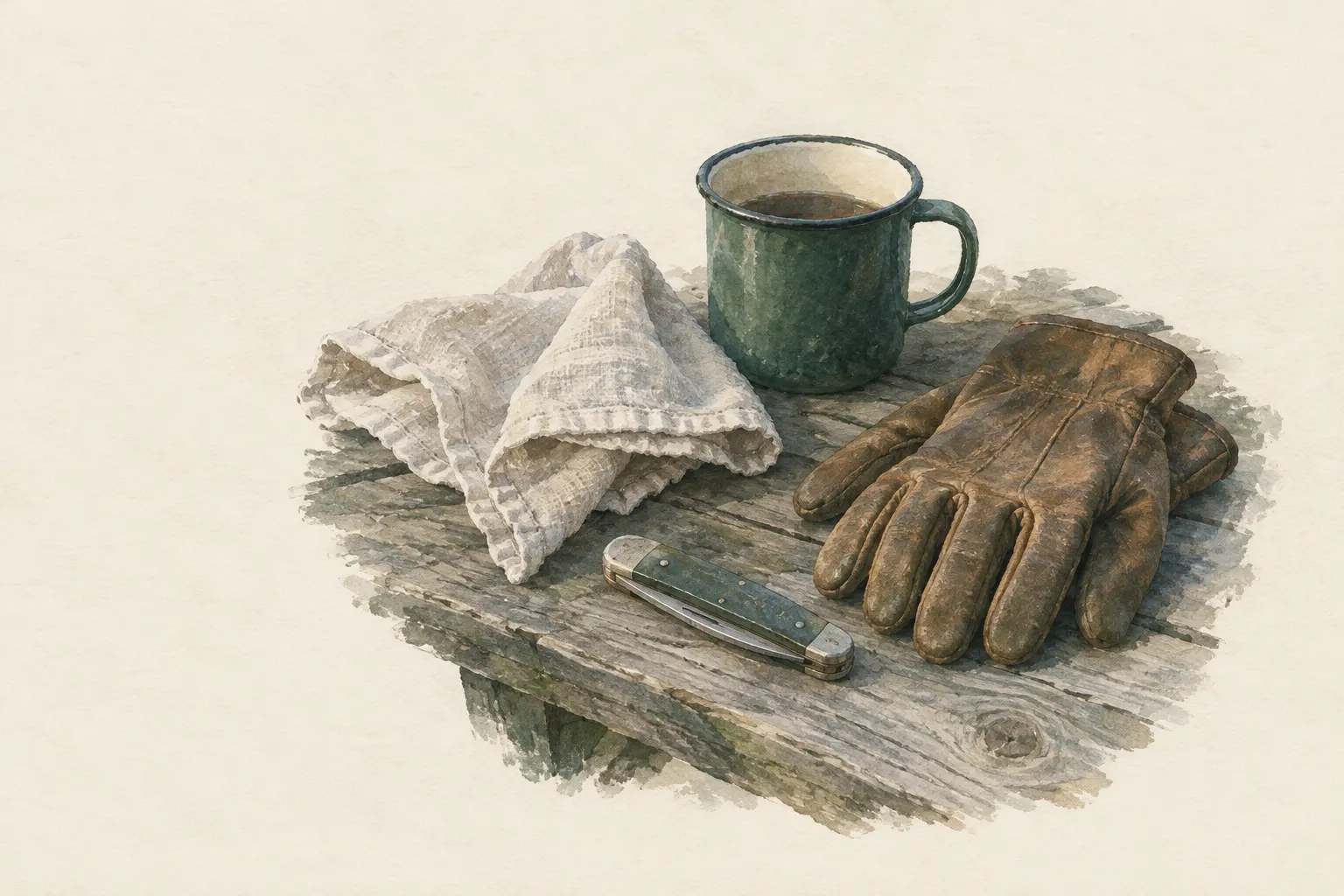
Sturdy work gloves
Against prickles and against the itchy hairs while cleaning
When handling flood mud or chemicals, also wear waterproof gloves.
Knife (fixed or locking blade)
For halving and scraping out
Cut away from your body.
Rules on carrying knives differ by region – check local rules.
Rigid collecting container (box, basket or mug)
One species per container – never mix in anything unknown
Metal pot (stainless steel, aluminium, titanium)
For purée and tea
Hot – scalding risk.
Fine sieve or dense straining cloth
Holds back seeds and hairs
For rose hips it must be fine enough to hold back the tiny hairs – a coarse colander is not enough
Coffee filter
For straining tea
Does not disinfect.
Suitable for
- September into winter – even when hardly anything else grows
- A source of vitamin C during long stays
- Beginners – the fruit is easy to recognise
Not suitable for
- Eating rose hips raw with their seeds
- Ornamental roses from gardens and parks (often sprayed)
- As a main food – few calories
Prerequisites
- Recognising wild roses reliably by prickles, leaves and fruit
- Knowing the red poisonous fruits (yew, mezereon, spindle, guelder rose)
- A pot and clean water
Safety
- The seeds are surrounded by fine, stiff hairs. They itch on the skin (children know them as itching powder) and irritate mouth, throat and gut. So always remove seeds and hairs completely or press the purée through a fine sieve. Wear gloves while scraping out and do not touch your eyes.
How it works
The rose hip is a compound fruit: outside there is a fleshy shell, inside lie many hard little nuts wrapped in hairs. Only the shell is the edible part. Frost and hanging longer loosen the flesh and make it softer and milder. By halving and scraping out, or by cooking and pressing through a sieve, you separate the flesh from the seeds and hairs.
Advantages
- Easy to recognise and widespread
- Hangs into winter, when little else grows
- Rich in vitamin C
- Light and long-lasting when dried
Disadvantages
- Cleaning is laborious
- Hairs irritate skin and gut
- Few calories – does not fill you up
- Long cooking reduces the vitamin C
Deep knowledge
Background
Rose hips have long been gathered for tea, purée and jam. Ray Mears and Gordon Hillman describe them in Wild Food as a valuable wild fruit and stress that the hairs around the seeds must be removed. The US Army survival manual FM 3-05.70 also lists wild roses as a food plant.
The German Federal Institute for Risk Assessment points out that conspicuous red fruits in particular attract children. Many of them are harmless, but some, such as yew and mezereon, are highly poisonous – which is why ruling out the look-alikes is part of every picking trip.
Variants
- Sucking out after frost
- Very soft, frozen-through rose hips can be squeezed open at the tip and the pulpy flesh carefully sucked out without biting the seeds. Spit out seeds and hairs – this is a stopgap, not a substitute for proper cleaning.
- Japanese rose on the coast
- On coasts you often find the Japanese rose with very large, flattened round hips and densely prickly branches. Its fruits are prepared in exactly the same way. In some areas it counts as an introduced species that crowds out native plants.
Common mistakes
- Eating rose hips raw with seeds and hairs
- Getting hairs into your face or eyes while cleaning
- Not straining the tea finely
- Picking red fruits without looking at leaves and prickles
- Using ornamental roses from parks and gardens
- Stripping all the fruit from one bush
Limits and risks
- Not a complete identification key
- Applies to Central Europe
- No medicinal claims
Material alternatives
Derived from material properties: a substitute must have all relevant properties. Observe the notes on the substitute.
- Rigid collecting container (box, basket or mug)
- Metal pot (stainless steel, aluminium, titanium) (Hot – scalding risk.), Single-wall stainless steel bottle (Heat only single-wall bottles without paint/plastic; remove the lid before heating.), Double-wall insulated bottle (Never heat directly.), PET bottle (clear, max. 2 litres) (Do not heat or place in a fire.), Food-grade water container (Only use containers that never held chemicals or fuel.), Airtight food-grade storage container (Fill only when clean and completely dry; never use containers that previously held chemicals.), Collapsible water container or bag (Protect from sharp objects.), Measuring jug, Food-grade water bag (Use only for drinking water, never for chemicals or fuel.), Fermentation jar or crock (Use only food-grade containers of glass, food-safe glazed stoneware or food-grade plastic – no metal containers for acidic food.), Resealable food bags (Use only bags intended for food; do not use with boiling water unless the manufacturer explicitly allows it.), Airy collecting bag or basket (Collect each species separately so nothing unknown gets mixed in)
- Metal pot (stainless steel, aluminium, titanium)
- Single-wall stainless steel bottle (Heat only single-wall bottles without paint/plastic; remove the lid before heating.)
- Coffee filter
- Cotton cloth / T-shirt (Removes coarse particles only – no disinfection.), Gravel, Charcoal from a campfire (Not activated carbon: adsorption capacity is low and unknown.)
Results come exclusively from structured entries. No improvised instructions are generated.
Sources
Ray Mears und Gordon Hillman, Hodder & Stoughton (2007): Wild Food
Rose hips as a wild fruit; remove the hairs around the seeds
Headquarters, Department of the Army (USA) (2002): FM 3-05.70 Survival
Wild roses as a food plant; only eat reliably identified plants
Bundesinstitut für Risikobewertung (BfR) (2017): Risiko Pflanze – Einschätzung und Hinweise
Poisonous red fruits such as yew and mezereon; children especially at risk
Bundesrepublik Deutschland (gesetze-im-internet.de) (2009): Gesetz über Naturschutz und Landschaftspflege (Bundesnaturschutzgesetz – BNatSchG), insbesondere § 39 und § 30
Collecting small amounts for personal use
Gesundheitsportal Österreich (gesundheit.gv.at), Bundesministerium für Soziales, Gesundheit, Pflege und Konsumentenschutz: Vergiftungsinformationszentrale (VIZ)
Poison information line in Austria (VIZ), available around the clock; in acute danger 112 or 144