Needle tea from spruce and pine – and why yew is deadly
Young shoots or green needles of spruce and pine make a resinous, fresh tea that keeps you warm and contains vitamin C. The key is telling the trees apart reliably: spruce and pine yes – yew never, because its needles are deadly poisonous. Here you learn the features of spruce, pine, fir and yew and how to steep the tea gently.
- 15–20 minutes including gathering
Explained simply
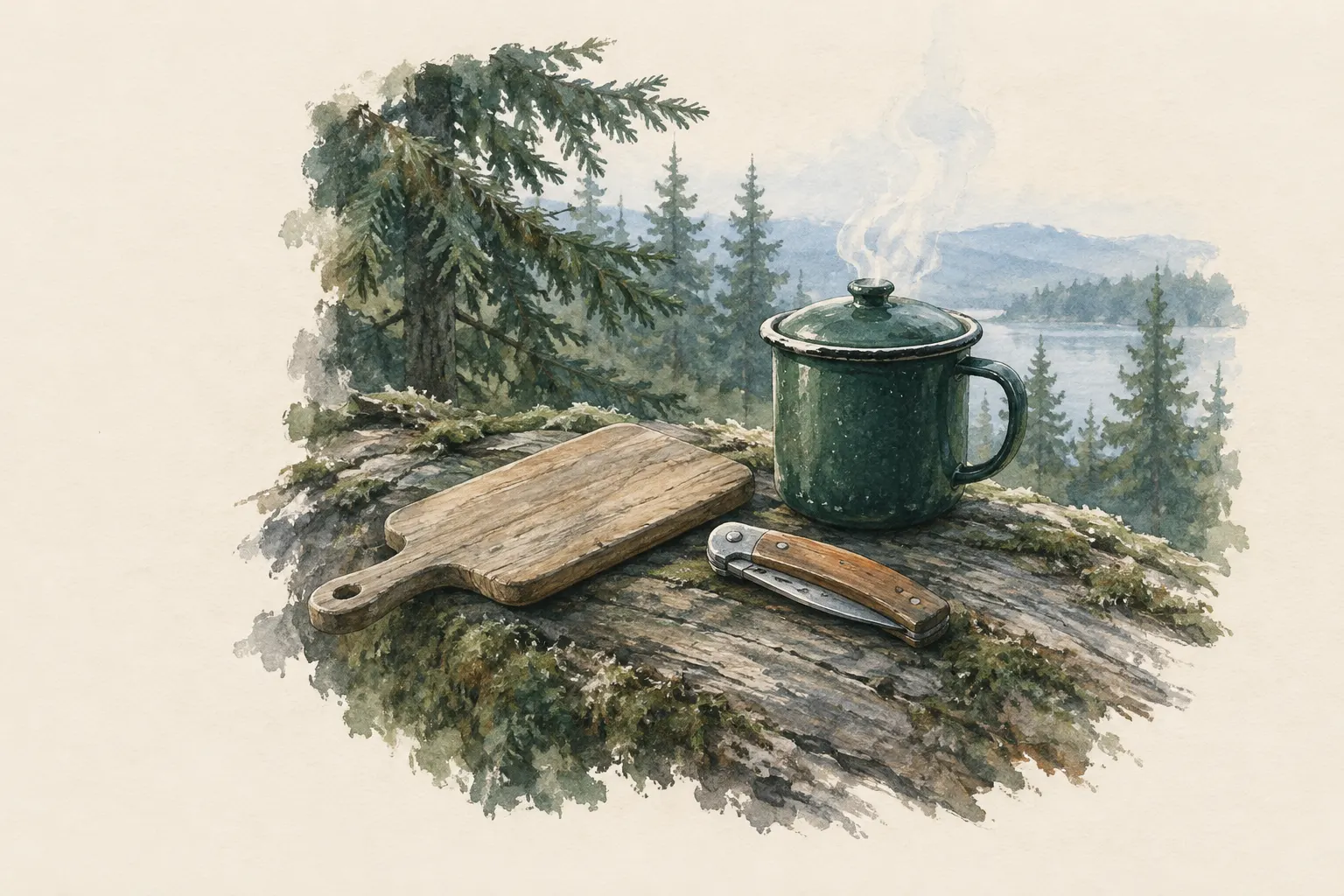
Spruces and pines are the conifers you see most often in the woods. Their green needles make a tea that tastes of forest and a little of lemon. On a cold day in camp a mug of this tea warms your hands and your tummy.
But careful: there is also a conifer that is very poisonous – the yew. Its needles are flat and soft, light green underneath with no white stripes, and it has red berries instead of cones. You must never make tea from yew, not even a tiny bit.
This is how the tea works: chop a few green needles from a reliably recognised spruce or pine, pour hot water over them, cover and wait ten minutes. The water should be hot but no longer bubbling. The tea does not fill you up – but it does you good.
How it works
Needles contain essential oils, which make the typical forest smell, and vitamin C. Hot water dissolves these substances out of the needles. Chopping increases the surface, so the tea becomes stronger. A lid keeps the aroma in the mug instead of letting it escape with the steam.
A rolling boil is not good for the tea: the oils evaporate faster, and vitamin C is sensitive to heat. That is why you boil the water first – so it is safe – and then pour it over after letting it cool briefly. This way you get clean water and still an aromatic tea.
The tea provides practically no calories. It is a warm, tasty drink that lifts your spirits and helps you drink enough. Exactly how much vitamin C is in it depends on the tree, the season and the preparation – so there is no reliable figure.
What really matters
Everything depends on telling the trees apart reliably. Spruce has sharp, prickly needles that stand all round the twig, each sitting on a small brown peg; its cones hang down. Scots pine has long needles that always come in pairs from a small sheath. You feel and see both features at the same time – that makes them reliable.
You learn fir as a comparison: flat, soft needles with a blunt or notched tip and two white stripes underneath, upright cones. Yew also has flat, soft needles, but underneath only light green with no white stripes, no cones and red cups in late summer. If you have flat needles in front of you, it is best to leave that tree out of your tea altogether.
Only take needles from trees in the woods, not from hedges and ornamental trees in gardens, parks or cemeteries. Yews, thujas or exotic species that can be poisonous often grow there. And always take only a little from each tree.
Safety: what to watch out for
Yew is highly poisonous to people and many animals. The poison acts on the heart, and poisoning can quickly become life-threatening. If someone has taken yew needles or tea made from them, call the emergency number at once (112, or 144 in Austria) and inform the poison centre.
With spruce and pine, too, keep it moderate: one or two cups a day. Pregnant women should go without, because some sources advise against it, and anyone with kidney disease or taking medication should ask a doctor first. Small children get only a mild, diluted tea, if any.
The tea does not make bad water safe. If you take water from a stream, boil it properly first or treat it another way. Only then let it cool briefly and pour it over the needles.
When it makes sense – and when not
Needle tea is ideal on cold evenings in camp, on winter trips and whenever you only have water with you and need something warm. It also helps you drink more when cold water is no fun. And it is good practice in looking closely at trees.
It makes no sense as food or as medicine. It replaces neither food nor clean drinking water, and it does not cure diseases. If you are not sure about a tree, drink plain hot water instead – it warms you just as well.
Good to know
In spring spruces put out light-green, soft tips. They taste milder and can be used for tea or, in small amounts, raw. But never take the tips of young saplings, because that injures the tree just as it is trying to grow upwards.
Bushcraft books describe needle tea as an old camp drink. Rules still apply in the woods: trees belong to someone, and breaking off branches is usually not allowed. A few needles from a low twig are different from a torn-off branch – ask if in doubt.
Step by step
Recognise spruce
Spruce has sharp, prickly, four-sided needles that stand all round the twig. Each needle sits on a small brown woody peg; if you pull it off, the twig stays rough like a rasp. The cones hang downwards and fall off whole.
- 1
Recognise spruce
Spruce has sharp, prickly, four-sided needles that stand all round the twig. Each needle sits on a small brown woody peg; if you pull it off, the twig stays rough like a rasp. The cones hang downwards and fall off whole.
- 2
Recognise pine
Scots pine has longer, blue-green needles that always grow in pairs from a small sheath. The bark high up the trunk is often orange-red. The cones are smaller and egg-shaped.
- 3
Fir for comparison
Fir has flat, soft needles with a blunt or notched tip and two clear white stripes underneath. Its cones stand upright on the branches. Fir is considered non-poisonous, but you do not need it for tea – it matters as a comparison with yew.
- 4
Recognise yew – and leave it
Yew has flat, soft needles with a short point, glossy dark green on top, lighter yellowish green underneath with no white stripes. It bears no cones but, in late summer, red cups open at the top. It often grows as a hedge in gardens, parks and cemeteries, but also in woods. All parts except the red flesh are highly poisonous.
Never use yew for tea – deadly.
- 5
Gather gently
Take a handful of young, light-green shoot tips in spring or green needles from several trees, never much from one. Avoid trees along roads, on sprayed land and all ornamental conifers. Check in the container that no other twigs got mixed in. In woods: only with permission and do not break off branches.
- 6
Chop
Rinse the needles briefly with clean water and chop them on a firm surface – this way they release more aroma. For one cup, about a heaped tablespoon of chopped needles or a small handful of shoot tips is enough.
- 7
Pour hot water, do not boil
Bring treated water to the boil, take it off the heat and let it cool briefly. Pour it over the needles, cover the mug and let it steep for about 10 minutes. Then strain. The tea is pale yellow and tastes resinous and lemony. One or two cups a day are enough – it does not replace drinking water or food.
Common mistakes
- Using yew or ornamental conifers
- Boiling the needles hard
- Tearing many branches off one tree
- Thinking the tea treats water
- Counting on it as a source of calories
Quick view
Materials
Metal pot (stainless steel, aluminium, titanium)
Hot – scalding risk.
Stove
Or a safe campfire
Never operate inside a tent, shelter or enclosed room – carbon monoxide and fire risk.
Knife (fixed or locking blade)
For chopping the needles
Cut away from your body.
Rules on carrying knives differ by region – check local rules.
Cotton cloth / T-shirt
For straining
Removes coarse particles only – no disinfection.
Suitable for
- A warm drink in camp, especially in the cold
- Variety when only water is available
- Practice in recognising conifers
Not suitable for
- Ornamental conifers in gardens, parks and cemeteries (often poisonous or exotic species)
- Trees along roads or sprayed plantations
- Pregnant women – some sources advise against it
Prerequisites
- Being able to tell spruce, pine and yew apart reliably
- Clean, treated water
- Permission to take a few shoots
Safety
- Thuja (arborvitae), savin juniper and many ornamental conifers are poisonous too. Only use spruce and Scots pine that you recognise 100 %. Pregnant women and people with kidney disease are better off without it; some sources advise against it in pregnancy.
- The tea does not make bad water safe if it is only steeped in hot, not boiling, water. Boil untreated water first and then let it cool briefly.
How it works
Spruce and pine needles contain essential oils and vitamin C. Hot water dissolves the aroma and some of the contents; water at a rolling boil drives off the aroma faster and destroys more vitamin C. So you pour the water over and let it steep covered. The tea does not fill you up – it provides practically no calories – but it warms you and tastes good.
Advantages
- A warm, aromatic drink from your surroundings
- Contains some vitamin C
- Lifts the mood in camp
Disadvantages
- Life-threatening confusion with yew is possible
- No calories
- Not suitable for everyone
Deep knowledge
Background
Needle teas are a tradition in many countries with conifer forests, and bushcraft textbooks describe them as a simple camp drink. How much vitamin C a cup contains varies greatly with tree species, season and preparation – so we give no figure.
The German Federal Institute for Risk Assessment lists yew among the highly poisonous plants; poisoning affects the heart and can progress without much warning.
Variants
- Spring tips
- In spring young spruce shoots are soft, light green and milder in taste. They can also be chewed raw – sparingly, and only from reliably recognised spruces.
- In a vacuum flask
- Put needles in a tea bag or cloth and add hot water in a vacuum flask – this keeps the tea warm on the move.
Common mistakes
- Using yew or ornamental conifers
- Boiling the needles hard
- Tearing many branches off one tree
- Thinking the tea treats water
- Counting on it as a source of calories
Limits and risks
- Applies to spruce and Scots pine in Central Europe
- No medical effect claimed
- No substitute for food or clean drinking water
Material alternatives
Derived from material properties: a substitute must have all relevant properties. Observe the notes on the substitute.
- Metal pot (stainless steel, aluminium, titanium)
- Single-wall stainless steel bottle (Heat only single-wall bottles without paint/plastic; remove the lid before heating.)
Results come exclusively from structured entries. No improvised instructions are generated.
Sources
Bundesinstitut für Risikobewertung (BfR) (2017): Risiko Pflanze – Einschätzung und Hinweise
Yew as a highly poisonous plant (needles, seeds)
Ray Mears – Hodder & Stoughton (2002): Bushcraft
Using conifers in camp; needle tea as a traditional camp drink
Headquarters, Department of the Army (USA) (2002): FM 3-05.70 Survival
Only use plants after reliable identification; avoid poisonous plants