Recognising and using important trees
If you can reliably recognise birch, spruce, pine, fir, oak, beech, hazel, willow and lime, you know where to find tinder, resin, weaving rods or good poles. You always look at several features – bark, leaf or needle, fruit or cone, growth form. You must be able to tell the poisonous yew apart from fir and spruce. Only deadwood or material the owner allows you is used.
- A first overview in an afternoon, reliable recognition over several seasons
Explained simply
Trees are like people: each one has a face. Some have white skin with black stripes, some a smooth grey one, others a rough, deeply furrowed one. Some have needles, others leaves. If you look closely, you recognise them again – like friends in the schoolyard.
This helps you a lot outdoors. The white birch gives bark that burns even when a little damp. On spruces and pines you find resin. Hazel has straight poles, willow flexible rods for weaving. So that you are not fooled, you always look at several things: bark, leaf or needle, fruit or cone.
There is one tree you need to know especially well: the yew. It looks a little like a fir but is very poisonous. You put nothing from it in your mouth and make nothing from it for eating. And remember: every tree belongs to someone – you do not cut into living trees.
How it works
Trees are identified by features that change little: the shape and arrangement of leaves or needles, the bark, the fruit or cones and the growth form. Any single feature can look similar in several species. Only the combination is unmistakable. That is why you always check at least three features.
For conifers a simple comparison helps. Spruce has pointed needles that stand all round the twig and prick; roll a needle between your fingers and you feel edges. Its cones hang down and fall whole. Fir has flat, soft needles with two white stripes on the underside; its cones stand upright on the branches and fall apart there, so you rarely find whole fir cones on the ground. Pine has long needles sitting in pairs in a bundle, and orange to reddish bark higher up the trunk.
For broadleaf trees, leaves and bark are the most important clues. Birch has white bark with black cracks and small, triangular, toothed leaves. Oak has lobed leaves, acorns and deeply furrowed bark. Beech has smooth, silver-grey bark, oval leaves with a wavy edge and beechnuts in a spiny husk. Hazel usually grows as a shrub with many straight shoots and roundish, softly hairy leaves. Willows often have long, narrow leaves and catkins and like to grow near water. Lime has heart-shaped leaves that are lopsided at the base.
What really matters
The most important comparison is fir against yew, because both have flat needles. Yew has no white stripes on the underside; it is pale green there. It carries no cones but, in autumn, red, cup-shaped seed coats. Its bark is red-brown and flakes off in thin scales. If you are not sure about a conifer with flat needles, treat it as a yew.
Each tree has a typical use in camp. Loose birch bark from dead, fallen wood is oily and burns even when slightly damp – a proven tinder. Resin from spruce and pine burns well and makes pitch glue. Oak and beech give hard, long-burning firewood. Hazel gives straight poles, willow flexible rods for weaving, and lime bast can be made into cord.
In winter the leaves are missing. Then bark, buds, growth form and what lies on the ground help: beechnut husks, acorns, cones or old leaves. If you visit the same trees several times over the year, you learn them fastest.
Safety: what to watch out for
Yew is highly poisonous in almost all parts: needles, bark, wood and seeds. Only the red, fleshy seed coat contains no poison – but the seed inside does. So the rule is: nothing from a yew in your mouth, no skewers, spoons or chopsticks of yew wood and no yew needles as tea. Children learn it as a hands-off tree. If poisoning is suspected, call 112 at once (in Austria also 144) or a poison information centre.
This entry is not a guide to eating. Even though some tree fruits are edible, acorns, for example, contain tannins, and raw beechnuts should not be eaten in large amounts. You only eat wild plants and fruits that you recognise with one hundred per cent certainty and know how to prepare.
Trees themselves can be dangerous too. Dead trees and hanging dead branches can fall without warning. Look up when collecting and camping and avoid such spots, especially in wind.
When it makes sense – and when not
Knowing trees pays off wherever you are outdoors: lighting fires, building a camp, making crafts and simply on a walk. The species described here are common in Central Europe. Parks and gardens also contain many foreign ornamental trees that can confuse.
Use follows clear rules. In Germany you may enter forests for recreation, and in Austria too – but that does not mean you may take wood away or cut trees. Wood belongs to the forest owner. For poles, rods or bast you ask the owner. For fires and crafts, fallen deadwood is usually enough where it is allowed.
Good to know
A German rhyme for conifers says: the spruce pricks, the fir does not. It helps, but it does not replace looking at the other features – yew hardly pricks either.
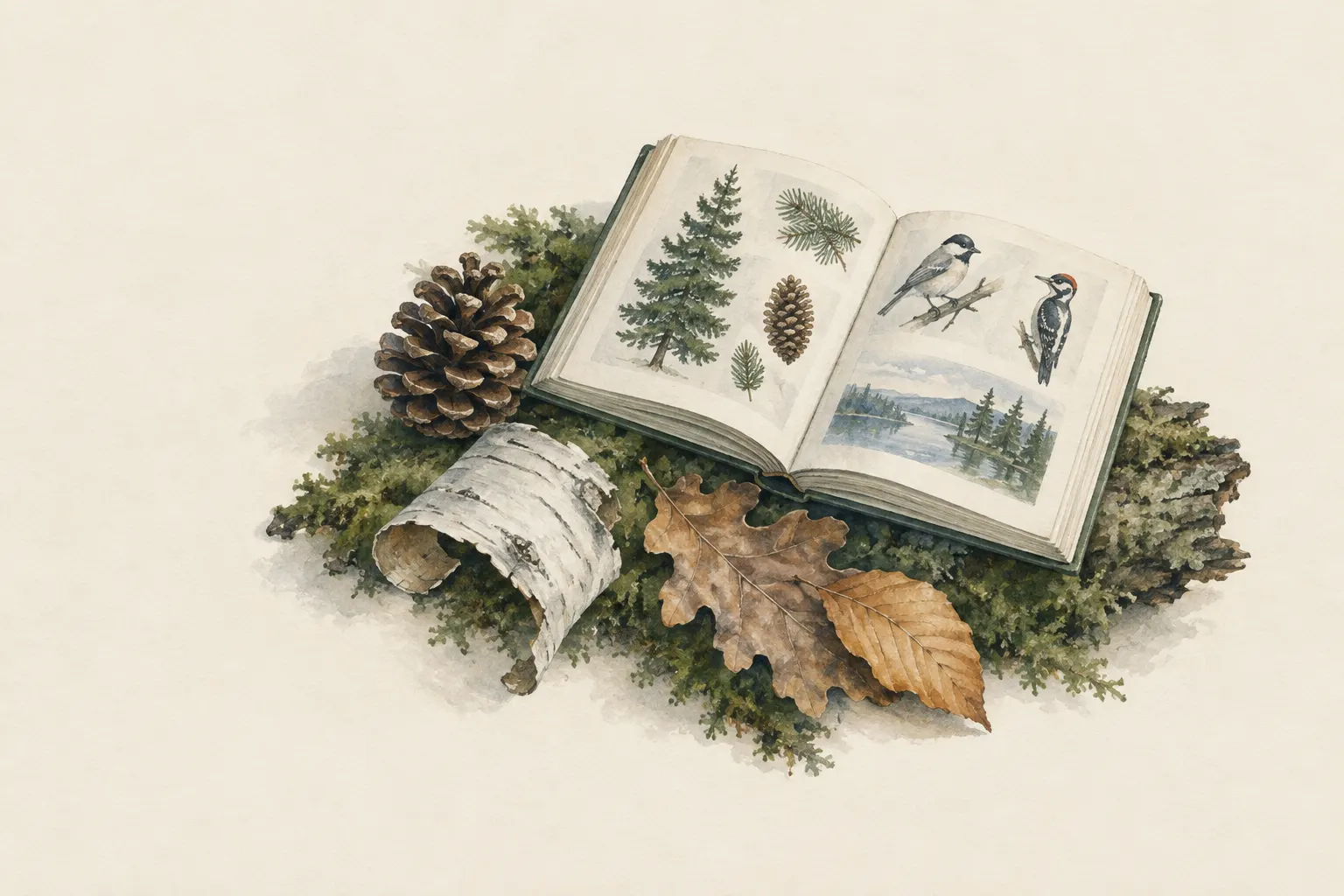
A good tree field guide with pictures of bark, buds and fruits is the most important tool. Many people also keep a small notebook in which they sketch or press leaves. That way you build your own tree book.
Trees are habitats. Woodpecker holes, deadwood and old trees are valuable for many animals. If you know trees, you see the forest with different eyes and treat it with more care.
Step by step
Check several features
Always look at at least three things: bark, leaf or needle and fruit or cone – plus the growth form. Only when everything fits is the tree identified.
- 1
Check several features
Always look at at least three things: bark, leaf or needle and fruit or cone – plus the growth form. Only when everything fits is the tree identified.
- 2
Spruce, fir, pine
Spruce: pointed needles all round the twig that prick; cones hang down. Fir: flat, soft needles with two white stripes underneath; cones stand upright. Pine: long needles in pairs, orange bark higher up.
- 3
Recognise and avoid yew
Yew: flat, pointed needles, pale green underneath without white stripes, no cones, red cups around the seeds, red-brown, flaking bark. Highly poisonous – use nothing from it.
Put nothing from a yew in your mouth.
- 4
Birch
White bark with black cracks, dark and rough at the base; small triangular, toothed leaves. Loose bark from dead, fallen wood burns even when slightly damp – good tinder.
- 5
Oak and beech
Oak: lobed leaves, acorns, deeply furrowed bark; hard wood that burns for a long time. Beech: smooth, silver-grey bark, oval leaves with a wavy edge, beechnuts in a spiny husk; good firewood.
- 6
Hazel, willow, lime
Hazel: a shrub with many straight shoots, roundish, softly hairy leaves – straight poles. Willow: often long, narrow leaves, catkins, near water – flexible rods for weaving. Lime: heart-shaped, lopsided leaves – bast fibre.
- 7
Use by the rules
For fires and crafts take only fallen deadwood. Cut poles, rods or bast only with the owner's permission, and never peel bark from standing trees.
- 8
Practise and take notes
Visit the same trees in summer and winter with a field guide. Note or sketch the features – in winter bark, buds and growth form help.
Common mistakes
- Identifying by a single feature
- Mistaking yew for fir
- Peeling bark off living birches
- Cutting fresh wood where only deadwood is allowed
- Assuming that a tree's nuts or fruits are edible raw
Quick view
Materials
Knife (fixed or locking blade)
Only for deadwood
Cut away from your body.
Rules on carrying knives differ by region – check local rules.
Suitable for
- Central European forests, parks and woodland edges
- Finding tinder, firewood and craft material on purpose
- Children and groups exploring nature
Not suitable for
- Identifying edible plants or mushrooms
- Identification when only a single feature is visible
- Other floral regions without a suitable guide
Prerequisites
- A tree identification book or a knowledgeable companion
- Patience to look at trees in different seasons
Safety
- Trees always belong to someone. Do not cut, peel or score living trees. Collect only what local rules allow – in Austria taking wood away generally needs the forest owner's consent.
- Only use what you have identified for certain by several features. If in doubt, do not use it.
How it works
Every tree species has a combination of features that together are unmistakable. A single feature can mislead – both fir and yew, for example, have flat needles. Only bark, leaf or needle, fruit or cone and growth form together give a reliable picture.
Advantages
- Saves time when looking for tinder, resin and material
- Protects against poisonous yew
- Makes every walk in the woods more interesting
Disadvantages
- Needs practice over several seasons
- Applies only to Central Europe – other species elsewhere
- Cultivated and ornamental trees can confuse
Deep knowledge
Background
Bushcraft textbooks often start with trees, because nearly every camp skill depends on wood, bark or resin. Tree field guides describe bark, leaf, fruit and growth form as the key features.
Yew is rare in forests but often grows in parks, gardens and churchyards. Its toxicity is well described in toxicology.
Variants
- Identifying in winter
- Without leaves, bark, bud shape, growth form and the remains of fruit on the ground help – such as beechnut husks or acorns.
- With children
- Feeling bark, collecting cones and comparing leaves is fun for children. Show them the yew as a hands-off tree.
Common mistakes
- Identifying by a single feature
- Mistaking yew for fir
- Peeling bark off living birches
- Cutting fresh wood where only deadwood is allowed
- Assuming that a tree's nuts or fruits are edible raw
Limits and risks
- No identification of edible wild plants or mushrooms
- Only a selection of common Central European trees
- Not legal advice – check the rules locally
Sources
HarperCollins (Owen Johnson, David More) (2004): Collins Tree Guide
Identification features of bark, leaf, needle, cone and growth form
Wissenschaftliche Verlagsgesellschaft Stuttgart (Dietrich Frohne, Hans Jürgen Pfänder): Giftpflanzen – Ein Handbuch für Apotheker, Ärzte, Toxikologen und Biologen
Toxicity of yew (Taxus baccata)
Ray Mears – Hodder & Stoughton (2002): Bushcraft
Uses of birch, pine, lime and other trees in camp
Republik Österreich – Rechtsinformationssystem des Bundes (RIS) (1975): Forstgesetz 1975 (BGBl. Nr. 440/1975), § 33 Benützung des Waldes zu Erholungszwecken
Access to forests in Austria; wood belongs to the forest owner
Bundesrepublik Deutschland – Bundesministerium der Justiz (1975): Gesetz zur Erhaltung des Waldes und zur Förderung der Forstwirtschaft (Bundeswaldgesetz), § 14 Betreten des Waldes
Access to forests in Germany