Pitch glue from spruce and pine resin
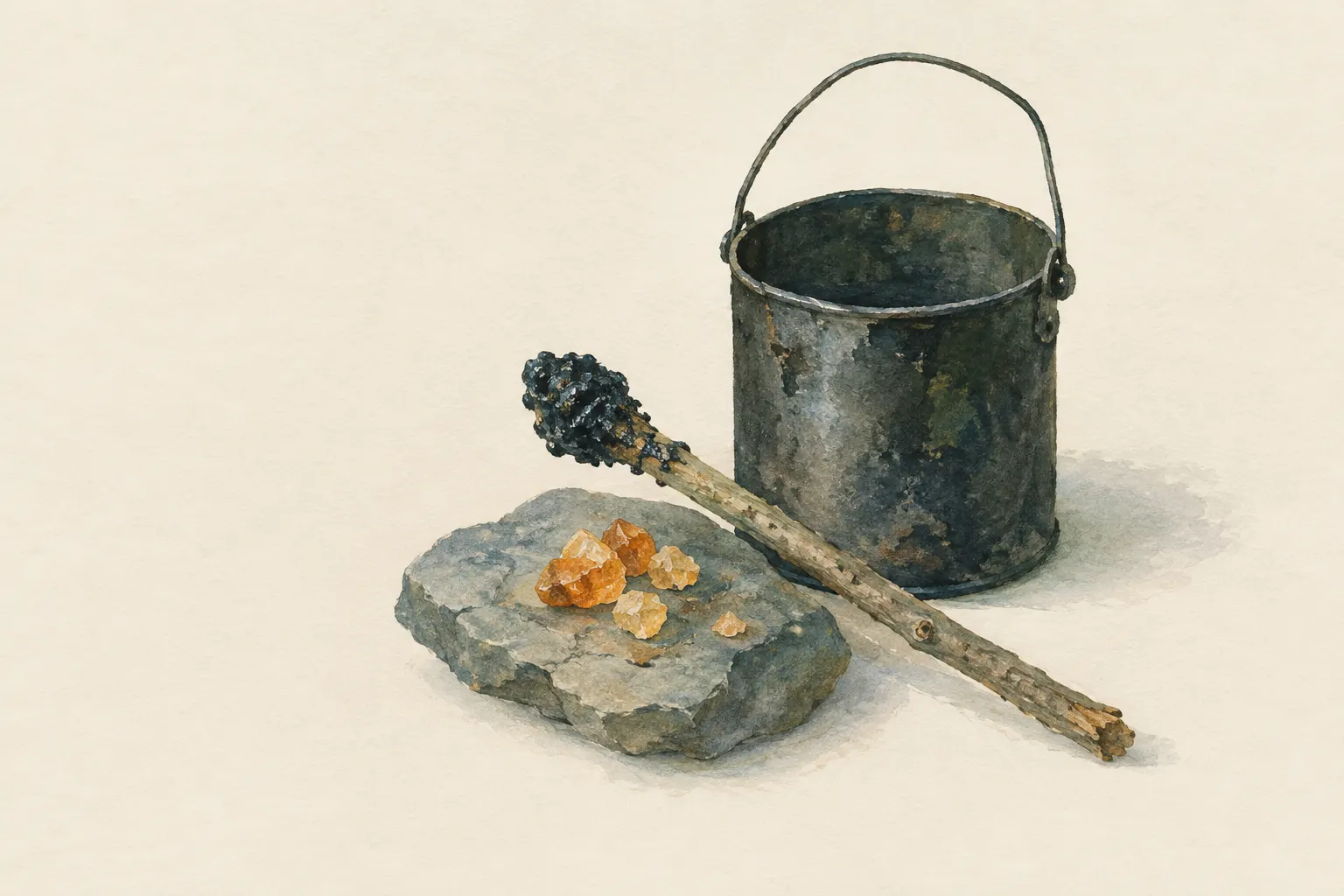
Tree resin and finely ground charcoal make a glue that softens when warmed and hardens when it cools. You collect only resin that has already oozed out of old wounds, melt it slowly over low heat – never in the flame –, stir in charcoal and wind the mass onto a stick. With it you seal cracks, glue and repair. Hot resin sticks to the skin and burns it.
- Collecting depends on the forest, making it about 30–60 minutes
Explained simply
Have you ever seen a sticky, golden drop on a conifer? That is resin. The tree uses it like a plaster: when it has a wound, resin runs out and seals it. From this resin you can make a glue that sets hard like plastic.
You collect only old, hard drops that are left over and leave a layer on the wound. Then you melt the resin very slowly in a small tin at the edge of the embers and stir fine charcoal powder into it. You wind the warm mass onto a stick. When you warm it later, it softens and sticks.
But careful: hot resin is like hot honey that sticks to the skin – it burns. And resin can catch fire. So never hold it in the flame, never touch it with your fingers and always keep a lid and water ready.
How it works
Resin is a mixture of solid resin acids and volatile oils like those found in turpentine. In air the volatile parts slowly evaporate and the resin hardens. When warmed it becomes liquid again. This property – soft when warm, hard when cold – makes it a glue that can be reshaped again and again.
Pure resin is often brittle as glass once it cools, or stays sticky depending on its age. Charcoal powder bulks out the mass and makes it firmer and less sticky. Very fine fibres work like the reinforcement in concrete and make the glue tougher. The right ratio depends on the resin, which is why you test with a drop.
The volatile oils in resin are also why it burns. If it gets too hot, vapours rise that can ignite at a flame. Slow, gentle melting keeps the temperature low and the vapours few.
What really matters
Good resin is hard, yellowish to brownish and hangs as drops or a crust at old wounds, broken branches or stumps of spruce and pine. You break off only this surplus. Fresh, liquid resin in a new wound is left alone – the tree needs it as protection.
The charcoal must be cold and very fine, almost like flour. Coarse pieces make the glue crumbly. Stir the powder in only after the tin has been taken off the fire, and add it in small amounts. A drop on a cold stone shows after a minute whether the mix is right: if it shatters when pressed, it needs more resin; if it sticks to your fingers, more charcoal.
Glue only holds on clean, dry surfaces. Rough surfaces hold better than smooth ones. Slightly warmed parts bond better because the resin does not set at once. To press it on, use a dampened piece of wood – resin hardly sticks to wet wood.
Safety: what to watch out for
Hot resin sticks to the skin and keeps giving off its heat – which makes burns deeper than with hot water. Never touch it with bare fingers. If it happens anyway, cool the spot at once with cool, not ice-cold, water for at least 20 minutes. Do not tear off the resin, because skin would come with it. For large burns, burns to the face or burns in children, call 112, in Austria also 144.
Resin burns fiercely and sootily. Melt it only at the edge of the embers, never in the flame, and stay with it the whole time. If the resin in the tin catches fire, put a lid or a flat stone on it to smother the flame. Never pour water in – hot resin can spatter like hot fat.
Before every fire, check whether fires are allowed there and whether there is currently a forest-fire danger. Afterwards put the fire out completely. Children can join in collecting and grinding; an adult does the melting.
When it makes sense – and when not
Pitch glue is handy for small repairs: securing a loose binding, sealing a crack in a bark container, fixing a blade in a wooden handle or making a seam waterproof. A pitch stick in the pack is light and keeps for a long time.
It is not suitable for vessels with hot contents, because it softens in the heat. In full sun or in a warm car it can run; in frost it can become brittle. It is unsuitable for parts under heavy load or carrying people. If modern glue is available, it is usually stronger and easier.
Good to know
Plant glues are among the oldest materials of all. Archaeologists have found Stone Age tools whose blades were fixed in the handle with birch tar. Birch tar, however, is made differently: birch bark is heated without air. That is more involved than resin-and-charcoal glue.
Resin is also a good fire starter because it burns so well – one more reason never to melt it near open flames. Resin-rich wood, fatwood, is described in the entry on fatwood.
Resin on your fingers comes off with a little cooking oil or fat: rub it in, leave it briefly, wipe it off. Water and soap alone hardly help.
Step by step
Collect resin
Hard drops of resin often hang at old wounds on spruce or pine trees. Break off only this surplus and leave a layer on the wound. Never cut the tree.
Caution: Collect only with the landowner's permission.
- 1
Collect resin
Hard drops of resin often hang at old wounds on spruce or pine trees. Break off only this surplus and leave a layer on the wound. Never cut the tree.
Collect only with the landowner's permission.
- 2
Grind charcoal
Grind a piece of cold charcoal from a dead fire between two stones into a fine powder.
- 3
Prepare the melting spot
Put the crushed resin into a small tin with a handle. Have a lid or flat stone for covering and water for cooling ready.
- 4
Melt slowly
Put the tin at the edge of the embers, not in the flame. Let the resin melt slowly. If it starts to smoke, take the tin off the fire.
If the resin burns, cover it; never pour water in.
- 5
Remove debris
Fish bits of bark, needles and insects out of the liquid resin with a twig.
- 6
Stir in charcoal
Take the tin off the fire and stir in charcoal powder a little at a time. If you like, add very fine, dry fibres.
- 7
Test and form a pitch stick
Let a drop cool on a stone: if it shatters, add more resin; if it stays sticky, add more charcoal. Then dip the end of a stick several times, turn it and let it cool.
- 8
Use the glue
Warm the pitch stick carefully over the embers until it softens and smear it onto the clean, dry spot. Press it on with a dampened piece of wood and let it cool.
Never press hot resin with your fingers.
Common mistakes
- Heating resin directly in the flame
- Pouring water on burning resin
- Cutting trees to get more resin
- Shaping hot resin with the fingers
- Applying it to wet or dirty surfaces – it will not hold
Quick view
Materials
Tree resin (spruce, pine)
Only resin that has already oozed out and hardened
Resin is flammable and sticks to the skin when hot – melt it only slowly over low heat.
Collect only resin that has already oozed out; never cut trees.
Charcoal from a campfire
Cold, very finely ground
Not activated carbon: adsorption capacity is low and unknown.
Barbecue briquettes may contain additives – do not use for water.
Small metal tin with lid
As a melting pot with a wire or stick handle
Burn off coated or painted tins outdoors first.
Gets very hot in a fire.
Water for extinguishing (bucket, canister or pot)
For cooling burns
Have several litres ready before lighting.
Sturdy sticks / poles
Stirring stick and pitch stick
Do not cut live wood where prohibited.
Suitable for
- Small repairs to containers, handles and bindings
- Sealing cracks in wood or bark
- Learning a traditional craft
Not suitable for
- Vessels for hot drinks or food – the glue softens
- Parts under heavy load or carrying people
- Days with fire bans or drought
Prerequisites
- Able to make a safe, small fire with embers and put it out completely
- Permission for the fire and for collecting
- No fire ban and no raised forest-fire danger
Safety
- Never cut trees or scrape resin off fresh wounds – the resin seals the wound. Take only surplus that has already hardened, and only with the landowner's permission.
How it works
Resin turns liquid when warmed and sets when it cools. On its own it is often brittle or stays sticky once cold. Fine charcoal powder acts as a filler: it makes the mass firmer and less sticky, giving a tough glue that can be warmed again.
Advantages
- Reusable – just warm it again
- Waterproof once cold
- Made from material often already lying in conifer forests
Disadvantages
- Risk of burns and fire
- Softens in the sun or heat
- Can turn brittle in the cold
Deep knowledge
Background
Glues of tree resin or birch tar are among humanity's oldest materials. Bushcraft textbooks show resin-and-charcoal glue as a simple, reusable repair compound.
In camp it does not replace a two-part adhesive, but it holds a loose binding, seals a crack in a bark container or fixes a blade in a handle when nothing else is available.
Variants
- With fibres
- Very fine dry plant fibres or crumbled dry grass make the glue tougher and less brittle.
- Birch tar (note)
- As early as the Stone Age people glued things with birch tar, made by heating birch bark without air. Making it is more involved and is not described here.
Common mistakes
- Heating resin directly in the flame
- Pouring water on burning resin
- Cutting trees to get more resin
- Shaping hot resin with the fingers
- Applying it to wet or dirty surfaces – it will not hold
Limits and risks
- No fixed mixing ratios – resin varies
- No figures for bond strength
- First aid only at lay level
Material alternatives
Derived from material properties: a substitute must have all relevant properties. Observe the notes on the substitute.
- Tree resin (spruce, pine)
- Dry firewood (Collect only where permitted.), Tinder (Carry in waterproof packaging.), Char cloth (charred cotton) (Store dry in a tin.), Finest-grade steel wool (Store separately from batteries – fire risk.), Fatwood (resin-rich wood) (Collect only dead wood where permitted.), Stove fuel (canister, liquid fuel, alcohol) (Store fuels apart from food and in original containers or bottles intended for them.), Petroleum jelly cotton balls (Use only pure cotton.), Cooking oil or cooking fat (tallow, lard) (Never put out burning fat with water – cover it with a lid to smother it.), Birch bark (from dead, fallen wood) (Never peel from living trees.)
- Charcoal from a campfire
- Cotton cloth / T-shirt (Removes coarse particles only – no disinfection.), Coffee filter (Does not disinfect.), Gravel
- Small metal tin with lid
- Single-wall stainless steel bottle (Heat only single-wall bottles without paint/plastic; remove the lid before heating.)
Results come exclusively from structured entries. No improvised instructions are generated.
Sources
Ray Mears – Hodder & Stoughton (2002): Bushcraft
Resin-and-charcoal glue, pitch stick
Mors L. Kochanski – Lone Pine Publishing: Bushcraft: Outdoor Skills and Wilderness Survival
Natural resin glue, handling fire in camp
European Resuscitation Council – Resuscitation (journal) (2021): European Resuscitation Council Guidelines 2021: First Aid
Cool burns with cool water, call for help with severe burns
National Fire Protection Association (NFPA): Cooking safety tips (including what to do with a grease fire)
Smother burning grease with a lid, no water