Weaving a basket from willow rods
From long, one-year willow rods you weave a simple gathering basket: cut rods in winter with permission, soak them, lay a base cross and bind it, fan out the spokes and weave the base in an over-under pattern. Then you bend the spokes up as stakes, weave the wall and finally lay in a border.
- Preparing rods 1–3 days (soaking), weaving 3–5 hours for a first basket
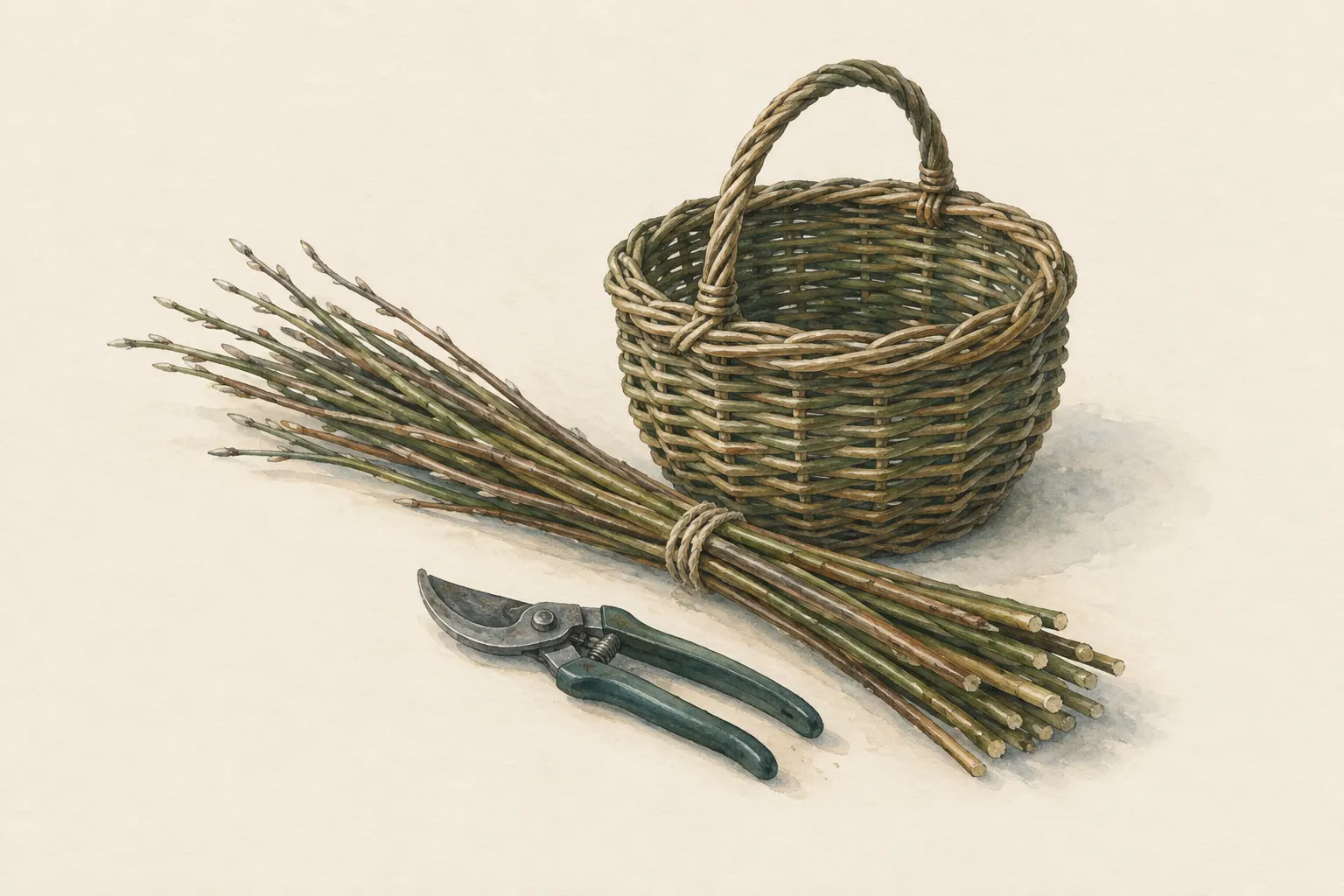
Explained simply
A basket is like a fence standing in a circle. First you put up the posts – these are the stakes. Then you pass long, flexible rods alternately in front of and behind the posts: once in front, once behind. Round by round the wall grows.
This works best with willow rods. They are long, thin and as bendy as a rubber band when they are wet. You cut them in winter, but only if the owner of the willow allows it. Dried rods go into water for a few days until they bend.
The basket starts with a cross of thick rods that is fanned out like a cartwheel. From it you weave the base, bend the spokes upwards and weave the wall. Finally you tuck the ends round as a border. It takes a few hours – but then you have a real basket for gathering.
How it works
A woven basket holds through friction and tension. Each weaver is passed alternately in front of and behind the stakes and bent slightly as it goes. The bend presses it against the stakes, and the stakes press back. So the whole weave clamps itself in place, without glue or nails.
In simple over-under weaving with a single rod you need an odd number of stakes. Then in each new round the rod automatically lies on the other side of each stake than in the round before, and the pattern staggers like a brick wall. With an even number the rod would always lie in front at the same places, and the rows would not interlock.
Willow works so well because one-year rods are long, straight and very flexible. When dried they become stiff, but water makes them supple again. As they dry after weaving they become firm again – the basket keeps its shape.
What really matters
Good material is half the work. You need long, one-year rods without side shoots: a few thick ones for the base cross and many thin ones for weaving. They are cut between leaf fall and spring, when the willow is dormant. Dried rods lie fully under water for a few days and then rest overnight in a damp cloth. The test: a rod bends around a finger without kinking.
The base decides the shape. Bind the cross firmly with two rounds before you fan out the spokes. Spread the spokes evenly like a wheel and push in one extra short spoke so that their number becomes odd. Press each row tightly against the previous one – a loose base will wobble later.
When bending up, kink each spoke slightly at the edge of the base so that it stands up cleanly and does not break. Tie the tips together at the top so the stakes stay in place while you weave the wall. If you pull the weavers tighter, the basket gets narrower; if you keep them looser, it opens out towards the top.
Safety: what to watch out for
Willows always belong to someone – a farmer, a municipality, a conservation group. Cut only with permission. In Germany the Federal Nature Conservation Act prohibits heavy cutting back of woody plants outside forests from 1 March to 30 September, to protect breeding birds. Cutting in winter fits this and is also best for the willow. Other countries have their own rules.
Knife and secateurs are the tools you can hurt yourself with here. Always cut away from the body and support the rod on a board or a stake while doing so. Your free hand stays behind the blade. The secateurs are closed after use. With children an adult does the cutting.
Long rods spring back when bent and woven. Watch out for eyes – yours and other people's – and keep enough distance from each other while working.
When it makes sense – and when not
A willow basket is a lovely project for a base camp, a winter afternoon or a group that wants to build something together. It is good for gathering cones, kindling and finds and for carrying light things.
It is no good as a quick emergency solution – soaking and weaving take time. It is not made for heavy loads such as stones or water. You do not cut rods in summer. If you need a container quickly, fold a bark container from loose bark of deadwood or use a bag instead.
Good to know
Willow basketry is one of the oldest crafts. Pollarded willows – trees with a thick trunk and a crown of many rods – exist because people have cut them back regularly for centuries. Many conservation groups look for helpers to maintain them in winter. That is a good way to get rods with permission.
The basket in this guide is a simplified form for beginners in which the base spokes become the stakes directly. Basket makers often work with separate stakes inserted afterwards and with techniques such as pairing or waling, which make firmer baskets.
The first basket almost always comes out a little lopsided. That is normal. With every further basket the rows become more even and the shape rounder.
Step by step
Cut rods in winter
With permission, between leaf fall and spring, cut long, one-year rods without side shoots at an angle with the secateurs. For a small basket you need 8 thick rods for the cross and a few dozen thin ones.
Caution: Only with the landowner's permission.
- 1
Cut rods in winter
With permission, between leaf fall and spring, cut long, one-year rods without side shoots at an angle with the secateurs. For a small basket you need 8 thick rods for the cross and a few dozen thin ones.
Only with the landowner's permission.
- 2
Soak and sort
Use fresh rods straight away; lay dried ones fully under water for a few days until they bend around a finger without breaking. Then wrap them in a damp cloth overnight. Sort thick and thin rods.
- 3
Lay the base cross
Lay four thick, long rods side by side and four more crosswise on top so that a cross with four arms forms. Hold the middle firmly.
- 4
Bind the cross
Tuck two thin rods into the middle and, for two rounds, pass them alternately in front of and behind each arm of four rods, crossing the two rods between the arms. This holds the cross together.
- 5
Fan the spokes and weave the base
Spread the rods apart one by one like the spokes of a wheel and push in one extra short spoke so the number is odd. Weave round with a thin rod, over-under, pushing the rows tightly inwards until the base is big enough.
- 6
Bend up the stakes
Kink each spoke slightly at the edge of the base with your thumbnail or the back of the knife without breaking it, and bend it upwards. Tie the tips together at the top with twine.
- 7
Weave the wall
Weave round after round over-under with thin rods. Push new rods in beside the end of the old one. Keep pressing the rows down and keep the stakes evenly spaced. Pull tighter for a narrower shape.
- 8
Lay in the border and trim
Untie the twine. Pass each stake behind the next one and push it down into the weave beside the one after that. Trim protruding ends at an angle with the blade away from the body, and let the basket dry.
Cut away from the body.
Common mistakes
- Cutting rods without permission or in summer
- Not soaking dry rods long enough – they break
- An even number of spokes with simple over-under weaving
- Not pressing the rows down – the basket gets loose
- Breaking the stakes when bending them up
Quick view
Materials
Willow rods (one-year growth)
Long, thin rods without side shoots; some thick ones for the cross
Cut only with the landowner's permission; respect cutting seasons and nature-protection rules.
Secateurs (pruning shears)
Sharp blades – always close and lock after use; never put fingers between the blades.
Knife (fixed or locking blade)
Sharp, for kinking and trimming
Cut away from your body.
Rules on carrying knives differ by region – check local rules.
Galvanised bucket
Or a tub or stream pool for soaking
Do not heat: the zinc coating can release harmful fumes when heated.
Thin twine
For tying the stakes together
Low breaking strength – light loads only.
Suitable for
- Gathering and carrying basket for wood, cones and finds
- A camp project over several days
- Making things together with children (an adult does the knife work)
Not suitable for
- A quick emergency solution – it takes hours
- Heavy loads such as stones or water
- Summer during the breeding and no-cutting season – do not cut then
Prerequisites
- The landowner's permission to cut willow rods
- Safe handling of a knife and secateurs
- Patience – a first basket is rarely perfect
Safety
- Willows always belong to someone. Cut only with permission, ideally when pollarded willows are being maintained. In Germany heavy cutting back of woody plants outside forests is prohibited from 1 March to 30 September; cutting in winter fits this and suits the willow.
- When kinking and trimming always cut away from the body, support the rod on a board or stake and keep your other hand behind the blade. Close the secateurs after use.
- Long rods spring back when weaving. Watch out for eyes, especially with children, and keep enough distance from each other.
How it works
A basket is a framework of stiff stakes through which flexible weavers are passed alternately in front of and behind the stakes. The alternating bend clamps every rod in place. With an odd number of stakes the pattern shifts by itself each round, so a single weaver can run over-under endlessly.
Advantages
- Light, sturdy container from renewable material
- Pollarded willows benefit from regular cutting
- Teaches patience and manual skill
Disadvantages
- Time-consuming
- Only with permission and only in the winter half-year
- First baskets often come out lopsided
Deep knowledge
Background
Willow basketry is one of Europe's oldest crafts. Pollarded willows were cut regularly for centuries precisely to get weaving rods, and conservation groups often look for helpers to maintain them – a good chance to get rods with permission.
Basketry manuals describe the same basic steps: base, stakes, wall, border. The basket shown here, with base spokes bent up into the wall, is a simplified form for beginners.
Variants
- Pairing
- Instead of one rod you weave with two rods that cross between each stake. This holds more firmly and also works with an even number of stakes.
- Green camp basket
- Freshly cut rods can be worked without soaking. As they dry, however, they shrink and the basket becomes a little loose.
Common mistakes
- Cutting rods without permission or in summer
- Not soaking dry rods long enough – they break
- An even number of spokes with simple over-under weaving
- Not pressing the rows down – the basket gets loose
- Breaking the stakes when bending them up
Limits and risks
- No load ratings
- Simplified technique, not professional basket making
- Not legal advice – check the rules locally
Material alternatives
Derived from material properties: a substitute must have all relevant properties. Observe the notes on the substitute.
- Galvanised bucket
- Single-wall stainless steel bottle (Heat only single-wall bottles without paint/plastic; remove the lid before heating.), Double-wall insulated bottle (Never heat directly.), PET bottle (clear, max. 2 litres) (Do not heat or place in a fire.), Food-grade water container (Only use containers that never held chemicals or fuel.), Used chemical or fuel container (Never for drinking water or food – residues cannot be reliably removed.), Waterproof case or bag, Airtight food-grade storage container (Fill only when clean and completely dry; never use containers that previously held chemicals.), Wildlife-resistant food container (Where specific containers are required, use only approved models – check local rules.), Small metal tin with lid (Burn off coated or painted tins outdoors first.), Collapsible water container or bag (Protect from sharp objects.), Food-grade water bag (Use only for drinking water, never for chemicals or fuel.), Fermentation jar or crock (Use only food-grade containers of glass, food-safe glazed stoneware or food-grade plastic – no metal containers for acidic food.), Resealable food bags (Use only bags intended for food; do not use with boiling water unless the manufacturer explicitly allows it.)
- Thin twine
- Rope (Never use unknown or damaged rope for life-safety purposes.), Paracord (Not a climbing or safety rope.), Accessory cord (Use only certified cord after training for life-safety purposes.), Webbing (tubular webbing) (Inspect knotted webbing before every use.), Jute or sisal twine (bought) (Low strength, absorbs water and rots – light loads and practice only.), Tree straps (Load only within the manufacturer's limits.), Monofilament fishing line (Never leave scraps of line behind: birds and other animals get tangled in them and die slowly. Wind up scraps and take them with you.), Thin, soft wire (brass or galvanised steel) (Wire ends are sharp – protect eyes and fingers when bending), Tow rope or tow strap (Attach only to the towing eyes provided by the manufacturer; never stand next to it under load.)
Results come exclusively from structured entries. No improvised instructions are generated.
Sources
Dryad Press (Mary Butcher) (1986): Willow Work
Preparing willow rods, base, stakes, wall and border
Bundesrepublik Deutschland (gesetze-im-internet.de) (2009): Gesetz über Naturschutz und Landschaftspflege (Bundesnaturschutzgesetz – BNatSchG), insbesondere § 39 und § 30
§ 39(5): no cutting back of woody plants outside forests from 1 March to 30 September
Headquarters, Department of the Army (USA) (2002): FM 3-05.70 Survival
Improvising containers and items from plant material
Ray Mears – Hodder & Stoughton (2002): Bushcraft
Natural materials for containers and crafts in camp