Collecting birch sap: water from the tree in spring
In early spring, before the leaves come out, a clear, slightly sweet sap rises in birch trees. With a small drilled hole you can collect it – but only in these few weeks, only with the forest owner's permission and only in a way that does not harm the tree: one small hole in a strong tree, closed with a wooden plug afterwards. The sap spoils quickly and yields varying amounts. It is a supplement, not a reliable water source.
- Drilling and setting up 15 minutes; collecting a few hours to a day; closing 5 minutes
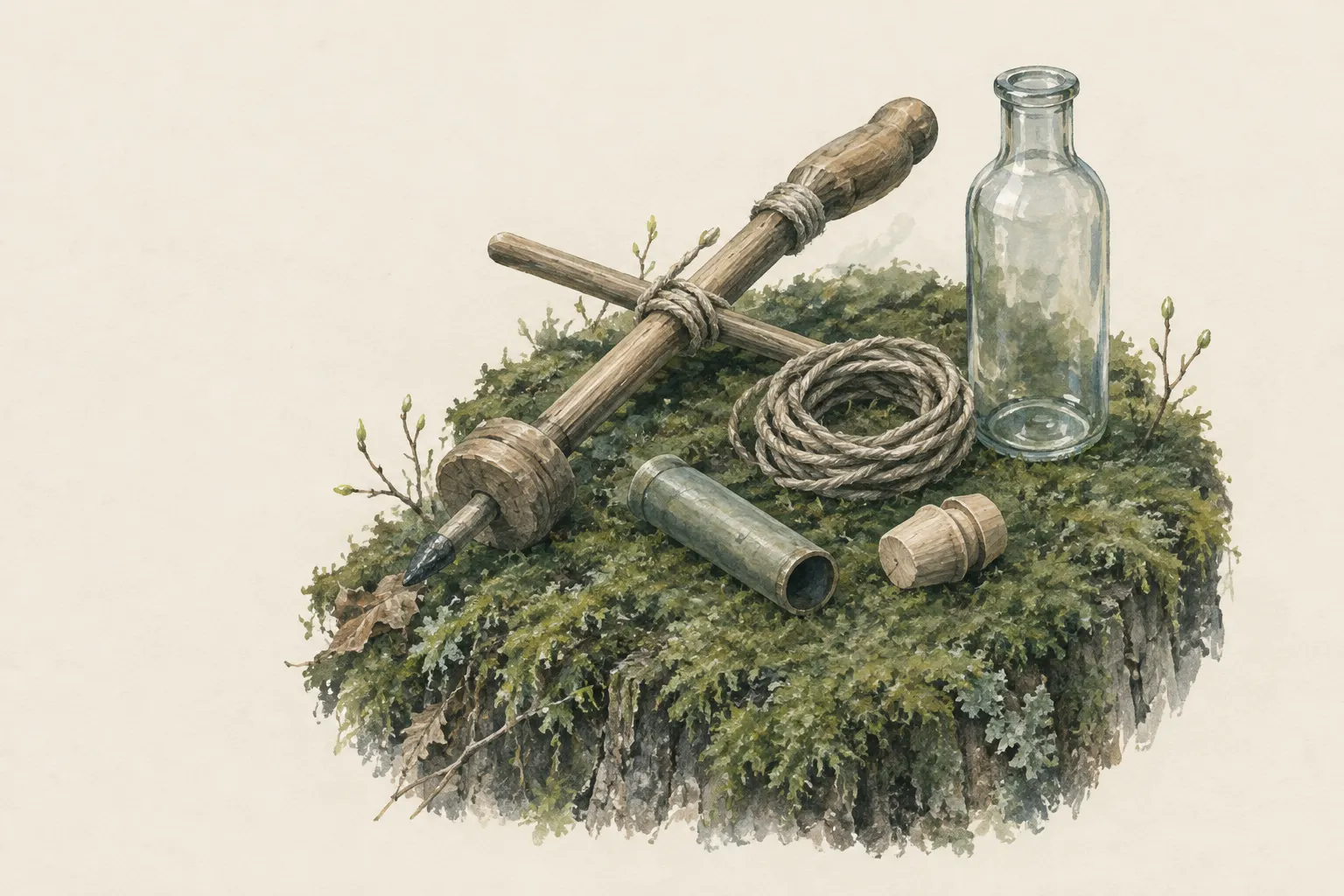
Explained simply
In spring, before the trees get their leaves, the birch sends water from its roots up to its buds. This water is called birch sap. It is clear and tastes just a tiny bit sweet.
With a small hole in the trunk you can collect the sap. But the tree belongs to someone, so first you ask the forest owner. You only drill one small hole in a thick, healthy tree, and afterwards you close it with a wooden plug so that the tree stays healthy.
There is only birch sap for a few weeks a year. It goes off quickly, so you keep it cool and drink it soon. If it smells funny or is cloudy, you pour it away.
How it works
In winter the birch stores sugar in its roots and wood. When the days become mild in early spring but the nights are still frosty, the tree begins to push water with dissolved sugar upwards so that the buds can open. This sap flows in the outer, light-coloured wood, just under the bark.
A small hole, drilled slightly upwards, cuts into these channels. The sap drips out, runs over a tube into a bottle and can be collected. How much comes depends on the tree, the weather and the day – sometimes only drops, sometimes several litres a day.
As soon as the leaves come out, the tree needs the water itself, the pressure drops and the sap becomes bitter. That ends the short season.
What really matters
Without leaves you recognise the birch by its white bark with dark marks running crosswise, by the dark, cracked bark at the base of the trunk and by the thin, often hanging twigs. Old triangular leaves on the ground also help. If you are unsure, it is not your tree.
The tree must be strong and healthy, with a trunk at least about 25 centimetres in diameter. A hole about 1 centimetre wide and 2 to 3 centimetres deep is enough. Larger or deeper holes hardly give more sap but wound the tree more.
Cleanliness decides how long the sap keeps: a clean drill, a boiled tube, a clean bottle, a cloth over the opening against insects. After at most one day a fitting wooden plug goes into the hole.
Safety: what to watch out for
Trees belong to the forest owner. In Austria you may enter the forest for recreation but not damage trees; in Germany the Federal Nature Conservation Act protects wild plants. So always ask beforehand. Without permission, tapping is only justifiable in genuine danger to life.
Birch sap spoils quickly because it contains sugar that germs feed on. Keep it cool, drink it within one to two days and pour it away if it turns cloudy, sour, slimy or smells strange. If in doubt about cleanliness, boil it.
When carving the plug always cut away from your body and keep your other hand out of the cutting line. Guide the drill straight and without force so that it does not slip.
When it makes sense – and when not
Birch sap is a nice supplement in early spring when you stay in one place for a while, have birches nearby and get permission. It is usually clean and needs no filter if everything was done cleanly.
As a water source for your survival it is no good: the season is short, the amount cannot be planned and at other times of year nothing comes at all. Always plan your water supply with streams, springs, rain or snow – and treat birch sap as a bonus.
Good to know
In northern and eastern Europe birch sap has long been drunk in spring. Some people also know it as birch water.
If nothing comes out after drilling, the timing is wrong – do not drill further, but close the hole at once and try another day or not at all.
Step by step
Get permission
Ask the forest owner or the forester before you drill into a tree, and explain that you will only make one small hole and close it again. Do not drill in nature reserves, parks or into roadside trees. Without permission, tapping is only justifiable in genuine danger to life.
- 1
Get permission
Ask the forest owner or the forester before you drill into a tree, and explain that you will only make one small hole and close it again. Do not drill in nature reserves, parks or into roadside trees. Without permission, tapping is only justifiable in genuine danger to life.
- 2
Find the right time
The sap only flows for a few weeks in early spring, roughly in March and April, when it still freezes at night and is mild during the day – and only until the buds burst. As soon as the first leaves come out, the time is over: the sap becomes less and tastes bitter. In the mountains the season starts later than in the valley.
- 3
Recognise the birch reliably
In early spring the birch has no leaves yet, so you recognise it by its trunk: white bark with dark marks and patches running crosswise, often dark, deeply cracked bark at the base of the trunk. The thin twigs often hang down, and small, triangular, toothed leaves from the previous year lie on the ground. If you are not sure it is a birch, do not drill.
- 4
Choose a strong tree
Choose a healthy tree with a trunk at least about 25 centimetres in diameter – roughly as wide as a large plate. Leave young, thin, diseased or injured trees alone, as well as trees by roads. Only one single hole per tree.
No young trees and never several holes in one tree.
- 5
Drill one small hole
At knee to hip height, use a clean hand drill to make a hole about 1 centimetre in diameter, angled slightly upwards so the sap runs out. It is enough to drill 2 to 3 centimetres deep through the bark into the light wood. Do not cut large notches and never cut the bark all the way round. If no drops come after a few minutes, it is too early or too late: close the hole at once.
- 6
Fit the spout and bottle
Push a clean tube or a carved little wooden channel firmly into the hole so that it points slightly downwards. Below it, tie a clean bottle to the trunk and cover the opening with a cloth against insects. How much comes varies a lot – from a few drops to several litres a day. Check after a few hours.
- 7
Close the hole
After at most one day, or as soon as you have enough, take off the tube and bottle. Carve a plug from a dry twig that fits the hole exactly and tap it in flush. This way no more sap runs out and the tree can grow over the wound. Do not tap the same tree again the next year.
- 8
Cool, check, drink quickly
Fresh birch sap is clear, almost like water, and tastes slightly sweet. Keep it cool – in the shade, sealed in cold stream water or in snow – and drink it within one to two days. If it is cloudy, sour, slimy or smells strange, pour it away. If the drill, tube or bottle were not clean or you are unsure, boil it before drinking.
Common mistakes
- Drilling without the forest owner's permission
- Tapping young or thin trees
- Cutting large notches or wounding the bark all the way round
- Leaving the hole open
- Storing sap warm for days
- Relying on birch sap as your only water source
Quick view
Materials
Small hand drill or gimlet (about 1 cm)
About 1 cm diameter, clean
Only drill into a living tree with the forest owner's permission
Keep it clean – a dirty drill carries germs into the tree and the sap
Knife (fixed or locking blade)
For carving the wooden plug
Cut away from your body.
Rules on carrying knives differ by region – check local rules.
Short clean tube as a spout
Or a cleanly carved little wooden channel
Food-safe and boiled or thoroughly cleaned beforehand
PET bottle (clear, max. 2 litres)
Clean, tied to the trunk with cord
Do not heat or place in a fire.
Cotton cloth / T-shirt
As insect protection over the bottle opening
Removes coarse particles only – no disinfection.
Metal pot (stainless steel, aluminium, titanium)
For boiling if in doubt
Hot – scalding risk.
Suitable for
- Early spring, roughly March to April, before the leaves come out
- An additional, clean drink during a longer stay
- Areas with many birches
Not suitable for
- Summer, autumn and winter – then no sap flows
- Someone else's forest without permission, nature reserves, parks
- Young or diseased trees
- As your only water source
Prerequisites
- Permission from the forest owner or forester
- Recognising birches reliably even without leaves
- Clean equipment and a plan for keeping the sap cool
Safety
- Trees belong to the forest owner. In Austria the Forest Act allows entering the forest for recreation, but not damaging trees; in Germany the Federal Nature Conservation Act forbids damaging wild plants without reasonable cause. So only drill with the owner's permission – except in a genuine emergency when your life is at stake.
- Birch sap spoils quickly: it turns cloudy, sour or slimy. Store it cool and drink it within one to two days. If it smells strange, is cloudy or slimy, pour it away. If the drill, tube or bottle were not clean or you are unsure, boil it.
- A drill hole is a wound through which fungi and germs can enter. Only one small hole in a strong, healthy tree, never cut the bark all the way round or in large notches, close the hole with a fitting wooden plug after collecting and do not tap the same tree every year.
- When carving the plug always cut away from your body and guide the drill straight so that it does not slip.
How it works
In early spring, when the nights are still frosty and the days already mild, the birch pumps water with dissolved sugar up from its roots to supply its buds. This sap flows in the outer, light-coloured wood just under the bark. A small hole drilled slightly upwards taps into this flow and the sap drips out. As soon as the leaves come out, the tree uses the water itself and the sap stops flowing.
Advantages
- Usually a clean drink straight from the tree
- No filter needed if everything is clean
- Slightly sweet and pleasant
Disadvantages
- Only a few weeks a year
- Only with the forest owner's permission
- Yield varies greatly
- Spoils quickly
- Harms the tree if done wrongly
Deep knowledge
Background
Birch sap has long been drunk in northern and eastern Europe. Ray Mears and Gordon Hillman describe in Wild Food how to tap birches in spring and stress that the hole must stay small and be closed afterwards. The survival manual FM 3-05.70 names plants as a possible water source when you know them reliably.
Legally, the Forest Act applies in Austria: anyone may enter the forest for recreation, but trees and forest products belong to the owner. In Germany the Federal Nature Conservation Act protects wild plants from damage without reasonable cause.
Variants
- Cut twig
- Some bushcrafters cut off a finger-thick twig instead of drilling a hole and hang a bottle over its end. This is also a wound on the tree, needs the owner's permission and usually yields less sap. Cut the stub off smoothly afterwards.
- Boiled as a warm drink
- Boiled birch sap tastes slightly sweet when warm and is a pleasant drink on cold spring days. Boiling does not make it keep much longer – store it cool and drink it soon even after boiling.
Common mistakes
- Drilling without the forest owner's permission
- Tapping young or thin trees
- Cutting large notches or wounding the bark all the way round
- Leaving the hole open
- Storing sap warm for days
- Relying on birch sap as your only water source
Limits and risks
- Applies to birches in Central Europe in early spring
- No information about other tree species
- Yields cannot be planned
Material alternatives
Derived from material properties: a substitute must have all relevant properties. Observe the notes on the substitute.
- Metal pot (stainless steel, aluminium, titanium)
- Single-wall stainless steel bottle (Heat only single-wall bottles without paint/plastic; remove the lid before heating.)
Results come exclusively from structured entries. No improvised instructions are generated.
Sources
Ray Mears und Gordon Hillman, Hodder & Stoughton (2007): Wild Food
Tapping birches in spring; small hole, closed afterwards
Headquarters, Department of the Army (USA) (2002): FM 3-05.70 Survival
Plants as a possible water source
Republik Österreich – Rechtsinformationssystem des Bundes (RIS) (1975): Forstgesetz 1975 (BGBl. Nr. 440/1975), § 33 Benützung des Waldes zu Erholungszwecken
Austria: entering the forest for recreation is allowed; trees belong to the forest owner
Bundesrepublik Deutschland (gesetze-im-internet.de) (2009): Gesetz über Naturschutz und Landschaftspflege (Bundesnaturschutzgesetz – BNatSchG), insbesondere § 39 und § 30
Germany: do not damage wild plants without reasonable cause (§ 39)
World Health Organization (2022): Guidelines for drinking-water quality, fourth edition incorporating the first and second addenda
Principles of safe drinking water; treat when in doubt