The right wood for friction fire
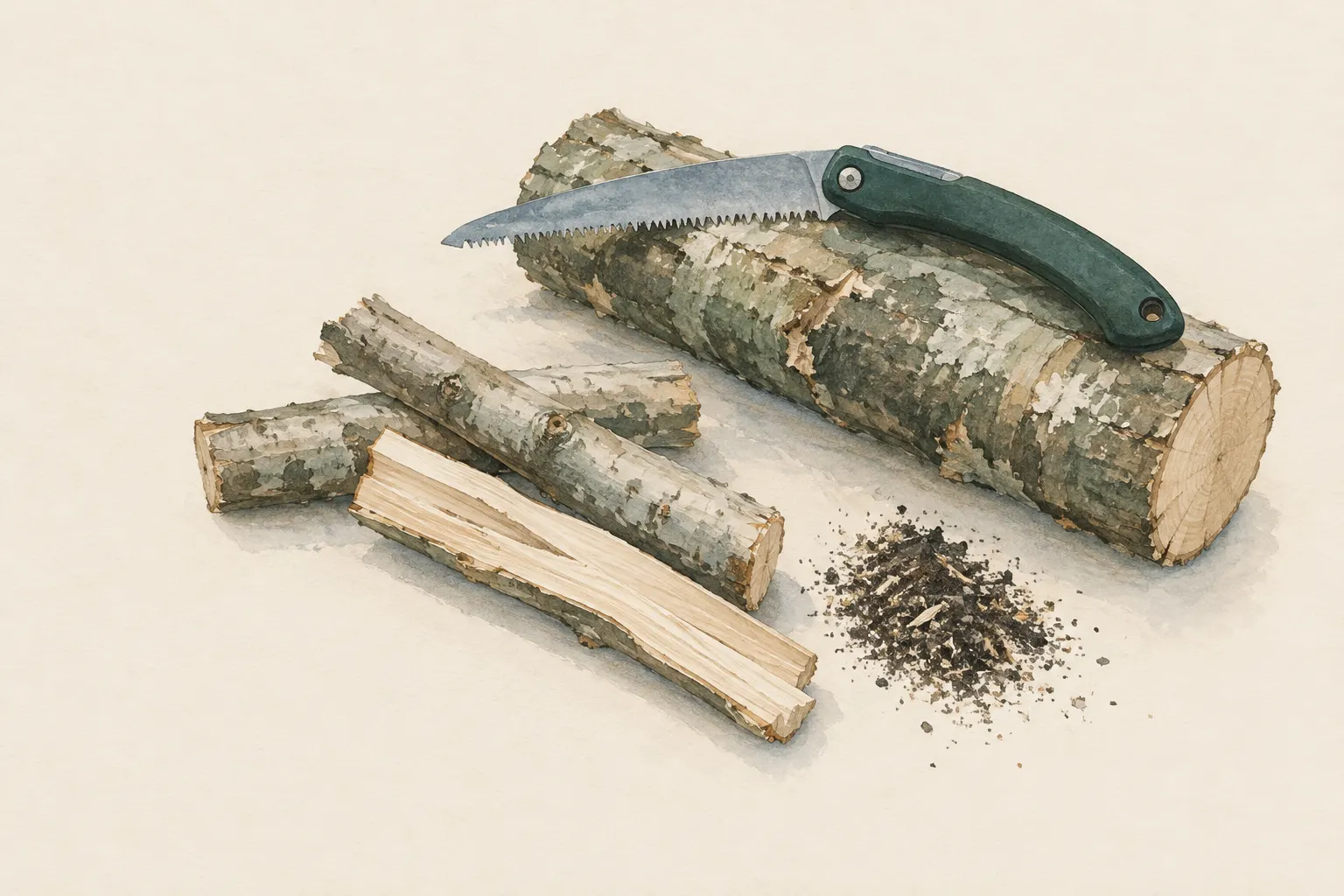
Whether a bow drill, pump drill or hand drill works depends first on the wood. Good choices are dead, dry, low-resin and fairly soft woods such as lime (basswood), willow, poplar or hazel – from standing dead wood, not from the damp ground. A fingernail test checks the hardness, a fresh shaving the dryness. Wood belongs to the forest owner: take even dead wood only with permission, never from living trees.
- Searching and checking usually 15–45 minutes
Explained simply
Rub your hands together really fast. Can you feel them getting warm? That is how fire by friction works too: wood rubs on wood until it gets so hot that fine wood dust starts to glow. But not every wood plays along.
If the wood is too hard, it just gets smooth and shiny as if polished. If it is too soft or rotten, it crumbles. If it is wet, the water cools everything down. Best is dead, dry, fairly soft wood without much resin, for example lime, willow or poplar. You can test with your fingernail: a small dent is good, no dent at all means too hard.
Wood in the forest always belongs to someone, even when it is lying around dead. So ask first, take only dead wood and never cut living trees. And look up: dead branches can fall down.
How it works
In a friction fire, the movement of your arms is turned into heat. For this to become an ember, the wood at the rubbing point must give off fine fibres that get hot and collect in the notch. So the wood has to give way just right: firm enough to get hot, and soft enough to be worn away.
Very hard wood hardly gives off any fibres. The rubbing surfaces become smooth, shine and squeak, and the heat disappears without wood dust forming. Rotten wood, on the other hand, falls apart into coarse, cool dust before it gets hot enough. Water in the wood absorbs heat, and resin melts in the heat and makes the socket smooth as glass.
That is why you look for wood that is dead, dry, sound and low in resin, with medium to soft hardness. Spindle and board of the same wood usually work best for beginners. The spindle may be a little harder than the board, but not much softer.
What really matters
The condition of the wood matters more than the exact species. The best pieces are dead branches still hanging on the tree and dead, standing saplings. They get wind and dry out. Wood lying on the ground soaks up moisture and starts to rot. Good wood is light, the bark comes away, and a thin branch snaps with a sharp crack.
The fingernail test shows the hardness: press your thumbnail firmly into the barked wood. If a clear dent remains without fibres crumbling, the hardness is good. If no dent remains, the wood is too hard. If the nail sinks in and the wood crumbles, it is rotten. Then split a piece or carve a fresh shaving: inside it should be pale, even and dry.
In the end a test drill decides. Fine, dark brown to black wood dust that clumps together shows that the wood is right. A shiny, squeaking socket means too hard. Coarse, pale dust and a socket that wears through quickly point to wood that is too soft or rotten – or to too little speed.
Safety: what to watch out for
Standing dead wood is good material, but also a hazard. Dead trees can fall over, and dead branches break off without warning. Do not pull anything down from above, do not shake dead trees and avoid them entirely in wind. Always look up while collecting.
Wood belongs to the forest owner, even when it is dead. The right to enter for recreation does not automatically allow you to take wood. Ask beforehand, take only small amounts of dead wood, nothing at all in protected areas, and never cut living trees. Only in genuine danger to life does your survival come first – afterwards you contact the owner.
When removing bark, splitting and carving you work with a knife and perhaps a saw. Always away from your body, on a firm surface and never prying with the blade. And remember: even the best wood does not make friction fire a safe emergency plan – a lighter and matches always belong in your pack.
When it makes sense – and when not
Recognising good wood is worthwhile for anyone who wants to learn the bow drill, pump drill or hand drill. Ideally you build your first set at home from dry, untreated softwood from a hardware store and learn the technique. After that you practise finding and checking suitable wood outdoors.
After days of rain it is hard to find really dry wood. Then only dead branches under dense crowns or the inside of split wood help – and often even that is not enough. In protected areas and without permission you do not collect at all and use carried ignition sources.
Good to know
For Central Europe, bushcraft books and courses keep naming lime, willow, poplar and aspen, with hazel especially as a spindle; with practice alder or maple also work. Very hard woods such as oak, beech, ash or black locust are difficult. In North America, American lime, called basswood there, corresponds to our lime.
Resinous wood is unsuitable for spindle and board, but not useless: as fatwood it is one of the best fire starters of all. And a set that has worked well once is valuable. Keep it dry and take it with you – then you do not have to start searching from scratch every time.
Step by step
Know the woods
Often named and proven are lime (basswood), willow, poplar and aspen, as well as hazel, which is especially good as a spindle. With practice alder or maple also work. Very hard woods such as oak, beech, ash or black locust are difficult; resinous pine and spruce glaze easily. Only use trees you recognise with certainty.
- 1
Know the woods
Often named and proven are lime (basswood), willow, poplar and aspen, as well as hazel, which is especially good as a spindle. With practice alder or maple also work. Very hard woods such as oak, beech, ash or black locust are difficult; resinous pine and spruce glaze easily. Only use trees you recognise with certainty.
- 2
Choose standing dead wood
Dead branches still hanging on the tree or dead, standing saplings are usually dry. Wood lying on the ground soaks up moisture and rots. Good wood is light, the bark comes away, and a thin branch snaps with a sharp crack.
Do not pull dead branches down from above.
- 3
Fingernail test for hardness
Press your thumbnail firmly into the barked wood. Ideal: a clear dent remains without fibres crumbling. No dent: too hard. The nail sinks in and the wood crumbles: rotten, unusable.
- 4
Check the inside
Split a piece or carve off a fresh shaving. The inside should be pale, even and dry and should not feel cool on your lip. Dark, soft, spongy or mouldy spots mean rot. Remove the bark completely.
- 5
Avoid resin and knots
If the wood smells strongly of resin or is sticky, it is unsuitable for spindle and board – but valuable as fatwood. Never put the socket or spindle tip at knots or cracks, because the wood is harder there or breaks.
- 6
Combine and test drill
Spindle and board of the same wood, or the spindle slightly harder than the board. Test drill: fine, dark brown to black dust that clumps together means a good match. If the socket shines and squeaks, the wood is too hard. Coarse, pale dust and a socket that wears through quickly point to wood that is too soft or rotten.
- 7
Permission and the dead-wood rule
You may enter a forest for recreation, but wood belongs to the forest owner. Ask beforehand, take only dead wood in small amounts, nothing at all in protected areas, and never cut living trees. In a genuine emergency your life comes first – afterwards you contact the owner.
- 8
Store the finished set dry
Store a proven set of spindle and board dry and airy, and carry it on trips in a bag close to your body. Dry damp wood for several days indoors or near a fire, not directly in the embers.
Common mistakes
- Taking wood from the damp ground
- Green wood from living trees
- Rotten wood because it is easy to carve
- Very hard or resinous wood
- Socket on a knot
- Leaving bark on the spindle
Quick view
Materials
Knife (fixed or locking blade)
Cut away from your body.
Rules on carrying knives differ by region – check local rules.
Folding saw
Fold or cover the blade after use; saw teeth are very sharp.
Bow drill set (bow, spindle, hearth board, bearing block)
For a test drill
Use only dry wood.
Requires a lot of practice.
Waterproof case or bag
Or a bag to keep the finished set dry
Suitable for
- Preparing any friction fire
- Building a practice set at home
- Troubleshooting when no ember forms
Not suitable for
- Protected areas and forests without permission
- Living trees
- Continuous rain without a dry source
Prerequisites
- Able to recognise trees reliably – or wood of known origin
- The forest owner's permission
- A knife and the skill to use it safely
Safety
- Wood and bark in the forest belong to the forest owner. Collect even dead wood only with permission, not at all in protected areas – and never take branches or bark from living trees.
- Standing dead trees can fall over, and dead branches break off without warning. Do not pull anything down from above, do not shake dead trees and avoid them in wind.
- When carving and boring, always work away from your body, on a firm surface, and never cut towards your hand or leg. Never pry with the knife.
- Friction fire is not a reliable emergency plan. It succeeds only with suitable, dry wood and a lot of practice, and it costs a lot of energy. Always carry at least two modern ignition sources (lighter, matches, ferro rod).
How it works
In friction fire, wood has to be worn away so that hot wood dust forms. Wood that is too hard only polishes and becomes smooth; wood that is too soft or rotten crumbles before it gets hot enough. Water in the wood soaks up heat, and resin melts and glazes the rubbing surface. So you look for dry, sound, low-resin wood of medium to soft hardness. For beginners it is easiest to make the spindle and board from the same kind of wood.
Advantages
- Raises the chance of success for every friction fire more than anything else
- Simple tests without tools
- A good set lasts for many fires
Disadvantages
- Needs tree knowledge
- Good, dry wood is hard to find after rain
- Collecting not permitted everywhere
Deep knowledge
Background
Bushcraft teachers keep naming similar woods for Central Europe, above all lime and willow; in North America, American basswood corresponds to lime. More important than the exact species, though, is the condition: dead, dry, sound and low in resin.
In Germany the Federal Forest Act governs entering the forest for recreation, in Austria the Forest Act. That does not automatically allow you to take wood.
Variants
- For the hand drill
- The hand drill needs especially light, straight stalks and a very soft board. Which plants suit it depends on the region – use only what you know for certain.
- Practice wood from home
- Untreated, dry battens of soft wood from a hardware store or offcuts from a carpenter are ideal for learning the technique before you look for wood outdoors.
Common mistakes
- Taking wood from the damp ground
- Green wood from living trees
- Rotten wood because it is easy to carve
- Very hard or resinous wood
- Socket on a knot
- Leaving bark on the spindle
Limits and risks
- Wood lists are guidelines – suitability varies even within one species
- No tree identification in this entry
- No legal advice – check the local rules
Material alternatives
Derived from material properties: a substitute must have all relevant properties. Observe the notes on the substitute.
- Bow drill set (bow, spindle, hearth board, bearing block)
- Lighter, matches or ferro rod (Observe local fire bans.), Ferro rod (Practise before you need it.), Fire striker and hard stone (Carbon steel, not stainless.), Burning lens / magnifier (Never leave lying in the sun – fire risk.), Fire piston (Maintain the seal.), Pump drill (spindle, flywheel, crossbar, cord) (Fix the flywheel firmly and centrally – a loose disc can fly off.)
- Waterproof case or bag
- Single-wall stainless steel bottle (Heat only single-wall bottles without paint/plastic; remove the lid before heating.), Double-wall insulated bottle (Never heat directly.), PET bottle (clear, max. 2 litres) (Do not heat or place in a fire.), Food-grade water container (Only use containers that never held chemicals or fuel.), Used chemical or fuel container (Never for drinking water or food – residues cannot be reliably removed.), Galvanised bucket (Do not heat: the zinc coating can release harmful fumes when heated.), Airtight food-grade storage container (Fill only when clean and completely dry; never use containers that previously held chemicals.), Wildlife-resistant food container (Where specific containers are required, use only approved models – check local rules.), Small metal tin with lid (Burn off coated or painted tins outdoors first.), Collapsible water container or bag (Protect from sharp objects.), Food-grade water bag (Use only for drinking water, never for chemicals or fuel.), Fermentation jar or crock (Use only food-grade containers of glass, food-safe glazed stoneware or food-grade plastic – no metal containers for acidic food.), Resealable food bags (Use only bags intended for food; do not use with boiling water unless the manufacturer explicitly allows it.)
Results come exclusively from structured entries. No improvised instructions are generated.
Sources
Headquarters, Department of the Army (USA) (2002): FM 3-05.70 Survival
Dry, seasoned wood for drill and fire board
Ray Mears – Hodder & Stoughton (2002): Bushcraft
Choosing wood for friction fire
Mors L. Kochanski – Lone Pine Publishing: Bushcraft: Outdoor Skills and Wilderness Survival
Suitable woods and wood condition for friction fire
Bundesrepublik Deutschland – Bundesministerium der Justiz (1975): Gesetz zur Erhaltung des Waldes und zur Förderung der Forstwirtschaft (Bundeswaldgesetz), § 14 Betreten des Waldes
Entering the forest for recreation (§ 14)
Republik Österreich – Rechtsinformationssystem des Bundes (RIS) (1975): Forstgesetz 1975 (BGBl. Nr. 440/1975), § 33 Benützung des Waldes zu Erholungszwecken
Use of the forest for recreation (§ 33)