Fire with the pump drill
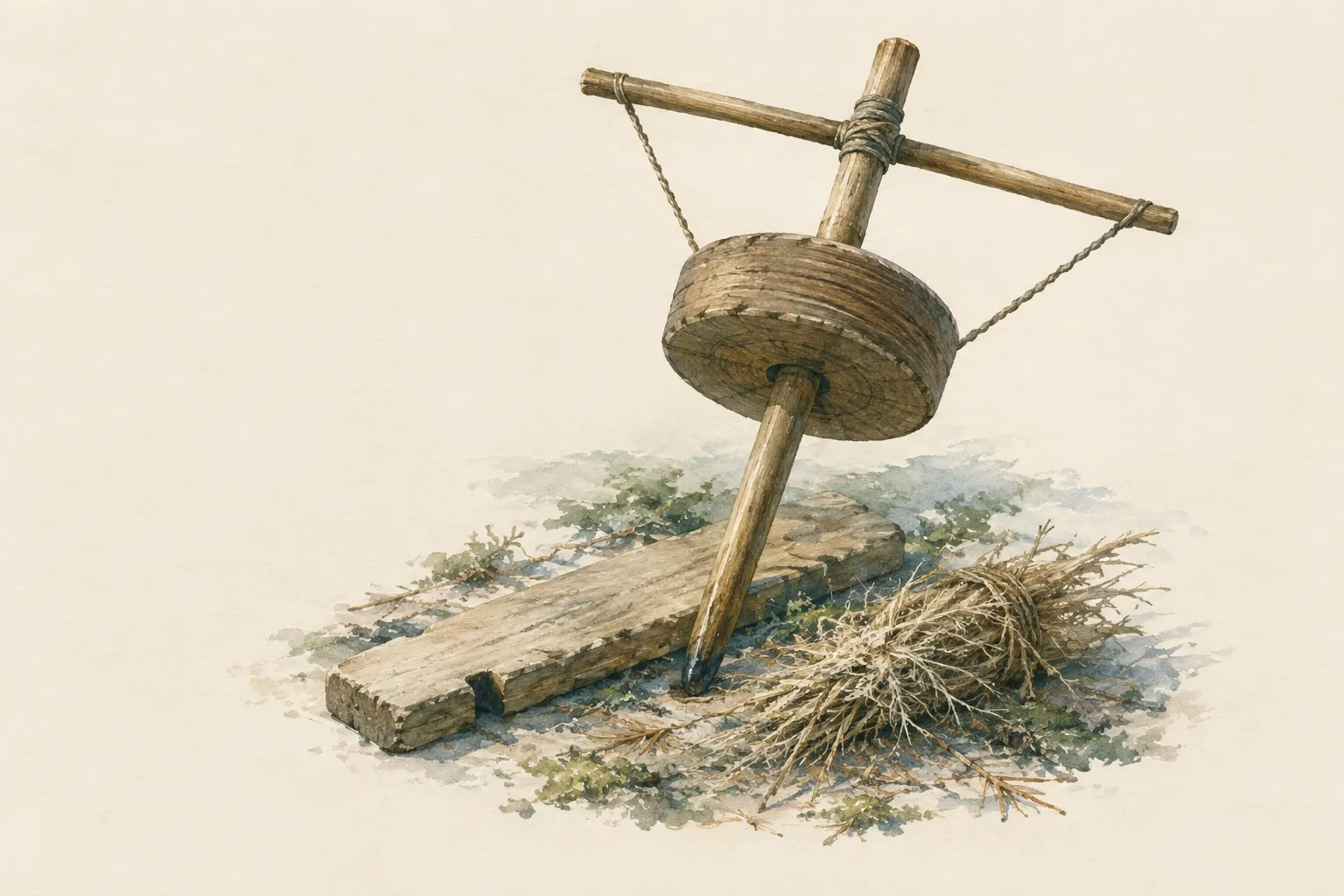
A pump drill has a heavy flywheel on a long spindle. A crossbar hangs from a cord that winds around the spindle: when you push the crossbar down, the spindle spins fast, and the momentum winds the cord back up by itself. Down in the hearth board, just as with the bow drill, hot wood dust forms and turns into an ember in a notch. The tool takes time to build and a lot of practice – it is no emergency plan, but it is an instructive skill.
- Building often takes two hours or more; each attempt means several minutes of steady pumping
Explained simply
Have you ever spun a top? Once it has momentum, it keeps spinning by itself for quite a while. The pump drill uses exactly this trick. A heavy disc sits on a long stick, the spindle. It is like a top that stores the momentum.
At the top a crossbar hangs from a cord that is wound around the spindle. When you push the crossbar down, the cord unwinds and the spindle spins fast. Then you ease off, and the heavy disc keeps turning and winds the cord back up the other way. So you pump up and down, and the spindle turns back and forth.
At the bottom the spindle rubs in a small hollow in a board. The wood gets so hot that tiny wood dust starts to glow. You put this ember into a nest of dry grass and blow it into a flame. It takes a lot of practice – that is why outdoors you always carry a lighter or matches as well.
How it works
The pump drill turns an up-and-down movement into rotation. When you push the crossbar down, the cord pulls at the top of the spindle and unwinds – the spindle has to turn. The heavy disc takes up this rotation and stores it. When the cord is fully unwound, the disc keeps turning and winds the cord back up in the opposite direction, which pulls the crossbar up.
Down in the hearth board the same thing happens as with the bow drill. The spindle tip rubs in a socket and wears away fine wood fibres. These fibres get hot and slide out through the notch, where they collect in a little pile. Because the pile insulates itself, the heat stays inside until it glows by itself.
With the pump drill, the pressure on the tip comes largely from the weight of the disc and only partly from your hands. That is why a heavy disc matters so much. If it is too light, the spindle may spin fast but it rubs too gently, and you get heat without an ember.
What really matters
The most important thing is that everything runs true. The disc must be bored exactly in the centre and sit firmly. If the spindle wobbles, it jumps out of the socket, and the friction spreads out instead of building heat in one place. Check this before you even think of fire: spin the spindle between your hands and see whether it runs smoothly.
The rhythm decides. Push the crossbar down evenly and ease off just before the disc so the cord can wind back up. If you push all the way down, everything stops. Many people find their rhythm after a few minutes of practice without a board, just to get the feel.
As with every friction fire, you need dry, suitable wood for the tip and board, a notch that reaches just into the centre of the socket, and a finished tinder bundle. Anyone who learns the bow drill first finds the pump drill easier, because they already know what smoke, wood dust and ember should look like.
Safety: what to watch out for
The flywheel is heavy and spins fast. If it sits loosely or crookedly, it can come off and fly away. Keep your face and feet out of its path and let onlookers, especially children, watch from a distance. Check that the disc is firm before every attempt.
While building, you do a lot of knife work: boring holes, cutting the notch, carving the tip. Always cut away from your body, work on a firm surface and never pry with the blade. A slipping knife is one of the most common injuries outdoors.
The ember is a real fire. The fire site, kindling and water to put it out must be ready beforehand. Check whether a fire ban is in force – it applies to practice too. And never rely on friction alone: lighters, matches and ferro rods are the reliable ignition sources.
When it makes sense – and when not
The pump drill is a practice and camp tool. It is worthwhile when you have time to build a good tool, for example in a base camp or on a course. Once built, it is quickly ready to use again and spares your wrists, because you push evenly instead of drawing a bow back and forth.
In a real emergency, when you are cold, tired or it is getting dark, it is the wrong choice. Building it costs time and energy, and without practice there is often no ember. Then what counts is keeping warm, shelter and carried ignition sources.
Good to know
The pump drill is a very old tool. In many cultures it was used mainly to drill holes, for example in beads, shells or wood – with a hard tip of stone or later metal. Holes need much less pressure than fire.
If no ember forms, it is almost always down to one of a few points: the disc is too light or not centred, the wood is too hard, damp or resinous, the notch is too small, or you stop too early. Go through this list in order instead of simply pumping harder.
Step by step
Gather the parts
Spindle: straight, dry, about 60–80 cm long and one to two fingers thick. Crossbar: a sturdy stick, about 40–60 cm. Flywheel: a heavy wooden disc about 15–25 cm across or a flat stone with a hole. Hearth board: soft, dry wood about 2 cm thick. Plus a strong, smooth cord.
- 1
Gather the parts
Spindle: straight, dry, about 60–80 cm long and one to two fingers thick. Crossbar: a sturdy stick, about 40–60 cm. Flywheel: a heavy wooden disc about 15–25 cm across or a flat stone with a hole. Hearth board: soft, dry wood about 2 cm thick. Plus a strong, smooth cord.
- 2
Fit the flywheel
Bore the disc exactly in the centre and wedge it tightly on the lower third of the spindle, if necessary with small wooden wedges or a cord wrap underneath. Spin the spindle between your hands: it must run true and must not wobble. Carve the bottom tip blunt and rounded.
Bore and carve away from your body.
- 3
Crossbar and cord
Bore a hole in the middle of the crossbar, slightly wider than the spindle, so it slides up and down easily. Tie the cord to both ends of the crossbar and run its middle through a slot at the top of the spindle. The length is right when the crossbar hangs about a hand's width above the disc with the cord taut.
- 4
Prepare the hearth board
Carve a small socket near the edge and drill it briefly until it is black. Then cut a wedge-shaped notch from the edge to just into the centre of the socket. Put a dry piece of bark or a leaf under the notch and lay the tinder bundle within reach.
- 5
Wind up and pump
Stand the spindle in the socket and hold the board with your foot or knee. Turn the crossbar until the cord winds around the spindle and the crossbar is at the top. Then push down evenly with both hands and ease off just before the disc: the momentum winds the cord back up and the crossbar rises. Push again – calmly, in rhythm, spindle upright.
- 6
Build up heat
As soon as smoke rises, push harder and a little faster. Dark, fine wood dust fills the notch. With thick smoke make a few more strong strokes, then stop and lift the spindle carefully straight up without knocking the dust over.
- 7
Ember into the tinder bundle
If the little pile keeps smoking although the spindle has stopped, it is an ember. Let it rest for a few seconds, then put it on its base into the tinder bundle, close the bundle loosely and blow gently and steadily until flames appear. Put the burning bundle under the prepared kindling at once.
- 8
Find the fault
Spindle wobbles: disc not centred or spindle crooked. Crossbar jams: widen the hole. No smoke: too little pressure – use a heavier disc. Socket is shiny: wood too hard or tip glazed, roughen the tip. Smoke but no ember: notch too small or not to the centre, stopped too early or wood damp.
Common mistakes
- Flywheel crooked or loose
- Hole in the crossbar too tight – it jams
- Pushing all the way down so the cord does not wind back
- Disc too light – too little pressure and momentum
- Damp, resinous or rotten wood
- Preparing the tinder bundle only after the ember
Quick view
Materials
Pump drill (spindle, flywheel, crossbar, cord)
Home-made from dry dead wood
Fix the flywheel firmly and centrally – a loose disc can fly off.
Paracord
Or another strong, smooth cord, about 1–1.5 m
Not a climbing or safety rope.
Knife (fixed or locking blade)
Cut away from your body.
Rules on carrying knives differ by region – check local rules.
Tinder
A finished tinder bundle
Carry in waterproof packaging.
Do not use liquid accelerants as tinder.
Water for extinguishing (bucket, canister or pot)
Have several litres ready before lighting.
Suitable for
- Practice and bushcraft courses
- Base camps where there is time to build
- People who want to spare their wrists – the crossbar is pushed evenly
- Understanding momentum and friction
Not suitable for
- Emergencies without prior practice
- Wet weather, damp wood, continuous rain
- Exhausted, hypothermic or injured people
- Time pressure as darkness falls
Prerequisites
- Dry, suitable wood for the spindle tip and hearth board
- Safe knife handling
- Experience with embers and tinder bundles (e.g. from the bow drill)
- Permission for the fire and the wood
Safety
- Friction fire is not a reliable emergency plan. It succeeds only with suitable, dry wood and a lot of practice, and it costs a lot of energy. Always carry at least two modern ignition sources (lighter, matches, ferro rod).
- The flywheel is heavy and spins fast. It must sit firmly and exactly centred; a loose or crooked disc can come off and fly away. Keep face, feet and onlookers out of its path, and let children watch from a distance.
- When carving and boring, always work away from your body, on a firm surface, and never cut towards your hand or leg. Never pry with the knife.
- The ember is small and fragile. Have the tinder bundle, kindling and fire site completely ready beforehand.
How it works
The cord turns the downward movement of your hands into fast rotation. The heavy disc stores that rotation as momentum, keeps turning when the cord is unwound, and winds it back up in the other direction. So the spindle turns left and right in turn without you having to change grip. At the bottom the tip rubs in the hearth board, pressed down by the weight of the disc and by your push; the hot wood dust collects in the notch, insulates itself and starts to smoulder.
Advantages
- Even movement, no bow sawing back and forth
- Easier on the wrists than the hand drill
- Once built, quickly ready to use again
Disadvantages
- Elaborate to build, needs a heavy disc
- Downward pressure is limited – often harder than the bow drill
- Strongly dependent on wood type and dryness
- Bulky to carry
Deep knowledge
Background
The pump drill is a very old tool that was used in various cultures mainly for drilling holes. For making fire it needs the same basics as every friction fire: dry, suitable wood, a socket with a notch and careful ember transfer.
Many practitioners find the pump drill harder for fire than the bow drill, because the pressure on the tip comes mostly from the weight of the disc. Anyone who has mastered the bow drill learns it more easily.
Variants
- Replaceable tip
- Some build the spindle from a hard, straight shaft and fit a short tip of good friction wood at the bottom. The tip wears down and is replaced; the shaft stays.
- For drilling holes
- With a stone or metal tip the pump drill is an old tool for drilling holes, for example in beads or wood. That needs much less pressure than fire.
Common mistakes
- Flywheel crooked or loose
- Hole in the crossbar too tight – it jams
- Pushing all the way down so the cord does not wind back
- Disc too light – too little pressure and momentum
- Damp, resinous or rotten wood
- Preparing the tinder bundle only after the ember
Limits and risks
- Not a substitute for a lighter, matches or ferro rod
- Dimensions are guidelines – every tool has to be tried out
- Hardly possible with injured hands
Material alternatives
Derived from material properties: a substitute must have all relevant properties. Observe the notes on the substitute.
- Pump drill (spindle, flywheel, crossbar, cord)
- Lighter, matches or ferro rod (Observe local fire bans.), Ferro rod (Practise before you need it.), Fire striker and hard stone (Carbon steel, not stainless.), Bow drill set (bow, spindle, hearth board, bearing block) (Use only dry wood.), Burning lens / magnifier (Never leave lying in the sun – fire risk.), Fire piston (Maintain the seal.)
- Paracord
- Rope (Never use unknown or damaged rope for life-safety purposes.), Thin, soft wire (brass or galvanised steel) (Wire ends are sharp – protect eyes and fingers when bending), Tow rope or tow strap (Attach only to the towing eyes provided by the manufacturer; never stand next to it under load.)
- Tinder
- Dry firewood (Collect only where permitted.), Char cloth (charred cotton) (Store dry in a tin.), Finest-grade steel wool (Store separately from batteries – fire risk.), Fatwood (resin-rich wood) (Collect only dead wood where permitted.), Stove fuel (canister, liquid fuel, alcohol) (Store fuels apart from food and in original containers or bottles intended for them.), Petroleum jelly cotton balls (Use only pure cotton.), Cooking oil or cooking fat (tallow, lard) (Never put out burning fat with water – cover it with a lid to smother it.), Tree resin (spruce, pine) (Resin is flammable and sticks to the skin when hot – melt it only slowly over low heat.), Birch bark (from dead, fallen wood) (Never peel from living trees.)
Results come exclusively from structured entries. No improvised instructions are generated.
Sources
Headquarters, Department of the Army (USA) (2002): FM 3-05.70 Survival
Basics of friction fire: drill, board, notch and ember
Ray Mears – Hodder & Stoughton (2002): Bushcraft
Friction fire, choice of wood and ember transfer into the tinder bundle
Mors L. Kochanski – Lone Pine Publishing: Bushcraft: Outdoor Skills and Wilderness Survival
Friction fire and preparation of tinder and kindling