Finding natural tinder and keeping it dry
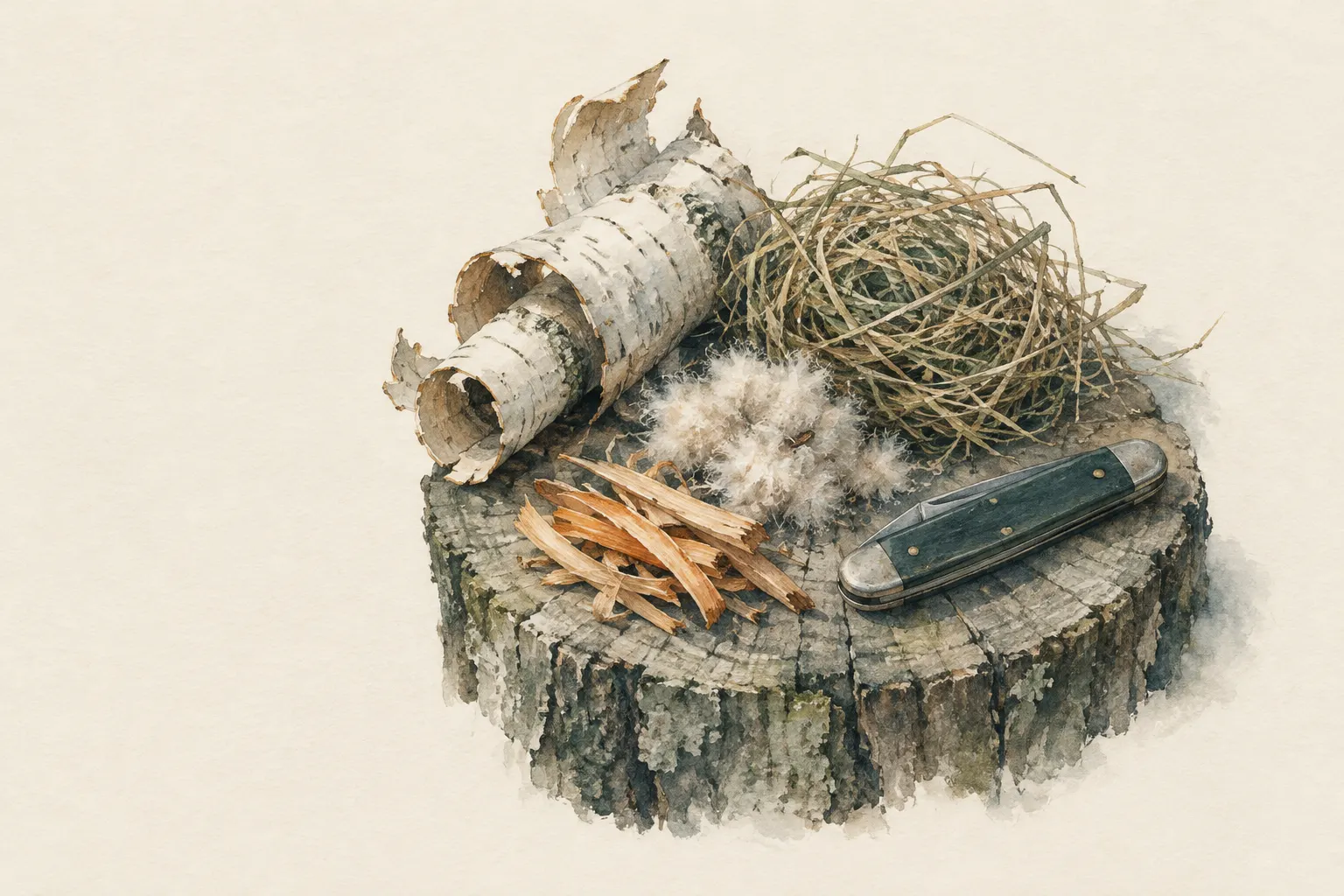
Tinder is the finest, driest material, which starts to burn from a single spark or an ember. In nature you find it in birch bark from dead wood, dry grass, fluffy seed heads, the fibrous bark of dead vines, dry needles and fine wood shavings. Collect it along the way before you need it, check that it is really dry, form a tinder bundle and carry it on your body so it stays dry.
- Along the way; forming a tinder bundle about 5–10 minutes
Explained simply
A fire starts small. A spark or a tiny ember is far too weak to light a branch. It needs something very fine and dry that starts burning at once – that is called tinder. Tinder is like the first domino that knocks all the others over.
Nature has plenty of tinder if you know where to look: the white, paper-thin bark of fallen birch branches, dry grass, fluffy seeds of cattails or thistles, fine fibres of dead vines and thin wood shavings. From these you form a nest as big as your fist, with the finest material in the middle.
The important thing is: take bark only from dead wood, never from living trees, and collect only plants you know for certain. Along the way, put some tinder in an inside pocket. There it stays dry, and your body heat even dries it if it was a little damp.
How it works
For something to burn, it must get hot enough to give off flammable gases, and it must get enough air. A thick branch needs a lot of heat for that, because the heat spreads into its inside. A wafer-thin fibre, on the other hand, is heated right through by a spark at once. Fine tinder has a lot of surface and little mass – exactly what a small fire needs.
Water is tinder's greatest enemy. Before damp material can burn, the water in it has to evaporate first, and that takes a lot of heat. A spark does not have that heat. That is why dry tinder is so valuable, and why it is worth checking and protecting it carefully.
Some tinders have a special property. Birch bark contains oily substances and so burns even when it is a little damp. Fatwood is soaked with resin and burns hot and long. Fluffy seed heads catch a spark at once but burn away in an instant – that is why they are mixed with coarser material.
What really matters
Collect early and a lot. Anyone who only starts looking in the evening or in the rain finds only damp material. While walking, keep picking things up: a piece of birch bark from a fallen branch, a handful of dry grass, a few fibres of bark. At camp you sort them into three piles – finest fluff, bundle material and thin twigs.
Check that it is really dry. Dry grass rustles; dry twigs snap with a sharp crack. Hold material briefly to your lip or cheek: if it feels cool, it is damp. Leave anything that is bendy, mushy or mouldy.
The tinder bundle turns an ember into a flame. Form it loosely, about the size of one or two fists, with coarser grass and bark on the outside and the finest material inside. Press a hollow into the middle for the ember. The bundle must close around the ember and still let enough air through.
Safety: what to watch out for
Peeling bark from living trees injures the tree and can kill it. That is why you take birch bark only from fallen branches and dead, fallen trunks. Wood and bark in the forest belong to the forest owner; collect only with permission and not at all in protected areas.
Use only plants you know with complete certainty. Fresh old man's beard (clematis) has a sap that irritates skin and eyes – take only the dry bark of dead vines and wash your hands afterwards. Cattails grow in wetlands, which are often protected; take only a little or nothing there. Fungi are not part of this guide.
Cattail or thistle down flares up in a split second. Keep your face and hair away. And as with every fire: check fire bans and wildfire danger beforehand and keep water ready to put it out.
When it makes sense – and when not
You need natural tinder for every fire that starts with sparks or an ember: ferro rod, flint and steel, friction fire or burning lens. Even with matches or a lighter, good tinder makes the difference, especially in wind and cold.
In protected areas, during a fire ban or when nothing dry can be found after long rain, you are better off relying on carried tinder such as cotton wool with petroleum jelly. Best of all, have both: a small emergency supply packed waterproof and the knowledge to find natural tinder along the way.
Good to know
Even in rain you can often find dry material: under dense conifers, under rock overhangs, in dead branches still hanging on the tree and inside split dead wood. From that dry inside you carve fine shavings or feather sticks.
In the past a certain bracket fungus was made into tinder, which is why it is called tinder fungus. Because fungi are easily confused and some are protected, this entry deliberately does not explain how to identify them. Birch bark, grass, bark fibre and shavings are completely sufficient.
Step by step
Collect along the way
Collect tinder while walking, not only at the campsite, and always about twice as much as you think. Sort it into three little piles: finest fluff, bundle material and thin starters such as dry twigs.
- 1
Collect along the way
Collect tinder while walking, not only at the campsite, and always about twice as much as you think. Sort it into three little piles: finest fluff, bundle material and thin starters such as dry twigs.
- 2
Birch bark from dead wood
Take the paper-thin, white outer bark only from fallen branches or dead, fallen birches – never from living trees. Scrape the thin layers with the back of the knife into fine curls and fibres.
- 3
Dry grass, needles, bark fibre
Take dead, dry grass from inside grass tussocks, dead bracken and dry pine needles for the bundle. Rub the bark of dead old man's beard (clematis) vines between your hands into soft fibres.
- 4
Down from seed heads
Ripe cattail or thistle down catches a spark at once but burns away in an instant. Mix a small handful into the middle of the bundle; never use it on its own.
- 5
Shavings and resin dust
Split dead wood and carve fine shavings from the dry inside. Scrape fine, resinous dust and shavings from fatwood – they burn hot, even when slightly damp.
- 6
Dry? Test it!
Dry material rustles and crackles; stalks and twigs snap with a crack. Held to your lip or cheek it does not feel cool. Leave out material that is bendy, cool, mouldy or mushy.
- 7
Form the tinder bundle
Form a loose bundle about the size of one or two fists from grass, bark fibre and needles: coarser outside, the finest fluff inside. Press a hollow into the middle for the ember, so that the bundle can be closed around it.
- 8
Keep it dry on your body
Carry tinder in a bag in an inside pocket of your jacket. Slightly damp material dries there from your body heat in a few hours. Never in outer pockets in the rain, and always carry an emergency supply in waterproof packing.
Common mistakes
- Collecting only when it gets dark or rains
- Too little tinder – the fire dies after seconds
- Peeling bark from living birches
- Taking damp material from the ground
- Using only down without coarser material
- Letting tinder get wet in an outer pocket
Quick view
Materials
Birch bark (from dead, fallen wood)
Never peel from living trees.
Collect only with the forest owner's permission.
Fatwood (resin-rich wood)
Collect only dead wood where permitted.
Very sooty.
Knife (fixed or locking blade)
For scraping and shaving
Cut away from your body.
Rules on carrying knives differ by region – check local rules.
Waterproof case or bag
Or a bag for the supply
Tinder
Carried tinder as a reserve
Carry in waterproof packaging.
Do not use liquid accelerants as tinder.
Suitable for
- Every fire lit with sparks, an ember or a lens
- Trips where tinder could run short
- Practice for children with an adult
Not suitable for
- Protected areas where collecting is forbidden
- Times with a fire ban
- Living plants and trees as a source of bark
Prerequisites
- Only use plants you recognise with certainty
- Permission to collect
- A knife and the skill to use it safely
Safety
- Wood and bark in the forest belong to the forest owner. Collect even dead wood only with permission, not at all in protected areas – and never take branches or bark from living trees.
- Only collect plants you recognise with complete certainty. Fresh old man's beard (clematis) irritates skin and eyes – take only the dry bark of dead vines and wash your hands afterwards. Wetlands with cattails are often protected: take little or nothing there.
- Fluffy seed heads such as cattail or thistle down flare up in a split second. Keep your face and hair away and use the down only mixed with coarser material.
- Fungi are not part of this entry. In the past a bracket fungus, the tinder fungus, was used as tinder – no identification is given here on purpose.
How it works
Fire needs heat, fuel and oxygen. Fine tinder has a lot of surface compared with its mass: a spark heats a tiny fibre at once to ignition, and there is enough air between the fibres. Water, on the other hand, soaks up heat until it has evaporated – that is why damp tinder hardly lights. Birch bark contains oily substances and so burns even when slightly damp.
Advantages
- Free and found almost everywhere
- Saves carried tinder
- Trains your eye for dry material
Disadvantages
- Hard to find after rain
- Needs plant knowledge
- Not permitted everywhere
Deep knowledge
Background
Military survival manuals and bushcraft books name very similar natural tinders: birch bark, dry grass, fine wood shavings, dry needles, fluffy seed heads and fibrous bark. In the past a certain bracket fungus was also made into tinder; this entry deliberately does not cover fungi.
Experienced people collect tinder all the time along the way and carry a small supply on their body. That way it is there when it suddenly rains or turns cold.
Variants
- In wet weather
- You find dry material under dense conifers, under rock overhangs, in dead branches still hanging on the tree and inside split dead wood. Birch bark and fatwood are especially valuable then.
- For sparks and embers
- Flint and steel or a burning lens need tinder that takes a tiny ember, such as char cloth. Natural tinder then forms the bundle in which the ember becomes a flame.
Common mistakes
- Collecting only when it gets dark or rains
- Too little tinder – the fire dies after seconds
- Peeling bark from living birches
- Taking damp material from the ground
- Using only down without coarser material
- Letting tinder get wet in an outer pocket
Limits and risks
- No plant identification – use only what you know for certain
- Which plants are available depends on region and season
Material alternatives
Derived from material properties: a substitute must have all relevant properties. Observe the notes on the substitute.
- Birch bark (from dead, fallen wood)
- Dry firewood (Collect only where permitted.), Tinder (Carry in waterproof packaging.), Char cloth (charred cotton) (Store dry in a tin.), Finest-grade steel wool (Store separately from batteries – fire risk.), Fatwood (resin-rich wood) (Collect only dead wood where permitted.), Stove fuel (canister, liquid fuel, alcohol) (Store fuels apart from food and in original containers or bottles intended for them.), Petroleum jelly cotton balls (Use only pure cotton.), Cooking oil or cooking fat (tallow, lard) (Never put out burning fat with water – cover it with a lid to smother it.), Tree resin (spruce, pine) (Resin is flammable and sticks to the skin when hot – melt it only slowly over low heat.)
- Fatwood (resin-rich wood)
- Dry firewood (Collect only where permitted.), Tinder (Carry in waterproof packaging.), Char cloth (charred cotton) (Store dry in a tin.), Finest-grade steel wool (Store separately from batteries – fire risk.), Stove fuel (canister, liquid fuel, alcohol) (Store fuels apart from food and in original containers or bottles intended for them.), Petroleum jelly cotton balls (Use only pure cotton.), Cooking oil or cooking fat (tallow, lard) (Never put out burning fat with water – cover it with a lid to smother it.), Tree resin (spruce, pine) (Resin is flammable and sticks to the skin when hot – melt it only slowly over low heat.), Birch bark (from dead, fallen wood) (Never peel from living trees.)
- Waterproof case or bag
- Single-wall stainless steel bottle (Heat only single-wall bottles without paint/plastic; remove the lid before heating.), Double-wall insulated bottle (Never heat directly.), PET bottle (clear, max. 2 litres) (Do not heat or place in a fire.), Food-grade water container (Only use containers that never held chemicals or fuel.), Used chemical or fuel container (Never for drinking water or food – residues cannot be reliably removed.), Galvanised bucket (Do not heat: the zinc coating can release harmful fumes when heated.), Airtight food-grade storage container (Fill only when clean and completely dry; never use containers that previously held chemicals.), Wildlife-resistant food container (Where specific containers are required, use only approved models – check local rules.), Small metal tin with lid (Burn off coated or painted tins outdoors first.), Collapsible water container or bag (Protect from sharp objects.), Food-grade water bag (Use only for drinking water, never for chemicals or fuel.), Fermentation jar or crock (Use only food-grade containers of glass, food-safe glazed stoneware or food-grade plastic – no metal containers for acidic food.), Resealable food bags (Use only bags intended for food; do not use with boiling water unless the manufacturer explicitly allows it.)
- Tinder
- Dry firewood (Collect only where permitted.), Char cloth (charred cotton) (Store dry in a tin.), Finest-grade steel wool (Store separately from batteries – fire risk.), Fatwood (resin-rich wood) (Collect only dead wood where permitted.), Stove fuel (canister, liquid fuel, alcohol) (Store fuels apart from food and in original containers or bottles intended for them.), Petroleum jelly cotton balls (Use only pure cotton.), Cooking oil or cooking fat (tallow, lard) (Never put out burning fat with water – cover it with a lid to smother it.), Tree resin (spruce, pine) (Resin is flammable and sticks to the skin when hot – melt it only slowly over low heat.), Birch bark (from dead, fallen wood) (Never peel from living trees.)
Results come exclusively from structured entries. No improvised instructions are generated.
Sources
Headquarters, Department of the Army (USA) (2002): FM 3-05.70 Survival
List of natural tinder materials such as birch bark, dry grass, seed down and fine shavings
Ray Mears – Hodder & Stoughton (2002): Bushcraft
Natural tinder, the tinder bundle and keeping it dry
Mors L. Kochanski – Lone Pine Publishing: Bushcraft: Outdoor Skills and Wilderness Survival
Preparing tinder, kindling and fuel
Leave No Trace Center for Outdoor Ethics: The Seven Principles of Leave No Trace (Principle 5: Minimize Campfire Impacts)
Use only dead and down material and respect nature