Smoking and drying meat and fish
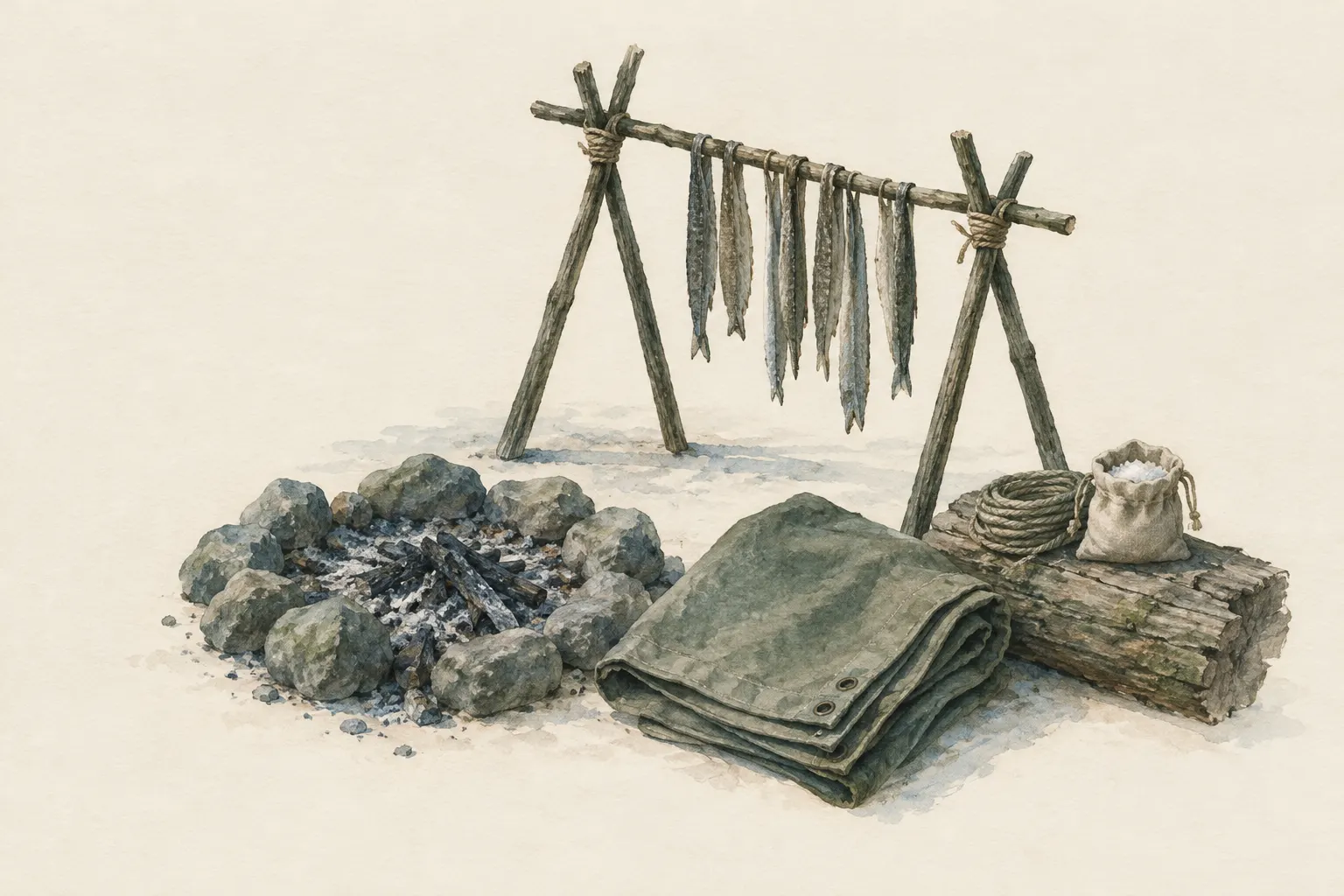
Thin, lean strips are first heated until cooked through and then dried on a rack over a small, smoking hardwood fire until they are hard and crack when bent. Smoke keeps flies away, but neither smoke nor drying reliably kills pathogens – heating beforehand is the most important step. Without it, field smoking is only a last resort.
- Preparation 1–2 hours, drying many hours to days
Explained simply
Fresh meat and fresh fish spoil quickly without a fridge because germs grow in them. Germs need water. If you make thin strips of meat very dry, the germs hardly find any water and the meat keeps longer. People did this thousands of years ago.
But careful: drying and smoke do not reliably kill germs. So you first cook the thin strips in bubbling water until they are no longer pink inside. Only then do you hang them on a rack over a small fire that smokes but does not make big flames. The smoke keeps the flies away.
The meat is done when it is hard and cracks when you bend it. Then you keep it dry and well closed. Meat from wild boar or bears is never just smoked, because it can contain tiny worms that only thorough cooking kills.
How it works
Bacteria and moulds need free water to grow. Fresh meat consists largely of water. If you dry it until it becomes hard and brittle, so little water is left that spoilage is greatly slowed. Salt helps because it binds and draws out water. Fat, on the other hand, does not dry but goes rancid over time – that is why it comes off beforehand.
Drying, however, does not kill pathogens. At the low temperatures above a smoke fire, salmonella or E. coli can even grow on the moist surface in the first hours before the meat is dry enough. That is why the US Department of Agriculture (USDA) and the National Center for Home Food Preservation recommend heating meat for jerky to a safe internal temperature: 71 °C (160 °F) for meat, 74 °C (165 °F) for poultry.
Smoke adds extra help: it keeps flies away so they do not lay eggs on the meat, and it dries the surface. Its germ-inhibiting effect, however, is limited and cannot be controlled in the field. So smoke is a helper, not a safety method.
What really matters
Cutting thin and evenly is half the work. Strips of about half a centimetre dry through before they spoil; thick pieces stay moist inside. Then the strips are cooked in batches in bubbling water until they are no longer pink inside. With a probe thermometer you check a thick strip.
The fire must be small and above all smoky. First dry hardwood burns down to embers, then a little wood is added again and again. Where the meat hangs it is warm but not hot: your hand must be able to stay there for a few seconds. If flames reach the meat, it becomes hard and cooked on the outside but stays moist inside – exactly what should not happen.
The test at the end: a cooled strip cracks when bent but does not snap like a dry twig, and there are no moist spots inside. Fish must be hard and dry all over. Only pack it when everything is cold, otherwise condensation forms in the bag.
Safety: what to watch out for
Trichinella are tiny roundworms that can occur in the muscle of wild boar, bears, foxes, badgers and other omnivores or predators. In humans they cause a serious illness. Smoking, drying and salting do not reliably kill them – only thorough cooking does. In Germany and Austria wild boar that has been shot must therefore be officially inspected. Such meat is never turned into dried meat but is cooked thoroughly while fresh.
The wood decides the smoke. Dry hardwood such as beech, oak, alder or fruit wood gives a mild smoke. Softwood contains resin and produces a lot of soot. Treated, painted or glued wood and chipboard release toxic substances. Some woods are themselves poisonous, such as yew. So only use wood you know for certain.
A smoke tent is a fire hazard: the tarp must never come near the heat, and the fire is never left unattended. Smoking food indoors or in closed tents is life-threatening because carbon monoxide builds up. Water to put out the fire is always ready, and fire bans apply without exception.
When it makes sense – and when not
Smoking and drying make sense when there is more meat or fish than can be eaten in one or two days and no cooling is available. Dry, windy weather helps a lot. If you dry at home, a dehydrator or the oven following tested instructions is better – it is safer and easier to control.
It does not make sense in damp, muggy weather, during a fire ban, or for meat from omnivores and predators. If there is no pot for pre-heating, drying directly over the fire remains a last resort with remaining risk. Such meat is heated thoroughly again before eating, for example in a soup.
Good to know
The National Center for Home Food Preservation gives about two weeks at room temperature in a tightly closed container for properly made jerky. Meat dried in the field under less controlled conditions should not be kept longer. Kept cool and dark it lasts better; mould, a slimy film or a rotten smell mean: throw it away.
Dried meat is light and energy-rich for its weight, but very high in protein and low in fat. It does not replace a balanced diet and makes you thirsty – plan enough safe drinking water. Dried meat can be soaked again in boiling water and eaten as a soup; this is also an extra safety step.
Step by step
Cut thin strips
Use only fresh, cooled meat or fresh fish. Remove all visible fat and sinew – fat goes rancid. Cut into even strips no thicker than about half a centimetre.
- 1
Cut thin strips
Use only fresh, cooled meat or fresh fish. Remove all visible fat and sinew – fat goes rancid. Cut into even strips no thicker than about half a centimetre.
- 2
Heat through first
Put the strips into rapidly boiling water in batches and cook until they are no longer pink inside; with a thermometer: meat 71 °C, poultry 74 °C. Cook fish until it is opaque and flakes. Then let them drain.
This is the most important step – do not skip it.
- 3
Salt if possible
If salt is available, rub the strips thinly all over. Salt draws out water and slows germs, but it does not replace heating.
- 4
Build a drying rack
Set two to four forked posts firmly in the ground and lay cross bars over them. Hang or lay the strips singly so that they do not touch. Where the meat hangs it must be warm but not hot: your hand must be able to stay there for a few seconds.
- 5
A smoking, not flaming fire
Under the rack build a small fire of dry hardwood and let it burn down to embers. Then keep adding a little hardwood so that it smokes but no flames reach the meat. No softwood, no treated or unknown wood.
Flames cook the outside and leave the inside moist.
- 6
Smoke tent from poles and a tarp
In wind or with many flies, loosely wrap a tripod or frame of poles with a tarp. Leave a gap at the bottom for air and an opening at the top for the smoke. The tarp must never come close to the heat.
Never smoke food in a closed room or a sleeping tent.
- 7
Dry and keep flies off
Keep the smoke going all day, turn the strips regularly and cover them with a fine cloth at night. Depending on thickness, weather and fire this takes many hours to days.
- 8
Test: hard and brittle
Bend a cooled strip: it is done when it is hard and dry and cracks when bent, with no moist, soft spots inside. Fish must be hard and dry all over.
- 9
Store dry and check
Let it cool completely, then keep it in a clean, tightly closing bag or container, dry, cool and safe from animals. Check regularly: mould, a slimy film or a rotten smell – throw it away. Eat home-dried food soon.
Common mistakes
- Skipping the heating before drying
- Strips that are too thick
- Leaving fat on the meat
- Flames instead of smoke
- Burning softwood or treated wood
- Smoking wild boar instead of cooking it through
- Packing it airtight while still warm and moist
Quick view
Materials
Knife (fixed or locking blade)
Cut away from your body.
Rules on carrying knives differ by region – check local rules.
Metal pot (stainless steel, aluminium, titanium)
For pre-heating the strips
Hot – scalding risk.
Probe thermometer (meat thermometer)
Measure at the thickest part, not against bone.
Clean after every use in raw meat.
Table salt
Salt improves keeping quality but does not replace heating through.
Sturdy sticks / poles
Forked posts and cross bars for the rack
Do not cut live wood where prohibited.
Dry firewood
Dry hardwood
Collect only where permitted.
Tarp
For a smoke tent – kept away from the heat
Fine cloth or muslin net against flies
Keep clean and dry; do not hang it over the flames.
Water for extinguishing (bucket, canister or pot)
Have several litres ready before lighting.
Suitable for
- More meat or fish than can be eaten at once
- Longer emergencies without refrigeration
- Dry, breezy weather
Not suitable for
- Wild boar, bear, badger and other carnivores – risk of Trichinella, only cook through at once
- Poultry and fish of unclear origin
- Damp, muggy weather
- Times with a fire ban or high wildfire danger
Prerequisites
- Legally obtained, fresh meat or fish
- Able to manage a small fire safely
- Permission for the fire and the wood
- Time to watch the fire for many hours
Safety
- Only use dry, untreated hardwood. No softwood (resin, soot), no painted, preserved or glued wood, no chipboard and no wood you do not know – some woods such as yew are poisonous.
- A tarp over a fire can catch fire. Keep enough distance, never leave the fire unattended, never smoke food indoors or in closed tents (carbon monoxide) and keep water ready to put it out.
How it works
Germs need water to grow. When thin meat becomes so dry that hardly any water is left, it spoils more slowly. Drying alone, however, kills no pathogens, and on the warm, moist surface they can even multiply in the first hours. That is why you heat first, then dry quickly. The smoke keeps flies away and dries the surface, but it is not a reliable preservative.
Advantages
- Makes meat and fish lighter and longer-lasting
- Smoke keeps flies away
- Needs only fire, poles and time
Disadvantages
- Not as safe as tested methods with a dehydrator or oven
- Lots of time, wood and supervision
- Weather-dependent
- Smoke and smell attract animals and give the camp away
Deep knowledge
Background
Smoking and drying are ancient ways to preserve meat and fish and are described in survival manuals such as FM 3-05.70. Today's food-safety authorities are more cautious: the USDA and the US National Center for Home Food Preservation recommend heating jerky to a safe internal temperature before or after drying, because pathogens can survive drying at low temperatures.
The NCHFP gives about two weeks at room temperature in a sealed container for properly dried jerky. Meat dried in the field should not be kept longer than that.
Variants
- Drying in sun and wind
- In hot, very dry climates pre-heated strips also dry in sun and wind. Without smoke they then need tight fly protection. In damp climates this usually fails.
- Fish
- Fish is gutted, cut into thin fillets or strips and also cooked first. Oily fish goes rancid sooner and keeps for a shorter time.
- Last resort without pre-heating
- If there is no pot, strips can be dried directly over the fire as a last resort. This is less safe: pathogens can survive. Heat such meat thoroughly again before eating, for example in boiling water or over the embers.
Common mistakes
- Skipping the heating before drying
- Strips that are too thick
- Leaving fat on the meat
- Flames instead of smoke
- Burning softwood or treated wood
- Smoking wild boar instead of cooking it through
- Packing it airtight while still warm and moist
Limits and risks
- Not a tested method – tested instructions (dehydrator, oven) are safer
- Does not kill Trichinella
- No instructions for cold smoking or curing with nitrite salt
- No fixed drying times
Material alternatives
Derived from material properties: a substitute must have all relevant properties. Observe the notes on the substitute.
- Metal pot (stainless steel, aluminium, titanium)
- Single-wall stainless steel bottle (Heat only single-wall bottles without paint/plastic; remove the lid before heating.)
- Dry firewood
- Tinder (Carry in waterproof packaging.), Char cloth (charred cotton) (Store dry in a tin.), Finest-grade steel wool (Store separately from batteries – fire risk.), Fatwood (resin-rich wood) (Collect only dead wood where permitted.), Stove fuel (canister, liquid fuel, alcohol) (Store fuels apart from food and in original containers or bottles intended for them.), Petroleum jelly cotton balls (Use only pure cotton.), Cooking oil or cooking fat (tallow, lard) (Never put out burning fat with water – cover it with a lid to smother it.), Tree resin (spruce, pine) (Resin is flammable and sticks to the skin when hot – melt it only slowly over low heat.), Birch bark (from dead, fallen wood) (Never peel from living trees.)
- Tarp
- Plastic sheet / large bin bag (Tears easily; never pull over the head (suffocation risk).), Emergency blanket (Tears easily once punctured; short-term shelter only.), Document folder (waterproof) (Store securely – contains sensitive personal data.), Rain poncho (When used as a shelter, it no longer protects your body from rain.), Bivy bag (Never fully close off the face.), Tent (Do not cook or heat inside the tent (fire and carbon monoxide danger).), Heavy-duty bin bag (large) (Suffocation risk: never pull plastic bags over the head or face and keep them away from small children.), Group shelter bag (Airtight – ventilate regularly.)
- Fine cloth or muslin net against flies
- Cotton cloth / T-shirt (Removes coarse particles only – no disinfection.)
Results come exclusively from structured entries. No improvised instructions are generated.
Sources
United States Department of Agriculture – Food Safety and Inspection Service (USDA FSIS): Jerky and Food Safety
Heat meat to 160 °F (71 °C), poultry to 165 °F (74 °C) before drying
University of Georgia / National Center for Home Food Preservation (USA): National Center for Home Food Preservation – tested guidance on drying and preserving food
Jerky: heating to a safe internal temperature, thin lean strips, bend test, storage time
Centers for Disease Control and Prevention (CDC): Trichinellosis – Prevention
Trichinella in wild game; smoking, drying and salting do not reliably kill them, cook thoroughly
United States Department of Agriculture – Food Safety and Inspection Service (USDA FSIS): Keeping Food Safe During an Emergency
Food safety in emergencies, when in doubt throw it out
Headquarters, Department of the Army (USA) (2002): FM 3-05.70 Survival
Smoking and drying meat and fish in the field
Centers for Disease Control and Prevention: Carbon Monoxide Poisoning – Prevention guidance
No fires in enclosed spaces or tents