Dressing, skinning and butchering small game
A rabbit or hare must be processed quickly, cleanly and with gloves: pull off the skin, open the belly carefully without cutting the gut, take out the entrails and check the liver. White or yellow spots mean the whole animal is not eaten. Then cool it, cut it into pieces, always cook it right through and dispose of all remains far from camp.
- 20–40 minutes per animal with practice
Explained simply
Meat from a rabbit or hare is good food – but only if you work cleanly. Many germs live in the animal's fur and gut. The meat itself is almost clean inside. So your job is to take away the fur and the gut without getting dirt on the meat.
Some hares and rabbits carry a disease that can also make people ill. That is why you wear gloves, do not touch your face and look closely at the liver. A healthy liver is evenly dark red. If it has white or yellow spots, the whole animal is not eaten.
Finally the meat is always cooked right through until nothing is pink inside. And one more thing matters: in Germany and Austria only people with a hunting licence and hunting rights may hunt. This knowledge is meant for an animal you get from a hunter, or for a genuine emergency.
How it works
The muscle meat of a healthy animal is almost free of germs inside. Most germs that spoil meat or cause illness come from outside: from the fur, the gut contents, the bladder and from hands and knife. Good dressing therefore mainly means keeping these sources away from the meat. The faster and cleaner this happens, the longer the meat stays good.
On a rabbit the skin is loose. You cut it only across the back and pull it off in two directions, like a jacket and trousers. That way the knife hardly touches the meat, and hairs stay on the outside. When opening the belly two fingers guide the blade: the edge points up, the fingers press the intestines down and away.
Warmth is the second enemy. Germs multiply quickly in warm meat. That is why the animal is gutted soon after it was killed and the meat is hung in a cool, airy, shady place. Without a fridge it should be cooked on the same day.
What really matters
Preparation prevents mistakes: two bags, one for meat and one for waste, clean water for hand washing, a clean surface and a sharp knife. The spot is at least 60 metres from water, paths and camp, so that neither water is polluted nor animals are drawn into camp.
Checking the liver is the most important control step. A healthy liver is evenly dark red, smooth and firm. White, yellow or grey spots, nodules, blisters or worms are warning signs of disease. Then the whole animal is not eaten, not even cooked through. Animals found dead or that behaved strangely beforehand, such as being tame or staggering, are equally off-limits.
If the gut does get cut, there is no need to panic: trim soiled areas away generously, wash hands and knife, carry on. At the end every piece is cooked right through until nothing is pink inside and the juices run clear.
Safety: what to watch out for
Tularemia, also called rabbit fever, is a bacterial disease that mainly affects hares, rabbits and rodents. People become infected among other ways when skinning and gutting – through tiny skin cuts, through the eyes or from undercooked meat. Gloves, keeping hands away from the face and thorough cooking are therefore a must. Anyone who develops fever, chills, swollen lymph nodes or a sore on the hand after contact with game sees a doctor and mentions the animal.
The knife is the second danger. Always cut away from your body, sit or kneel, and keep your free hand behind the blade. With heavy bleeding: press firmly on the wound and call 112, in Austria also 144.
Waste attracts foxes, wild boar and in some areas bears. It is buried deep – far from camp and water – or packed out. Hands, knife and surface are washed with soap afterwards.
When it makes sense – and when not
This knowledge makes sense when you obtain an animal legally – for example from a hunter – or when you have to survive outdoors for a long time in a genuine emergency. Many hunting and cooking courses offer the chance to practise butchering under guidance. That is the best way to learn it safely.
In Germany and Austria game may only be killed or caught with hunting rights. Even a deer hit by a car or a dead hare by the path belongs to the holder of the hunting rights; taking it is a criminal offence. Red squirrels are specially protected in Germany. No animal that seems sick or was found dead belongs on the plate.
Good to know
Rabbit meat is very lean. Anyone who lives for a long time almost only on lean meat gets too little energy and can become ill despite a full stomach. Fat, for example from nuts or supplies, and carbohydrates always belong in the diet. The heart and kidneys of a healthy animal can be cooked too if they look normal.
The skin can be used further, for example as lining for gloves, but it has to be cleaned and tanned for that – a craft of its own. For food safety, what the WHO sums up in its five keys applies: keep clean, separate raw and cooked, cook thoroughly, do not leave food standing warm, and use safe water.
Step by step
Check the animal and your hands
Only process a legally obtained, fresh animal that behaved normally. Put on gloves (plastic bags if need be), cover cuts on your hands and do not eat, smoke or touch your face while working.
Caution: Leave animals found dead or sick.
- 1
Check the animal and your hands
Only process a legally obtained, fresh animal that behaved normally. Put on gloves (plastic bags if need be), cover cuts on your hands and do not eat, smoke or touch your face while working.
Leave animals found dead or sick.
- 2
Set up the work place
Choose a spot at least 60 metres from water, paths and camp. Lay out a clean surface (tarp, bark, large bag) and get safe water for hand washing and two bags ready: one for the meat, one for waste.
- 3
Pull off the skin
Lift the skin in the middle of the back with two fingers and cut across through the skin only – the blade does not touch the meat. Hook your fingers into the cut and pull the skin apart in both directions like a jacket: one half towards the head, one towards the hind legs. Cut off the feet at the joints, the head and the tail.
Keep fur away from the meat – wash your hands in between.
- 4
Open the belly carefully
Lay the animal on its back. Lift the belly wall low down between the hind legs with your fingers and cut a small hole. Push two fingers in as a V, guide the blade edge-up between them and cut shallowly up to the breastbone – this keeps gut and bladder intact.
If the gut is cut, trim away soiled parts generously.
- 5
Remove the entrails and check the liver
Lift out the entrails carefully, do not squeeze the bladder, cut the end of the gut free at the pelvis. Then look at the liver: healthy, it is evenly dark red, smooth and firm. White, yellow or grey spots, lumps or worms mean the whole animal is not eaten – gloves into the waste bag, wash hands thoroughly.
When in doubt: do not eat it.
- 6
Clean and cool
Cut away hair, blood clots and damaged or soiled areas. Rinse briefly with safe water and pat dry. Hang the meat in the shade in an airy, cool place and protect it from flies with a fine cloth. Without refrigeration, cook it on the same day if possible.
- 7
Cut into pieces
Separate the hind legs at the hip joint, cut the front legs off flat under the shoulder blade and divide the back into two or three pieces. Small pieces cook faster and more evenly.
- 8
Cook through and dispose of remains
Always cook the meat right through: no pink inside, the juices run clear. Bury waste in a deep hole far from camp and water or pack it out. Clean knife, surface and hands with soap and water.
Never eat game raw or half raw.
Common mistakes
- Working without gloves
- Cutting the gut while opening
- Not checking the liver
- Leaving the meat lying around warm for hours
- Eating half-raw game
- Leaving remains next to camp – it attracts animals
Quick view
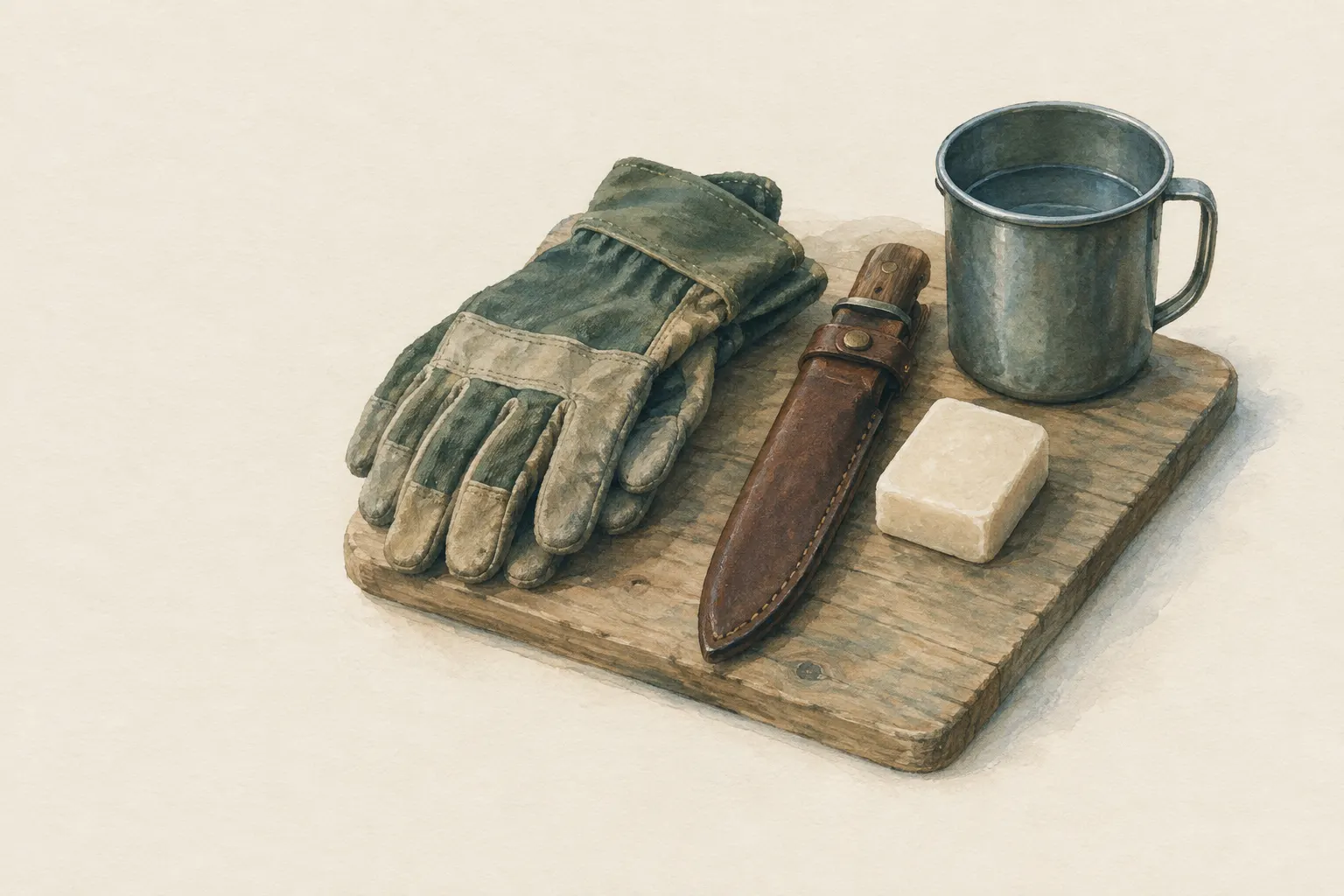
Materials
Disposable gloves
Or two plastic bags over the hands
Consider latex allergies – prefer latex-free gloves (e.g. nitrile).
Knife (fixed or locking blade)
Sharp, with a short blade
Cut away from your body.
Rules on carrying knives differ by region – check local rules.
Soap / detergent
And safe water for hand washing
Rinse drinking-water containers thoroughly after cleaning.
Resealable food bags
Separate ones for meat and for waste
Use only bags intended for food; do not use with boiling water unless the manufacturer explicitly allows it.
Fine cloth or muslin net against flies
Keep clean and dry; do not hang it over the flames.
Small trowel
For burying the remains
Suitable for
- Rabbits and hares passed on by a hunter
- Genuine emergencies with a longer stay outdoors
- Practice under guidance, for example in a hunting or cooking course
Not suitable for
- Animals found dead or strangely tame and sick
- Protected species – in Germany, for example, the red squirrel
- Situations where the meat cannot be cooked right through
- People with open cuts on their hands and no gloves
Prerequisites
- A legally obtained animal or a genuine emergency
- Safe knife handling
- A fire for thorough cooking
- Safe water for washing hands
Safety
- In Germany and Austria game may only be killed or caught with hunting rights; even game found dead (for example after a road collision) belongs to the holder of the hunting rights and must not be taken. This entry assumes a legally obtained animal – or a genuine danger to life.
- Always cut away from your body and, when opening the belly, guide the blade edge-up between two fingers. With a deep cut: press on the wound, call 112 (in Austria also 144).
How it works
Inside a healthy animal the meat is almost free of germs. Germs come mainly from outside – from the fur, from damaged intestines and from dirty hands. If you pull the skin off cleanly, take out the gut undamaged, cool the meat quickly and finally cook it thoroughly, you keep the germ count low and kill the rest. The liver often shows disease first.
Advantages
- High-quality protein with little equipment
- Clean work lowers the risk of disease considerably
- The skin can be used further
Disadvantages
- Legally mostly only possible with hunting rights
- Risk of infection from zoonoses
- Small game is very lean – provides little energy
Deep knowledge
Background
Military survival manuals such as FM 3-05.70 describe skinning and gutting small game and advise checking the liver for spots. The US health authority CDC explicitly names hunters who skin rabbits and hares in connection with tularemia and recommends gloves and thorough cooking.
Rabbit meat is almost fat-free. Anyone who lives for a long time almost only on very lean meat gets too little energy and can become ill – fat and carbohydrates always belong in the diet too.
Variants
- Hare instead of rabbit
- Hares are bigger and their skin is more firmly attached. The method is the same, but pulling takes more strength; the hare is often hung up by the hind legs for this. In Central Europe brown hares in particular are a common source of tularemia – gloves are a must.
- Working hanging up
- Hung by the hind legs from a branch, the animal can be skinned and gutted more cleanly because nothing touches the ground.
Common mistakes
- Working without gloves
- Cutting the gut while opening
- Not checking the liver
- Leaving the meat lying around warm for hours
- Eating half-raw game
- Leaving remains next to camp – it attracts animals
Limits and risks
- No instructions for catching or killing
- No substitute for official meat inspection where it is required
- Larger game (deer, wild boar) needs expert knowledge and equipment
Material alternatives
Derived from material properties: a substitute must have all relevant properties. Observe the notes on the substitute.
- Resealable food bags
- Single-wall stainless steel bottle (Heat only single-wall bottles without paint/plastic; remove the lid before heating.), Double-wall insulated bottle (Never heat directly.), PET bottle (clear, max. 2 litres) (Do not heat or place in a fire.), Food-grade water container (Only use containers that never held chemicals or fuel.), Airtight food-grade storage container (Fill only when clean and completely dry; never use containers that previously held chemicals.), Collapsible water container or bag (Protect from sharp objects.), Food-grade water bag (Use only for drinking water, never for chemicals or fuel.), Fermentation jar or crock (Use only food-grade containers of glass, food-safe glazed stoneware or food-grade plastic – no metal containers for acidic food.)
- Fine cloth or muslin net against flies
- Cotton cloth / T-shirt (Removes coarse particles only – no disinfection.)
Results come exclusively from structured entries. No improvised instructions are generated.
Sources
Headquarters, Department of the Army (USA) (2002): FM 3-05.70 Survival
Skinning, gutting and butchering small game; checking the liver for spots
Centers for Disease Control and Prevention (CDC): Tularemia – Prevention
Tularemia in rabbits and hares; gloves when skinning, cook game thoroughly, avoid sick or dead animals
World Health Organization (WHO) (2006): Five Keys to Safer Food Manual
Keep clean, separate raw and cooked, cook thoroughly
Ray Mears – Hodder & Stoughton (2002): Bushcraft
Processing small game in the field