Evaporative cooling: clay pot cooler and wet cloth
Evaporating water removes heat. A clay pot inside a larger clay pot with wet sand in between, or a damp cloth over a basket, keeps fruit and vegetables fresh longer in dry, warm air. It is not a fridge: the temperature is not reliably low enough for meat, fish, dairy or leftovers.
- 1 hour to build, re-wet daily
Explained simply
Do you know this feeling? You come out of the swimming pool wet, a breeze blows, and suddenly you are cold even though it is warm. That happens because the water on your skin evaporates – and as it does, it takes heat with it. A clay pot cooler uses exactly that.
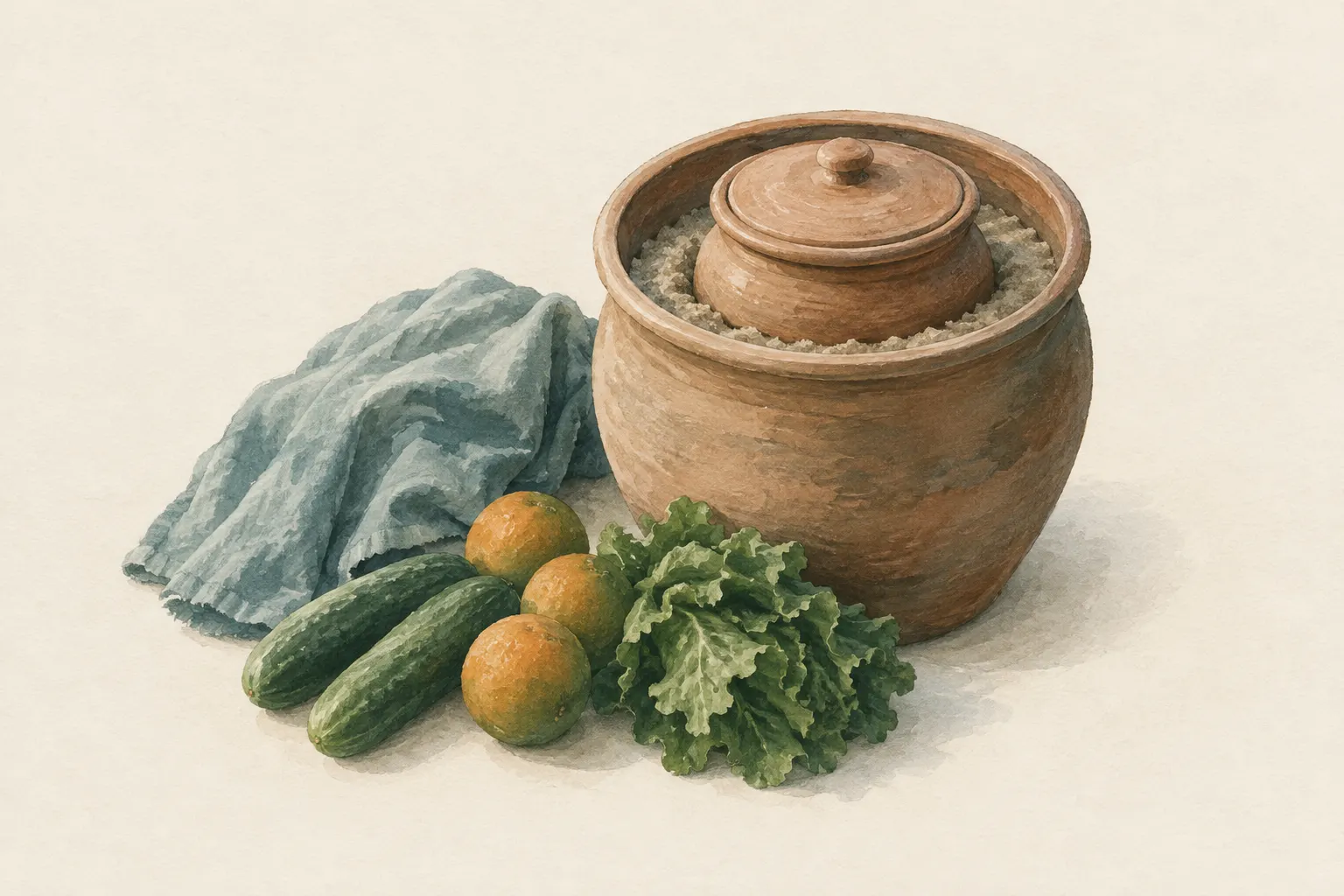
You put a small clay pot inside a big one and fill the gap with wet sand. The water moves through the clay to the outside and evaporates there. In doing so it takes heat from the pot, and the inside gets cooler. This works best when the air is warm and dry and a light wind is blowing. In muggy weather the pot hardly cools at all.
Important: a clay pot cooler is not a fridge. It keeps fruit and vegetables fresh for longer, but meat, fish, milk or leftovers do not belong in it.
How it works
For water to change from liquid to gas, it needs energy. It takes this energy, the heat of evaporation, from its surroundings – from the clay, the sand and therefore also from the inside of the pot. As long as water is evaporating, heat is constantly being drawn out of the cooler.
Unglazed clay is porous, meaning it has tiny pores through which water slowly seeps outwards. On the outside it evaporates. Glazed pots do not work, because the glaze seals the pores. How strong the cooling is depends mainly on the air: dry air takes up a lot of water vapour, and moving air carries the vapour away and makes room for more evaporation.
There is a natural limit: an evaporative cooler can never get colder than a certain value that depends on air temperature and humidity. In very dry air this value is well below the air temperature; in muggy air it is hardly below it. That is why this entry gives no temperatures – the effect varies greatly with the weather.
What really matters
You need two unglazed clay pots that fit inside each other with a few fingers' width of space all round. If the pots have drainage holes, seal them first. The gap is filled with clean sand and soaked thoroughly without letting water run into the inner pot. A wet cotton cloth serves as a lid.
The location decides success or failure. The cooler belongs in the shade in an airy place, for example under a canopy where a breeze blows. In the sun it heats up; in a closed room the moist air builds up and evaporation comes to a standstill.
The sand must always stay damp – usually this means re-wetting it once or twice a day. Check the contents every day and remove anything that turns soft or rotten, otherwise it spoils its neighbours. The pots are cleaned regularly so that no mould takes hold. A simpler version is a basket covered with a wet cloth whose ends hang in a dish of water.
When it makes sense – and when not
An evaporative cooler makes sense in heat and dry air: during a long power cut in summer, for a garden harvest without a fridge, or in regions with a hot, dry climate. Fruit and vegetables stay crisp for longer and wilt more slowly in it, because they are kept cooler and dry out less.
It makes little sense in damp, muggy weather, because then hardly anything evaporates and the cooling effect collapses. It is also the wrong choice when water is scarce: it uses water every day, and drinking water always comes first. Use only water that would not be drunk anyway.
Safety: what to watch out for
Perishable foods – meat, fish, dairy, cooked leftovers and infant food – need real, reliable refrigeration. An evaporative cooler does not reliably reach those temperatures and varies with the weather. Anything stored in it therefore counts as unrefrigerated. When in doubt, it is thrown away.
Germs that make you ill often cannot be detected by smell or appearance. So with perishable foods, do not rely on them “still seeming fine”. Wash fruit and vegetables from the cooler with safe water before eating them.
The damp cooler can attract insects and is a good place for mould. So keep it covered and clean and remove anything spoiled straight away.
Good to know
Clay pot coolers have long been used in hot, dry regions to keep food fresh without electricity; the pot-in-pot cooler is also known as a “zeer”. The same principle is at work in unglazed water jugs, whose contents stay pleasantly cool on hot days.
Your body uses evaporative cooling too: when you sweat, water evaporates on the skin and cools you down. That is why heat often feels more bearable in dry air than in muggy air – there, sweat evaporates less well.
Step by step
Nest the pots
Place the small clay pot inside the large one and fill the gap with sand. Seal drainage holes first if necessary.
- 1
Nest the pots
Place the small clay pot inside the large one and fill the gap with sand. Seal drainage holes first if necessary.
- 2
Wet
Soak the sand thoroughly with water without letting water run into the inner pot.
- 3
Fill and cover
Put clean, undamaged fruit and vegetables in the inner pot and cover with a wet cloth.
- 4
Position
Place it in the shade in an airy spot, not in the sun or in a closed room.
- 5
Maintain
Re-wet the sand once or twice a day, check the contents daily, remove anything rotting and clean the pots regularly.
Common mistakes
- Storing meat or milk in it
- Placing it in the sun
- Using glazed pots – they do not let water through
- Relying on cooling in humid weather
Quick view
Materials
Clean sand
Improvised sand layers do not reliably remove pathogens.
Cotton cloth / T-shirt
Removes coarse particles only – no disinfection.
Suitable for
- Fruit and vegetables in heat and dry air
- Long summer power cut
- Garden harvest without a fridge
Not suitable for
- Meat, fish, dairy, cooked leftovers, infant food
- Damp, humid weather – it barely cools there
- Situations with scarce drinking water
Prerequisites
- Two unglazed clay pots of different sizes, or a basket and a cotton cloth
- Water not needed for drinking
- A shady, airy place
Safety
- Perishable foods need real refrigeration. Stored in an evaporative cooler they count as unrefrigerated – when in doubt, throw it out.
- Drinking water comes first. Use only water that would not be drunk anyway.
How it works
Water needs energy to evaporate, which it takes from its surroundings as heat. The drier and more moving the air, the stronger the evaporation and the cooler the inside. In high humidity little evaporates and the cooling effect collapses.
Advantages
- No electricity needed
- Cheap materials
- Fewer losses of fruit and vegetables
Disadvantages
- Uses water
- Only works in dry air
- Does not reach fridge temperatures
Deep knowledge
Background
Clay pot coolers are used in hot, dry regions to keep fruit and vegetables fresh longer without electricity. Physically, they rely on the heat of evaporation of water.
The WHO's food safety rules require real refrigeration for perishable food – an evaporative cooler cannot reliably provide that.
Variants
- Basket with damp cloth
- A basket of vegetables covered with a wet cotton cloth whose ends sit in a dish of water uses the same principle.
Common mistakes
- Storing meat or milk in it
- Placing it in the sun
- Using glazed pots – they do not let water through
- Relying on cooling in humid weather
Limits and risks
- No temperature figures – the effect depends strongly on humidity and wind
Sources
David Halliday, Robert Resnick, Jearl Walker – John Wiley & Sons: Fundamentals of Physics
Heat of vaporisation
World Health Organization (WHO) (2006): Five Keys to Safer Food Manual
Perishable food needs refrigeration