Fermenting vegetables: principle and safety limits
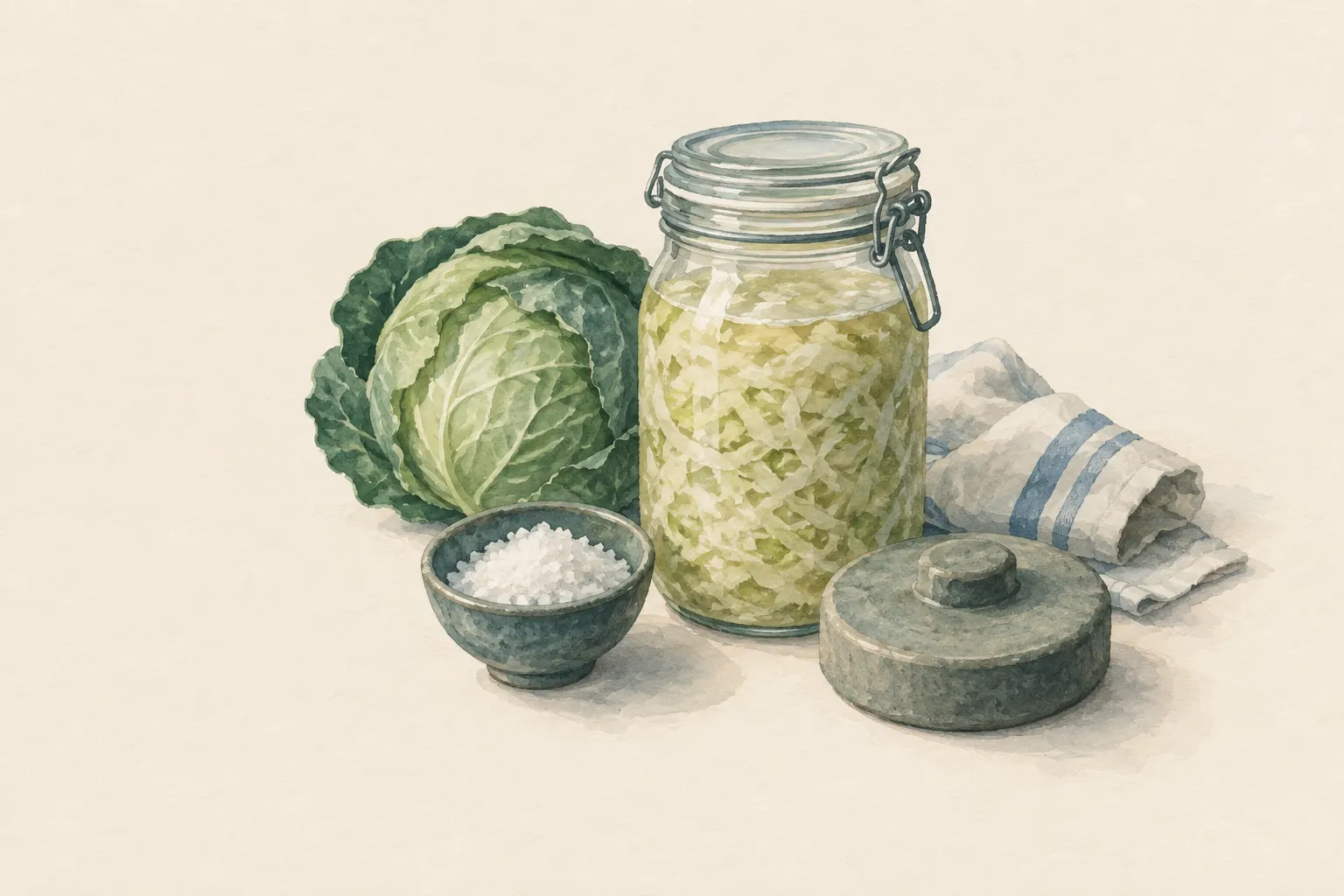
In lactic acid fermentation – for sauerkraut, for example – lactic acid bacteria turn sugars in the vegetables into acid that inhibits spoilage. This requires the right amount of salt, exclusion of air under the brine, cleanliness and a suitable temperature. Working from tested instructions and taking warning signs seriously, you can preserve vegetables this way. Fermented foods do not replace canning by recipe.
- 1 hour preparation, then several weeks of fermentation
Explained simply
Small, helpful bacteria called lactic acid bacteria live invisibly on cabbage and other vegetables. When you pack the vegetables with salt and press them under liquid so that no air gets in, they start to work. They eat the sugar in the vegetables and turn it into acid. That is how sauerkraut, for example, is made.
The acid is like a shield: many germs that spoil food do not like sour conditions. The salt helps at the start so that the good bacteria get a head start. That is why you must not simply cut down on the salt by feel.
The vegetables must always stay under the liquid, because otherwise mould easily grows at the top where there is air. And if something turns pink, slimy or smells putrid, or mould grows into the vegetables, it is thrown away.
How it works
Lactic acid bacteria live naturally on vegetables. They cope well with salt and without oxygen – many putrefying and mould organisms, by contrast, do not. So salt and the exclusion of air give the lactic acid bacteria a head start. They convert the natural sugar in the vegetables into lactic acid, the pH drops and the vegetables turn sour.
The acidic environment inhibits many spoilage organisms. At the same time the salt draws juice out of the vegetables. With shredded cabbage the brine forms by itself; this is called dry salting. Whole cucumbers or larger pieces do not release enough juice, so they are covered with a salt brine.
Oxygen at the surface, on the other hand, favours yeasts and mould. So the most important step is to keep the vegetables under the liquid with a weight. The container is covered so that the fermentation gases can escape but little air and no insects can get in.
What really matters
The amount of salt decides success and safety. Tested instructions give it as an amount per weight of vegetables, so vegetables and salt are weighed, not estimated. Too little salt lets unwanted germs grow before there is enough acid; too much slows the fermentation.
Temperature counts too. In a cool place with even temperature the vegetables ferment slowly and evenly. If it is too warm, the vegetables easily turn soft and unwanted organisms can take over; if it is too cold, fermentation hardly gets going. The suitable ranges are in the instructions.
Cleanliness is the foundation: clean containers with hot water, wash hands, use only fresh, sound vegetables and remove wilted or rotten parts. Label the container with contents and date, check it regularly and top up brine only as the instructions say.
Safety: what to watch out for
Warning signs are pink, slimy or soft vegetables, an unusual putrid smell or mould growing into the vegetables. Then the whole contents are discarded – when in doubt, throw it out, do not taste it. Check briefly for these signs before each use.
The amount of salt is not reduced by feel. Anyone who must eat low-salt for a medical condition or has a weakened immune system should check with a doctor beforehand whether fermented foods are suitable. Meat, fish and eggs do not belong in experiments without specialist knowledge.
Garlic or herbs in oil are not fermentation. Under oil there is neither acid formation nor salt protection, but there is no air – at room temperature a botulism risk. Fermented vegetables also do not replace canning by tested recipe.
When it makes sense – and when not
Fermentation is suitable for cabbage, cucumbers and other firm vegetables, especially harvest surpluses. A big advantage: preserving needs no energy for heat, only salt, a clean container, a weight and a cool place.
It does take patience – fermentation lasts weeks – and it does not always succeed; losses are part of it. Fermented food is also high in salt. For an acute emergency it is therefore less an emergency tool than a craft to learn in calm times.
Good to know
Fermentation is one of the oldest preservation methods in the world, and many cuisines have their own variants. The National Center for Home Food Preservation provides tested instructions for sauerkraut and fermented pickles, with notes on salt content, temperature and signs of spoilage.
This entry explains the principle and makes no claims about health effects. Quantities and times always come from tested instructions – that is how an old craft becomes a safe one.
Step by step
Tested instructions
Choose tested instructions with the amount of salt per weight of vegetables and weigh vegetables and salt.
- 1
Tested instructions
Choose tested instructions with the amount of salt per weight of vegetables and weigh vegetables and salt.
- 2
Prepare cleanly
Clean containers with hot water, wash hands, trim vegetables and remove wilted or rotten parts.
- 3
Salt and pack
Mix the vegetables with salt or pour over brine, and press down firmly until liquid comes out.
- 4
Keep submerged
Keep the vegetables under the liquid with a weight. Cover the container so gas can escape but little air and no insects can get in.
- 5
Ferment and observe
Let it ferment in a cool place with even temperature, check regularly and top up brine according to the instructions if needed.
- 6
Store cool
When the instructions say it is ready, store the finished ferment cool and label it. Check for warning signs before each use.
Common mistakes
- Vegetables sticking out of the brine
- Salt by feel
- Fermenting too warm
- Tasting a suspicious ferment instead of discarding it
Quick view
Materials
Fermentation jar or crock
Use only food-grade containers of glass, food-safe glazed stoneware or food-grade plastic – no metal containers for acidic food.
Labels and permanent marker
Suitable for
- Cabbage, cucumbers and other firm vegetables
- Harvest surpluses
- Preserving without energy for heating
Not suitable for
- Meat, fish, eggs – not without specialist knowledge
- Low-salt experiments without instructions
- Garlic or herbs in oil (not fermentation, botulism risk)
Prerequisites
- Tested instructions stating the salt amount
- Fresh, sound vegetables
- Clean, food-grade containers and a weight
- A cool place with even temperature
Safety
- Pink, slimy or soft vegetables, an unusual putrid smell or mould growing into the vegetables: discard. When in doubt, throw it out.
- Do not reduce the salt by feel – salt suppresses unwanted microbes until enough acid has formed.
- Anyone who must eat low-salt for a medical condition or has a weakened immune system should check with a doctor beforehand whether fermented foods are suitable.
How it works
Lactic acid bacteria live naturally on vegetables. Salt and the exclusion of air give them a head start over putrefying and mould organisms. They produce lactic acid, the pH drops and the acidic environment inhibits many spoilage organisms. Oxygen at the surface, on the other hand, favours yeasts and mould – so the vegetables must stay under the brine.
Advantages
- No fuel needed for preserving
- Simple equipment
Disadvantages
- Takes weeks and a cool place
- High in salt
- Does not always succeed – losses possible
Deep knowledge
Background
Fermentation is one of the oldest preservation methods. The National Center for Home Food Preservation provides tested instructions for sauerkraut and fermented pickles, including notes on salt content, temperature and signs of spoilage.
This entry explains the principle; quantities and times always come from tested instructions.
Variants
- Dry salting or brine
- Shredded cabbage releases its own juice with salt (dry salting); whole cucumbers or pieces are covered with brine.
Common mistakes
- Vegetables sticking out of the brine
- Salt by feel
- Fermenting too warm
- Tasting a suspicious ferment instead of discarding it
Limits and risks
- No quantities or times
- No claims about health effects
Material alternatives
Derived from material properties: a substitute must have all relevant properties. Observe the notes on the substitute.
- Fermentation jar or crock
- Single-wall stainless steel bottle (Heat only single-wall bottles without paint/plastic; remove the lid before heating.), Double-wall insulated bottle (Never heat directly.), PET bottle (clear, max. 2 litres) (Do not heat or place in a fire.), Food-grade water container (Only use containers that never held chemicals or fuel.), Airtight food-grade storage container (Fill only when clean and completely dry; never use containers that previously held chemicals.), Collapsible water container or bag (Protect from sharp objects.), Food-grade water bag (Use only for drinking water, never for chemicals or fuel.), Resealable food bags (Use only bags intended for food; do not use with boiling water unless the manufacturer explicitly allows it.)
Results come exclusively from structured entries. No improvised instructions are generated.
Sources
University of Georgia / National Center for Home Food Preservation (USA): National Center for Home Food Preservation – tested guidance on drying and preserving food
Tested instructions for sauerkraut and fermented pickles, signs of spoilage
World Health Organization (WHO) (2006): Five Keys to Safer Food Manual
Cleanliness in preparation