Pan flatbread – bread without an oven
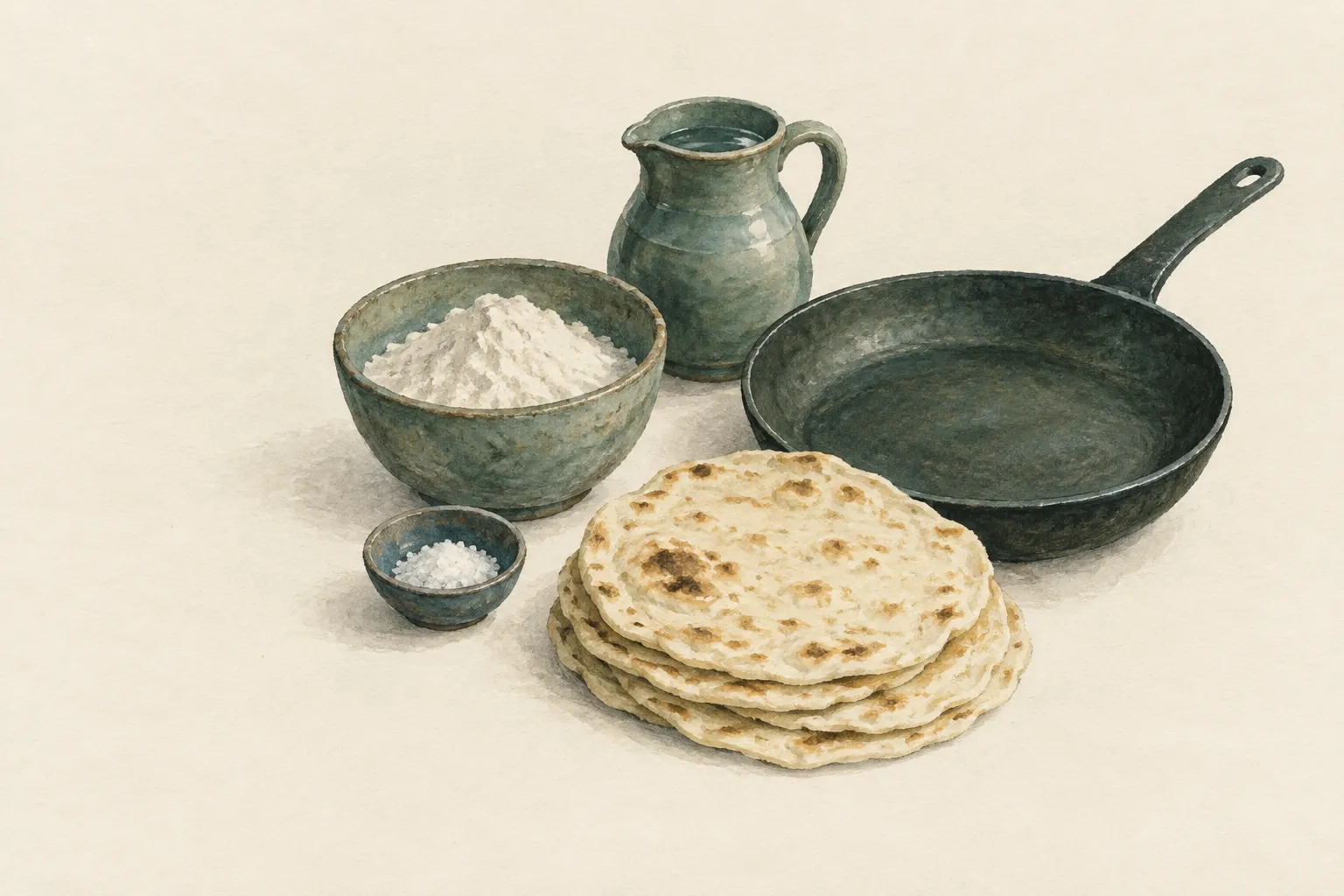
With flour, water and a pinch of salt, a simple flatbread can be cooked in a dry frying pan or on a griddle over a stove. It needs no yeast and no oven and turns flour from the stock into a filling meal. Do not eat raw dough and cook the bread right through.
- 20–30 minutes
Explained simply
Flatbread is the simplest bread in the world: flour, water and a pinch of salt. You knead it into a dough, press it out very thin and cook it in a hot pan. You need neither yeast nor an oven.
Why does the dough have to be so thin? The heat comes from below, from the pan. In a thin flatbread it reaches the middle quickly – just as a thin slice of butter melts faster in the sun than a thick block. A thick flatbread would be black outside and still raw inside.
Two safety rules: do not nibble the raw dough, because raw flour can contain germs. And a camping stove is used only outside, never in the home or in a tent.
How it works
When wheat or spelt flour is kneaded with water, certain proteins in the flour link up into an elastic network called gluten. It makes the dough mouldable and holds it together. If you let the dough rest briefly, this network relaxes and the dough is easier to roll out thinly without springing back again and again.
In the hot pan two things then happen: the starch in the flour absorbs water and cooks, and part of the water turns to steam. Where steam is trapped between layers of dough, bubbles puff up – sometimes the whole flatbread. The brown spots appear because sugars and proteins react with each other under strong heat; this creates the typical toasted flavour.
Because there is no raising agent in the dough, the bread stays flat. That is exactly the advantage: a thin flatbread cooks through in a few minutes and needs far less fuel than a thick loaf that has to bake for a long time in a pot or oven.
What really matters
There are no fixed quantities, because every flour absorbs a different amount of water. So add the water gradually and knead until the dough is smooth and no longer sticks to your fingers. If it is too wet, a little flour helps; if it is crumbly, a little water. A splash of oil makes it more pliable and the breads a bit softer.
Roll small portions out evenly and thinly – a smooth bottle replaces a rolling pin. Spots of different thickness cook at different speeds. The pan should be properly hot but not smoking: too cold, and the bread becomes hard and dry; too hot, and it burns outside before it is cooked inside. Turn the bread when bubbles form and the underside has brown spots.
The flatbread is done when it has browned patches on both sides and is no longer doughy inside. Tear one open to check. To keep the breads soft, wrap them straight away in a clean cloth. They taste best the same day.
Safety: what to watch out for
Flour is milled from grain that grows in the field, and it is not sterilised in the process. Raw flour is therefore not a ready-to-eat food and can contain pathogens. Only cooking it thoroughly makes the flatbread safe. Do not taste raw dough and wash your hands after kneading; the board and bowl are cleaned too.
In a power cut the cooking place is the most important safety point. A gas cooker in the kitchen may be used as usual, but a camping stove only outdoors – never in the home, a tent, an enclosed balcony or a garage. It gives off carbon monoxide, which you cannot smell and which can be deadly. Anyone cooking over an open fire outdoors checks the local rules on fires and wildfire danger first.
Hot pans and handles easily cause burns. Set the pan down securely, turn the handle inwards and keep small children away from the stove. For people with coeliac disease, flatbread made from wheat, spelt or rye flour is not suitable.
Variations and the stock
A little baking powder makes the breads lighter; then shape them slightly thicker and cook them over medium heat with a lid so that they cook through inside. Wholemeal, maize or chickpea flour work too. Gluten-free flours, however, hold together less well and need their own, tested recipes.
For the stock, flour is practical as long as it is kept dry and tightly sealed. White flour keeps longer than wholemeal flour, because wholemeal contains more fat and can go rancid over time. Remember that every flatbread also needs water and fuel – both must be planned into the stock.
Good to know
Unleavened flatbreads have been cooked without ovens in many cultures for thousands of years – for example as chapati in South Asia or tortillas in Central America. They show that you need neither electricity nor a kitchen full of appliances to make bread.
Feel free to practise the recipe at home once while everything is normal. Then you know how the right dough feels and how hot the pan needs to be. In a real emergency you no longer have to experiment, you can simply get started.
Step by step
Mix the dough
Knead flour with a pinch of salt, gradually adding safe water, until the dough is smooth and not sticky. A little oil makes it more pliable.
- 1
Mix the dough
Knead flour with a pinch of salt, gradually adding safe water, until the dough is smooth and not sticky. A little oil makes it more pliable.
- 2
Rest
Cover and rest the dough for 10–15 minutes; it is then easier to roll out.
- 3
Roll out
Roll small portions out thinly or press them flat – a bottle replaces a rolling pin.
- 4
Cook
Cook on both sides in the hot, dry or lightly oiled pan until brown spots appear and the inside is no longer doughy.
- 5
Keep warm
Wrap finished breads in a clean cloth to keep them soft. Eat the same day.
Common mistakes
- Rolling too thick – raw inside
- Pan too hot – burnt outside
- Tasting raw dough
- Running a camping stove in the kitchen
Quick view
Materials
Stove
Never operate inside a tent, shelter or enclosed room – carbon monoxide and fire risk.
Stove fuel (canister, liquid fuel, alcohol)
Store fuels apart from food and in original containers or bottles intended for them.
Store cool, well ventilated and out of children's reach.
Metal pot (stainless steel, aluminium, titanium)
Or a frying pan
Hot – scalding risk.
Suitable for
- Power cut with flour in stock
- Camping
- Variety in emergency meals
Not suitable for
- People with coeliac disease when wheat or rye flour is used
Prerequisites
- Flour, safe water, salt
- A frying pan or griddle
- A safe cooking place (cooker, or a stove outdoors)
Safety
- Raw flour is not a ready-to-eat food and can contain pathogens. Do not eat raw dough, cook the bread through, clean hands and surfaces after kneading.
How it works
Flour and water form a mouldable dough. Rolled thin, it cooks through on a hot surface in a few minutes because the heat has only a short way to the centre. Without a raising agent it stays flat; trapped steam can puff it up in places.
Advantages
- Only basic ingredients needed
- Quick, no oven
- Flour keeps a long time
Disadvantages
- Needs fuel and water
- The breads dry out quickly
Deep knowledge
Background
Unleavened flatbreads have been cooked without ovens in many cultures for thousands of years. They are an obvious way to use flour from the stock without electricity.
The WHO's basic food safety rules – work cleanly, cook thoroughly – apply here too.
Variants
- With baking powder
- A little baking powder makes the breads lighter; shape them slightly thicker and cook over medium heat with a lid.
- Other flours
- Also possible with wholemeal, maize or chickpea flour; gluten-free flours hold together less well and need their own recipes.
Common mistakes
- Rolling too thick – raw inside
- Pan too hot – burnt outside
- Tasting raw dough
- Running a camping stove in the kitchen
Limits and risks
- No exact quantities – flours absorb different amounts of water
Material alternatives
Derived from material properties: a substitute must have all relevant properties. Observe the notes on the substitute.
- Stove fuel (canister, liquid fuel, alcohol)
- Dry firewood (Collect only where permitted.), Tinder (Carry in waterproof packaging.), Char cloth (charred cotton) (Store dry in a tin.), Finest-grade steel wool (Store separately from batteries – fire risk.), Fatwood (resin-rich wood) (Collect only dead wood where permitted.), Petroleum jelly cotton balls (Use only pure cotton.)
- Metal pot (stainless steel, aluminium, titanium)
- Single-wall stainless steel bottle (Heat only single-wall bottles without paint/plastic; remove the lid before heating.)
Results come exclusively from structured entries. No improvised instructions are generated.
Sources
World Health Organization (WHO) (2006): Five Keys to Safer Food Manual
Work cleanly and cook thoroughly
Centers for Disease Control and Prevention: Carbon Monoxide Poisoning – Prevention guidance
No stoves or grills indoors