Making a menu plan for the emergency stock
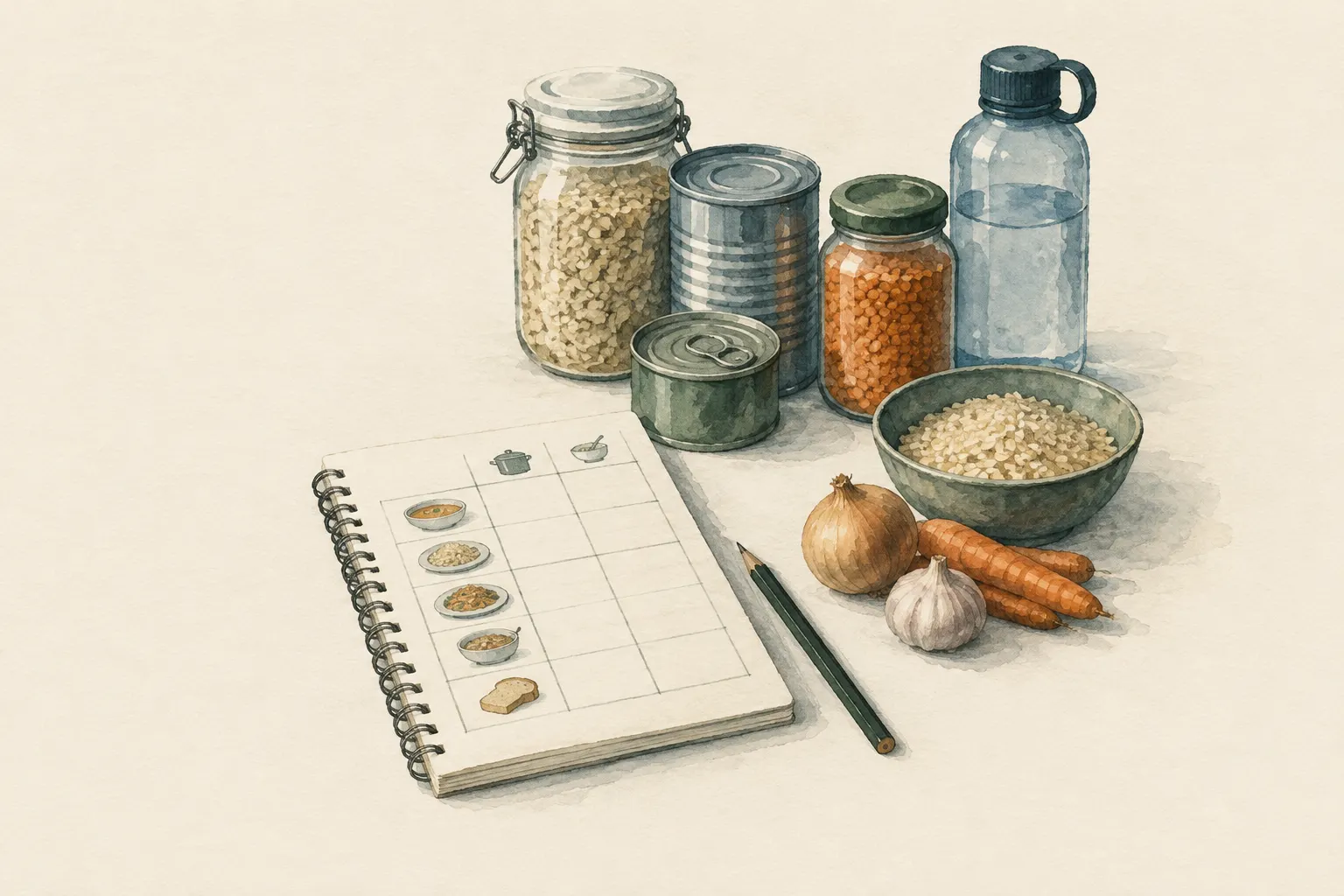
Instead of buying random tins, plan the stock as a concrete menu: what does the household eat on day 1, 2, 3 … – with and without the ability to cook? This creates a stock that suits taste, needs and cooking options and can be rotated in everyday life. National agencies such as the BBK or Ready.gov say how many days make sense.
- One to two hours of planning
Explained simply
Imagine the power goes off for a few days and the shops are closed. A stock of food only helps you then if you can turn it into real meals. A menu plan is like a timetable for food: for each day it says what there is for breakfast, lunch and dinner.
When you write the plan down, you quickly notice what is missing – for example a can opener, or something your little sister likes to eat. You also only buy things you really like. Then you eat them in everyday life too and buy new ones. That way nothing in the stock gets old.
The most important safety point: plan enough food that can be eaten without cooking. Grills and camping stoves must never be used inside the home, because they produce an invisible, odourless and very poisonous gas – carbon monoxide.
How it works
Agencies such as the BBK in Germany or Ready.gov in the USA recommend keeping a stock for a certain number of days. That number is abstract: nobody eats “ten days of stock”, people eat breakfast, lunch and dinner. The menu plan therefore translates the recommendation into very concrete meals. How many days make sense is stated in your national agency's current recommendation – the figures differ by country and are adjusted from time to time.
The easiest format is a table: write the days in the rows and the meals and snacks in the columns. For the first days, plan what is already in the fridge and spoils quickly. Only after that do the shelf-stable supplies take their turn. This way you first use what would otherwise have to be thrown away.
Next to each meal, write what it needs: cooking or not, how much water, which tools. This shows whether the plan also works without electricity. From the finished table you then derive the shopping list and compare it with what is already in the cupboard.
What really matters
The best stock consists of things your household actually eats. Ten tins of a dish nobody likes will sit there until they expire. Also look for variety: anyone who eats the same thing for days will eventually eat less – especially children. Familiar favourites and a few small treats do people good in a stressful situation.
Do not plan only calories but also protein, some fruit and vegetables (for example from tins or jars) and drinks. Many stock foods need water: pasta, rice or instant soups for cooking, dry food to wash it down. This water must be in the stock in addition to the drinking water.
Do not forget the tools. A manual can opener, cutlery, plates, rubbish bags, kitchen paper and, if needed, fuel for a stove belong in the plan. Also note who in the household has allergies, a special diet or particular needs – including babies, older people and pets.
Safety: what to watch out for
At least part of the meals must work entirely without cooking, for example tinned bread, crispbread, nut butter, tinned fish, tinned fruit or ready-cooked beans. The reason: anyone improvising cooking quickly reaches for a grill or camping stove. These appliances give off carbon monoxide, a gas you can neither smell nor see. In a home, basement, garage or tent it can become life-threatening. Such appliances belong outdoors only.
Without a fridge, opened packs are a problem. So plan small tins and single-portion packs that are finished in one meal. Whatever has been cooked is eaten soon and not kept lukewarm for hours.
Hygiene also needs a place in the plan: when water is scarce, disposable gloves, wet wipes and soap help you work cleanly. Food that became too warm in the fridge during a power cut follows separate rules – when in doubt, it is thrown away.
How to practise it
Try a “stock day”: for one day the whole household eats only from the plan, without cooker, microwave or fridge. Afterwards you note what was missing, what did not taste good and where things were awkward. Many people only notice then that the can opener is missing or that breakfast was forgotten.
To keep the stock from spoiling, it is built into everyday life: you regularly eat things from the stock and replace them on the next shopping trip. New packs go to the back, older ones to the front. That way everything stays fresh without you having to think about it specially.
Once a year the plan is reviewed – and whenever something changes in the household: a baby, a new pet, a new allergy, a move to a home without a gas cooker. Some agencies offer checklists or online calculators that help with planning quantities. The plan does not, however, replace dietary advice for medical conditions.
Step by step
Look up guidance
Check the national agency's current recommendation (e.g. BBK in Germany, Ready.gov in the USA) on stock duration and water quantity.
- 1
Look up guidance
Check the national agency's current recommendation (e.g. BBK in Germany, Ready.gov in the USA) on stock duration and water quantity.
- 2
List the household
Note people, ages, allergies, diets, infants, pets.
- 3
Write day plans
Define breakfast, lunch, dinner and snacks for each day. The first days use perishables from the fridge, then shelf-stable food.
- 4
Mark no-cook meals
Mark which meals work without cooking and make sure there are enough of them.
- 5
Derive a shopping list
Derive quantities from the plan, compare with what you have and buy missing items step by step. Do not forget aids: can opener, fuel, rubbish bags.
- 6
Use in everyday life
Eat stock items regularly in everyday life and replace them; review the plan once a year.
Common mistakes
- Only buying tins nobody likes
- No no-cook meals
- Forgetting the can opener
- Never updating the plan
Quick view
Materials
Non-perishable food
Prefer food that can be eaten without cooking; consider allergies and dietary needs; do not forget a can opener.
Labels and permanent marker
Manual can opener
Electric can openers do not work during a power outage.
Suitable for
- Building a new stock
- Reviewing an existing stock
- Households with children or special needs
Not suitable for
- Replacing dietary advice for medical conditions
Prerequisites
- Current recommendation of the national agency on stock duration
- Knowledge of allergies, diets and preferences in the household
Safety
- Make at least part of the plan work without cooking – cooking indoors with a grill or camping stove is life-threatening because of carbon monoxide.
How it works
A menu plan translates the abstract recommendation "stock for X days" into concrete meals. This reveals gaps (no breakfast, nothing for children, no can opener), and the stock consists of things that are actually eaten – the precondition for it to be rotated rather than spoil.
Advantages
- The stock suits the household
- Less waste
- Gaps become visible
Disadvantages
- One-off planning effort
- Must be adapted when the household changes
Deep knowledge
Background
The BBK guide and Ready.gov ("Build A Kit") recommend keeping a food stock that keeps without refrigeration, needs little or no preparation and takes the needs of all household members into account.
Recommendations on duration differ by country and are updated from time to time – so this entry gives no number.
Variants
- Stock calculators
- Some agencies offer online calculators or checklists that help with planning quantities.
Common mistakes
- Only buying tins nobody likes
- No no-cook meals
- Forgetting the can opener
- Never updating the plan
Limits and risks
- No quantities
- No individual dietary advice
Sources
Bundesamt für Bevölkerungsschutz und Katastrophenhilfe (BBK), Deutschland: Ratgeber für Notfallvorsorge und richtiges Handeln in Notsituationen
Emergency food stock, duration per agency recommendation
Ready.gov – U.S. Federal Emergency Management Agency (FEMA): Build A Kit
Shelf-stable food needing little preparation, special needs