Emergency food stock for pets
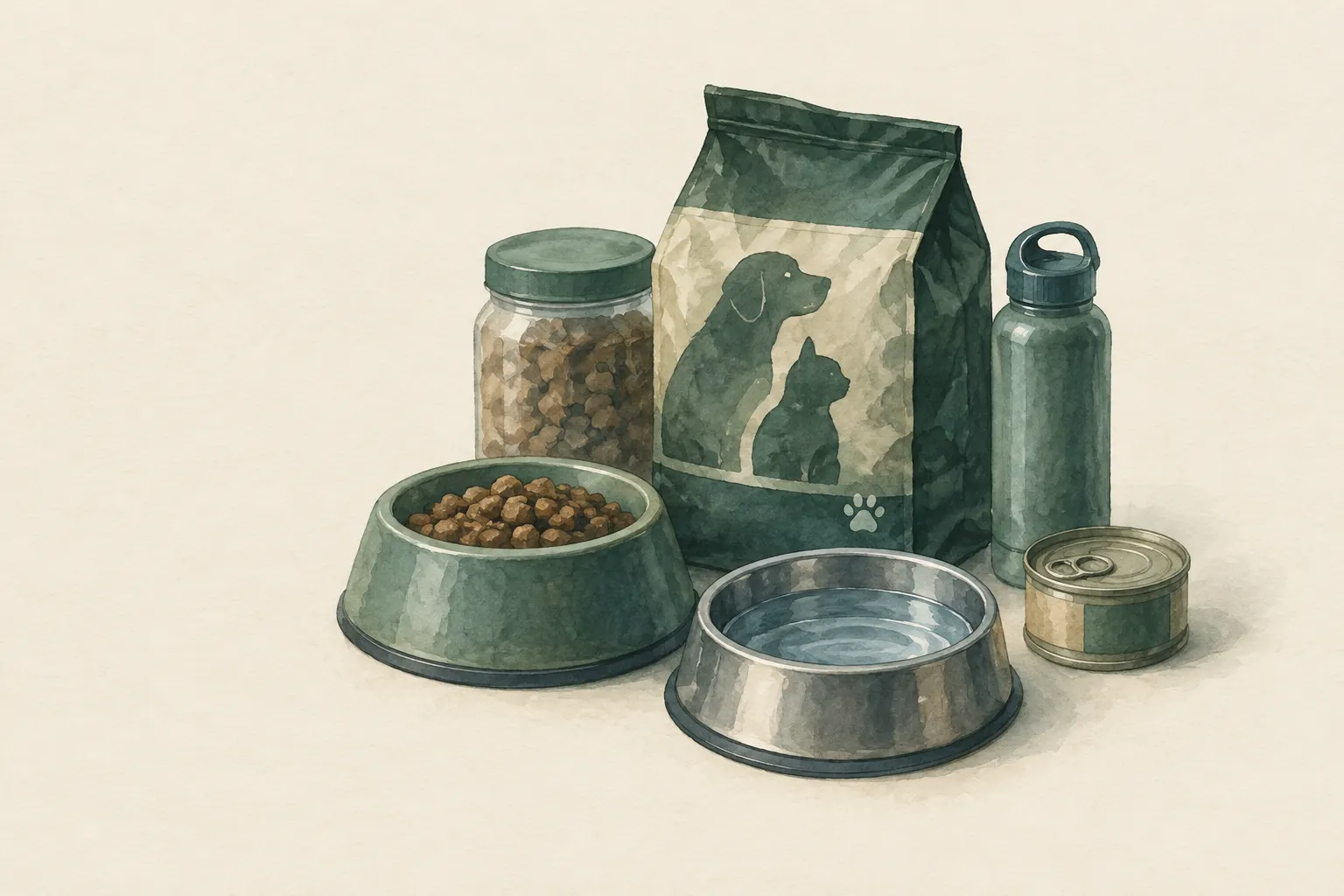
Dogs, cats and other pets need a stock too: their usual food, water, bowls and any special diet food. A sudden change of food can cause digestive problems, and many foods for people are unsuitable or toxic for animals. The pet food stock is rotated like the household's own stock.
- Set up once, then rotate when restocking
Explained simply
Your dog, cat or rabbit cannot go shopping by itself. In an emergency your animal relies entirely on you. That is why pets need a stock at home too: their usual food, water, bowls and – if needed – medication.
Why the usual food? An animal's stomach does not like sudden surprises. An animal that suddenly gets completely different food can get a tummy ache and diarrhoea. And many things people eat are even poisonous for animals – chocolate, grapes or onions for dogs, for example.
The pet food stock is used just like your own: you always take the oldest pack first and buy new ones. That way everything stays fresh.
What really matters
For each animal, note which food it gets and how much per day – of food and of water. Plan the stock for the same period as the stock for the people in the household; national agencies recommend how long that should be. This entry gives no fixed food amounts, because they depend on species, size, age and food.
Dry food is best kept in its original bag, which you put inside a tight container. That keeps it protected from moisture and pests, and the type, batch and date stay readable – important in case there is ever a recall. For wet food, cans or trays that open without tools are practical; otherwise add a can opener. Small portions are better without a fridge, because opened food spoils quickly.
Accessories belong in the stock: bowls, a spoon, cat litter, waste bags, medication with its dosing schedule and the vaccination record. For small animals such as rabbits or guinea pigs, hay belongs too; for birds, their usual food. For diet food or medication, ask the vet how much stock makes sense and what could serve as a substitute in an emergency.
Safety: what to watch out for
Leftovers are no substitute food. Chocolate, grapes and raisins, onions, garlic and products sweetened with xylitol are dangerous for dogs. Cats do not tolerate many foods either, onions and garlic for example. Cats also need nutrients that dog food does not contain in sufficient amounts – so dog food is no long-term substitute for cat food. If poisoning is suspected, call the vet or emergency vet service immediately.
Animals need safe drinking water from the stock. Floodwater, puddles or water from a toilet cistern with cleaning products are off-limits, because they can contain germs or chemicals. Animals that eat dry food need particularly plenty of water.
Pet food and bowls can transmit germs. Wash your hands after feeding and clean bowls separately from people's dishes.
Rotating and avoiding changes of food
A sudden change of food can cause digestive problems in dogs and cats – and that in a situation that is stressful for the animal anyway. The best emergency stock is therefore simply the usual food in sufficient quantity. If a change is unavoidable, it is best done slowly, by mixing the new food into the old one little by little.
To keep the food fresh, it is rotated: feed the oldest pack first, put new packs at the back and keep an eye on the date. Dry food contains fat that can go rancid over time. If you always stay one pack “ahead”, you have a stock that never gets old, with no extra effort.
Typical situations
During a power cut or a storm you stay at home and the shops are closed. That is when it shows whether there is enough food, water and cat litter. The phrase “the shop is just round the corner” does not help in that situation.
If the household has to be evacuated, every minute counts. A small food and water ration for a few days, bowls, a lead, medication and the vaccination record are therefore kept ready next to the carrier. Not every emergency shelter accepts animals; find out in advance where you could stay with your pet. Livestock is covered by separate preparedness plans.
Step by step
Determine needs
Note the daily amount of food and water for each animal and plan for the same period as the household's own stock. Follow official recommendations on duration.
- 1
Determine needs
Note the daily amount of food and water for each animal and plan for the same period as the household's own stock. Follow official recommendations on duration.
- 2
Store food correctly
Put dry food in its original bag inside a tight container – this keeps type, batch and date readable in case of a recall. Prefer wet food in cans or trays that open without tools, or store a can opener with it.
- 3
Accessories
Keep bowls, a spoon, cat litter, waste bags, medication with dosing schedule and vaccination records with the food stock.
- 4
Rotate
Feed the oldest pack first, put new ones at the back and check dates.
- 5
Ready for evacuation
Keep a small food and water ration for a few days ready next to the carrier.
Common mistakes
- No food because "the shop is just round the corner"
- Switching to unfamiliar food or leftovers in an emergency
- Storing food without its original packaging
- Not planning water for the animals
Quick view
Materials
Pet emergency supplies
Airtight food-grade storage container
Fill only when clean and completely dry; never use containers that previously held chemicals.
Manual can opener
Electric can openers do not work during a power outage.
Pet carrier
Get the animal used to the carrier before it is needed.
Label the carrier with name and contact details.
Suitable for
- Dogs, cats, small animals and birds at home
- Power cuts, storms, evacuation
- Times when shops are closed
Not suitable for
- Animals on changing special diets without veterinary planning
- Livestock – separate preparedness plans apply
Prerequisites
- Knowing the animal's food type and daily amount
- For special diets or medication: consultation with the vet
Safety
- Do not simply feed leftovers: chocolate, grapes and raisins, onions, garlic and products sweetened with xylitol are dangerous for dogs; cats do not tolerate many foods either. If poisoning is suspected, call a vet or emergency vet service immediately.
- Animals need safe drinking water from the stock – not floodwater, puddle water or water from toilet cisterns with cleaning products.
- Wash hands after handling pet food and bowls; clean bowls separately from people's dishes.
How it works
In an emergency an animal depends entirely on its keepers. The usual food in sufficient quantity avoids changes of diet in an already stressful situation. Taking the food from the stock in everyday life and replacing it keeps it fresh – just like the household's own stock.
Advantages
- The animal stays fed and calmer
- No risky changes of food
- Easy to integrate into daily life
Disadvantages
- Takes space, a lot for large dogs
- Special food is more expensive and sometimes hard to get
Deep knowledge
Background
Ready.gov explicitly recommends including pet food in airtight, waterproof containers, water, medication and records in emergency preparedness.
The link to evacuating with animals is covered in more depth in the entry on pet evacuation.
Variants
- Special diet food
- For diet food or medication, ask the vet how much stock makes sense and what could serve as a substitute in an emergency.
Common mistakes
- No food because "the shop is just round the corner"
- Switching to unfamiliar food or leftovers in an emergency
- Storing food without its original packaging
- Not planning water for the animals
Limits and risks
- No food amounts per species – they depend on the animal and the food
- No veterinary treatment advice
Material alternatives
Derived from material properties: a substitute must have all relevant properties. Observe the notes on the substitute.
- Airtight food-grade storage container
- Single-wall stainless steel bottle (Heat only single-wall bottles without paint/plastic; remove the lid before heating.), Double-wall insulated bottle (Never heat directly.), PET bottle (clear, max. 2 litres) (Do not heat or place in a fire.), Food-grade water container (Only use containers that never held chemicals or fuel.), Collapsible water container or bag (Protect from sharp objects.), Food-grade water bag (Use only for drinking water, never for chemicals or fuel.), Fermentation jar or crock (Use only food-grade containers of glass, food-safe glazed stoneware or food-grade plastic – no metal containers for acidic food.), Resealable food bags (Use only bags intended for food; do not use with boiling water unless the manufacturer explicitly allows it.)
Results come exclusively from structured entries. No improvised instructions are generated.
Sources
Ready.gov – U.S. Federal Emergency Management Agency (FEMA): Pets and animals – disaster preparedness guidance
Food, water and medication for pets in emergency preparedness
Bundesamt für Bevölkerungsschutz und Katastrophenhilfe (BBK), Deutschland: Ratgeber für Notfallvorsorge und richtiges Handeln in Notsituationen
Considering pets in stock planning