Outdoor gear for children
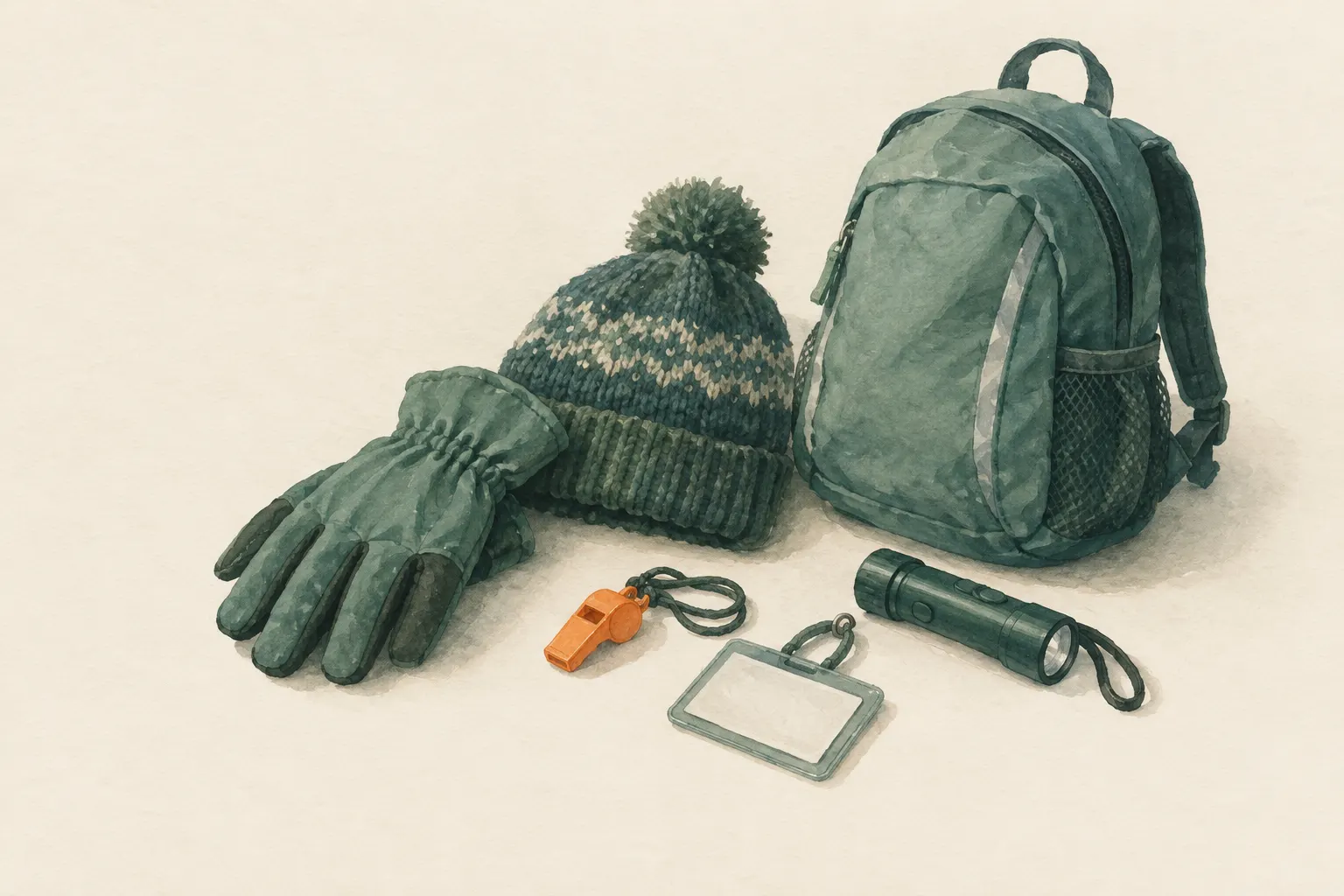
Children get cold and overheat faster than adults, carry less and lose things more easily. Their gear should fit rather than be bought to grow into, be warm and weatherproof, light and easy to see. A whistle, a light and a card with contact details belong in every child's jacket.
- 10 minutes reading; a fitting before each season
Explained simply
Children are not small adults. Because their body is smaller, it has more skin relative to its weight, through which heat is lost – a bit like a small cup of tea that cools faster than a big pot. That is why children get cold faster, and in the sun they get sunburnt more easily.
Good children's gear fits properly: not too big “to grow into”, but so that it keeps them warm and doesn't slip or pinch. Children carry only a small, light pack with a water bottle, a snack, a jacket and perhaps a favourite item. Adults carry everything heavy.
Every child's jacket should hold a whistle, a small light and a note with the child's name and the parents' phone number. And practise together: anyone who is lost stays put and blows the whistle – that makes them much easier to find.
How it works: why children are different
The smaller a body is, the larger its surface relative to its weight. Heat is lost through the skin, so children cool down faster than adults in cold, wind and wet. At the same time they can also overheat faster in heat and during exertion. Their skin is more sensitive in the sun; the WHO therefore stresses that children should be especially well protected from the sun.
Children often report cold, hunger, thirst or exhaustion late – sometimes because they are playing and don't notice, sometimes because they don't want to complain. A tired, whiny or suddenly very quiet child can be a sign that they are cold or need energy. Adults therefore have to pay closer attention than they would to themselves.
Children also lose things more easily, run ahead or fall behind. Good children's gear makes up for these differences: it keeps them warm, protects from the sun, is easy to see and does not overload them.
What really matters: clothing, pack, sleeping
Children need the same layering system as adults: a base layer on the skin, a warm mid layer, rain jacket and rain trousers, plus a warm hat, gloves and a sun hat. An adult carries a complete spare set, because children get wet quickly while playing – in the stream, in puddles, in the snow.
Their own small pack makes children proud and gives them responsibility. It should be light and have a chest strap so the shoulder straps don't slip off. Inside go only a water bottle, a snack, a jacket and a favourite item. Everything heavy – water for everyone, food, first aid, the warmth reserve – is carried by the adults.
When camping, a child needs a sleeping bag of the right length. An adult bag that is too long stays cold at the foot end, because the child would have to heat the empty space with their own body heat. Underneath belongs a good sleeping pad, because otherwise the cold ground draws the heat out.
Safety: what to watch out for
Check the child's hands, neck and mood regularly on the way. Cold hands and a cold neck show that more clothing is needed; a sweaty neck shows that one layer less will do. Plan trips so that you can turn back early at any time – better too short than too long.
Drawstrings on hoods and at the neck can catch on branches, play equipment or fences. So choose children's clothing without long drawstrings at the neck. Bright, vivid colours and reflectors make children much easier to see at dusk and in the woods; dark clothing without reflectors is a common mistake.
Practise with the children what to do if they get lost: stop, wait in one place and blow the whistle regularly. A whistle can be heard further than shouting and takes less effort. If a child is missing and you cannot find them quickly, call the local emergency number (112 in the EU).
Fit and growth
Before every season, try on shoes and clothing again, because children's feet grow quickly. Shoes that are too small pinch and cause blisters; shoes that are far too big let the foot slide, which also causes blisters and makes tripping more likely. A little room for the toes is right; a huge amount of space is not.
Clothing “to grow into” is tempting but works poorly outdoors: sleeves that are too wide let in cold and snow, trouser legs that are too long get wet and dirty, and a pack that is too big doesn't sit right. Because children's gear is outgrown so quickly, it is especially worth buying second-hand or swapping with other families – how to check used gear is covered in its own entry.
Babies and toddlers have additional needs, for example with baby carriers and child seats. For these, the manufacturer's information and specialist advice are the right way to go.
Making it fun for children
Children who feel comfortable want to come again. Plan plenty of breaks, enough snacks and small goals along the way: a stream, a big rock, a viewpoint. The trip should suit the child's age and fitness, not the adults' wishes.
Let children take responsibility for their own gear: packing their own pack, clipping the whistle to their jacket, checking the lamp. That way they learn through play what matters outdoors and know where their things are in an emergency. The same goes for a child's go bag: small, light and with something familiar that comforts.
Step by step
Clothing in layers
Base layer, warm mid layer, rain jacket and trousers, hat, gloves, sun hat. An adult carries a complete spare set.
- 1
Clothing in layers
Base layer, warm mid layer, rain jacket and trousers, hat, gloves, sun hat. An adult carries a complete spare set.
- 2
Their own small pack
Light, with a chest strap; inside only a water bottle, a snack, a jacket and a favourite item. Adults carry the heavy things.
- 3
Safety kit
Whistle on the jacket, small light, card with name and parents' phone number, bright colours or reflectors.
- 4
Sleeping
Children's sleeping bag of the right length – bags that are too long stay cold. A good sleeping pad underneath.
- 5
Check fit
Try on footwear and clothing before every season; children's feet grow quickly.
Common mistakes
- Clothing and shoes too big “to grow into”
- Making children carry heavy loads
- No spare set
- Dark clothing without reflectors at dusk
Quick view
Materials
Signal whistle
Carry within easy reach, not deep in the pack.
Do not blow right next to other people's ears.
Headlamp / flashlight
Wide-brimmed sun hat
Base layer
Rain and wind shell
Suitable for
- Family hikes
- Camping with children
- Children's go bags
Not suitable for
- Choosing baby carriers and child seats – follow manufacturer information and specialist advice
Prerequisites
- Trip matched to the child's age and fitness
- Adults carry the reserve
Safety
- Children often report cold, hunger or exhaustion late. Regularly check hands, neck and mood, and turn back early.
- Drawstrings on hoods and necks can catch. Choose children's clothing without long drawstrings at the neck.
- Practise with children: if lost, stay put and blow the whistle. Bright colours make finding easier.
How it works
Children have a larger surface area relative to body weight and so lose heat faster; in the sun their skin is more sensitive. They can only comfortably carry a small fraction of their weight. Good children's gear compensates for this without overloading them.
Advantages
- More safety and enjoyment for children
- Children learn responsibility for their own gear
Disadvantages
- Frequent replacement due to growth
Deep knowledge
Background
The WHO guide to the UV index stresses that children should be especially protected from the sun. Child-specific gear such as child-length sleeping bags is offered by many manufacturers.
The notes here are general; babies and toddlers have additional needs for which specialist advice is sensible.
Variants
- Used and swapping
- Children's gear is outgrown quickly. Buying used or swapping saves a lot – see used gear for checking.
Common mistakes
- Clothing and shoes too big “to grow into”
- Making children carry heavy loads
- No spare set
- Dark clothing without reflectors at dusk
Limits and risks
- No age limits or carrying loads in figures
- No advice on baby carriers or child seats
Material alternatives
Derived from material properties: a substitute must have all relevant properties. Observe the notes on the substitute.
- Headlamp / flashlight
- Mobile phone (The battery drains quickly in cold and with continuous screen and GPS use.), Battery lantern / LED light
- Rain and wind shell
- Cotton cloth / T-shirt (Removes coarse particles only – no disinfection.)
Results come exclusively from structured entries. No improvised instructions are generated.
Sources
World Health Organization (with WMO, UNEP and ICNIRP) (2002): Global Solar UV Index: A Practical Guide
Special sun protection for children