Coping with pain and injury when help is far away
An injury far from help is frightening, and fear makes pain stronger. After the emergency call and simple first aid there is a lot you can do to make the pain more bearable: breathe calmly, steer your attention, describe the pain factually, distract yourself, pace your strength, stay warm and divide the time into small sections. This does not replace treatment – it helps you hold on until help arrives.
- Ongoing until help arrives
Explained simply
When you get hurt outdoors and help is far away, it does not only hurt – it is also frightening. And fear makes pain stronger. That is why the first thing is always: call for help. Throughout Europe you dial 112. In Austria there is also 144 for the ambulance and 140 for mountain rescue.
After that you can do a lot yourself to make the pain easier to bear. Breathe in calmly and breathe out for a very long time, as if you were making a candle flicker just a little. Let your shoulders and hands go loose. And give the pain a number from 0 to 10 – that helps you describe it more precisely, and the rescuers want to know too.
Then turn your thoughts to something else: count five things you can see, or sing a song in your head. Stay warm, drink a few sips and do not move the injured leg or arm unnecessarily. Tell yourself: “Help is on the way. I will stay calm and warm.”
How it works
Pain is a warning signal that arises in the brain. Nerves report an injury, and the brain evaluates how threatening it is. This evaluation depends not only on the injury but also on how we are otherwise: fear, tension, cold, tiredness and thoughts like “This is getting worse and worse” amplify the experience of pain. Calm, warmth and attention to other things can dampen it.
Long exhaling calms the body and lowers muscle tension. This matters because cramped muscles around an injury hurt additionally. Describing the pain with a number and neutral words replaces catastrophic thoughts with facts. Distraction uses the fact that attention is limited: what occupies the mind leaves less room for pain.
What really matters
The order is decisive: first safety and the emergency call, then simple first aid, then coping with the pain. Heavy bleeding is stopped with firm, direct pressure. Position and support a painful leg or arm in the way that hurts least and do not move it unnecessarily. Cool bruises briefly with wrapped snow or cold water. Insulating from the ground and wrapping up warmly is almost always right.
For the pain score: 0 means no pain, 10 the worst imaginable. Note the time and score about every hour and whether anything has changed. The distraction can be simple: see five things, hear four, feel three; mental arithmetic; a song; a familiar route you walk in your mind; plans for later.
Pacing your strength means moving only what is necessary – for example a few metres out of wind and wet – and then in short sections with breaks. Divide the waiting time into sections too: “Until the next full hour.” That makes a long time manageable.
Safety: what to watch out for
Coping with pain is no reason to skip or delay the emergency call. Call 112 again immediately if warning signs appear: pale, cold, sweaty skin, rapid pulse, restlessness or confusion, increasing shortness of breath, heavy or increasing bleeding, chest or abdominal pain, numbness or paralysis. Until help comes: lie flat, keep warm, do not leave the person alone.
Lay first aid only: do not reset anything, do not pull objects out of wounds. Never put cold directly on the skin and only briefly – otherwise there is a risk of cold injury, and the rest of the body must stay warm. Painkillers only if you know and tolerate them, and only according to the package leaflet. Alcohol is off limits: it chills you and impairs judgement.
When it makes sense – and when not
The techniques help with sprains, bruises, suspected fractures and wounds when rescue takes longer – for example in the mountains or in remote forests. They also help companions: speak calmly, count breaths together, ask for the pain score, write it down and keep the person warm.
With unconsciousness, breathing difficulty or heavy bleeding, only the emergency call and first aid count. And the techniques do not take the pain away and do not replace treatment. They help you get through the time until treatment better.
Good to know
The guidelines of the European Resuscitation Council and the international first aid guidelines of the Red Cross and Red Crescent Movement describe the lay measures this entry builds on. A first aid course is the best preparation – there you practise pressure bandages, positioning and the emergency call hands-on.
The pain scores and times in your notebook are valuable for rescuers: they show whether the condition has improved or worsened. Many people also find that writing things down gives them the feeling of being able to do something again.
Step by step
Safety and emergency call
If necessary, move out of immediate danger (rockfall, water) – but only if you can do so without much movement. Then call 112 (in Austria also 144, or 140 in the mountains): what happened, where you are, what injury. Follow the instructions and keep the phone reachable.
- 1
Safety and emergency call
If necessary, move out of immediate danger (rockfall, water) – but only if you can do so without much movement. Then call 112 (in Austria also 144, or 140 in the mountains): what happened, where you are, what injury. Follow the instructions and keep the phone reachable.
- 2
Simple first aid
Stop heavy bleeding with firm, direct pressure. Position and support a painful leg or arm in the way that hurts least and do not move it unnecessarily. Cool bruises briefly with wrapped snow or cold water. Insulate from the ground and keep warm with an emergency blanket and clothing.
Lay first aid only – do not reset anything, do not pull objects out of wounds.
- 3
Breathe out slowly
With pain you often hold your breath without noticing and tense up everything. Instead breathe in calmly and out for a long time, as if gently making a candle flicker. With every exhale let your shoulders, jaw and hands relax. Tense muscles around the injury hurt additionally.
- 4
Describe the pain factually
Give the pain a number from 0 to 10 and describe it neutrally: where exactly? Stabbing, dull, throbbing? Is it getting stronger or weaker? Write down the time and score, about every hour. This replaces thoughts like “It is getting worse and worse” with facts – and is valuable information for the rescuers.
- 5
Steer your attention
Deliberately steer your attention to other things: count five things you see, four you hear, three you feel. Mental arithmetic, a song in your head, walking a familiar route in your mind, making plans for later. Small tasks such as preparing signals also distract.
- 6
Pace your strength
Move only when necessary – for example a few metres out of wind or wet. Then in short sections with breaks, and do not keep “testing” the injury. Afterwards lie or sit still and keep the injured body part supported.
- 7
Stay warm and divide the time
Warmth, a few sips of water and a little food make pain and shivering more bearable. Divide the waiting time into small sections: “Until the next full hour.” Tell yourself: “Help is on the way. My job is to stay calm and warm.” Watch for the warning signs and call 112 again if things get worse.
Common mistakes
- Delaying the emergency call out of embarrassment or hope it will improve
- Constantly moving and testing the injured body part
- Putting snow directly on the skin
- Drinking alcohol against pain
- Fighting the pain and tensing up completely
Quick view
Materials
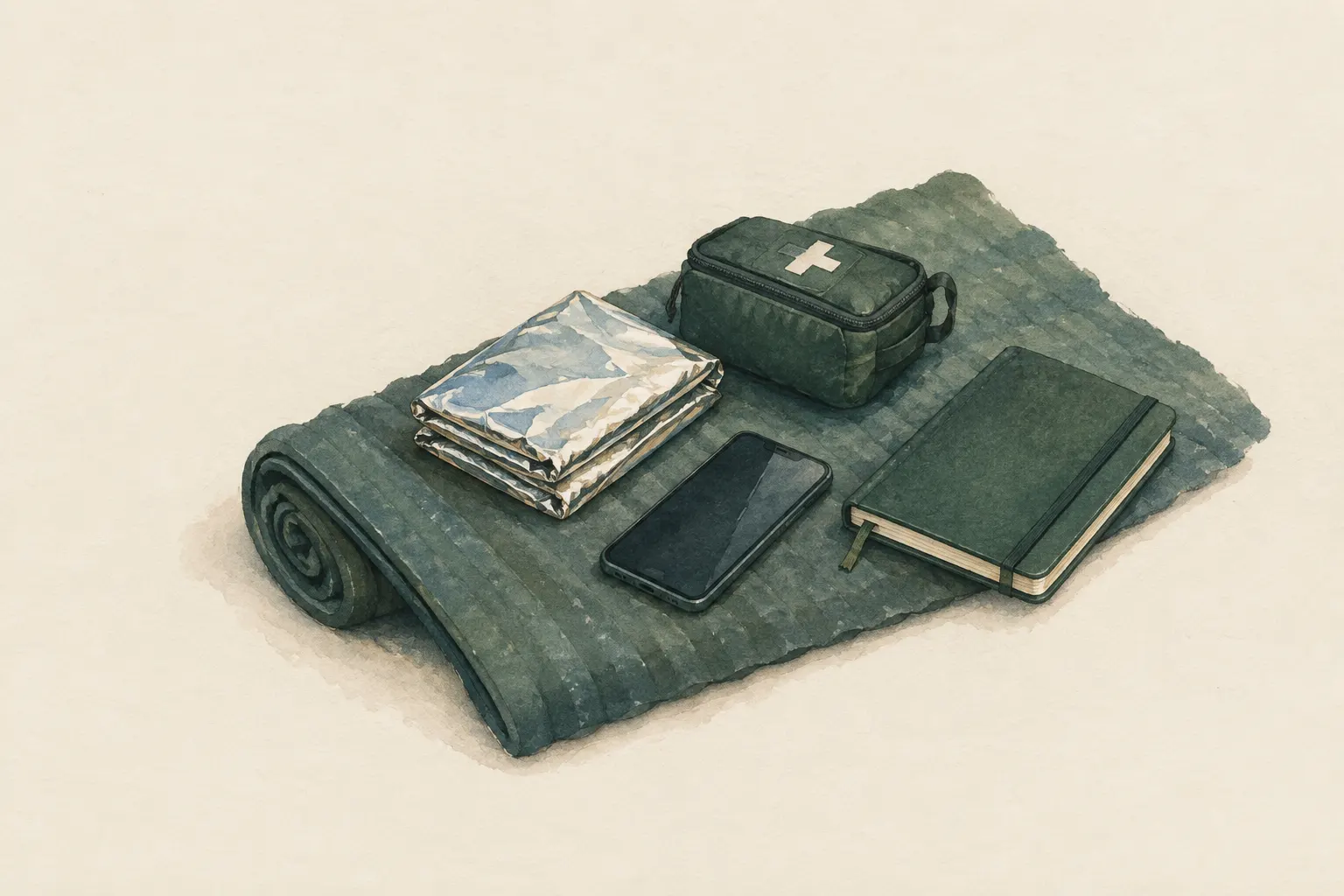
Mobile phone
The battery drains quickly in cold and with continuous screen and GPS use.
Do not plan on it as your only means of navigation or emergency calls.
First-aid kit (household)
A small first-aid kit for the trail
Does not replace a first-aid course; check contents and expiry dates regularly.
Emergency blanket
Tears easily once punctured; short-term shelter only.
Conductive – keep away from power lines.
Field notebook and pencil
For pain scores and times
Suitable for
- Sprains, bruises, suspected fractures, wounds far from help
- Waiting for mountain rescue
- Companions supporting an injured person
Not suitable for
- As a reason not to call for help
- Unconsciousness, breathing difficulty, severe bleeding – only the emergency call and first aid matter here
Prerequisites
- The emergency call has been made or help is on the way – or there is currently no way to call
- Anything life-threatening has been dealt with (severe bleeding, breathing)
Safety
- Painkillers only if you know and tolerate them, and only according to the package leaflet. No alcohol – it chills you and impairs judgement.
- Never put cold directly on the skin (wrap snow or a cold pack in a cloth) and cool only briefly. Keep the rest of the body warm at the same time.
How it works
Pain arises in the brain, which evaluates signals from the body. Fear, tension, cold and exhaustion amplify this evaluation; calm and attention to other things can dampen it. That is why it helps to calm the body, describe the pain factually rather than catastrophically and occupy the mind with other things – the cause remains, but the pain often becomes more bearable.
Advantages
- Helps immediately and without aids
- Reduces fear and muscle tension
- Gives rescuers information about how things have developed
Disadvantages
- Does not take pain away – only makes it more bearable
- No substitute for medical treatment
Deep knowledge
Background
The European Resuscitation Council guidelines (2021) and the international first aid guidelines of the Red Cross and Red Crescent Movement describe lay measures such as direct pressure on bleeding, immobilisation and keeping warm. The US Army survival manual (FM 3-05.70) names injury and pain as strong stressors in emergencies.
That breathing, attention and thoughts influence the experience of pain is well established; exercises such as consciously noticing the surroundings are also found in the WHO booklet “Doing What Matters in Times of Stress”.
Variants
- As a companion
- Speak calmly, explain what you are doing, count the breaths together, ask for the pain score and write it down. Do not leave the injured person alone unless absolutely necessary, and keep them warm.
- When moving is unavoidable
- Plan beforehand, split into stages, breathe out when exerting yourself and rest after each stage. Better very short distances than one big attempt.
Common mistakes
- Delaying the emergency call out of embarrassment or hope it will improve
- Constantly moving and testing the injured body part
- Putting snow directly on the skin
- Drinking alcohol against pain
- Fighting the pain and tensing up completely
Limits and risks
- Lay first aid only, no medical treatment
- No dosage information for medication
Material alternatives
Derived from material properties: a substitute must have all relevant properties. Observe the notes on the substitute.
- Mobile phone
- Headlamp / flashlight, Battery lantern / LED light
Results come exclusively from structured entries. No improvised instructions are generated.
Sources
European Resuscitation Council – Resuscitation (journal) (2021): European Resuscitation Council Guidelines 2021: First Aid
Lay first aid: stopping bleeding, immobilisation, keeping warm
International Federation of Red Cross and Red Crescent Societies (IFRC) – Global First Aid Reference Centre (2020): International First Aid, Resuscitation, and Education Guidelines 2020
International first aid guidelines for lay people
Headquarters, Department of the Army (USA) (2002): FM 3-05.70 Survival
Injury and pain as stressors in emergencies
World Health Organization (2020): Doing What Matters in Times of Stress: An Illustrated Guide
Deliberately steering attention to the surroundings
Bundesministerium für Finanzen – Amtshelfer oesterreich.gv.at: Notrufnummern (oesterreich.gv.at)
Emergency numbers in Austria (112, 144, 140)