Why boiling disinfects water
Heat damages the proteins, membranes and genetic material of microorganisms so badly that they can no longer multiply or cause disease. How quickly that happens depends on temperature and time. A rolling boil is far above what most waterborne pathogens can survive – which is why it is regarded as very reliable. Heat does not help against chemicals and salt, however.
- 8 minutes to read
Explained simply
Water from streams, lakes or broken pipes can contain tiny living things so small that you cannot see them: bacteria, viruses and single-celled organisms. Some of them cause tummy ache, diarrhoea or worse illnesses. Clear water is therefore not automatically clean water.
These germs are built like little machines made of protein. Protein changes for good when it gets very hot – think of an egg in a pan: the see-through egg white turns white and firm and never becomes runny again. Something similar happens to germs in boiling water: their “parts” break and they can no longer make you ill.
Important: boiling only frees water from germs, not from poison, oil or salt. Water from the sea or next to a factory does not become drinkable by boiling. And never cook inside a tent or an enclosed room – this can produce an invisible gas that is very dangerous.
How it works
Waterborne pathogens fall into three big groups: bacteria, viruses and protozoa (single-celled organisms such as Giardia). Different as they are, they all consist of proteins, membranes made of fat-like substances, and genetic material. These building blocks only work within a certain temperature range.
When it gets too hot, the proteins unfold – experts call this denaturation. A protein is like a carefully folded string; its shape determines what it does. If it loses its shape, it no longer works. At the same time, membranes become leaky. The pathogen is then “inactivated”: it can no longer multiply or cause disease.
What counts is two things together: temperature and time. The hotter it is, the faster it happens. Pasteurising milk uses lower temperatures and a set time instead. A rolling boil is so far above what most waterborne pathogens can survive that it is regarded as very reliable.
What really matters
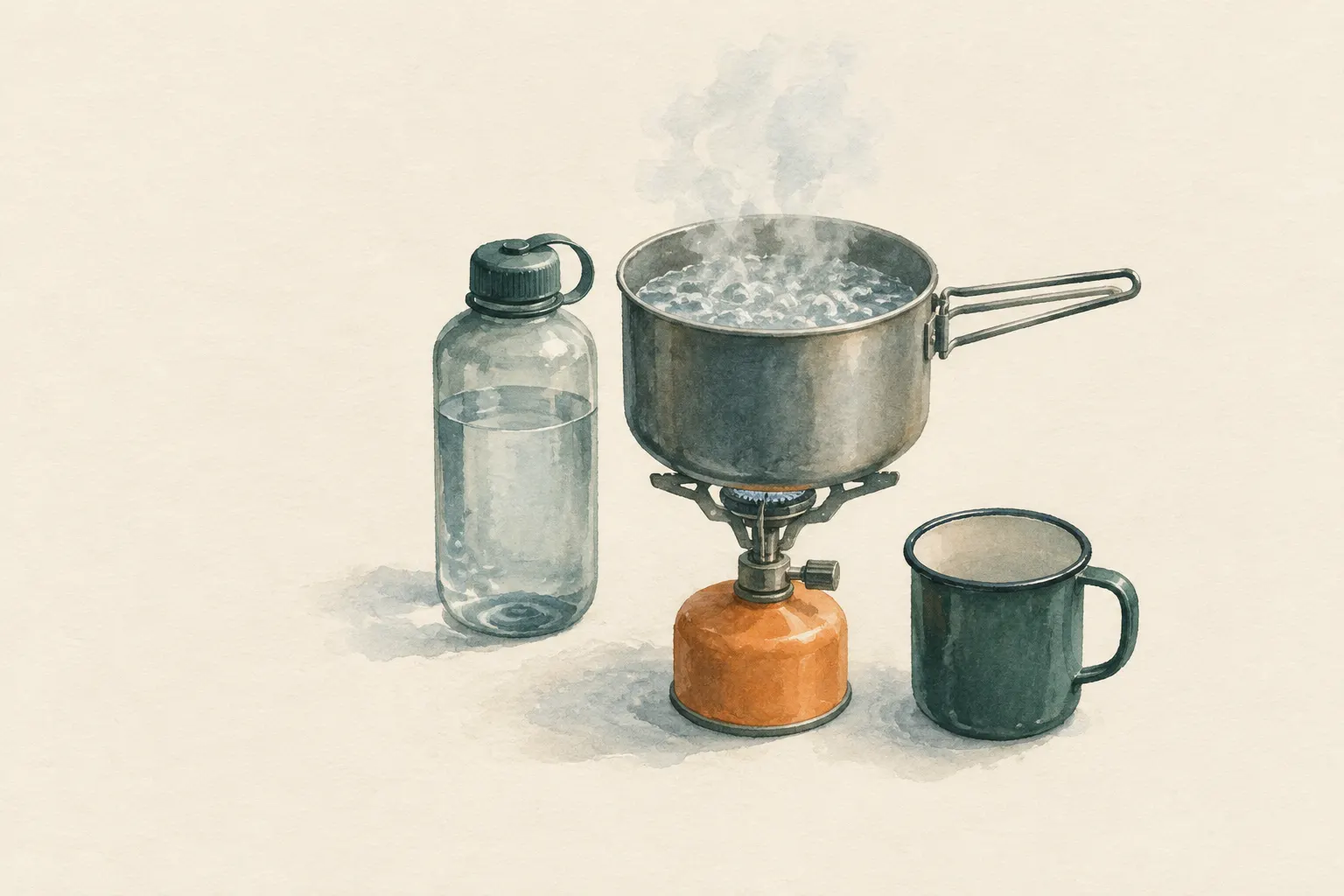
“Boiling” means a rolling boil: big bubbles rise continuously from the whole body of water. The first small bubbles at the bottom of the pot or a gentle humming are not yet boiling. How long the water should boil is set by health authorities – the practical instructions are in the entry “Boiling water”.
At sea level water boils at 100 °C. As altitude increases, air pressure falls and water boils at a lower temperature. It bubbles just the same but is less hot. Authorities such as the CDC therefore recommend a longer boiling time at high altitude.
After boiling, cleanliness counts: boiled water can be recontaminated immediately if it is poured into a dirty container or scooped with unwashed hands. Letting cloudy water settle first or pouring it through a cloth makes it more pleasant but never replaces boiling.
When it makes sense – and when not
Boiling is the right choice when germs are the concern: water from streams and lakes, tap water during an official boil-water advisory, or water after flooding, as long as no chemicals are involved. It works against all three groups of pathogens and does not depend on how cloudy the water is, as long as it boils properly.
Boiling does not help against chemicals, heavy metals, fuel or salt. Some substances even become more concentrated because water evaporates and the substance stays behind in the pot. Seawater does not become drinkable by boiling. If chemical contamination is suspected – an oily film, a chemical smell, water downstream of industry or mining – another water source is needed.
Safety: what to watch out for
If an authority issues a boil-water advisory, its instructions apply – they know what is in the water and how long the advisory lasts. Never run stoves or fires in tents, vehicles or enclosed spaces without good ventilation: burning can produce carbon monoxide, a gas you can neither smell nor see.
Boiling water causes severe scalds. Place the pot securely and stably, keep children away and let the water cool in peace. Anyone who develops severe diarrhoea, vomiting or fever after drinking water, especially children or older people, should get medical help or call the local emergency number (112 in the EU).
Good to know
Boiling is not the same as sterilising. Some bacteria can form tough resting forms called spores that survive boiling temperature. For drinking water, a rolling boil following official guidance is nevertheless regarded as sufficient. Preserving food by canning, on the other hand, has its own, stricter rules.
A common misconception is that very hot but not boiling water is “almost as good”. Without a thermometer and a clock, however, you do not know which temperature was reached for how long. Bubbling, by contrast, is a sign anyone can recognise without a measuring device – which is why authorities recommend exactly that sign.
Quick view
Suitable for
- Understanding water treatment
- Understanding food hygiene when cooking
Not suitable for
- Chemically contaminated water
- Seawater
- Preserving food (separate rules)
Prerequisites
- None
Safety
- For practical use, follow health authority guidance on boiling water, see the entry “Boiling water”. Follow instructions when a boil-water advisory is issued.
- Boiling does not remove chemicals, heavy metals or salt; some substances even become more concentrated as water evaporates. If chemical contamination is suspected, use another water source.
How it works
Microorganisms consist of proteins, fatty membranes and genetic material that only work within a certain temperature range. As the temperature rises, proteins unfold (denaturation), membranes become leaky and the organism is inactivated. The higher the temperature, the shorter the time needed – which is why pasteurisation at lower temperatures takes longer. At a rolling boil the temperature is high enough to inactivate bacteria, viruses and protozoa within a short time. With altitude the air pressure, and with it the boiling point, falls; this is why authorities such as the CDC recommend a longer boiling time at high altitude.
Advantages
- Works against all groups of waterborne pathogens
- Independent of turbidity as long as the water boils
Disadvantages
- Requires energy
- No protection against recontamination
- No effect on chemicals
Deep knowledge
Background
In its technical brief, WHO describes a rolling boil as an effective method of disinfecting water; the CDC gives specific boiling times and a longer time at high altitude. Both point out that chemical contamination is not removed this way.
The relationship between temperature, time and inactivation is the basis of food and water hygiene. It also explains why water that is only hot, but not boiling, offers no reliable safety unless temperature and time are known precisely.
Variants
- Boiling is not sterilisation
- Some bacterial spores survive boiling temperature. For disinfecting drinking water, a rolling boil according to official guidance is nevertheless regarded as sufficient. Home canning of food has its own, stricter rules.
Common mistakes
- Mistaking the first bubbles at the bottom for boiling
- Pouring boiled water into dirty containers
- Assuming boiling removes chemicals
- Confusing boiling with sterilisation
Limits and risks
- No separate practical instructions – see the entry “Boiling water”
- No details on individual pathogens
Sources
World Health Organization (2015): Boil water – Technical brief
A rolling boil as an effective disinfection method
Centers for Disease Control and Prevention: Making Water Safe in an Emergency
Boiling times, longer boiling time at high altitude
World Health Organization (2022): Guidelines for drinking-water quality, fourth edition incorporating the first and second addenda
Limits of boiling for chemical contamination